The Edo-Tokyo Museum charges ¥800 for its permanent exhibition, opens at 9:30 every day and closes at 17:30, so you can walk in and pay at the first-floor counter. The ramen floor at Tokyo Station sits outside the JR ticket gates, so a bowl costs a walk back through the barriers. Add markets that only wake up after 09:00 and counters that take no walk-ins at all, and picking tokyo food experiences to book comes down to routes, queues and deadlines.
Everything here is sorted by how you get in: walk in, book online, ask a hotel concierge, or turn up on one fixed date a month. Food is the reason for each visit, with one honest drawback attached. I left out hosted cooking classes, because I could not confirm a single school's format, price or teaching language; you get the five questions that decide whether a market-to-table cooking class in Tokyo is worth your money instead.
Tokyo Food Experiences to Book: How I Picked and Compared Them
What each experience had to deliver
Every candidate went through the same six checks before it reached the table. A place that fails on price or on access can still be worth going to. It just does not go in the list.
- Food is the reason to go, and the reason to spend the money.
- A price is published, or at least a clear rule about what sets it.
- It runs on ordinary days, in hours that fit an ordinary trip.
- The way in is defined: a ticket, an advance booking, a queue or a walk-in.
- Booking friction is stated, including telephone-only lines and counters with no walk-ins.
- There is a drawback worth naming, not just a nice photograph.
Fourteen Tokyo food experiences side by side
Amounts are the venues' own figures, in the currency each one publishes. The three dollar entries are operators who sell in dollars, not converted estimates; where a venue prices by piece or by counter, the row says so instead of one number.
| Experience | Area and access | Type | How you get in | Price from | Why it is here | Watch out for |
|---|---|---|---|---|---|---|
| Edo-Tokyo Museum | Sumida-ku, 1-4-1 Yokoami | Museum | Webket online or 1F counter | ¥800; ¥640 each for 20+ | 9,000 m² of Edo food culture, floors five and six | No refunds, no date changes |
| Tsukiji Outer Market | Chuo-ku, Tsukiji | Food market | Walk in | From ¥200 a bowl | Katsuobushi, tsukudani, tamagoyaki in one walk | Separate shop hours; buyers first before 09:00 |
| Tokyo Wasabi Tour | Mitake, west Tokyo | Guided food tour | Online advance | US$123 a person | Private wasabi-farm slot, English guide, boots, two hours | One group a day |
| Arigato Travel | Tokyo, registered agency | Tour operator | Booked per programme | Priced per programme | 45+ culinary formats across five regions | A menu of formats, not one fixed thing |
| Camellia Garden | Showa Kinen Park | Hosted tea session | Advance, fixed monthly date | ¥2,000 a session | Teaches the bowl-and-whisk sequence | Third Sunday only, two slots |
| Toraya Nihonbashi | Nihonbashi, 3 min from Exit B9 | Wagashi shop | Walk in | From about ¥300 a piece | Company-made seasonal sweets | Small counter, no seating |
| Ninben | COREDO Muromachi 1, first floor | Dashi and bonito flakes | Walk in | From ¥110 a pack | Trading since 1699 | Pantry goods, no meal |
| Kappabashi Dougu Street | Taito, Ueno to Asakusa | Kitchenware street | Walk in | From ¥1,500 a knife | 800 m, 170+ kitchen shops | 170 shops, 170 opening hours |
| Tempura Kanda Honten | Kanda | Tempura | Walk in or queue | Lunch set from ¥1,050 | Rice refills, miso soup, pickles and tsukudani | Dinner sets cost about twice as much |
| Tonkatsu Maisen Aoyama Honten | Aoyama | Tonkatsu | Walk in or queue | ¥1,990 a set | 130 g loin and 100 g tenderloin, one price | Long queue at lunch |
| Tokyo Station Ramen Street | Station B1, Yaesu side, outside JR gates | Ramen floor | Walk in | From ¥850 a bowl | Ten kitchens under one roof | Plan the walk back through the gates |
| Sushiro | Lower, mid and central branches | Conveyor belt sushi | Walk in | ¥120 a plate, tax included | Lowest sushi price in the list | ¥120 plates sit outside central Tokyo |
| Sushi Saito | Azabudai Hills Market B1F, 12 seats | Sushi counter | Advance, no walk-ins | From US$104 a seat | Three seatings, twelve counter seats | No queue at the door |
| Sukiyabashi Jiro | Ginza | Sushi counter | Telephone only, via concierge | From US$580 a seat | Omakase counter, Edomae sushi roots | Phone answered in Japanese |
How I compared them
Each candidate had to clear the six checks above, then I looked at the same three things: is there a published way in, is there a published price, and is there a drawback worth mentioning. No scores and no price-per-hour arithmetic, because the table has neither and inventing them would only look tidy. A few well-known names are missing on purpose: I could not place a branch, a city or a price for them, and a wrong address costs a reader a whole morning.
Guided Food Tours, and How to Judge a Cooking Class
Two Tokyo food tours with completely different shapes
Tokyo Wasabi Tour takes you to a wasabi farm in Mitake: about two hours, one group a day, an English guide and rubber boots, US$123 a person. With only one group running, the farm is effectively yours for the slot, which suits a family or a pair who would rather not spend the morning in a coach with fifteen other people and a headset. It does not suit someone who wants a market walk with six stops and a long lunch on top.
Arigato Travel is a different animal: a Tokyo-registered travel agency (No. 2-8620) running more than 45 culinary programmes across Tokyo, Osaka, Kyoto, Hiroshima and the Mt. Fuji area. The formats include market tasting walks and small group food tours in English, and every programme carries its own price, so the choice you make is a format rather than a date.
If wasabi is the reason you are going, I would take the private slot. If the point is to see how one programme compares with another, the agency list gives you more to read. What I would not do is pay for a guided market walk in a city I already know. I would walk Tsukiji myself after 09:00, when the professional buyers have left and the stalls have spread out.
Five questions that decide whether a cooking class is worth it
I could not verify a single hosted kitchen in Tokyo properly, down to its name, price and teaching language. So instead of recommending a school I would send you to, here is what to ask, and take the answers to the school's own page.
- What language do the instructions run in?
- How many people share the kitchen, and is there a knife skills demonstration you watch or do?
- Does the ticket cover the market visit and the cooking, or only the cooking?
- How are allergies and dietary needs handled?
- What do you take home, and what are the cancellation terms?
A market-to-table cooking class normally runs as a sequence: a stop at the market, picking up ingredients, knife work at the bench, cooking, then a seated meal. That is the shape of the format, not a promise about any one school, and the two details worth comparing across schools are the group size and whether the meal is included.
A Matcha Workshop in Tokyo, and the Wagashi That Goes With It
A hosted ceremony, and what a café bowl is not
Camellia Garden runs the one matcha workshop in this list that teaches the sequence instead of pouring it: a hosted tea ceremony (歓楓亭) inside Showa Kinen Park in west Tokyo, ¥2,000, on the third Sunday of the month, with sessions at 11:00 and 13:00. What that buys is the folding and whisking done in front of you, in a chawan with a chasen bamboo whisk. A café matcha latte is milk, powder and ice. A whisked bowl is neither of those things.
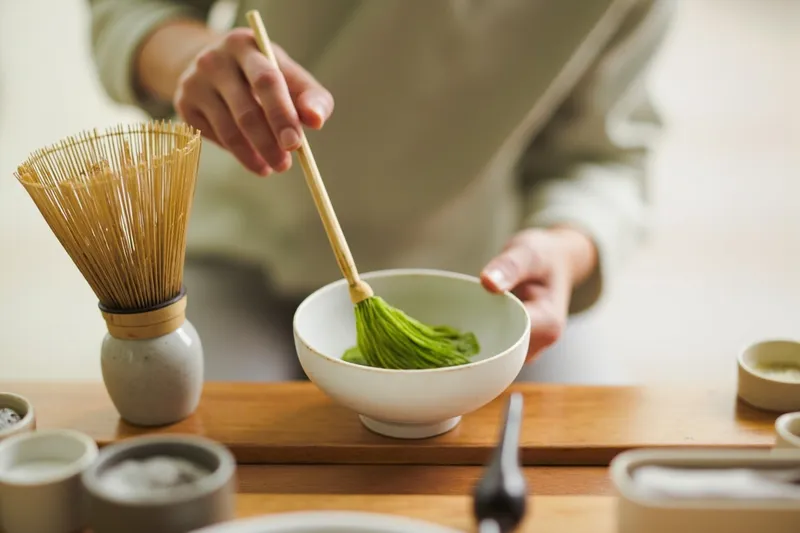
Two words matter when you order tea in Japan. Usucha is thin matcha, whisked in one movement and drunk straight away; koicha is thicker, kneaded rather than whisked, and takes far longer to prepare. The host decides which one the session covers, which is worth knowing before you set aside a morning for it.
- Chawan – the bowl the tea is served in, thick and unglazed inside.
- Chasen – the split bamboo whisk that does the work.
- Usucha – thin matcha, whisked quickly, finished in one bowl.
- Koicha – thick matcha, kneaded, drunk in small sips.
Price depends on the neighbourhood as much as on the host. Across the ceremony prices I compared, the spread runs from ¥850 to ¥20,000 with a middle around ¥6,300, and the same kind of session costs less in Asakusa than in Ginza, ¥4,620 against ¥6,000. You are paying for the setting as much as for the tea, and both cost more in Ginza. For the teaching I would take the park session; for a second bowl in the same afternoon, take whichever neighbourhood you are already in.
Wagashi to go with the tea
Toraya Nihonbashi is a company-run wagashi counter at 1-2-6 Nihonbashi, Chuo-ku, three minutes from Nihonbashi Station Exit B9. Sweets start around ¥300, and the counter is small enough that you buy and eat somewhere else. Wagashi are made for tea rather than for dessert on its own: a horigoyaki, the brown-sugar skewer grilled on a hot plate, and tamagoyaki-style sweets are what a bitter bowl of matcha actually wants. Some counters also keep temari-style confectionery, the decorated rice-paste balls that turn up at gift times of year.
The Edo-Tokyo Museum is where the same era comes into focus, because its permanent exhibition covers how food was cooked, stored and served in Edo and in later Tokyo, down to the ichiju-sansai pattern of one bowl of rice with soup and small dishes beside it. I would read the Edo Zone first and eat afterwards: it explains the plate you just had better than any leaflet does.
Edo Food Culture: the Museum, the Market and the Pantry
Edo-Tokyo Museum: the food-culture floors and how to buy a ticket
The Edo-Tokyo Museum is the Edo food culture museum in the city, and its permanent exhibition covers about 9,000 m² across floors five and six, split into an Edo zone and a Tokyo zone, with a special exhibition room as well. It is open daily from 9:30 to 17:30 at 1-4-1 Yokoami, Sumida-ku, and the phone number is +81-3-3626-9974.
An individual ticket is ¥800, and the rest of the price list is where people either overpay or assume they qualify for something they do not.
- ¥800 – permanent exhibition, individual ticket
- ¥640 each – permanent exhibition, group of 20 or more
- ¥400 – visitors 65 and over
- ¥480 – university students
- ¥300 – high school students
- Free – middle school pupils and younger, plus preschool and primary school children
Two free days sit on the calendar. Silver Day, the third Wednesday of every month, is free for visitors 65 and over. Family Day, the third Saturday and the Sunday after it, charges half the adult price for up to two accompanying children under 18, but only for children living in Tokyo, so a visiting family gets nothing from it. Tokyo school groups are admitted free if the visit is arranged in advance, and visitors with a disability certificate come in free with up to two companions.
The Maruyama Ōkyo special exhibition runs in the first-floor special exhibition room from 28 November 2026 to 24 January 2027. On its own it is ¥2,100 on the day and ¥1,900 booked ahead; combined with the permanent exhibition it is ¥2,740 on the day and ¥2,540 in advance. Do that arithmetic: ¥2,740 is less than ¥800 and ¥2,100 bought separately, and the advance combined ticket is another ¥200 off.
Groups of 20 or more pay ¥1,680 and ¥2,320 for the same two combinations. High school students get into the exhibition free on the day and pay for it when the ticket was bought in advance, which is a strange way round, but it is the rule.
You can buy online through Webket with Visa, Mastercard, JCB, American Express or Paypay, and pay at the first-floor counter with cash, a transport IC card, a bank card, electronic money or a QR code. Bought tickets cannot be returned and the date cannot be changed, which makes that advance discount a real decision rather than free money. The Edohaku Culture session on 26 November 2026 needs advance registration. Details: Edo-Tokyo Museum ticket guide.
Tsukiji Outer Market: bonito, tsukudani and standing food
Tsukiji today is the retail and restaurant strip around the old wholesale core. The stalls cover dried katsuobushi flakes, seaweed and green tea, tsukudani and tamagoyaki, with knives and kitchenware in among them, plus tea and coffee shops, restaurants and sushi counters serving sashimi rice plates.
The rules are simple: prices are not negotiated, you ask the seller before photographing the goods, large bags go in a locker, and a stroller can be handed over at the Plat Tsukiji information centre for ¥500. Before 09:00 the professional buyers have priority, and each shop keeps its own hours, so the market is a sequence of openings rather than one schedule. Later is calmer and the queues are shorter, though popular stalls sell out by mid-morning.
Standing food and food to take home are two different lists. Standing, I would eat oden with simmered fish cake and daikon, or a sashimi rice bowl. To take home: tsukudani, katsuobushi, dried kombu, nori and hijiki, the ingredients that turn a shop-bought lunch into dinner at home.
Go after 09:00, walk the arcade once before you buy anything, and check the hours of the specific stalls you want: they do not share one schedule.
Pantry shopping: dashi, knives and the depachika floors
Ninben's head store (日本橋本店) is on the first floor of COREDO Muromachi 1, and the company has sold katsuobushi and dashi since 1699. This is a pantry stop: flakes and dashi for the kitchen at home, no meal. Kappabashi Dougu Street is the other kind, 800 metres with more than 170 kitchen shops between Ueno and Asakusa, so knives and food tools sit in one walkable stretch, and several of the shops sharpen a knife you have just bought.
The depachika food floors work the other way round: you shop first, then cook. Shinjuku Takashimaya keeps its grocery and gourmet floor on B1, open 10:30 to 19:30, 09:30 to 18:00 on 31 December, and closed on 1 and 2 January. Ginza Mitsukoshi has its food counters on the lower floors, so go down, since B1 is cosmetics. Daimaru Tokyo's basement food hall connects straight into Tokyo Station, and Yurakucho Marui's is on B1 of the building next door, with the UNO pachinko hall as a landmark.
Casual Tokyo Eating: Sushi Counters, Ramen Floors and Set Meals
Sushi counters: what a booking really costs
Sushi Saito has 12 counter seats on the basement floor of Azabudai Hills Market, with seatings at 12:00, 13:30 and 18:00, and no walk-ins. There is no queue to join when a seat frees up, so the booking is the whole entry process. Omakase counter seating also means the menu is the chef's choice, and Edomae sushi comes from the same city: nigiri built on vinegar rice, hirasu for the tuna cut, and the rest decided for you.
Sukiyabashi Jiro in Ginza is booked by telephone only, on +81-3-3535-3600, and the line is answered in Japanese. Guests from outside Japan book through their hotel concierge, which means the concierge calls, negotiates a slot and comes back to you, and that round trip usually takes a day or more. Budget that time before you budget the money: from US$580 a seat, the paperwork is part of the price.
Sushiro is the opposite kind of purchase, plates off a belt, from ¥120 with tax at the lower tier of the chain, ¥130 in the middle tier and ¥150 in central Tokyo. The ¥120 plates are not in central Tokyo, and that tier difference is the thing worth remembering: the same plate of sushi at different rates depending on the address. Between a counter quoting dollars and a belt quoting yen, there is no honest cost-per-seat comparison to make.
Ramen floors and bowls
Tokyo Station Ramen Street puts ten kitchens on B1 of First Avenue Tokyo Station, outside the JR ticket gates on the Yaesu side, with bowls from ¥850. The gate position is the practical point: you leave the paid area to eat, so the meal becomes the thing you do rather than a stop squeezed between two trains. Inside, you can put tonkotsu, the cloudy pork-bone broth, next to shio, the clear salt broth, in one sitting, and add a chanko nabe if the bowl looks small.
Two other ramen stops work differently. Ichiran Shibuya puts you in a solo booth at a basement counter, which suits anyone who would rather not share a table with strangers while eating. Afuri Ebisu is a first-floor shop a few minutes from JR Ebisu Station, open from late morning until after midnight, and easier to drop into than to plan around. If you want no plan at all, Sushi Zanmai Honten in Tsukiji is open around the clock.
One floor of ten kitchens means a short wait and a wide choice; a single shop means one queue and one queue only.
Tempura, tonkatsu and the cheapest sushi on the list
Tempura Kanda Honten does weekday lunch sets from ¥1,050, and the set is more than a plate of battered prawn: rice refills, miso soup, pickles and tsukudani come with it, which is why a set costs more than a single portion. Dinner sets start at ¥2,200. Order tempura tendon if you want the batter over rice rather than beside it, and eat it straight away, because tempura waits for nobody.
Tonkatsu Maisen Aoyama Honten works the other way: one fixed portion per set, and the same price for both cuts, 130 g of Chami pork loin or 100 g of tenderloin at ¥1,990. The queue at lunch is long enough that I would go early in the day.
Then there is Sushiro, where a plate starts at ¥120 with tax, the lowest sushi price in this list and the one that does not depend on which branch tier you sit in. If you need the cheapest hot meal in central Tokyo, the convenience store counter is cheaper still and takes four minutes, and on a cooking trip it also shows you what a packed lunch looks like here.
Booking, Payment and Getting Around
How each booking is actually made
| Experience | Route | How far ahead | What to watch |
|---|---|---|---|
| Museum, single ticket | Webket or first-floor counter | Same day | Cash and cards both work at the counter |
| Museum, 20 or more | Group rate, arranged ahead | Before the visit | You need names and numbers for everyone |
| Edohaku Culture session, 26 November 2026 | Advance registration | Fixed date | The session sells out |
| Hosted tea ceremony | Third Sunday, 11:00 or 13:00 | Weeks ahead | Only two slots a month |
| Wasabi farm tour | Online advance | Days ahead | One group a day |
| Sushi Saito | Advance, no walk-ins | Weeks ahead | Twelve seats, three seatings |
| Sukiyabashi Jiro | Telephone in Japanese, or your hotel concierge | Days to weeks | No second route from outside Japan |
Walk in when the venue takes numbers. Book ahead when the date is fixed, the seat count is small, or the advance ticket is cheaper and cannot be refunded, which is exactly the museum's combination.
Cash, cards, IC cards and tax-free
Payment in Tokyo runs on cash, cards and one card that does everything: a Suica or PASMO transport IC card gets you through the ticket gates, buys a bowl in the food halls and pays for a museum ticket at the counter. The Edo-Tokyo Museum sells online through Webket with Visa, Mastercard, JCB, American Express or Paypay, and at the first-floor counter it takes cash, an IC card, a bank card, electronic money and a QR code.
In the smaller market and kitchenware shops, carry yen. Card acceptance there is patchy, and a shop that takes cash only will not wait while you dig for a card reader.
Two rules from the Ministry of Foreign Affairs matter before you plan a long food trip. Visitors from countries with a visa waiver may stay up to 90 days for tourism, and the ministry keeps the current list; a tourist visa does not permit paid work in Japan, so a run of food tours is a holiday, not a job. Registering in Visit Japan Web is not required for entry, but it makes the tax-free shopping paperwork at the counters much quicker, which matters if you are buying knives or a tea set. Details: visa information for visitors to Japan.
One day, in order
Tsukiji wants the morning and the Edo-Tokyo Museum wants the early afternoon: it opens at 9:30 and shuts at 17:30, and it sits in Sumida-ku while the market is in Chuo-ku, so the crossing is part of the plan. Come to Tsukiji after 09:00, eat standing, take a bowl and a bag of tsukudani home, then book the museum for the early afternoon and add one counter meal in the evening if the day still has room.
Which Tokyo Food Experience to Book
The pick for each scenario
- One day, first visit: Tsukiji after 09:00 for the morning, the Edo-Tokyo Museum at ¥800 in the early afternoon, then one counter meal in the evening.
- A museum-led day: the permanent exhibition at ¥800, or ¥640 each if your group reaches 20 people, plus the combined ¥2,740 ticket while the Maruyama Ōkyo exhibition runs to 24 January 2027.
- With children: primary and middle school children enter the permanent exhibition free, and Tokyo school groups come free by prior arrangement. Family Day's half price needs children living in Tokyo, so it does nothing for a visiting family.
- Tight budget: a Sushiro plate at ¥120 with tax and a museum ticket at ¥800 each. The rest of the day you eat standing.
- Keen to learn something: the wasabi farm slot in Mitake, about two hours with an English guide and boots, one group a day.
- A celebration: the hosted tea ceremony on the third Sunday, or Sushi Saito's twelve seats. Both need planning weeks ahead.
- Spending properly: Sukiyabashi Jiro, and start with the concierge call rather than with the restaurant.
Where I would save, and where I would not
I would not pay for a hosted ceremony if a café bowl satisfies the plan. The ceremony prices I compared run from ¥850 to ¥20,000 with a middle near ¥6,300, and the park session at ¥2,000 buys a taught hour, not a better bowl. I would not pay for a guided market walk in a city I already know either, since walking Tsukiji myself after 09:00 costs a bowl and a bag of tsukudani.
What I would pay for: the museum ticket at ¥800, because the Edo Zone explains the food the rest of this list is built on, and one counter meal in a fixed seating window, because that is the one thing you cannot improvise on the day. The wasabi farm slot earns its place when wasabi is the reason for the trip.
My rule: book ahead when the date is fixed, the seats are few, or the advance ticket is cheaper and cannot be refunded, which is the museum's combined ticket at ¥2,540. Walk in when the venue takes numbers.
What to check before you go
- Tea ceremony: the price and the date of the next session on the Showa Kinen Park events page. The park runs the ceremony on the third Sunday with two slots, and each month differs.
- Tours: what Tokyo Wasabi Tour charges for the date you want, and what each Arigato Travel programme costs.
- Sushi counters: Sushi Saito's seatings and price, and Jiro's booking route through the concierge.
- Set meals and the ramen floor: today's lunch sets at Tempura Kanda and Maisen Aoyama, and the bowls at Tokyo Station Ramen Street.
- Shops and floors: whether Toraya Nihonbashi is trading, and the B1 hours of the department stores, since Shinjuku Takashimaya closes on 1 and 2 January.