
The Tokyo Station Ramen Street is ten ramen kitchens on the B1 floor of First Avenue Tokyo Station, and you can walk in without a train ticket: the corridor sits outside the JR gates on the Yaesu side. A bowl runs ¥850–¥1,400, a side dish ¥120–¥480. Two things catch newcomers out – you pay at a ticket machine before you eat, and the queue builds hard between 11:30 and 14:00.
Cash and a charged Suica are the safe pair; a credit card fails at some counters. If your train leaves soon, eat before 11:00 or after 14:00, and skip the famous kitchens.
Tokyo Station Ramen Street: where it is and how to reach it
On B1 of First Avenue Tokyo Station, outside the ticket gates
The row runs along the B1 floor of First Avenue Tokyo Station (Tokyo Eki Ichibangai), at 1-9-1 Marunouchi, Chiyoda-ku, on the Yaesu side of the station, east of the JR gates. Ten kitchens line one corridor, and because that corridor sits outside the gates you can reach it without a ticket. Tokyo Station Development Co., Ltd. runs the space; its official Ramen Street page carries the shop list, the side-dish prices and a downloadable B1 floor map.
Search results often say "first floor", and that word sends people round in circles. The row is one level down. Come up from the Yaesu Underground Central Exit (八重洲地下中央口) and use the B1 map on that page to find the exact spot; the shopping and dining floors are above.
Before you commit to a bowl, the street's guide gives every kitchen a "Ramen Data" panel: soup base, taste strength, oil level, noodle thickness and the cut of the chashu. I would read two or three of those and pick from them rather than from the queue.
Trains, taxis and the 20–30 minute rule
Finish your bowl 20–30 minutes before the train leaves, and allow more if the station is unfamiliar, if you are travelling with children or if you are carrying a suitcase. If a Shinkansen departure is the clock you are working against, that 20–30 minutes is the buffer I would build in.
The corridor suits a layover for one simple reason: nothing is booked ahead, no deposit, no table to reserve. You buy a ticket, eat at a counter and go.
Getting out of the corridor, without printed walking times: the connecting passages vary by route. The first visit always takes longer than the second.
| Where you are heading | How you leave | Worth knowing |
|---|---|---|
| Yaesu Underground Central Exit (八重洲地下中央口) | the exit beside the corridor | marked on the B1 floor map |
| First Avenue Tokyo Station coin lockers | same building, B1 | drop a suitcase here before you queue |
| JR ticket gates | Yaesu side concourse | a short walk past the shops |
| KITTE Marunouchi B1 "Ramen Gekisenku" | across the station | the second ramen cluster |
| Marunouchi, Ginza, Shimbashi | through the station's connecting passages | several minutes; longer on a first visit |
Lockers, elevators and a suitcase in the queue
Coin lockers sit at Tokyo Station and at First Avenue, and KITTE lists them on B1. On weekends and holidays availability isn't guaranteed, so treat a locker as a plan rather than a certainty. A large suitcase is awkward in the queue and may not fit beside a stool.
Step-free access runs through the station elevators, though the fastest signed route can include stairs or escalators. Staff may not seat a group until every member turns up, which makes meeting at one counter harder for a party of three or four.
Seating is counter-style throughout the row. ひるがお has 22 seats and 六厘舎 26, and both rooms are non-smoking. I haven't walked this corridor with a case, so my own plan is simple: locker first, queue second, ramen third.
How the Ramen Street works: ticket machines, cash and the queue
Pay at the machine before you queue
Ordering runs through ticket vending machines in the corridor. You press the button for your bowl, put in the money, take the printed ticket and hand it to the staff at the counter. Nothing is rung up at a till, and nobody takes your order out loud first.
- Pick the kitchen and the bowl on the menu board.
- Pay at the machine; the screen shows the price.
- Take the printed ticket with you.
- Hand it over at the counter and sit down.
The order of the steps isn't the same at every counter: at some you buy the ticket before you join the line, at others the machine is behind you in the queue. Look for the machine first, because paying early also means you see the price before you commit to a bowl you can't afford.
六厘舎 may stop letting new customers join the queue before the last order when the waiting line cannot be seated. Go earlier rather than later.
Cash and Suica: why a card often won't work
Two of the ten counters list cash and transport-type electronic money only, with no credit card: ひるがお and 六厘舎. Across the row, cash and a topped-up Suica are the pair I would rely on. Keep small notes and coins in your pocket, because the machines take both.
Prices are paid at the machine, not at the counter, so the number on the screen is the number you pay. Where published ranges disagree, the machine wins: 六厘舎's shop card carries ¥1,000–¥1,999 across the menu, while its ramen bowls are listed at ¥950–¥1,350. See 六厘舎's shop card.
If you are paying with a foreign card, plan on cash. Two counters take no cards at all, and a card declined at the machine costs you minutes you may not have before a train.
The Tokyo Station ramen queue, and what the counter really looks like
The queue is heaviest from about 11:30 to 14:00, when office workers and sightseeing groups overlap. Half past twelve sits in the middle of that crush, and a counter seat at 12:30 is the hard case. The flexible windows are an early lunch before 11:00, a mid-afternoon bowl after 14:00, or a late dinner.
A famous counter can have a line at almost any hour, so the quiet hours only help if you are flexible about which kitchen you eat in. If you are set on そらのいろ or 六厘舎, plan for the line rather than for the seat.
Seating is counter-style. ひるがお has 22 seats, 六厘舎 26, both non-smoking. The waiting line stands close to the kitchen, so you queue beside a working counter with its noise and steam, and the corridor is compact enough that you feel the crowd.
Seats and smoking rules for the two kitchens where both are confirmed. Ask the staff at the other eight.
| Kitchen | Seats | Smoking | Note |
|---|---|---|---|
| ひるがお | 22 | non-smoking | 10:00–23:00, last order 22:30 |
| 六厘舎 | 26 | non-smoking | 7:30–9:45 session, then 10:00–23:00 |
The Tokyo Station Ramen Street line-up: ten kitchens, ten broth styles
The ten kitchens and what each one cooks
Ten kitchens, and the styles barely repeat: salt, tonkotsu, miso, dried sardine, chicken broth and tsukemen. The cheapest published band belongs to とんこつらーめん 俺式 純 at ¥850–¥1,150, and the dearest to そらのいろ NIPPON at ¥1,000–¥1,400. Only five kitchens carry a printed band at all, so treat ¥850–¥1,400 as the working range and let the ticket machine have the last word.
The current line-up of the corridor. Bands are printed for five of the ten; where a cell is empty, the ticket machine in front of the counter is the price list. Sources: the official Ramen Street page and the Ramen Street guide.
| Kitchen | Broth or format | Published band | Worth knowing |
|---|---|---|---|
| 東京煮干 らーめん 玉 | dried sardine (煮干) | – | a bonito-flake rice bowl is its classic partner |
| そらのいろ NIPPON | chicken shoyu, scallop shio, mushroom veggie soba | ¥1,000–¥1,400 | vegan and gluten-free menus; dearest band on the row |
| 六厘舎 (Rokurinsha) | tsukemen, dipped at the table | ¥950–¥1,350 | shop card band ¥1,000–¥1,999; morning asa tsukemen |
| 塩らーめん専門 ひるがお | salt tare, no chemical seasonings | ¥900–¥1,200 | 22 seats, non-smoking, no credit cards |
| とんこつらーめん 俺式 純 | tonkotsu, 24-hour broth | ¥850–¥1,150 | lowest band; four noodle firmnesses |
| 東京駅 斑鳩 | – | – | a plate of roast pork and chicken chashu on the side menu |
| 花道庵 | miso, two-day broth | – | Michelin Guide Tokyo pick for miso, two years running |
| 革新家 TOKYO | – | ¥900–¥1,200 | read its Ramen Data panel for broth and noodles |
| 津軽煮干 ひらこ屋 | dried sardine, Tsugaru style | – | first permanent branch outside Aomori |
| 食堂はせ川 | Kitakata style | – | pop-up, Aug–Nov 2026; the only kitchen with a fixed closing date |
The line-up moves. 食堂はせ川 is a temporary kitchen and the only one on the row with a fixed closing date, 23 November 2026; every other name on the list carries no end date, so even an accurate photo of the corridor can be out of date.
What ¥850–¥1,400 actually buys
The standard bowl is a single serving: broth, noodles and whatever toppings that kitchen puts in by default. The row's guide adds a "Ramen Data" panel for every kitchen, which is how I would tell a ¥900 salt bowl from a ¥1,400 chicken one – the broth, the oil level and the noodles change more than the volume does.
The "tokusei" bowl is the exception: it piles egg, extra pork and a sheet of nori onto the signature ramen, and it is much bigger. Between trains I would take the standard bowl and keep the window.
Add one side dish and you are at roughly ¥970 to ¥1,880, which is my own arithmetic on the published bands, so a machine price just outside that range is no surprise. The per-kitchen bands are in the Ramen Street guide.
Sides and the price of a fuller meal
The side dishes are the cheap way to turn a bowl into a meal, and the official list prices them with tax included. They run from ¥120 to ¥480.
Official side dishes, with tax included. Source: the official Ramen Street page.
| Side dish | Kitchen | Price |
|---|---|---|
| とろけるかつお節ごはん | らーめん 玉 | ¥350 |
| 豚ゴボウおにぎり | そらのいろ NIPPON | ¥120 |
| お得3点盛り | 六厘舎 | ¥250 |
| ひるがお式親子丼 | ひるがお | ¥380 |
| とんこつカレー | 俺式 純 | ¥380 |
| 炙りチャーシュー皿 豚・鶏2種盛り | 東京駅 斑鳩 | ¥480 |
If money is tight, the ¥120 rice ball or the ¥250 three-piece set does more for a hungry traveller than a second bowl of ramen. A bowl plus one of these runs from about ¥970 to ¥1,880.
Top picks: three ways to eat your way down the street
六厘舎 (Rokurinsha): tsukemen and the soup-wari finish
Start at the tsukemen counter, 六厘舎, listed in English as Rokurinsha. The bowl arrives with a separate pot of concentrated dipping broth: take a few noodles at a time and dip them, rather than tipping the whole bowl in. It is the format I like most for a short stop, because it slows you down and stretches one serving.
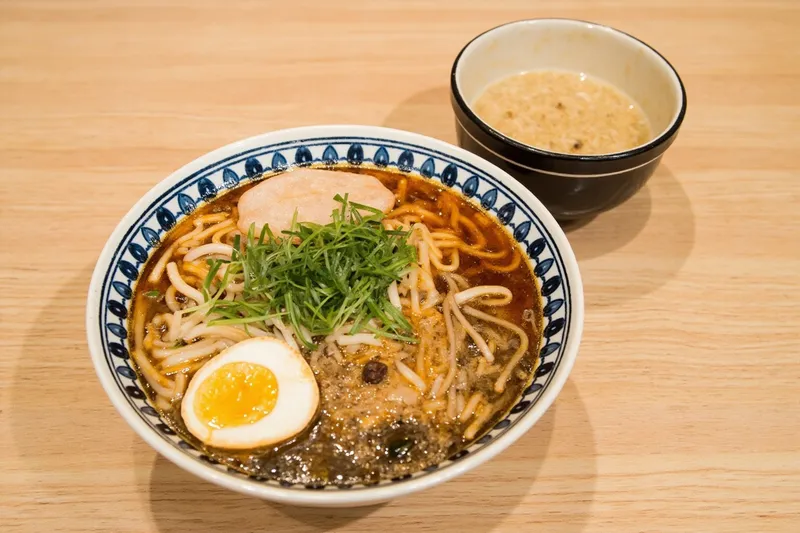
The best trick on the row costs nothing: at the end, ask for soup-wari and the staff thin the leftover dipping broth into a drinkable soup. You get a second, lighter bowl out of the pot you already paid for.
六厘舎 runs two sessions, 7:30–9:45 with last order at 9:30 when the morning-only asa tsukemen is on, then 10:00–23:00 with last order at 22:30. Its ramen is listed at ¥950–¥1,350, while its shop card carries ¥1,000–¥1,999 across the menu. Details on 六厘舎's shop card.
ひるがお for salt, 俺式 純 for tonkotsu
ひるがお is the shio (salt) counter, the sister brand of せたが屋, the Setagaya shop whose queue on 環七 became a Tokyo landmark. There are no chemical seasonings here: the tare is built on Vietnamese natural sea salt, Mats Kuraya white soy sauce and natural dried bonito flakes. It runs 10:00–23:00 with last order at 22:30, has 22 non-smoking seats, takes cash and transport-type e-money only, and answers the phone on 03-3213-7000. See ひるがお's shop card.
俺式 純 is the opposite pole: pork bone broth simmered for 24 hours in the shop, and a choice of four firmness levels – extra-firm, firm, regular or soft. Its band starts at ¥850, the lowest floor on the row, and the firmness choice lets you order soft and eat fast. If I had time for exactly one bowl here, this is where I would spend it.
Miso, chicken and sardine: 花道庵, そらのいろ, ひらこ屋
花道庵 simmers its miso broth for two days and was picked by the Michelin Guide Tokyo two years running as a miso ramen shop. If miso is your thing, that is the counter I would not skip.
そらのいろ NIPPON is the one for chicken: the shoyu ramen is built on 天草大王 (Amakusa Ō) chicken broth, with a scallop-broth shio and a mushroom veggie soba as its other signatures. It is also the only kitchen here whose menus include vegan and gluten-free options, which matters if that is how you eat, because no other counter publishes anything like it.
津軽煮干 ひらこ屋 comes from Aomori and is the first permanent branch of that shop outside its home prefecture. 食堂はせ川 is the odd one out: a Kitakata-style pop-up running Aug–Nov 2026 and the only kitchen on the row with a fixed closing date. If it was your target, look at the official list before you travel, because that is the one name that may not be there when you arrive.
Strengths, and the friction you'll hit
What the row does well
- No paperwork: you buy a ticket from a machine and eat at a counter, so the only wait is the queue.
- Ten broth styles under one roof, with no second walk and no second ticket.
- Two of the counters, ひるがお and 六厘舎, are non-smoking rooms with 22 and 26 seats.
- The tsukemen format and the free soup-wari finish at 六厘舎.
- A bowl of real ramen for ¥850–¥1,400 in a station you walk through anyway.
The counter layout is the quiet advantage. You stand, you sit, you eat, and nobody is holding a table for you. For anyone who has never used a ticket machine, the four steps take about as long as reading a menu board.
What gets in the way
- The 11:30–14:00 crush, when office crowds and tour groups overlap.
- No credit cards at ひるがお or 六厘舎.
- Stairs or escalators on the quickest signed route, even though elevators exist.
- Luggage in the queue, and no room for a case beside a stool.
- Locker availability isn't guaranteed at weekends and holidays.
- The oversized tokusei bowl, a poor solo choice between trains.
All of that is fixable by choosing your hour and your kitchen. The people who leave the row frustrated are the ones who wanted a table, a card and an empty queue at half past twelve.
Why the corridor behaves this way
Ten kitchens on one B1 corridor outside the gates turn the Tokyo Ramen Street into a single stream of people: station footfall, office workers and anyone with a spare twenty minutes between trains. The ticket machines sit along that corridor, so people stop and pay in the narrowest part of the walk. Seating is counter-only, so a queue that cannot be seated turns into a queue that cannot be seated quickly.
The stairs and the luggage problem come from the same source: a station built for trains, where a corridor on B1 is an afterthought next to the concourse. And the line-up is not fixed – the 食堂はせ川 pop-up shuts on 23 November 2026, so treat the official list as the reference rather than an old photo of the corridor.
Practical notes: hours, portions and the other ramen cluster
Hours, the early session and the last order
Hours, last order, seats and phone numbers. The third line covers the remaining eight kitchens as a group, and each has its own card on the official site.
| Kitchen | Hours | Last order | Seats | Phone |
|---|---|---|---|---|
| 六厘舎 | 7:30–9:45 (morning asa tsukemen), 10:00–23:00 | 9:30 / 22:30 | 26 | 03-3286-0166 |
| ひるがお | 10:00–23:00 | 22:30 | 22 | 03-3213-7000 |
| The other eight kitchens | 10:00–10:30 open, 23:00 close | 22:30 | – | – |
六厘舎 may stop letting new customers join the queue before the last order when the line cannot be seated, which makes the 7:30 session the calmest window on the row. There is no booking system anywhere on the corridor: the phone numbers answer questions about hours and space, they don't hold a counter.
Portions, noodle firmness and eating between trains
The standard signature bowl is a single serving, and that is the size that suits a 20–30 minute slot. It also matches how I grew up in Yokohama, where the fish or tofu was a small portion shared in the middle of the table rather than a course on its own.
The tokusei bowl adds egg, extra pork and a sheet of nori on top of the signature ramen and is much larger, so I would skip it between trains. 俺式 純 lets you pick the noodle firmness – extra-firm, firm, regular or soft – which makes a big bowl of tonkotsu easier to finish in the time you have.
On dietary needs, そらのいろ NIPPON publishes vegan and gluten-free menus, the only kitchen on the row confirmed to do so, and ひるがお's salt tare is built on natural ingredients with no chemical seasonings. For allergens or anything else, ask the staff at the counter before you order.
The second cluster: KITTE Marunouchi Ramen Gekisenku
Across the station, KITTE Marunouchi B1 has a "Ramen Gekisenku", a second group of ramen shops. Most of them open at 11:00 and close earlier at weekends and holidays. If you are after the best ramen near Tokyo Station and the row outside the gates is packed, that is the second stop, and it is also the answer when the style you want isn't on the Ramen Street at all.
KITTE lists coin lockers on B1 as well, so a bag and a second bowl in the same trip is possible. Seating at those shops I cannot describe from what I know, so I would still assume counter stools and tight spacing rather than plan on a table for four.
For the wider area, my Tokyo on a budget guide covers cheap eats around the station, and if you would rather have a light sit-down lunch than ramen, Yurakucho Marui's basement is the better bet.
Who this row suits, and when to skip it
Good for, and not for
It suits a traveller with a layover who wants a hot bowl without booking anything: allow 20–30 minutes for the bowl plus the walk to the platform. It suits a first-timer who wants to compare salt, tonkotsu, miso and tsukemen under one roof, and anyone who wants the morning-only asa tsukemen.
Skip it if you are paying only by card, since ひるがお and 六厘舎 take cash and transport IC only. Skip it if your schedule has no slack, because a famous counter can queue at almost any hour. Skip it if you are hauling a suitcase, need a guaranteed step-free route, or want four people at one table. And if the plan was to find the best ramen in Tokyo, this row is a sampler rather than a verdict.
My own line: if the train is close, I eat before I get to the corridor. The ramen is good, but the timetable wins.
How to buy, what it costs and what changes
There is no booking, no deposit and nothing to cancel: you buy a ticket from the machine and eat. Signature bowls run ¥850–¥1,400 and side dishes ¥120–¥480 with tax included. The official Ramen Street page carries the current ten kitchens, the side-dish prices and the B1 floor map; the ramen guide carries the per-kitchen price bands and the Ramen Data panels.
Only one name on the row has an end date: the 食堂はせ川 pop-up closes on 23 November 2026. Look at the official list before you travel for that kitchen.
Before you go
- Check the bowl price on the ticket machine: printed bands cover only five of the ten kitchens, and 六厘舎 carries two different ranges.
- Carry cash; ひるがお and 六厘舎 take no credit cards.
- 食堂はせ川 closes on 23 November 2026, so do not build a trip around it after that date.
- Budget ¥850–¥1,400 a bowl and ¥120–¥480 a side.
- Finish 20–30 minutes before your train, more with luggage or children.