
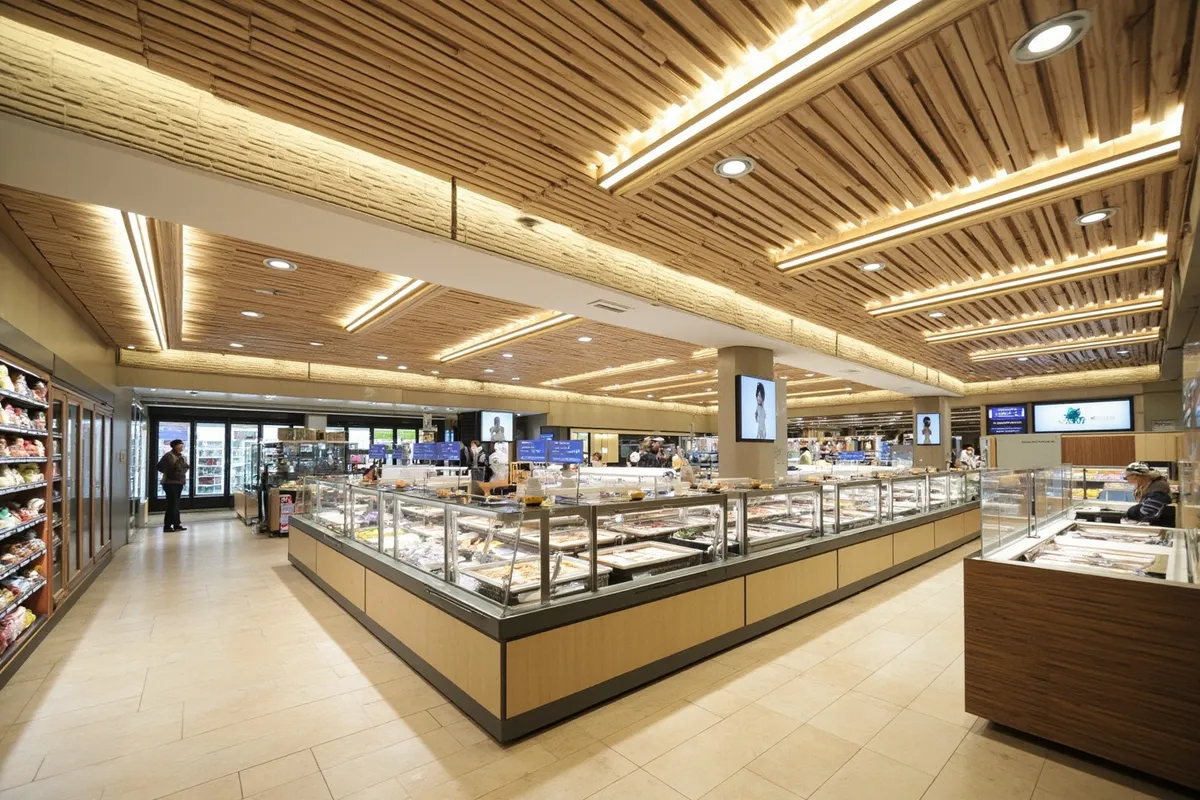
The Daimaru Tokyo food hall is the B1F 食品 (shokuhin) floor of the Daimaru department store in Marunouchi, and that floor connects straight into Tokyo Station. It works well between trains: come down from the Shinkansen platforms, pick up a set meal at a counter, walk back up to the platforms without touching the street. The trade-off is that nothing here is table service, so your waiting time is measured in queues in front of counters.
Budget by band, not by dish: around ¥1,000 for a simple set, around ¥2,000–3,000 for a fuller one, around ¥5,000 at the top. The counters sell from producers across many regions of Japan, more than you would guess from one basement, though not every region on the map. The food floor runs 10:00–20:00, and individual counters keep hours of their own.
What the Daimaru Tokyo food hall actually is
The 食品フロア under the Marunouchi store
Daimaru Tokyo stands at 1-9-1 Marunouchi, Chiyoda-ku, Tokyo 100-6701, and the building runs thirteen levels from B1F to 13F. The food is on the B1F 食品フロア. The store's line is 050-1782-0000 if you want to confirm a counter's hours before travelling, and the Daimaru Tokyo B1F floor guide shows the layout.
Arriving is the easy part. The basement opens into the Tokyo Station passage (連絡口), so there is no street-level detour, and the JR Yaesu North Exit puts you in front of the store. If you have been calling this the Marunouchi food court, that name sets up the wrong picture: every stall belongs to one department store, and each counter carries a brand you can recognise. Ginza Mitsukoshi's depachika guide covers the same idea from the other side of the city.
What makes this a depachika rather than a market hall:
- Counters have established names, such as Kinokuniya, Nenrin-ya and Okazu Honpo Tsukuda Asai, so you know who made what.
- One buyer curates the floor, so the regional mix is chosen rather than gathered stall by stall.
- Each counter sets its own hours and prices its own board.
- You arrive through the store or the station passage, not through a street door lined with signs.
Getting there: trains, walks and parking
Two routes matter for most people: the station passage on foot, and Yaechika Parking if you have a car.
| From / to | Route | Cost |
|---|---|---|
| JR Tokyo Station, Yaesu North Exit | Out of the gates, the store is directly ahead | Free |
| B1F to Tokyo Station | Through the station passage, no street level | Free |
| B1F to Shinkansen platforms | Same passage, straight from the food floor | Platform access only |
| B1F to the Marunouchi office district | Station passage, underground the whole way | Free |
| B1F to Yaechika Parking | Street-level entrance, ramps down to the basement | ¥380 per 30 minutes beyond the free period |
Parking deserves a decision before you arrive. Yaechika's west and east lots run down to the basement and carry the Daimaru discount: one hour free with a same-day purchase of ¥5,000 including tax, two hours at ¥10,000, five hours at ¥100,000. Food bought in the store counts towards the spend, and the ticket is stamped once a day at the 1F information desk. From 16:00, stamping happens at that same desk. The Daimaru Tokyo access and parking guide has the full tariff.
| Car park | Daimaru discount |
|---|---|
| Yaechika west and east lots | 1 hour free at a ¥5,000 same-day purchase, 2 hours at ¥10,000, 5 hours at ¥100,000 |
| Marunouchi Park-in, Tokyo Yaesu Parking, Marunouchi Trust Tower, Sapia Tower | None, these Marunouchi-side lots carry no Daimaru discount |
| Yaechika with an app coupon or foreign-customer card | 2 hours free with a foreign-customer (外商) card receipt of ¥5,000, or the Daimaru/Matsuzakaya app coupon (Diamond or Ruby rank) with a ¥5,000 receipt; these cannot be combined with each other or with the standard tiers |
Free parking is not automatic, and this is where lunch visitors get caught: the Marunouchi-side lots give no discount, and that is where most office workers leave the car. One ¥2,000–3,000 set does not reach the ¥5,000 spend that buys an hour, so add a bento for the train or park on the Yaechika side.
Opening hours and the floors above
The floor's own hours are the easy bit. The complications start one level up and in the individual shops.
- B1F food floor: 10:00–20:00
- 12F restaurants: 11:00–22:00
- 13F restaurants: 11:00–23:00
- Tax-free counter on the 12F: 10:00–20:00
- Closed only on 1 and 2 January, otherwise open every day of the year
- Individual shops keep hours of their own, so a counter can stop before the floor does; the Daimaru Tokyo hours page carries a shop-by-shop notice when those change
Two of these numbers decide plans. The basement is finished at 20:00, so a late dinner has to move upstairs, where the 12F runs to 22:00 and the 13F to 23:00. The tax-free counter closes at 20:00 too, one floor above you, so a tourist coupon is something to sort before the basement shuts rather than after.
Japanese regional food at the Daimaru Tokyo food hall
Which counters are worth your time
One correction to the usual description before the list. The floor covers many regions, not every region. These are the ご当地グルメ (go-satachi gourmet) counters, a single regional producer selling its own speciality, and they reach further across the country than you would guess, but no basement has a counter for every prefecture. The board above the counter is always the last word.
| Counter | What it is known for | Typical spend |
|---|---|---|
| ねんりん家 Nenrin-ya | Hokkaido butter, cheese, soft-serve | Around ¥1,000 |
| おかず本舗 佃浅 Okazu Honpo Tsukuda Asai | Hokkaido-style oden, ready-made side dishes | Around ¥1,000 |
| 肉のたかさご Niku no Takasago | Kagoshima black pork and charcuterie | Around ¥2,000–3,000 |
| 船橋屋 Funabashiya and 米屋のおにぎり屋 菊太屋米穀店 Kikutaya Beigoya | Toyama mochi and Toyama onigiri | Around ¥1,000 |
| 鎌倉五郎本店 Kamakura Goro Honten and KAMAKURA 茶の福 | Kamakura yokan and tea | Around ¥1,000–3,000 |
| 浅草今半 Asakusa Imahan | Sukiyaki sets, higher for a full course | Around ¥2,000–3,000 |
| 浅草梅園 Asakusa Baien | Ningyo-yaki and old-style sweets | Around ¥1,000 |
| なだ万厨房 Nadaman Kitchen | Udon and donburi sets | Around ¥2,000–3,000 |
| 山本海苔店 Yamamoto Noriten | Nori and seaweed | Around ¥1,000 |
The rest of the line-up runs in the same spirit: 明治屋 Meijiya for confections, 福寿園 Fukujuen for green tea, 源吉兆庵 Genkichoan for yokan, 舟和 Funawa and 錦松梅 Nishimatsume for Kanto sweets, 五大力 Five Great Forces for kamaboko, 銀座かねまつ Ginza Kanematsu for fruit, ヨックモック YOCMOC for deli-style plates, 紀ノ国屋 Kinokuniya for konbu and dried goods, and La Noix for chocolate. The current descriptions sit on the Daimaru Tokyo counter list.
How a counter meal works
There is no menu that applies across the floor. You read the board above a counter, you order, you pay there, and the queue forms in front of the counter. That mechanic explains most of what follows, including why a basement lunch can beat a restaurant lunch on speed and still feel more rushed.
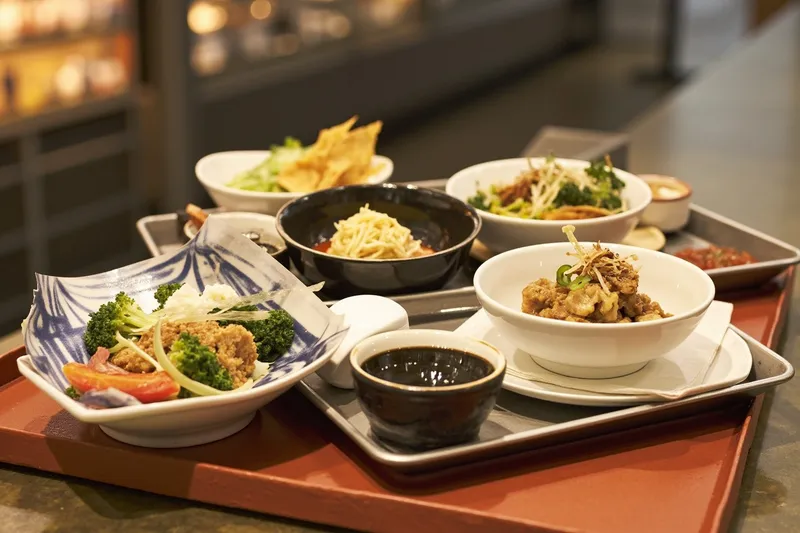
A counter set meal is the plainest version of a Japanese lunch: rice, one main, two or three small dishes, pickles, often soup. The small dishes are the part worth paying attention to. That ichiju-sansai pattern, rice and three small dishes, is the frame my grandmother cooked in and the cheapest way to eat it away from home. Around ¥1,000 is where the light version sits, a fuller set lands in the ¥2,000–3,000 band, and a bento box is the takeaway version of the same idea. The hara hachi bu habit, stopping at eight-tenths full, fits this floor far better than it fits a set menu.
Two pieces of infrastructure make a short visit work. The basement has refrigerated coin lockers, so you can collect a bento and a block of cheese, put them in a locker and collect them before your train. The order counter for bento and party food stops at 16:00, four hours before the floor closes.
- Arrive at 11:00. The 11:30–13:00 window on weekdays is the busy one.
- Read two or three boards before you commit, and choose the counters whose queues are shortest.
- After 13:30 the first wave has gone, and re-ordering from a counter you skipped is easy.
- Lock anything perishable, then take the station passage to the platforms.
If what you want is light Japanese meals in central Tokyo without sitting down, this floor is the easy answer, and the meal finishes in the time a queue would have taken anywhere else.
Bargain days and the weekly rotation
Some weekdays have a theme: Monday chicken, Tuesday fruit and pork, Wednesday cheese and fish, Thursday beef, Friday vegetables. Themed days are a weekday thing, so on a weekend you choose from the boards alone. A theme is a reason to move faster, not a reason to expect a fixed low number, since prices still sit in the ¥1,000, ¥2,000–3,000 and ¥5,000 bands and the popular items go first.
The store's Daimaru Tokyo food blog follows the basement counters week by week, including seasonal specials and a matcha category for the drinks and sweets down here. If a seasonal item matters to you, look before you travel, because limited items often do not come back the same afternoon.
What it costs at the Daimaru Tokyo food hall
Price bands: from a ¥1,000 plate to a ¥5,000 set
The number you need is on the board above the counter, so budget in bands instead of in exact prices: around ¥1,000 for a one-plate set, an onigiri with a side or a bento-style item, around ¥2,000–3,000 for a proper lunch with fuller sets and the regional mains, around ¥5,000 for the top of the range, where the gift-grade boxes sit. Read the board before you join the queue, which saves standing in a line and then walking away.
There is a pricier alternative that most visitors never consider, and it is upstairs. The restaurant floors serve fixed set menus and stay open much later, the 12F until 22:00 and the 13F until 23:00 against the basement's 20:00, but they are sit-down restaurants with the wait and the service that go with them. I would only move up if you want a long meal rather than a fast one.
What arrives on the plate and what costs extra
A counter meal comes as a set, rice and a main and small dishes and pickles and soup, and you eat it standing at the counter or in the seating pockets between counters. The extra money usually goes on bottled drinks, takeaway items and gift boxes rather than on anything hidden. The tray is the only thing you carry, and if you want it hot you eat it there.
The basement also has the practical rooms: restrooms, a multi-purpose toilet for wheelchairs and strollers, a public telephone and refrigerated coin lockers. None of that forces a trip upstairs, which is what makes a 45-minute stop workable between trains. If you are planning to cook from the shopping rather than the meal, the same counters sell the staples, and Tokyo Kitchen and Grocery Errands covers where to build a proper home basket around a Tokyo trip.
Seasonal counters and how the price moves
The counters rotate over the year, and seasonal specials sit at the top of the bands. A limited item that sells out is often not replaced the same afternoon, so if you want one, go early rather than late. Prices move with the season rather than with a published calendar, so treat any figure you have read about a seasonal item as approximate.
Matcha is well covered down here, which makes it a decent substitute for the specialist tea rooms when you have an hour rather than an afternoon. The Tokyo Green Tea Trail has the dedicated addresses if you have the time.
Crowds, queues and the rhythm of a basement lunch
The Marunouchi office lunch peak
Marunouchi's office towers empty into the station at lunchtime, and a good share of that flow ends up on the B1F. I would treat 11:30–13:00 on weekdays as the busiest part of the day and plan around it: come at 11:00, when the counters have restocked and the queues are short, or come after 13:30, when the first wave has gone and the staff have time to serve you properly.
The themed bargain days land in exactly that hour, which gives you a second reason to avoid the middle of the day if you are in a hurry. If your train leaves before 13:30, eat early rather than gamble on the queue.
Noise, seating and how the floor moves
One covered floor, hard surfaces, no acoustic separation: it is loud in a way a restaurant is not. The sound is not unpleasant, it is the sound of a lot of small transactions and trolleys, but if you want to talk properly the seating pockets between counters beat the open stretches.
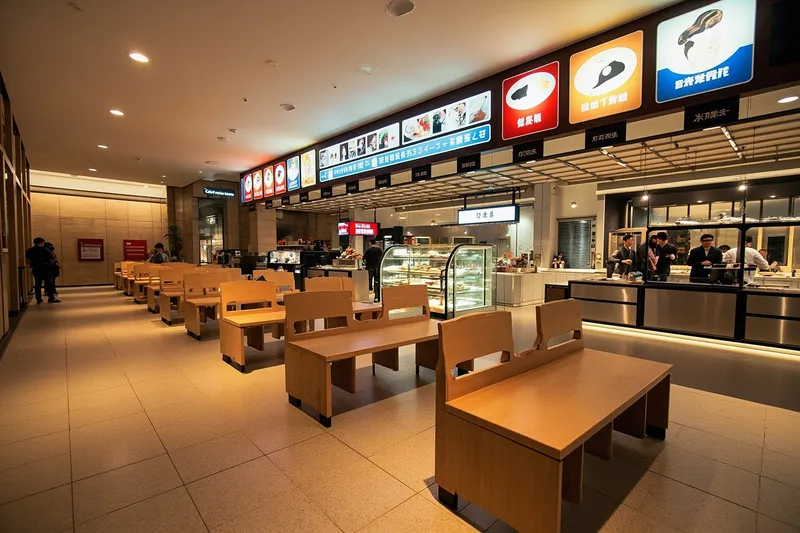
Popular counters make pinch points in the corridor, and that is where your time goes. The straight connection to the station is the floor's real advantage: you can pick up food, leave with it in your hand, reach the platforms without going up to the street first and eat a bento on the train. Tokyo Station Ramen Street is the other fast station option, and the basement wins on range rather than on speed.
How the floor behaves through the day
The pattern is predictable enough to plan around, mostly because of how the floor is put together.
| Moment | What to expect | What to do |
|---|---|---|
| 11:30–13:00 on a weekday | Office lunch peak, and themed bargain counters pull extra people | Come before 11:00 or after 13:30 |
| A popular counter | A queue forms, and the floor's 20:00 close does not mean each counter runs to 20:00 | Check that counter's own hours, then queue for the one you can actually wait for |
| Bento and party orders | The order counter closes at 16:00, four hours before the floor | Order before 16:00, or buy ready-made boxes during the day |
| Paying at a stall | Accepted cards and code payments differ by counter | Check the store's payment list for foreign visitors that morning and keep cash as a fallback |
The friction here is structural rather than accidental: counters run their own hours, prices live on boards, and the queues form exactly where the famous counters are. The upside is equally structural, with one floor, dozens of producers and a train station on top of it.
Orders, tax-free and paying
Ordering bento and party food ahead
The basement has a dedicated bento and party-food order counter, and it stops at 16:00, four hours before the floor closes. That deadline is the argument for ordering ahead: a bento packed for a Shinkansen run, collected before 16:00 and carried out through the station passage, beats buying something at 19:00 and hoping it survives the journey.
Party orders go through the same counter. The store's service information page carries the current order line and the pick-up terms, and I would not trust a number written down from an old visit.
Tax-free shopping and the tourist coupon
The tax-free counter is on the 12F, open 10:00 to 20:00, the same time the basement shuts and one floor above it. Tourist coupons are issued there, so sort that before you go down or right after you come up, not at 19:55.
Do not plan around your basement meal being tax-free. Japan's export tax-free scheme is for goods you take out of the country, while a meal you eat on the spot is food and service, not export goods. That general rule is the reason the food floor is the wrong place to ask about it.
Details like the minimum spend and the handling fee follow the national rules and change, so read them off the store's own tax-free information rather than from an old article and confirm them on the day you shop.
First-timer notes
Five things I would tell anyone going for the first time.
- Facilities on the B1F: restrooms, a multi-purpose toilet, a public telephone and refrigerated coin lockers, so a short stop needs nothing from upstairs.
- You never need street level, because the B1F connects to Tokyo Station directly and the Yaesu North Exit is at the door.
- Payment acceptance varies by counter. The store keeps a list of accepted cards and code payments for foreign visitors on its visitor information page, so check it that morning and carry cash as a fallback.
- Parking: use the Yaechika west or east lot for the Daimaru discount, since Marunouchi-side lots carry none and the app or foreign-customer card free hours cannot be combined with the standard tiers.
- Luggage: refrigerated lockers plus the station passage make a shop-and-go Shinkansen plan realistic. Questions about the floor, the lockers or parking go to 050-1782-0000.
Who the Daimaru Tokyo food hall suits
Honest downsides
Nothing here is broken, but five things will annoy you if you are not ready for them.
- Your budget is a band, not a number, so a ¥2,000–3,000 set can turn into something bigger once a drink joins it.
- Counters keep their own hours and can stop before the floor's 20:00 close, so a late arrival has fewer choices, not more.
- The order counter for bento and party food shuts at 16:00 while the floor runs until 20:00, and an evening arrival still finds food but not a custom order.
- Parking is not automatically free: the Marunouchi-side lots carry no Daimaru discount, and the app or foreign-customer card free hours cannot be combined with the standard tiers.
- A meal eaten here will not be tax-free, and the tax-free counter on the 12F shuts at the same hour as the basement.
Before you go
- It suits first-timers doing a depachika crawl, office workers with a 45–60 minute lunch who arrive before 11:00 or after 13:30, families who want many counters on one level, and Shinkansen passengers for whom the station passage is the whole point. Shinjuku Takashimaya's basement is the closest comparison in scale, and Yurakucho Marui's basement lunch is the shorter version of the same idea.
- Skip it if you want table service and a long sit-down meal, if you need a fixed price list before you arrive, if your plan depends on tax-free shopping on the food floor, or if you turn up after 20:00 for a basement dinner, because the restaurant floors are still open until 22:00 and 23:00.
- Check before you travel the payment list for foreign visitors, the shop-by-shop hours notice, your car park's discount eligibility, and the 16:00 deadline if you want an order.
The short version
I would treat this as a station-side stop rather than a meal in itself: come at 11:00, read the boards because the prices live on them, and let the queue decide which counters you actually reach. Sample a couple of regions in one walk, and the Hokkaido dairy and the Toyama mochi are my two, with around ¥1,000 each enough for both.
It is the wrong choice if you want a fixed menu, a table, a quiet room or a tax-free lunch. And remember the basement is done at 20:00 even though the restaurant floors run on for another two and three hours.
Five things to check before you go:
- Which counters will be open when you arrive, since counters keep hours of their own and the floor's hours-change notice lists them.
- Which cards and code payments each counter takes, on the store's foreign-visitors page, and keep cash as a fallback.
- The order line and pick-up terms if you want a bento or a party order, and remember the counter stops at 16:00.
- Which car park you are using and whether it carries the Daimaru discount at all.
- The current tax-free rules and coupon terms on the store's own page, including anything about food floors.
A few questions that come up most often.
Do I need to come up to street level to reach the Daimaru Tokyo food hall?
No. The B1F connects straight into Tokyo Station through the station passage, and the JR Yaesu North Exit puts you in front of the store.
What should a first-timer order first?
Start in the around ¥1,000 band at a counter whose board you can read, then add a second plate from a different region.
How much time should I budget?
About an hour, plus queue time. The bento and party-food order counter stops at 16:00 and the floor closes at 20:00.
Is the food hall open every day?
The store is open every day of the year except 1 and 2 January, and the food floor runs 10:00–20:00. Individual counters may close earlier than the floor.