
Cheap Tokyo food is easier to find than most visitors expect: a bowl of ramen, two onigiri and a drink from a convenience store fit under ¥1,000, roughly US$7, as long as you know which counter to walk up to. The cheap end of this city runs on standing counters, ticket machines and the discount stickers that appear on prepared food late in the evening.
I set the rules before I started looking. One eating occasion under ¥1,000. No booking, no membership, no taxi ride to reach it. A short walk from a station, or a stall in a lane you were going to walk anyway. And a price I can point at rather than a rumour. Six tests in all, and they are listed below before a single place appears in the table. Every price here is a 2026 figure.
Cheap Tokyo Food: What Passed the ¥1,000 Test
The six tests every stop had to pass
A place made the list only if it cleared all six. I dropped anything I could not price from a published figure, and anything that needs a reservation, a membership or a detour to reach.
- One eating occasion under ¥1,000, with tax included where the price is quoted that way.
- Service you can walk up to: a standing counter, a counter with a ticket machine (券売機), or food you take away.
- Close to a station, or inside a market lane you were going to walk anyway.
- Payment you can plan for: a card or an IC card, or a stated cash rule.
- No reservation system and no membership to join before you eat.
- A price with a source behind it, kept as a range when the counter quotes a range.
Two things stay out on purpose. A traditional sushi counter starts at ¥2,000 and runs past ¥20,000, and a guided food tour with five tastings is listed at about US$95, so neither belongs to a budget day.
How to read the table: Price from is the cheapest item published at that stop, and it is often a single bite. The second price column is what one eating occasion really costs there. A ¥250 onigiri and a ¥250 bowl of soba are not the same purchase.
How I compared the stops
The unit of comparison was one eating occasion, not one restaurant, and I marked which rows are a bite rather than a plate. Portions do the work here: four or five sushi plates fill one person, six to eight takoyaki pieces are a snack, and a bowl of soba is a whole lunch.
Prices are printed as they come, in ranges, with tax where the counter quotes it that way. I recorded the service style, standing counter, table, conveyor or takeaway, and I left waiting times out on purpose because I measured none. I also logged the friction at the till: cash-only stalls and how much cash a visit asks for.
Opening hours went in beside every price, because a counter that shuts at 13:30 and one that never closes belong to the same market. Here is the short version of the comparison.
| Place | Key details | Type | Price from | One occasion costs | Main advantage | Main drawback |
|---|---|---|---|---|---|---|
| Tsukiji Outer Market | 333 shops; stalls close in stages from 12:30 to 14:00; one counter open all night | Food market | ¥150 tamagoyaki | ¥1,200–2,500 for five or six bites | A bite every few steps | Only 71 of 333 shops publish a payment policy and 58 take cards; no eating while you walk |
| FamilyMart | Open when the trains run; hot counter and microwave | Convenience store | ¥150 onigiri | ¥700–1,000 for a meal, ¥400–600 for breakfast | A complete meal with no booking | Read the sticker, prices vary by chain |
| Kitsuneya | Tsukiji rice-bowl stand, closes 13:30 | Rice-bowl stand | ¥870 horumon-don | ¥870 | One hot bowl, one printed price | Cash only, no reservations, closes 13:30 |
| Marutoyo | Tsukiji, oversized hand-pressed onigiri | Onigiri shop | ¥218 | One onigiri | The cheapest hot breakfast in the lanes | Sold per piece, nowhere to sit, eat in the marked area |
| Torikizoku | Chain izakaya; most items ¥328 before tax, ¥361 with tax | Izakaya | ¥328 | ¥300–800 a plate, ¥300–600 a drink; one plate and one drink ≈ ¥720 | Plates ordered one at a time | A second round of drinks breaks ¥1,000 |
| Sushiro, Kura Sushi, Hama Sushi | Plates ¥110–150; take one and eat it | Conveyor-belt sushi | ¥110 | ¥600–900 for four or five plates | Sushi for two, no booking | With drinks a session runs ¥1,500–2,500 |
| Standing soba counter | Near the gates at nearly every major JR station | Standing noodle bar | ¥300 kake soba | ¥300–350; tempura soba ¥450–550 | A bowl between two sights | No seats; toppings push past ¥500 |
| Sukiya, Matsuya | Station food floors and street counters | Rice-bowl chain | ¥400 | ¥400–500; large with miso under ¥700 | A hot bowl for under ¥700 | Sets with sides cross ¥1,000 |
| CoCo Ichibanya | Order on a ticket machine | Curry house | ¥530 pork curry | ¥800–900 katsu curry; ¥800–950 lunch set | A hot plate for ¥530 | Extras and sides pass ¥900 |
| Hidakaya, Kourakuen, Ichiran | Counters; some Ichiran branches seat one person per booth | Ramen shop | ¥390 | ¥390–980; best-shop band ¥750–950; egg +¥100–150 | A hot bowl plus an egg | At ¥980 the egg breaks ¥1,000 |
| Ito-Yokado and other depachika floors | Basement ready-made counters | Supermarket food hall | ¥250 | ¥500–700 for a bento set; 20–50% off late | The cheapest hot meal with seats | The discount depends on the clock |
| Vending machine | Station concourses and pavements | Drink vending | ¥110 | ¥110–160 | A hot or cold drink, no purchase needed | Premium cans cost more than the published range |
| Nana's Green Tea | Matcha counters around Tokyo | Tea counter | ¥550 | From ¥550 for a matcha drink | A sit-down break mid-walk | Prices differ by branch, check the board on arrival |
What a ¥2,200 food day looks like
Here is a day of food in Tokyo priced the way a printed guide prices it: ¥400 for breakfast, ¥900 for a bowl of ramen at lunch, ¥250 for a taiyaki in the afternoon and ¥650 for a gyudon in the evening. That is ¥2,200 in total, and every line is one of the stops below.
It is more than I would spend, and I would drop the taiyaki. The day still needs no booking and no queue. If you want to spend more than this, the sushi counter is where the budget stops holding; if you want to spend less, a kake soba for ¥300 replaces any one of those lines.
Under 1000 Yen: Cheap Tokyo Food by Type of Place
Konbini breakfast and lunch: what ¥400–1,000 buys
A konbini (コンビニ) is the most dependable budget stop in Tokyo, because it is open when your train arrives and nothing in it needs a booking. The prices on the shelves are averages rather than fixed sums, and they shift between chains, so read the sticker on the item in front of you. This konbini price roundup tracks the usual bands.
The cold shelves hold onigiri (おにぎり) and a tamago sando (たまごサンド); the hot counter has oden (おでん), karaage and edamame. I would build a breakfast from an onigiri, a tamago sando and a machine coffee, and for lunch take the noodle bowl rather than a bento, because it fills you for less. Every bento box carries its own calorie count on the lid, so read that rather than trusting an average for a whole chain, and see the FamilyMart bento review for the lighter side of the shelf.
| Konbini item | Typical price |
|---|---|
| Onigiri | ¥150–200 |
| Sandwich | ¥200–500 |
| Noodle or pasta bowl | ¥300–500 |
| Hot snack | ¥150–300 |
| Drink | ¥100–300 |
| Machine coffee | ¥100–150 |
| Two onigiri and a drink | under ¥500 |
| One full meal | ¥700–1,000 |
Standing soba and gyudon counters
A tachinomi (立ち飲み) soba counter is the fastest hot lunch in the city. Kake soba costs ¥300–350 and tempura soba ¥450–550, and nearly every major JR station has one within a couple of minutes of the gates. You stand at the counter and eat in ten minutes, which suits a day that is mostly walking.
The other workhorse is the gyudon (牛丼) chain, Sukiya or Matsuya, and you will find them on station food floors too. A regular bowl is ¥400–500, and a large with a side of miso soup stays under ¥700. The trap is the set menu: add salad and sides and you cross ¥1,000 for what started as a ¥400 bowl.
Curry, ramen and kaiten-zushi counters
Curry is the cheapest hot plate with rice. A basic pork curry at CoCo Ichibanya starts at ¥530, and you order it on a ticket machine (券売機), so nothing needs a word of Japanese. A katsu curry with extras runs ¥800–900, and a station lunch set with curry, cutlet, salad and miso soup costs ¥800–950. The station prices come from Tokyo tourism's cheap eats page.
Ramen sits higher. A basic bowl at the best-known shops runs ¥750–950, Hidakaya starts at ¥390, Kourakuen at ¥500 and Ichiran at ¥980, and an ajitama egg adds ¥100–150. At the ¥980 end, the egg is what pushes you over ¥1,000. Underneath Tokyo Station, Ramen Street keeps its top bowls under ¥1,000 as well. Some Ichiran branches seat one person per booth, so four friends eat separately.
Conveyor-belt sushi (kaiten zushi) is the other end of the scale. Plates start at ¥100–150, mostly ¥120 at Sushiro and Kura Sushi and ¥110 at Hama Sushi, and four or five plates fill you for ¥600–900 a head. Take the plates, not the drinks, because a session with drinks runs ¥1,500–2,500.
Depachika floors and station food courts
The depachika (デパ地下) is the basement food floor of a department store, and it is where prepared food is cheapest. A ready-made box runs ¥250–500 and a bento set ¥500–700, sold from counters where you can sit down. Ito-Yokado is the classic example, and the same style of counter works in other department stores.
Timing is the trick. Prices often drop 10–50% from around 19:00, and prepared items in the last hour, up to ninety minutes before closing, are marked 20–50% off with a waribiki (割り引き) sticker, usually from around 20:00. The hour depends on the store, and the good boxes go first, so I would go late and go hungry.
Station food courts work the same way. Almost every major station has standing soba, a gyudon chain, a konbini and a bakery within a two-minute walk of the gates, in the areas called eki-naka (駅ナカ) and hado-shita (はど下). You can build a whole day from station floors without crossing a threshold you did not want to cross.
Affordable Tokyo Snacks: Tsukiji Outer Market, ¥150 Bites and Where the Line Breaks
Timing the lanes and carrying the right money
One rule shapes the whole market: do not eat while you walk. The stalls want you to finish at the counter or in the marked eating areas, and a crawl is easier to follow that way than to hunt for a wall to stand against. The lanes also close in stages rather than all at once, so the later you arrive, the shorter your list.
The market's own suggested route runs 09:00–12:00, and professional buyers have the lanes before 09:00. The tuna counters stop at 12:30, Kitsuneya closes at 13:30 and the grills at 14:00. Taneichi, the longest-open bowl shop, trades 06:30–16:00, which makes it the one place for a rice bowl before the crowds. Sushizanmai never closes at all, and takes cards.
| Counter | Hours |
|---|---|
| Taneichi (bowls) | 06:30–16:00 |
| Tuna counters | close 12:30 |
| Kitsuneya | closes 13:30 |
| Grill stalls | close 14:00 |
| Sushizanmai | 24 hours, 365 days |
Money matters here more than anywhere else in Tokyo. Only 71 of the 333 shops in the market's directory publish a payment policy, and 58 of those take cards, so I carry ¥5,000–10,000 per person in ¥1,000 notes and coins. Kururi Zushi / GINie CAFE is listed as taking no cash at all, and Tsukiji Miyukido takes a card only on purchases of ¥5,000 and above. The Tsukiji Outer Market review covers the lanes in more detail.
The ¥1,200–2,500 snack crawl
The cheapest bite in the market is the tamagoyaki (卵焼き) skewer at ¥150–300, which the market's own food guide calls its best-value bite. Marutoyo sells an oversized hand-pressed onigiri for ¥218–310, hot and ready to eat, though you buy it per piece and there is nowhere to sit.
Around the lanes the street snacks add up quickly.
- Takoyaki, 6–8 pieces, ¥400–600
- Taiyaki (鯛焼き), ¥200–350
- Yakitori, ¥100–200 a skewer
- Melon pan, ¥150–250
Five or six bites like that come to ¥1,200–2,500, and adding one seafood bowl takes the same crawl to ¥4,000–7,000. That is the number to keep in your head when someone tells you the market is cheap.
If you want one hot bowl rather than more bites, Kitsuneya's horumon-don is the one to know: beef offal simmered in hatcho-miso over rice, ¥870. It is cash only, takes no reservations and shuts at 13:30, so you cannot wait out a rush there.
When the market stops being cheap
Sea urchin is where the market turns into a splurge. A small cup of uni over rice from a grill stall runs ¥500–1,200 depending on grade, and that is the cheapest way to taste it. A proper bowl is another story: the current menu at Uni-Tora Honten lists a 70g uni-don at ¥8,300, a five-origin tasting at ¥14,500 and the top Kotei bowl at ¥24,500, tax included.
The reason is supply. A 2025 Reuters report linked warming seas to a cut in the northern catch and roughly double the uni prices in a few years, so the cheap cup is getting harder to justify. The same logic runs through the rest of the market: bites are cheap because they are small, and bowls are expensive because the fish is the point.
My own rule there is simple. I spend on the bites, skip the bowls, and go to Taneichi or Sushizanmai when I want rice. If you want the full walk, the market review linked above lays it out.
Cheap Drinks in Tokyo: Free Refills, Vending Machines and Tea on a Budget
The drinks you never have to buy
The cheapest drinks in Tokyo are the ones nobody charges you for. Restaurants and izakaya bring water or cold tea with the table and refill it free, so a ¥400 soft drink per person twice a day is ¥1,600 you never needed to spend. Ask for more cold tea when the pot looks empty, it is free and it is faster than a vending machine.
When you do want a drink in your hand, the vending machine is the cheapest option on the street: hot or cold, ¥110–160. Tap water in Tokyo is safe and free as well, which matters if you are walking a long route with an empty bottle.
| Drink | Cost |
|---|---|
| Tap water | free |
| Restaurant or izakaya refill | free |
| Vending machine, hot or cold | ¥110–160 |
| Konbini bottled drink | ¥100–300 |
A konbini bottle costs more than the machine outside, and it is the easiest way to keep tea in your bag for the rest of the walk: genmaicha (玄米茶) bottles sit in the same fridge as the water.
Izakaya otsumami: where the drink column eats the budget
An izakaya works on small plates, otsumami (おつまみ), which is why it is easy to overspend there. Plates run ¥300–800 and alcoholic drinks ¥300–600, and Torikizoku, the chain with the most branches, prices most items at ¥328 before tax, about ¥361 with tax. One plate and one drink comes to roughly ¥720 per person.
Two plates and two drinks break the ¥1,000 line, and that is where most of the money goes. Water and cold tea are still free here, so nobody needs a second bottle of beer to get through the evening. If you want to drink with friends and watch the numbers, I would order one plate and one drink each and skip the second round.
A tea break: the bottle version and the counter version
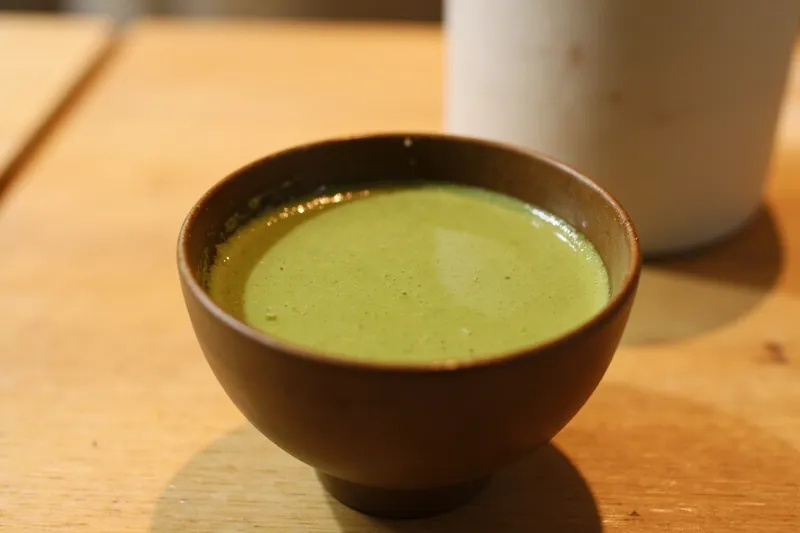
The priced version of a tea break is the bottle: genmaicha, hojicha (ほうじ茶) or a matcha latte for ¥100–300, or a vending machine drink for ¥110–160. If you want to sit down with a proper bowl of matcha, Nana's Green Tea is the counter most people mean. The cheapest drink there is around ¥550, and prices differ by branch, so check the board on the spot rather than budgeting for one exact figure.
For loose-leaf tea to brew at home, the Ippodo counters are the better place to look; check their shop list for the branch and the price before you set out across the city for one.
Local Notes That Change Your Bill
Tax, cards and the cash you need
Restaurant meals carry consumption tax (消費税) at the standard 10%, made up of 7.8% national and 2.2% local. The reduced 8% rate for food and drink sold for consumption is not a standing rule. It is a temporary measure tied to a Cabinet decision of 15 September 2026 whose bill still has to go to the Diet, so the rate you pay depends on the months you travel.
Check the rate in force before you travel on the National Tax Agency page on reduced consumption tax. Tax-free shopping applies to goods, not to restaurant meals, so a lunch is never tax-free.
Cards and IC cards (Suica, PASMO) work in konbini, chain restaurants and ticket machines, so the only place I plan cash is the market lanes, and I carry ¥5,000–10,000 for that. After midnight the picture narrows further: Sushizanmai in Tsukiji trades 24 hours a day, 365 days a year and takes cards, which makes it the one guaranteed hot meal in the market at 03:00.
Reading a ¥500 menu board
Menu words decide what you pay, so it is worth knowing five of them. A teishoku (定食) set comes with rice, soup and a side; a higawari (日替り) is the daily special that changes with the day; a ranchi setto (ランチセット) lunch set is the cutlet version of the same idea; okawari (おかわり) is the extra rice refill; and the waribiki (割り引き) sticker on a prepared box means the shop is discounting it.
The pricing follows from those words. A lunch set with a cutlet and a salad lands at ¥800–950, a curry with extras at ¥800–900, a gyudon set crosses ¥1,000, and a ready-made bento at the department store floor runs ¥500–700 before the sticker appears. On the konbini side, a sandwich is ¥200–500 and a noodle bowl ¥300–500, so a hot lunch there sits under ¥700.
Two side trips that cost almost nothing
Not every stop in a day of walking has to involve food. Yoyogi Park has no admission fee and no gate to close, which makes it a free place to sit and eat what you bought earlier. The stalls around the park are priced for tourists, so I would buy lunch at a konbini and eat it on the grass.
If you cook at home, Kappabashi Dougu Street between Ueno and Asakusa is where kitchen tools live, from knives to donabe pots. It sits on a different budget from this one, but it is where to spend on a day when you have decided to cook the cheap Tokyo food you bought instead of eating it.
Budget Eats in Tokyo: Picking the Right Stop for the Day
Best pick by scenario
The list below is my own shortlist, ordered by situation rather than by price. The bills are what one person pays, and where a price is missing it is because the counter sets it on the day. For the wider pattern behind a small breakfast, the Japanese breakfast guide is worth a look.
| Situation | Pick | Bill |
|---|---|---|
| Breakfast in 10 minutes before 09:00 | FamilyMart onigiri, tamago sando and a machine coffee | ¥400–600 |
| Breakfast before the market opens | Taneichi rice bowl, 06:30–16:00 | check the board |
| Lunch under ¥600 between two sights | Standing soba, kake soba | ¥300–350 |
| Hot lunch with a side | Gyudon chain, large with miso | under ¥700 |
| Curry with a cutlet | CoCo Ichibanya katsu curry | ¥800–900 |
| Half a day on foot | Tsukiji crawl of five or six bites | ¥1,200–2,500 |
| Dinner with friends, one round each | Torikizoku otsumami and one drink | about ¥720 each with tax |
| Sushi for two, no booking | Kaiten-zushi, four or five plates | ¥600–900 each |
| A drink without a meal | Vending machine | ¥110–160 |
| Sit-down tea break | Nana's Green Tea, price on the branch menu | from ¥550 |
| After 23:00 | Sushizanmai, open 24 hours | check the board |
Where the ¥1,000 line breaks
Some things in this city are simply not budget items, and it saves time to know which. A uni-don at ¥8,300, a five-origin uni tasting at ¥14,500 and the Kotei bowl at ¥24,500 are restaurant prices with tax included. Add one seafood bowl to a Tsukiji crawl and you are at ¥4,000–7,000. A kaiten-zushi session with drinks runs ¥1,500–2,500, and a traditional sushi counter starts at ¥2,000 and goes past ¥20,000.
Two more price cliffs: a second round of drinks in an izakaya, and a yokocho (横丁) alley where a nomihodai (飲み放題) all-you-can-drink table belongs to a different budget entirely. Guided food tours are the third: one with five tastings is listed at about US$95, while a walk with no tastings is listed at about US$13 for the guide fee alone, which is a fee for a guide rather than the price of a tour you eat your way through.
Prices, cards and taxes, in short
Three things to hold on to. The tax on a restaurant meal is the standard 10% unless the temporary reduced rate is in force when you travel, so check the National Tax Agency page before you go. Cash belongs to the market lanes, where I would carry ¥5,000–10,000, and to Kitsuneya, which takes nothing else. And the cheap end of the city stays open late: a konbini at any hour, a vending machine drink at ¥110–160, and Sushizanmai in Tsukiji serving all night and taking cards.
What to check before you travel:
- Read the price sticker on the shelf: konbini prices vary by chain and by item size, so the sticker is the number that counts.
- Check the consumption tax rate in force for your travel months on the National Tax Agency, and remember that tax-free shopping covers goods, not restaurant meals.
- Carry ¥5,000–10,000 in ¥1,000 notes and coins for Tsukiji, and do not count on a card at every stall.
- At a matcha counter, check the branch menu on arrival, since prices differ between branches.
- For a trip longer than a day, check your visa conditions on the Ministry of Foreign Affairs short-stay exemption page.