
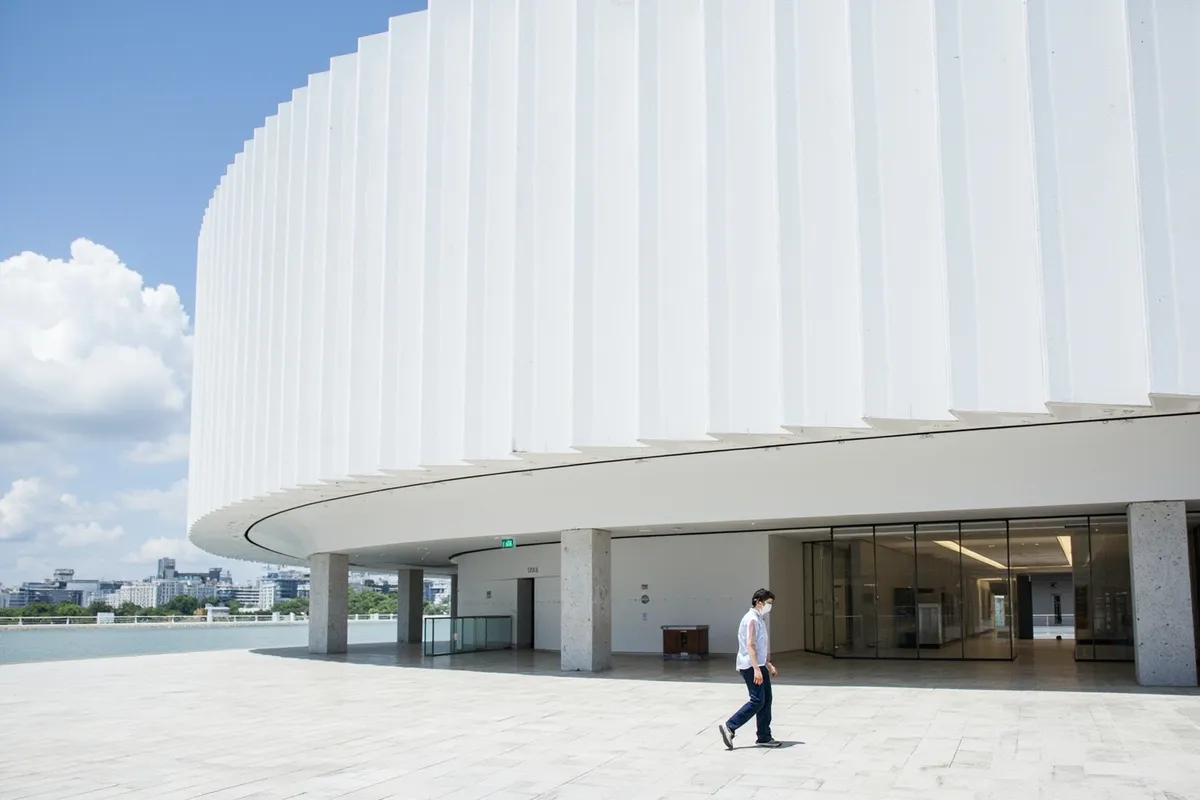
¥800 for adults gets you about 9,000 square metres of Edo and Tokyo history on floors five and six of the Edo-Tokyo Museum, reopened on 31 March 2026 after a four-year refurbishment. The permanent exhibition's food material is Edo's street trade: scale shop fronts with lanterns, the stalls where people bought their okazu outside the home. The museum is a one-minute walk from the Toei Oedo Line at Ryogoku, with a sumo arena next door. The meal format behind all this, ichiju-sansai, one soup and three sides, comes out of culinary history rather than a gallery label, and I keep the two apart on purpose.
Edo-Tokyo Museum: a reopened museum where Edo trade is on show
What the museum actually covers
The Edo-Tokyo Museum is a Tokyo Metropolitan Government museum at 1-4-1 Yokoami in Sumida-ku. It closed in April 2022 for a major renovation and reopened on 31 March 2026, so the layout you walk into now is new. The permanent exhibition occupies the fifth and sixth floors across roughly 9,000 m² and splits into the Edo Zone, the Tokyo Zone and the History of Edo-Tokyo Gallery, with the special exhibition kept separately on the first floor. The permanent exhibition page lists every section, which is worth reading before you travel.
The order is chronological. The Edo Zone runs through sections E1 to E10, the Tokyo Zone from the Meiji-era "Civilization and Enlightenment" through industrialisation, the 1923 Great Kanto earthquake, wartime air raids and the city's revival into modern Tokyo. The section that matters for food is E4, "Commerce of Edo", where scale models of Edo-period shop fronts with lanterns show the street trade that supplied a city buying much of its food out of the house.
| Floor | What is on it |
|---|---|
| 5th and 6th | Permanent exhibition, about 9,000 m²: Edo Zone (E1–E10, including E4 "Commerce of Edo" and E6 "Edo's Four Seasons and Its Entertainment Districts"), Tokyo Zone (T1–T10), History of Edo-Tokyo Gallery, Museum Laboratory |
| 1st | Special exhibition gallery, sold as a separate ticket |
Hours, closed days and how much time to allow
Doors open at 9:30 and close at 17:30, Saturdays run to 19:30, and last admission is half an hour before closing. Mondays are shut, and so is the following weekday when Monday is a national holiday, plus the year-end and New Year holidays. Four Friday evenings stretch to 20:00, on 6, 13, 20 and 27 November 2026. The late days and the holiday closures are what usually break a plan, and the opening hours page carries the current dates.
How long to allow: two hours for the permanent exhibition on my own estimate, closer to three with the special show on top. Two floors of 9,000 m² adds up to a lot of walking, and I would rather you slowed down in the Edo Zone than hurried through it.
If your Japanese is thin, the free Bloomberg Connects digital guide is the way round the galleries. Download it before you arrive rather than in the entrance hall.
Ichiju-sansai: how one soup and three sides became the standard meal
From ichiju-issai to ichiju-sansai
Ichiju-sansai describes what a normal Japanese meal is made of, one soup and three sides, and it also names the opening course of a standard kaiseki meal. Its roots sit in classical kaiseki, honzen and yushoku, so it started in court and temple kitchens rather than in the family kitchen where the format turned ordinary.
The direct ancestor was ichiju-issai, one soup and one dish, a deliberately frugal style developed at the Five Great Zen Temples in the 12th-century Kamakura period as a model of simplicity. The third side came later, when a growing city could pay for it and the trading streets could supply it. The wider culture around all this is what Washoku, the traditional Japanese diet explained covers in more depth.
Washoku was added to UNESCO's Representative List of the Intangible Cultural Heritage of Humanity on 4 December 2013, and that inscription is the label carrying most of the international interest in Japanese eating. The UNESCO record for washoku is short and worth five minutes.
One caveat before the museum part, because the promise of a title like this usually outruns the galleries: ichiju-sansai is not presented as an exhibit anywhere in the Edo-Tokyo Museum. The Edo Zone's food material is the street trade of E4. The meal format is history you read, and the museum shows you where the food came from.
The table itself: chawan, miso, okazu and tsukemono
| Term | What it is | Where it sits |
|---|---|---|
| chawan | The rice bowl | On your left |
| miso | Miso soup | On your right |
| okazu | The three side dishes | Three small plates behind the two bowls |
| tsukemono | Pickles | Served on the side, and not counted as one of the three okazu |
The traditional setting puts the chawan rice bowl on your left and the miso soup bowl on your right, with the three okazu plates behind them. Each side dish gets its own small plate or bowl, even at a family table at home, rather than the shared platters most of us are used to. Putting side dishes on top of the rice is frowned on, because the rice has to stay a bowl of rice.
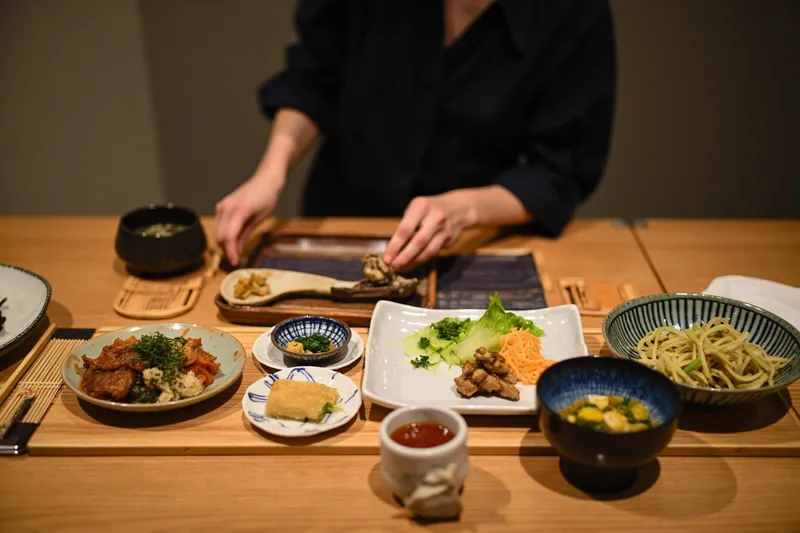
The teishoku set meal in a restaurant reproduces that layout, usually for a fraction of what kaiseki costs, and it is the version most people recognise from a train-station lunch. What counts as the Japanese diet sets the same table out in more detail.
What Edo kitchens refused, and what they borrowed
Through the Edo period, four-legged animals were treated as unclean and kept out of the diet, while whale and terrapin were permitted. The yotsuashi taboo is the label attached to this, and it explains why Edo cooking leans on the sea rather than on pork and beef.
What the same period took on board was frying. Deep frying arrived through Western nanban-ryori and Chinese cooking, and it left dishes still on the table now: tempura, aburaage and satsuma age. Sushi made without fermentation arrived at the end of the Edo period in the early 19th century, and hand-rolled nigiri was invented in the same century, which is where sushi turns from a preserved fish into something you order while you wait.
What the Edo Zone shows about food, trade and the city
E4 Commerce of Edo: the shop models that fed the city
"Commerce of Edo", section E4, is where the permanent exhibition comes closest to how Edo people ate. Its detailed scale models of Edo-period shop fronts, lanterns and all, show the street-level trade that supplied a city where households bought much of their food from other people's kitchens. Edo street food was a normal part of the day, and much of what ended up as okazu on a home table came from a shop rather than from the household hearth.
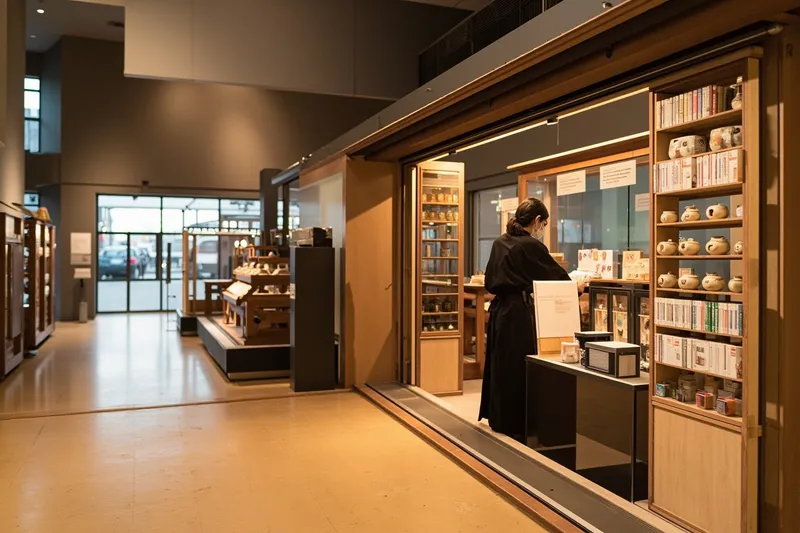
Three things I would look at while standing in front of those models: how narrow the street is at shop-front scale, which tells you how little room a stall had to work with; where the lanterns hang and who lit them; and how the goods sit at eye level, so a passer-by can read what is on sale without stopping.
The link to the home table is plain enough: small plates in the kitchen, small shops on the street, and a family eating three okazu without cooking all three from scratch.
Reading the city from the Edo Zone models
The Edo Zone is built around the city itself, so the models work as a map as well as a diorama. Section E1, "Edo Castle and the District Zones", sets the castle precinct in the middle and the rest of the city reads outward from it: wards, river, crossings, entertainment districts. The Honmaru and Ninomaru enclosures inside Edo Castle are the pieces to find if the castle is your interest, and the crossings at Nihonbashi Bridge and Ryogoku Bridge are the other half of the geography.
Look at the floor map at the entrance before you walk. The sections follow the story of Edo rather than today's street grid, so a minute with the plan saves a second lap, and it shows you where the Ryogoku Bridge model stands relative to the shops of E4.
E6 and the entertainment districts
Section E6, "Edo's Four Seasons and Its Entertainment Districts", is where Edo's eating-out culture comes into focus. Edo-period street stalls fed the theatre districts, and the pleasure quarters had a food economy of their own, with the seasons setting what was served and when. It ties back to the dinner table, because so much of what reached it was cooked by people who did it for a living rather than by the household itself.
Two reconstructions to ask about as you come through: the Nihonbashi Bridge and the kabuki front of the Nakamura-za theatre. The floor map shows where they stand, and if you only have two hours, pick your two on the map before you start walking.
Tickets: what you pay for the Edo Zone and the show
Permanent exhibition prices, groups and free entry
The permanent exhibition is ¥800 for adults. Here is the full list, with the reduced rate for groups of 20 or more alongside.
| Category | Individual | Group of 20 or more |
|---|---|---|
| Adults | ¥800 | ¥640 |
| 65 and over | ¥400 | ¥320 |
| University and vocational students | ¥480 | ¥380 |
| High school students | ¥300 | ¥240 |
| Junior high school and younger | Free | – |
Two things about what that money buys. The ¥800 covers the permanent exhibition on the fifth and sixth floors, while the special exhibition on the first floor is a separate ticket. And the museum prices in yen only, so what your card is charged in depends on the exchange rate on the day you pay. Fees do get revised, so the admission guide holds the figures that count.
Free entry exists in a few cases: a disability certificate holder comes in free along with up to two people accompanying them, with the certificate shown at the entrance, and Tokyo elementary, junior high and high school classes visit free as an educational activity arranged in advance.
Silver Day and Family Day
Silver Day is the third Wednesday of every month, when visitors aged 65 and over get into the permanent exhibition free. Third Wednesdays tend to be calmer than weekends, which is worth something on its own.
Family Day runs on the third Saturday of every month and the Sunday after it. Up to two guardians accompanying a child under 18 who lives in Tokyo pay half the adult permanent-exhibition fee. For a family, that third weekend is the date to plan around.
The Maruyama Okyo special exhibition and the combined ticket
The special exhibition on the first floor is currently Maruyama Okyo, running 28 November 2026 to 24 January 2027. The previous show, BROTHERS IN ARMS, closed on 8 November 2026, so the paintings on the ground floor now are the ones you will see. If you came for Edo streets and food, this one is optional.
| Maruyama Okyo | Same day | Advance |
|---|---|---|
| Adults | ¥2,100 | ¥1,900 |
| 65 and over | ¥1,600 | ¥1,400 |
| University students | ¥1,300 | ¥1,100 |
| High school students and younger | Free | Free |
| Group of 20 or more | ¥1,680 | – |
| Special plus permanent exhibition | ¥2,740 | ¥2,540 |
The combined ticket covers the special exhibition and the permanent exhibition on the same day. At ¥2,740 it works out at roughly three and a half times the permanent-exhibition price, so I would add it only if the show is the point of the trip.
One calendar trap: this run crosses the year-end and New Year break, when the museum closes for the holidays. The exact closed days sit on the museum calendar, so line a January visit around them.
Getting to Ryogoku and getting through the entrance
Address, stations and the walk from the platform
The address is 1-4-1 Yokoami, Sumida-ku, Tokyo 130-0015, and the museum's number is +81-3-3626-9974. From the Toei Oedo Line, use exits A3 or A4 at Ryogoku Station and you are one minute away; from JR Ryogoku Station it is about three minutes from the west exit. Both walks are short, which is the point of the location: you can have dinner near the arena and still get into the Edo Zone the same evening.
Take the train rather than the car. With the station a minute away, driving only adds the job of finding somewhere to leave it.
The sumo arena, Ryogoku Kokugikan, is next door, and the neighbourhood foot traffic changes completely on tournament days. Buy your ticket in advance on those days and walk in with the crowd rather than against it.
Where to buy, and the rules you cannot skip
No reservation is needed. Tickets are sold online through Webket, which takes Visa, Mastercard, JCB, American Express and PayPay, and at the first-floor counter, where you can pay in cash, with a transport IC card such as Suica, by credit card, electronic money or QR code. A foreign visitor is not stuck needing cash, though yen is still easier for the shops around Ryogoku.
Two rules catch people out. A bought ticket cannot be refunded and its date cannot be changed, so a wrong-day plan is a loss rather than a swap. And if you are claiming a student or 65+ rate, you need the ID with you at the door.
Guided tours are sold by third parties rather than by the museum, and the price changes with the tour and the date. If you want the subject explained in English, the food walks listed here are a different shape of thing: Arigato Travel runs guided food tours that explain everyday Japanese meals, which is the part of this story the museum only hints at.
What is next door
The confirmed anchors are the arena and the two stations. The rest are my own rough estimates from the street layout, so read them as ballpark figures rather than precise times.
| Destination | On foot | By rail | Note |
|---|---|---|---|
| Ryogoku Kokugikan | Adjacent | – | Separate tickets; busy on tournament days |
| JR Ryogoku Station | About 3 min | – | West exit |
| Toei Oedo Line Ryogoku | 1 min | – | Exits A3/A4 |
| Honjo-azumabashi | About 5 min | One stop on the Oedo Line | Two stops from there to Asakusa |
| Sumida Edo Kiriko Museum | Roughly 25 min | One stop, then a short walk | Edo-period glass; pair it with Kameido |
| Kameido Katori Shrine | Roughly 35–40 min | Three stops to Kameido | Pair the two in one trip |
| Tokyo Station | – | About 15 min by JR | A good place to end the day |
The visit in practice, and who should skip it
What you actually walk through
Roughly 9,000 m² over two floors, which means you are on your feet for most of it: Edo Zone models and reconstructed streets on one floor, the story of modern Tokyo on the other. The shop fronts of E4 are the part I would linger over, because they are the closest thing here to a scene you can walk into rather than read about.
The Edo Zone and the Tokyo Zone sit on separate floors, so on a short visit it matters which one you reach first. Go up and read the floor plan, then pick the floor that gives you the thing you came for.
The free Bloomberg Connects digital guide has the commentary in English and is the fastest way round if your Japanese is thin.
Honest drawbacks, and who should skip it
The practical drawbacks, in the order they bite:
- Closed on Mondays, on the following weekday when Monday is a national holiday, and across the year-end and New Year holidays.
- The ¥800 covers the permanent exhibition only. The special show is a separate ticket, and the combined price is ¥2,740.
- Two floors and 9,000 m² is a proper walk, not a quick hour.
- Bought tickets are neither refundable nor movable to another date, so a wrong day is a wasted ¥800.
- If you need step-free access, tactile guides or accessible toilets, call the museum on +81-3-3626-9974 before you book.
It suits families with older children who like models and dioramas, anyone tracing how Japanese food culture developed, and visitors already deep in Edo history, who will get the most out of the Edo Zone. I would skip it if you came to eat Edo food rather than to look at it, and if you need an English-guided tour, since those are extra and sold by third parties.
If the food is the real target, go and eat it: Tokyo Wasabi Tour runs market walks and sushi-making classes, and Tsukiji Outer Market is Edo street trade with a modern price tag.
Verdict: is ¥800 worth it, and when to add the show
¥800 for 9,000 m² of Edo and Tokyo is cheap for a Tokyo museum, and the food-relevant material is real if narrow: the E4 commerce models and what they imply about buying okazu outside the home. On my own two-hour estimate that is roughly ¥400 an hour, and with the museum only just reopened after four years closed, this is a one-off for most readers rather than a repeat.
Add Maruyama Okyo only if the painting is why you are coming. The combined ticket at ¥2,740 is about three and a half times the permanent-exhibition price, and you can walk the Edo Zone without paying it.
When to go: not a Monday, not the holiday weekday after one, and not through the year-end closure. The four Friday evenings running to 20:00 in November 2026 give you longer in the galleries once the daytime rush is over, and the show runs to 24 January 2027.
What to check before you travel:
- The Maruyama Okyo run crosses the year-end and New Year closure, so line a January visit around the closed days on the museum calendar.
- Fees get revised, so compare the current prices on the museum's admission guide before you buy.
- Silver Day (third Wednesday) and Family Day (third Saturday and Sunday) are the cheapest ways in.
- On a sumo tournament day the arena next door brings a crowd, so buy your ticket online ahead.
- Doing several Tokyo museums this trip? The Museum Grutto Pass venue list and the current tier price are worth a look before you buy single tickets.
Frequently asked questions
The questions that come up most often at the ticket desk and on the way in:
- Do I need to book? No reservation is needed. Buy online through Webket or at the first-floor counter on the day.
- What does ¥800 include? The permanent exhibition on floors five and six only. The special exhibition is a separate ticket, and the combined one is ¥2,740.
- How long should I allow? Two hours on my own estimate for the permanent exhibition, closer to three with the special show.
- Is there an English guide? Yes, the free Bloomberg Connects digital guide app.
- Is there parking? I would not bother with a car. Ryogoku Station is one minute away on the Toei Oedo Line and about three minutes from the JR west exit.
- Which days is it closed? Mondays, the following weekday when Monday is a national holiday, and the year-end and New Year holidays.