
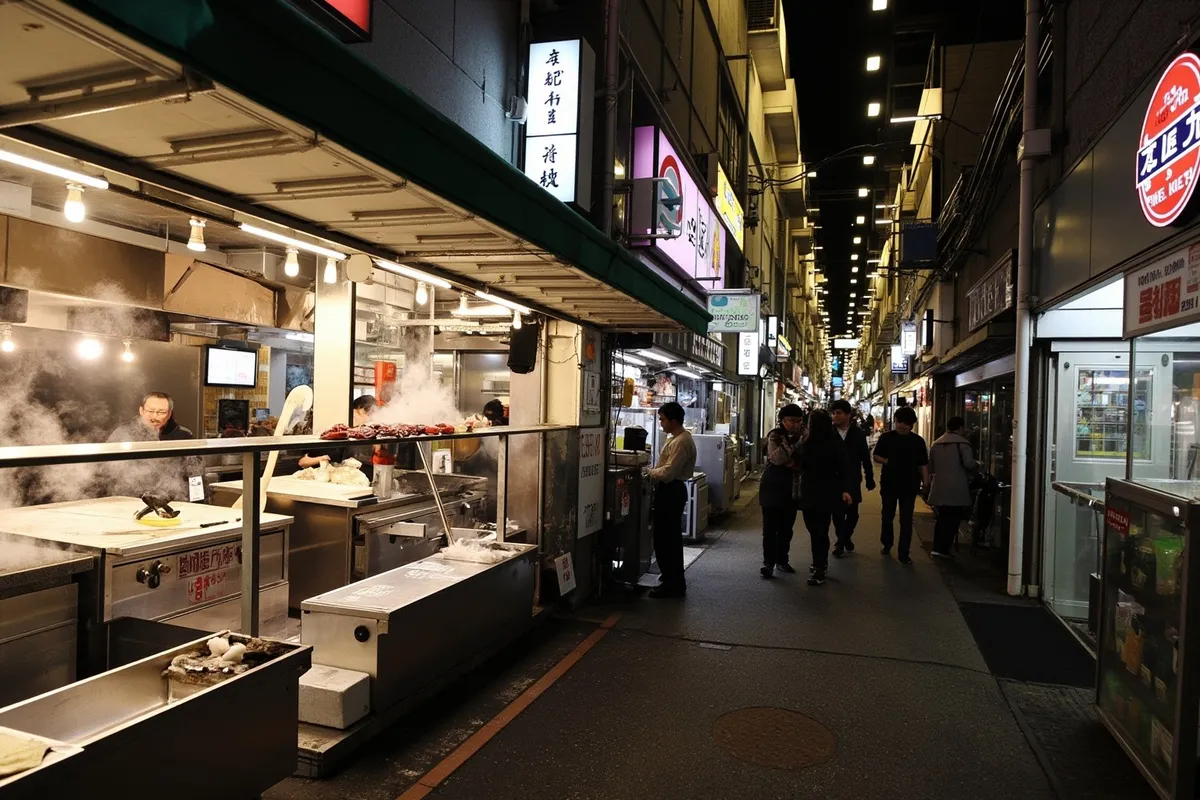
Tsukiji Outer Market food is a two-hour breakfast spread across four counters, and it works better if you know which street to start on. The lanes run on a working schedule: from 06:00 the professional buyers are in, visitors get the market from 09:00 to 14:00, and after 14:00 only the shops that chose to keep going stay open. There is no gate and no ticket; you walk in from the street and start eating.
Tsukiji itself never moved. When the tuna auction and the wholesale market shifted to Toyosu in 2018, the outer market stayed on its original blocks. What catches people out is the calendar: many shops close on Sundays and on some Wednesdays, and every stall keeps its own hours on top of the market-wide bands. The trading days sit on the market's business calendar page.
Tsukiji Outer Market opening hours: three bands and the closed days
Three bands, not one opening time
People ask for the opening time, and the market has three of them. Which band you arrive in decides whether you see a working market or a breakfast street.
| Hours | Who is in the lane | What to do |
|---|---|---|
| 06:00–09:00 | Professional buyers | Step aside and let them work |
| 09:00–14:00 | Visitors | The breakfast window |
| From 14:00 | Flexible | Only the shops and restaurants that keep going stay open |
Before 06:00 there is nothing to count on. Professional buyers work the lanes first and expect you to step aside, because they are moving crates and their rhythm is not negotiable. From 09:00 the public band opens and the stall-to-stall breakfast crowd starts to build.
Restaurants inside the seafood halls can start their breakfast sets earlier than the lane hours. I would not build a schedule around that without asking the counter that morning.
Closed days: Sundays, some Wednesdays and the calendar
Many shops shut on Sundays and on some Wednesdays, so the market on a trading day and the market on a Sunday are two different places. The lanes follow the business days of the Tokyo Central Wholesale Market, which is why closures line up with the wholesale calendar and not with a fixed weekly pattern.
Every shop keeps its own schedule on top of that. Two neighbouring egg stands can be open on different days, so a stall you read about online may be shut when you arrive. The association's annual calendar for 2026 is on the business calendar page with the PDF beside it, and when you travel later, look for the newer version.
The Plat Tsukiji information centre is the place to sort this out in person: 08:00–14:00 on weekdays and Saturdays, 10:00–14:00 on Sundays, public holidays and market closure days, and closed over the New Year period when the market around it is shut anyway.
Train, bus and car: reaching the lanes
Two metro stations put you at the edge of the market in about a minute, and a third in three minutes, which makes it easy to add a morning in Ginza.
| Station | Line | Walk to the market |
|---|---|---|
| Tsukijishijo | Toei Oedo Line | 1 minute |
| Tsukiji | Tokyo Metro Hibiya Line | 1 minute |
| Higashi-Ginza | Toei Asakusa Line and Tokyo Metro Hibiya Line | 3 minutes |
Buses cover the rest. From Tokyo Station's Marunouchi South Exit, Toei 04 (Toyomi Suisan Futo), 05-1 (Harumi Futo) and 05-2 (Tokyo Big Sight) all stop at Tsukiji-Sanchome (Tsukiji 3). From Shimbashi's Ginza Exit, Toei Gyou 10 towards TOKYO SKYTREE Sta. stops at the same place, and Shi 01 towards Toyosu-Shijo stops at Kokuritsu-Gan-Kenkyu Center. From Kinshicho, Nishiki 11 bound for Tsukiji Sta. drops you at the market.
For a map app the market sits at 35.6649 N, 139.7686 E, in the Tsukiji district of Chuo-ku.
Driving is the part I would skip. Parking details for the district are on the Japanese access page of the market's site, and the lanes are too narrow for a car, a suitcase or a stroller. Take the train and walk in.
Tsukiji Outer Market food: what the stalls actually serve
Tamagoyaki and egg snacks: the quickest first bite
Tamagoyaki is a rolled Japanese omelette, cooked in thin layers and sold by the portion, sweet or seasoned with dashi depending on the stall. It is not sushi, whatever the photographs suggest, and it is the first thing I would buy here: hot, cut into pieces you can eat straight at the counter, and cheap enough that you are not committed to a seafood order before you have seen what the day looks like.
A portion runs at roughly ¥200 by my planning and tea often comes with it, but the board in front of the stall is what you actually pay. The egg stands are also among the quickest counters to serve you on the whole market, which is why I would go there first rather than third.
One line for allergies: dashi seasoning means bonito (katsuobushi) stock, and the board will not tell you that. Ask the shopkeeper what the tamagoyaki is seasoned with before you order.
Uni, oysters and the seafood counters
Sea urchin is the headline. The standard serving is uni don, steamed rice with a nest of uni on top, and several counters serve the same rice with a small sashimi portion and miso soup, which is closer to a real Japanese breakfast than to a rice bowl.
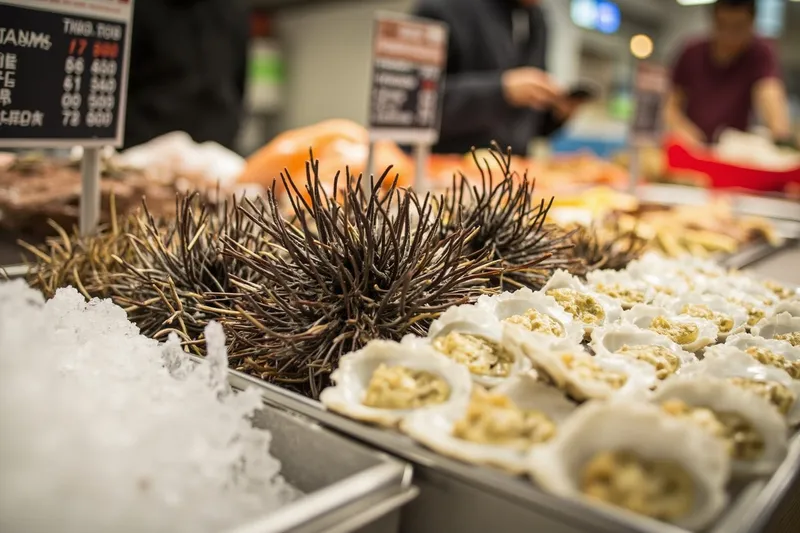
Shellfish counters along the lanes sell oysters and clams on ice, shucked in front of you or ready to cook. What you find depends on the day and the season. If uni is what you are after, the colder months are the ones to target, when the supply is larger and the bowls are richer; in the warm months the same counters lean on oysters and other shellfish instead.
On nutrition I keep to the same rule as at home: the figures that matter come from the Ministry of Health, Labour and Welfare's Japan Food Composition Tables for protein, energy and sodium per 100 g, not from a stall board. Uni and soy-marinated dishes are salty, and cholesterol or gout is a question for a doctor, not for me.
Grilled skewers, hamayaki and sushi sets at the counter
The grilled stands cook fish over charcoal at the window, and the format is simple: a skewer of scallop, prawn or a small fish, roughly ¥400 by my planning, eaten standing up. Hamayaki-style grilling takes the idea further, and on some days the market sets out a hanamachi terrace where you grill the fish you have just bought. The programme moves through the year, so I would treat it as a bonus rather than build a morning around it.
For sushi, the standing-counter nigiri set is the one worth knowing: a short run of nigiri served one after another at the counter, roughly ¥1,500 by my planning and the priciest breakfast item on my list. A kaigendon, a sashimi rice bowl, is the other common format and the easiest to eat quickly when the counters are busy.
Ask the counter what is raw and what is cooked if that matters to you, because the boards rarely say.
Tsukiji market sushi and tamagoyaki: a breakfast plan that works
A two-hour route through the market
For the best of the Tsukiji street food breakfast in one visit, the order matters more than the time you spend. This is the route I would walk.
- Egg stand near the entrance. A tamagoyaki portion, around ¥200, eaten on the spot.
- A grilled skewer. Around ¥400, and the first thing that smells like charcoal.
- One seafood dish. Uni don or the standing-counter nigiri set, depending on the queue.
- One dry-goods stall. Nori and katsuobushi for the kitchen at home.
Each stop takes ten to fifteen minutes of eating and ordering, which is my planning estimate and not a published timetable. The spread across counters is the point of the morning: several small plates, each one finished, instead of one heavy bowl.
What I would not do is split one meal across two counters. The eateries are small, seating is limited and splitting a meal during busy hours is discouraged, so eat where you buy and keep the next stop separate.
Eat at 9:30, not at 8:00: the queue window
The market's own advice is 09:00 to 14:00 as the best visiting window, and it is right. Before 09:00 the lanes belong to professional buyers, who are working and would rather you were not in the way. I would arrive around 09:00, take the egg snack while the crowd is thin, and go back for the seafood dish at about 10:00 rather than at noon.
By late morning the popular counters have real lines, and the uni and seafood stalls are where the wait forms. On weekends and holidays it can be long enough to eat your next dish first and come back.
If you already eat lightly, the hara hachi bu habit of stopping at 80% full suits this format well: small plates, and stop before you are stuffed. I wrote about what that habit actually does, and this is one of the mornings it fits without any effort.
Dashi, kombu, katsuobushi and nori to take home
The second half of the market is dry goods, and it is the part I care about as a home cook. Dried kombu for dashi, katsuobushi (dried bonito flakes) and nori sit in tubs and boxes, sold by weight or in sealed packs. My own dashi starts with exactly these two ingredients, so this is where I spend my money after breakfast, and my miso soup routine is built on the same kombu and katsuobushi.
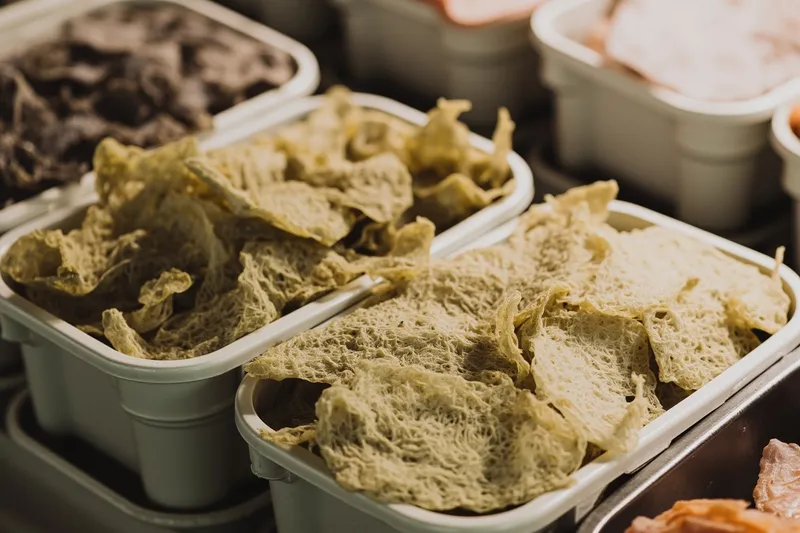
Prices depend on weight and pack size, so the number in your hand depends on what you pick up. For anything you want sent home, the shopping section of the market points to a tax-refund and delivery service that handles these orders, which beats carrying paper bags through the metro.
I would buy the small pack of katsuobushi unless I was cooking with it every day; the aroma fades faster than the packet does.
What a Tsukiji breakfast costs, and how you pay
Price bands to budget from
Here is what I would set aside for one person before the seafood splurge.
| Item | Guide price |
|---|---|
| Tamagoyaki portion | about ¥200 |
| Grilled fish skewer | about ¥400 |
| Standing-counter nigiri set | about ¥1,500 |
| Breakfast across several stalls | ¥1,500–¥3,000 |
| Fuller sushi breakfast | ¥2,000–¥5,000 |
These are planning ranges for budgeting, not a quote. The board outside each stall is the price, stalls change their boards without announcing it, and a street-food band of roughly ¥300–¥1,500 covers most single items. Seasonal items such as uni and oysters move with the supply, so the boards differ between a winter morning and a summer one.
Eat at three counters and you land in the middle of the range. Eat at one, with a seafood rice bowl, and you spend less, though you miss the part of the market that makes the trip worth it.
Cash first, cards shop by shop, and the tax-free route
There is no money-exchange counter inside the market, so get yen before you arrive and bring small notes. Most stalls take cash only and card acceptance changes from shop to shop, so ask the shopkeeper before you hand over a card.
For the tax-free route, bring your passport. Shops here take part in the Japan Tax-free Shop scheme, and for consumables the threshold is ¥5,000 before tax at one shop on one day, for travellers without Japanese residence status. The official tax-free shopping rules explain the paperwork, and the information centre will walk you through it.
There is also a shared shopping-and-meal voucher for the district, listed among the shops on the market's store list, and it is worth asking the information centre how the current version works before you spend a morning collecting receipts. IC card and ATM details vary around the district too, and the information centre is the place to ask.
Small counters, queues and where you may eat
Tsukiji's eateries are small. Seating is limited, most people eat standing or perching at the counter, and queues often form on the street outside. Expect to be looked at while you wait; that is normal here.
The market asks you to eat inside the shop or in a space set aside for eating rather than walking the lanes with food in hand. It is not snobbery, the lanes are working aisles and a bowl of uni in your elbow is genuinely awkward.
If you want a sit-down breakfast, pick a shop with seats on purpose. A full breakfast set in a standing room is a cramped way to start the day, and I would rather spend the extra time on the dry-goods side of the market.
Crowds, queues and the honest downsides
How busy it really is, and when
Between 09:00 and 14:00 the popular counters turn busy, and the busiest of them, uni and the raw seafood stalls, can have a wait long enough to talk someone out of standing in line. Weekends and public holidays are the worst. On a weekday morning the lanes are calmer, though the trade buyers are still working around you.
From about half past nine the lanes smell of charcoal smoke and dashi at the same time, and the rattle of the buyers' carts mixes with the queues. That noise is the market being a market, not a fault.
The market also runs seasonal events, an autumn festival and evening markets among them, and an evening event can push opening past the usual 14:00. The programme changes each year, so the events page on the market's site is where you see whether a night market is running on your date.
Market etiquette that changes what you get
A few rules at Tsukiji are not politeness, they are how the trade keeps working.
- Prices are fixed. Bargaining over fish or uni is not done here, so if the board says ¥800, that is the price you pay.
- Ask before you photograph. Some shops display no-photography signs, and a quick question is better than a pointed camera.
- Keep your hands off the stock. The shopkeeper checks the fish and produce for you; touching it yourself is what gets you stopped.
- Smoke only in designated areas. Street smoking is banned across Chuo-ku, and dropped butts in the lanes are the fastest way to be asked to move on.
- Tsukiji Uogashi opens to everyone after 09:00. Before that, the wholesale hall is for visitors with permission in advance.
None of it is meant to make visitors feel unwelcome. Get one of these wrong and a shopkeeper will correct you quickly, which is cheaper than guessing.
Bags, strollers, lockers and where to ask questions
Large bags go into the coin lockers, and a limited number of suitcase lockers sits near the Plat Tsukiji information centre, open 06:00–16:00. Strollers can be left at the information centre for ¥500 each, which is the easiest way to get through the crowd with a child. There is free Wi-Fi there and a toilet for wheelchair users nearby.
That same counter is where to ask anything you would rather not ask in a queue: which shop is open today, what the uni is like, how the tax-free paperwork works. Staff there give English-language help, which matters because most menu boards are Japanese only.
One structural risk: the 4-chome block of the district has been under redevelopment for some years, and stretches of the lanes around it close and shift as the work moves along. The market's news page shows what is open at the moment.
First-time visitor notes, who the market suits and the verdict
Coming from abroad: passport, customs and menus
Bring your passport for the tax-free procedure and read those rules before you spend anything, so you know which single shop to concentrate your purchases in. Spending under ¥5,000 in one place will not get you a refund, and splitting the spend across ten stalls is the classic mistake.
Fresh seafood is the hard part to bring home. Many countries restrict unprocessed fish, meat and dairy in passenger luggage, while dried kombu, katsuobushi and nori travel far more easily than fresh uni or oysters, and your own customs rules are the thing to read before you fly.
Menus are written in Japanese, with little or no English on the boards, so ordering is a pointing exercise unless someone helps. The Plat Tsukiji information centre is the place for English help, and the counters will answer questions about allergies and raw items if you ask.
Who the market suits, and who should skip it
Tsukiji suits people who want several small breakfasts in one walk, who like seafood counters, and who cook Japanese food at home and want kombu, katsuobushi and nori at market prices. The information centre gives English help and the district is small enough to cover in a morning.
Skip it, or plan it differently, if you need one large sit-down meal: seating is small, queues form outside and splitting a meal is discouraged. Come after 09:00, because before that the lanes belong to professional buyers. Do not expect a formal seafood hall or the tuna auction either, since the auction moved to Toyosu in 2018 and Tsukiji is a street of small shops. If your morning depends on one particular stall, plan around that stall's own hours.
For size, around 400 shops and restaurants are packed into these lanes. That is a rough figure, and the shop and restaurant list is where you can see who is trading before you travel.
Frequently asked questions
Is Tsukiji Outer Market open on Sundays?
Many shops close on Sundays and on some Wednesdays. The trading days follow the Tokyo Central Wholesale Market calendar, so pick your date from the market's business calendar.
Is there an entrance fee or ticket?
No gate and no ticket, you walk in from the street. Nothing to book and nothing to pay before you eat.
What time should I arrive?
Around 09:00. The market recommends 09:00–14:00 for visitors, and before 09:00 the lanes belong to professional buyers.
What should I eat first?
A tamagoyaki portion at around ¥200, then a grilled skewer at about ¥400, then a seafood dish if the queue allows.
How much does one breakfast cost?
Roughly ¥1,500–¥3,000 for one person eating at three counters. The board at the stall is the price you pay.
Can I pay by card?
It varies by shop and most stalls take cash only, so ask before you hand over a card and bring small notes.
The order I would make on a first visit
Go on a market trading day, pick the date from the business calendar, and leave Sundays and the closed Wednesdays alone. Arrive at 09:00 and eat between 09:00 and 14:00, the window the market itself recommends.
Order one egg snack, one grilled skewer and one seafood dish, each from a different counter, and budget roughly ¥1,500–¥3,000 for the lot. Keep small notes in yen. When the uni counter is deep in a queue, skip it and come back later: the dry-goods side of the market has no queue at all, and for anyone who cooks it is the better half of the morning.
Tsukiji rewards a slow morning rather than a quick stop for photographs. Come as a working street market that happens to sell breakfast well, and treat the queue, the noise and the narrow lanes as part of the price.
What to check before you go
- Pick the date from the market's business calendar: many shops close on Sundays and on some Wednesdays.
- Confirm the individual stall you want, because each shop keeps its own hours on top of the market bands.
- Read the price board at the stall before you order; prices change without notice.
- If you plan to drive, look up nearby parking on the Japanese access page of the market's site.
- See the events page for the hanamachi grilling terrace, and ask the information centre about card and ATM acceptance.