
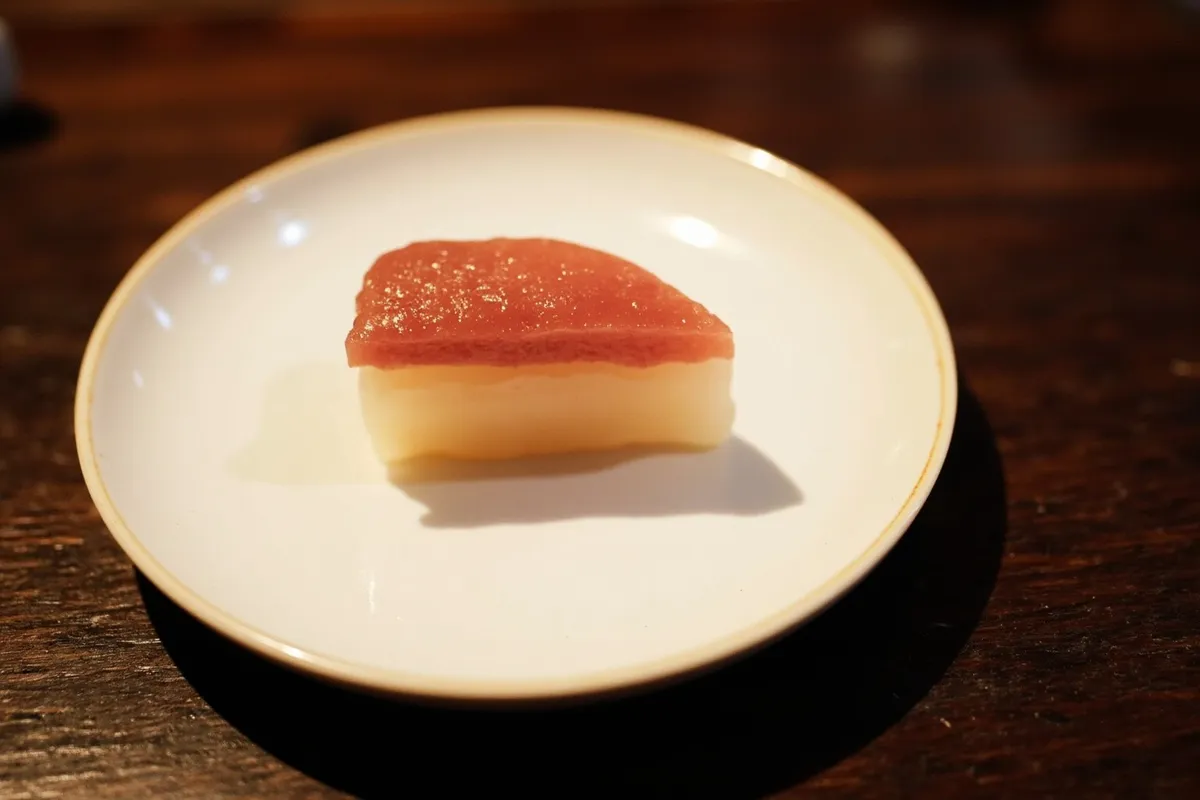
The cheapest famous sweet in Tokyo costs 324 yen: Toraya's small yōkan called Yoru no Ume, a 50 g slab of azuki and agar jelly with 148 kcal, 35 g of carbohydrate and no salt at all. That price and that size are the whole point of a Toraya counter, and the rest of this guide is built around them: what each piece weighs, what it costs, where the visit falls short.
Toraya Nihonbashi is a Japanese wagashi shop in Tokyo in the plain sense, a narrow company-run counter on Chuo-dori in Chuo-ku, three minutes from Nihonbashi Station Exit B9. It opens at 9:00 and closes at 18:00 on weekdays, 17:00 on Saturdays, and it is shut on Sundays. There is no seating, no tea and no coffee counter: you stand at the tray, choose a piece and go. Twice a year the picture changes completely, because the autumn medium yōkan Teru Momiji takes over the shelf for six weeks and the fresh wagashi (namagashi) tray turns over roughly every fortnight.
Toraya Nihonbashi: a company-run wagashi counter on Chuo-dori
Three minutes from Nihonbashi Station: address, hours and the name on the door
Toraya is an old Tokyo confectioner, and the company behind the counter is Toraya Confectionery. Across the country it runs 81 shops: 10 company-run stores (直営店), 71 reseller counters, 8 airport outlets and 12 with a Toraya cafe and tea lounge (虎屋菓寮・喫茶). The Nihonbashi shop is one of the ten the company runs itself, and the only one of the ten with no café attached, which decides the shape of the visit: there is nowhere to sit down with matcha here.
The shop traces back to the café Mikaku (みかく), opened in 1946 and reopened as this Nihonbashi counter in 1948. None of that is on show, but the address, the hours and the phone number all sit on Toraya's store page, and they are worth keeping to hand before you set out.
- Address: 1-2-6 Nihonbashi, Chuo-ku, Tokyo
- Hours: 9:00–18:00 weekdays; 9:00–17:00 Saturdays and public holidays
- Closed: Sundays and 1 January
- Station: Nihonbashi, Tokyo Metro Ginza Line and Tozai Line, Exit B9, three minutes on foot
- Telephone: 03-3271-8856
- Price from: ¥324 (US$2.03) for one small yōkan
- Seating: none, a standing counter with no café
- Seasonal window: Teru Momiji on sale 21 October to around mid-November
Getting there: the station, the street and the landmarks around it
Chuo-dori is the wide shopping street between Mitsukoshi Nihonbashi and Takashimaya S.C., and the Toraya counter faces onto it. Up from Nihonbashi Station at Exit B9, on the Ginza and Tozai lines, you are three minutes away and never long out of sight of the shop. Tokyo Station on the Yaesu side is a ten to fifteen minute walk, or one stop on the Ginza Line to Kyobashi and a short walk from there.
There is no car park attached to the shop. If you drive, use one of the coin garages around the station and walk the last few minutes. The telephone number, 03-3271-8856, is the one to ring if you want a taxi brought back to the door; from a phone that hides your number, dial 186 first.
| From | Walking time | What the figure is |
|---|---|---|
| Nihonbashi Station, Exit B9 | 3 min | stated by Toraya |
| Mitsukoshi Nihonbashi | about 1 min | rough estimate |
| Takashimaya S.C. | about 7 min | rough estimate |
| Daimaru Tokyo | about 9 min | rough estimate |
| Coredo Muromachi, Toei Asakusa Line | about 6 min | rough estimate |
| Nihonbashi riverbank | about 6 min | rough estimate |
| Tokyo Station, Yaesu side | 10–15 min on foot, or one Ginza Line stop to Kyobashi | rough estimate |
Only the three minutes from Exit B9 is a stated figure; the rest are rough estimates, so treat them as guidance rather than measurement. In heavy rain, the station concourse and the Coredo Muromachi passage make more sense than the open street. If a step-free entrance matters to you, ring the shop before you travel.
Hours, closed days and how the counter refills
Open 9 to 6 on weekdays, closed on Sundays and 1 January
Toraya keeps longer hours than most Tokyo confectionery counters, and the week is simple enough to plan a trip around: nine in the morning every day except Sunday, six in the evening on weekdays, five on Saturdays and public holidays.
| Monday to Friday | 9:00–18:00 |
| Saturday and public holidays | 9:00–17:00 |
| Sunday, 1 January | closed |
Nothing here is sold to order. The counter works from trays, and when a tray empties it empties. Fresh wagashi in particular goes early in the day, so if one particular piece is the reason for your trip, arrive before lunch and buy it first.
Fresh wagashi changes roughly every half month: why a visit can find an empty tray
Namagashi, the fresh sweets made to be eaten within a day or two, is sold over the counter only, in limited quantities released at set times. The selection turns over about every half month, which makes this a shop with a wagashi calendar rather than a fixed menu, and the middle of a half month is when the trays are fullest.
The counter list moves in calendar steps. Inoko-mochi (亥の子餅) sits on it, and from 16 November the list swaps in apple-shaped white an (林檎形白餡入), kikunoka (菊の香小倉餡入), awajigata (淡路潟御膳餡入) and kono-ma-no-nishiki (木の間の錦白飴餡入). A few items are limited to the Kanto and Kansai regions, among them kudamono-an (竜田の里), mikan-mochi (蜜柑餅) and the autumn-colours assortment (秋の彩), and they are stocked at this Tokyo counter.
- Inoko-mochi (亥の子餅)
- Apple-shaped white an (林檎形白餡入), from 16 November
- Kikunoka (菊の香小倉餡入), from 16 November, Kanto and Kansai limited
- Awajigata (淡路潟御膳餡入), from 16 November, Kanto and Kansai limited
- Kono-ma-no-nishiki (木の間の錦白飴餡入), from 16 November
- Kudamono-an (竜田の里), mikan-mochi (蜜柑餅) and autumn-colours wagashi (秋の彩), Kanto and Kansai limited
The list moves on, so look at Toraya's fresh-wagashi page before you travel and expect the tray to have changed by the time you arrive.
What to buy: yokan, monaka and an-paste
Yokan as the anchor: Yoru no Ume all year, Teru Momiji in autumn
Two yōkan do most of the work here. Yoru no Ume is the small one: 50 g, roughly 7.9 × 2.8 × 2.0 cm, a finger-length slab of sweet red-bean jelly that Toraya has been making since 1819. One piece is 148 kcal with 35 g of carbohydrate, 2 g of protein, no fat and no salt. It is sold in every Toraya shop all year, and the shelf price is 324 yen with tax included.
Teru Momiji is the seasonal one: a medium 330 g yōkan, 360 g in the box, first made in 1989 and on sale from 21 October until around mid-November. Per 100 g it is 283 kcal, 67 g of carbohydrate, 4 g of protein, no fat and no salt, so a whole piece comes to about 934 kcal. That is a pudding rather than a snack, and it is the one item people queue for.
Both are set with kanten agar: Yoru no Ume lists sugar, azuki beans and agar, with sugar first. Teru Momiji cannot be shipped abroad, and the single 50 g Yoru no Ume piece is sold in the shop rather than online, so this counter is the only place to buy either of them as a single serving.
The counter range in plain words: monaka, higashi, an-paste, mizu-yokan, natsukan
Under yōkan sits a family of bean and starch sweets whose names get confusing fast. A monaka is a thin wafer shell filled with an-paste. Higashi is the denser, oven-baked branch of the range. An-paste is the paste on its own. Mizu-yokan is a firm agar jelly without beans. Natsukan is the summer apricot version of yōkan.
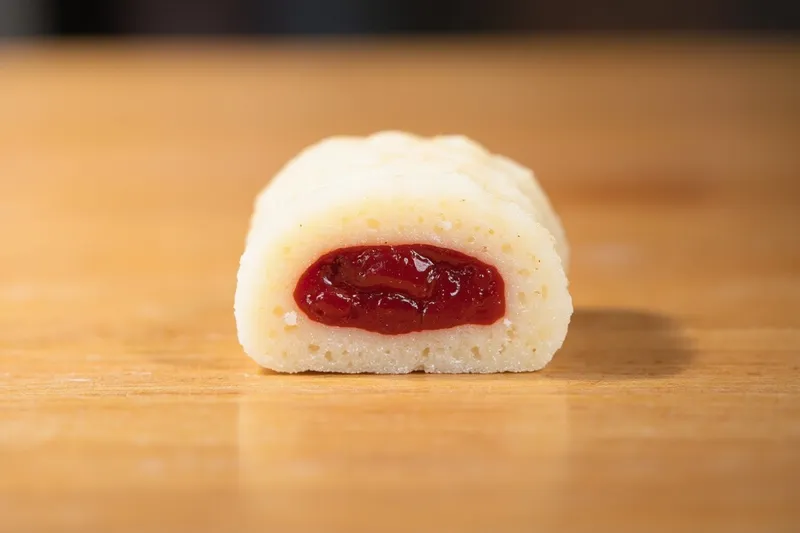
- Monaka – a thin shell with red or white azuki paste; the sakura monaka “Miyono no Haru” comes in both, and “Yasaka” is the everyday 30 g version
- Higashi, baked wagashi – oven-baked and sturdy enough for a warm day; “Zangetsu” at 47 g is the ginger one
- An-paste (anko) – bean paste as a sweet on its own; koshian is the smooth style, kogara-an the coarse one
- An-mitsu – an-paste set with agar and syrup
- Mizu-yokan – a firm agar jelly sweetened only with sugar, no beans; “Gozen” is the 55 g one
- Natsukan – the apricot yōkan of the warm months, “momo” at 50 g
Allergens differ from product to product, so read the label rather than the shelf. The baked Zangetsu contains wheat and egg, and Toraya's ingredient lists are where to look before you buy something specific.
Prices by season and what the money buys
Price table: from a US$2 sweet to a US$36 gift box, and the four-season calendar
If you want to buy traditional Japanese sweets, budget per piece, because the spread is wide. Every shelf price is the tax-included retail price, and the gift boxes add the box and its wrapping, so nothing else is due at the till. Dollar figures move with the yen; the yen on the shelf is the real price. There is no drink to add, since this counter has no café.
| Item | What it is | Size as sold | Yen, tax included | USD | Where you buy it |
|---|---|---|---|---|---|
| Yoru no Ume | small yōkan | 50 g | ¥324 | US$2.03 | shop counter, single piece, all year |
| Teru Momiji | seasonal limited yōkan | 330 g, 360 g boxed | ¥2,160 | US$13.57 | shop only, 21 Oct to mid-Nov |
| Gift box | 7 small yōkan | 7 × 50 g | ¥2,300 | US$14.44 | online store |
| Gift box | 3 medium yōkan, Toraya's standard medium | – | ¥4,400 | US$27.63 | online store |
| Gift box | 2 large yōkan | – | ¥5,800 | US$36.42 | online store |
| Gift box | 3 an-paste | – | ¥3,300 | US$20.72 | online store |
Most visits end with one to three pieces, roughly US$2 to US$14, or with a gift box from ¥2,300 for an omiyage souvenir gift. The three-medium-yōkan box is Toraya's standard medium yōkan, not the autumn Teru Momiji, which stays in the shop.
- Spring: sakura monaka “Miyono no Haru”, in red or white azuki paste
- Summer: apricot natsukan “momo”, 50 g
- Autumn: Teru Momiji, 21 October to around mid-November
- Winter: hot o-shiruko “Gozen”, sweet white bean soup with mochi
Calories and carbohydrate per piece: which sweets work as a light snack
Toraya publishes a nutrition table for its products, and for anyone counting it is the most useful thing on the site. Read the figures per piece as sold rather than per 100 g and the range is surprisingly wide, from a 17 kcal dry sweet to a 276 kcal bowl of o-shiruko that behaves more like a drink.
| Item | Serving as sold | kcal | Protein g | Fat g | Carbohydrate g | Salt g |
|---|---|---|---|---|---|---|
| Suiko (推古), dry sweet | per piece | 17 | – | – | 4 | – |
| An-paste koshian | 20 g portion | 51 | – | – | 11 | – |
| Monaka “Yasaka” | 30 g | 90 | – | – | 21 | – |
| Monaka “Miyono no Haru”, white an | 30 g | 91 | – | – | 21 | – |
| Monaka “Miyono no Haru”, red an | 30 g | 92 | – | – | 21 | – |
| Natsukan “momo” | 50 g | 92 | – | – | 23 | – |
| Soft yōkan “Yururuka matcha” | 55 g | 129 | – | – | 29 | – |
| Mizu-yōkan “Gozen” | 55 g | 130 | – | – | 31 | – |
| Yoru no Ume, small yōkan | 50 g | 148 | 2 | 0 | 35 | 0 |
| Baked “Zangetsu” | 47 g | 152 | 3 | 1 | 34 | – |
| O-shiruko “Gozen”, winter | 170 g with 20 g mochi | 276 | – | – | 64 | – |
| Teru Momiji, seasonal yōkan | per 100 g | 283 | 4 | 0 | 67 | 0 |
| Yoru no Ume, medium yōkan | per 100 g | 296 | – | – | 70 | – |
A dash marks a figure the table leaves blank. One 330 g piece of Teru Momiji comes to about 934 kcal, worked out from the per-100 g line rather than printed on the pack. The table covers Toraya's range as a company, and the counter at any single shop is narrower than that.
And the honest note for anyone watching their intake: carbohydrate dominates every line here. The case for a wagashi as a light snack rests on the portion, one 50 g piece at 148 kcal, together with zero salt and no trans fats. Low sugar is not part of the argument. The discipline behind that portioning is the one described in the [traditional Japanese diet](/washoku/).
How to buy, and what happens to the box afterwards
Four ways to buy, and what each one gives you
There are four ways in, and they do not give you the same thing. The walk-in counter at Nihonbashi is the only place with the full fresh range, single pieces and the seasonal yōkan. Toraya's English online store sells gift assortments only, boxes of small, medium and large yōkan and boxes of an-paste, and it ships internationally, with the destination countries, cost and window on its delivery page. The seasonal Teru Momiji is not among them.
- Counter at Nihonbashi – the full fresh range, single pieces and the seasonal yōkan
- Toraya's online store – gift boxes only, international delivery, no Teru Momiji
- Toraya counters in Mitsukoshi Nihonbashi, Takashimaya S.C. and Daimaru Tokyo – the same brand in a department-store food hall, with a different assortment, different prices and a different atmosphere; the [Mitsukoshi Nihonbashi depachika guide](/ginza-mitsukoshi-depachika-guide/) covers that side of the street
- Other Toraya shops in Tokyo – 33 of the group's 81 shops are in the capital, and some of them have a cafe and tea lounge, unlike this one
For a single sweet or the seasonal piece, the shop is the only channel. For a gift that has to travel, an online box is simpler than anything you can assemble on a pavement.
Shelf life, storage and paying at the counter
Shelf life is generous, which helps when you are buying for someone else. Small yōkan Yoru no Ume keeps a year from production and about eight months from the moment it reaches the shop; the seasonal Teru Momiji keeps 140 days from production and about 95 days from arrival. Even so, treat the box as food rather than as a souvenir that can sit in a warm bag: keep it cool and out of direct sun until you cut into it.
On payment, cashless payment is reported to work here, with PayPay and takeout both mentioned by visitors, but I would still carry yen rather than count on a foreign bank card. If a box arrives damaged or past its date, the counter sorts it out, and the online store handles returns on its own terms, so keep the order number.
What visitors actually experience
What map listings keep mentioning, and what they dislike
The review trail for this shop is short and the platforms do not agree with each other about the same shop, so the themes are worth more than the scores. The praise is consistent: the seasonal limited yōkan is sold here rather than at the airport counters, the range is broad for a specialist of this size, the staff are friendly, and the department-store location makes it easy to pair with a shopping trip. Fresh wagashi on the counter gets mentioned as a reason to come in.
- Kept coming up: the seasonal limited yōkan sold here and not at the airport counters; a broad range for a specialist; friendly staff; fresh wagashi on the counter; the location next to the department stores
- Kept criticising: the queue at the main counter; nothing to sit with, no seating, no tea, no café
A separate TORAYA AN STAND has been reported at the entrance, and when it is not running, everyone queues at the main counter instead. That is the structural reason a visit can take longer than the walk from the station suggests.
A small standing counter, a busy street and the Saturday queue
Expect a compact ground-floor counter with Chuo-dori foot traffic outside, department-store shoppers drifting in, and no seating at all. The Nihonbashi shop is the only company-run branch without a Toraya cafe and tea lounge, so every visit is a standing one and the trays are cleared as people buy. Fresh wagashi comes out in limited quantities at set times, so an early arrival helps, and on a Saturday with a seasonal release a queue at the main counter is the reported reality. I would allow 20 to 40 minutes for the whole stop, shopping included.
On a Saturday, buy in two rounds. The seasonal yōkan first, since it is the piece most likely to run out, and the fresh wagashi after, because trays are released at set times through the day.
Who should come, who should skip it, and the verdict
Good fits, poor fits and the closer alternatives
Toraya suits people who want one thing done properly and quickly, and it does not suit anyone shopping for a sit-down tea break. Azuki beans are an everyday part of the Japanese plate rather than a miracle food, and this counter treats them that way, in small precise portions. The [Japanese diet and longevity](/japanese-diet-and-longevity/) piece covers how that pattern is usually explained.
- Worth it if you want a specialist yōkan counter with fresh namagashi and one autumn release; you arrive by metro with half an hour to spare; you eat sweets in small pieces and care about portioning and salt; you want both the classic small yōkan and the autumn medium one in the same trip
- Skip it if you want to sit down with matcha, since this branch has no café and the [matcha ceremony stop in west Tokyo](/camellia-garden-matcha-ceremony/) is what that day is for; you want a photo-first display; you need a cheap souvenir you can mail on the spot, because Teru Momiji stays in Japan
- Alternatives nearby Eitakuya Nihonbashi, Usagiya and Nihonbashi Ichaya are all a short walk away; Toraya's own counters inside Mitsukoshi, Takashimaya S.C. and Daimaru carry the same brand with a different assortment, and other Toraya branches elsewhere in Tokyo do have a cafe and tea lounge
Verdict: a short, precise stop, and what to plan around
My verdict: worth 30 minutes and about US$2 to US$14, no more. One small Yoru no Ume all year, one Teru Momiji in autumn, a fresh tray that turns over every fortnight, no seating, and no queue on an ordinary weekday. Go mid month on a weekday morning, buy two small pieces, and leave the gift boxes alone unless you are mailing them.
- Is there seating or matcha? No. Nihonbashi is the only company-run Toraya shop without a cafe and tea lounge, so it is a standing counter.
- Can I order Teru Momiji online? No. It stays in Japan and goes on sale in the shop from 21 October to around mid-November. The 50 g Yoru no Ume is sold online only inside gift boxes, so single pieces are bought in the shop.
- What is the cheapest thing here? The 50 g Yoru no Ume at ¥324, about US$2.03, with 148 kcal and 0 g of salt.
- Can I pay by card? PayPay and takeout are reported to work, but I would not count on a foreign bank card. Bring yen and ask at the till.
- Is there a queue? On busy days, yes. Fresh wagashi is released in limited quantities at set times, so an early arrival shortens the wait.
Before you travel
- Check the store page for the hours on the day you plan to go: Sunday and 1 January are dark, and Saturdays close an hour earlier.
- Check the fresh-wagashi page for the tray that is running, since the list changes about every half month.
- Read the shelf tags for the pieces not listed here, and ask the staff about allergens per product.
- Decide in advance whether Teru Momiji is worth about 934 kcal in one sitting; it cannot be shipped, so there is no second chance.
- Bring cash. PayPay and takeout are reported to work, but not every foreign card is guaranteed.