
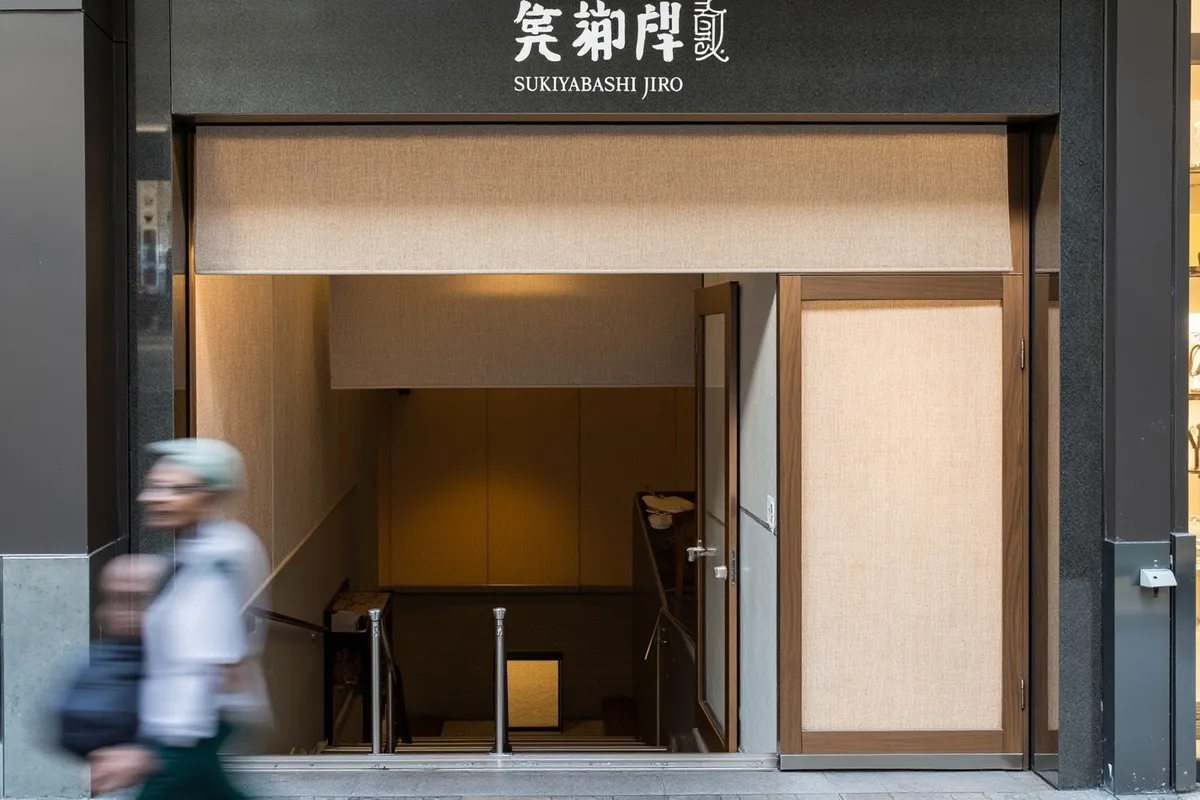
The cheapest honest way into Sukiyabashi Jiro is a phone call, and the meal starts at ¥88,000 including tax – the chef's recommended course of about 20 pieces of nigiri, served one at a time. There is no online booking for the Ginza counter and no release day, so a Sukiyabashi Jiro reservation has to be solved with a call and a good deal of luck. The counter is on the basement floor of the Tsukamoto Sogyo Building, 4-2-15 Ginza, and it has been in the same basement since 1965.
Guests from outside Japan are asked to book through the concierge of the hotel they are staying in, and the booking has to be in the name of the person who will actually eat. Photo ID – a passport or a residence card – is checked at the door, and cancelling inside seven days costs ¥44,000. Those three rules decide most of the planning, and they run through everything below: which line to call, what to hand the concierge, what the course covers, and how long the walk from Ginza Station is.
| Address | Ginza honten, B1F, Tsukamoto Sogyo Building, 4-2-15 Ginza, Chuo-ku, Tokyo |
| Service | Lunch 11:30–14:00, dinner 17:30–20:30 |
| Closed | Sundays, public holidays, Saturday evenings, mid-August, New Year period |
| Course price | ¥88,000 incl. tax, from – about US$580 at ¥150 to the dollar |
| Booking | Telephone only; overseas guests via hotel concierge; no online booking |
| Phone | +81-3-3535-3600, answered in Japanese |
| On arrival | Photo ID: passport or residence card |
| Cancellation | ¥44,000 incl. tax from 7 days before the booking date |
Two things the box does not settle. The entrance is downstairs from the Ginza street door, so if parking or step-free access matters to you, ask your hotel before you commit to a date. And the ¥88,000 is the published starting price, not the bill you will pay.
The Ginza honten: one basement, one format
Where the counter sits and what the service is
You come down from the Ginza street entrance into the basement of the Tsukamoto Sogyo Building. This is the original shop: Sukiyabashi Jiro opened in 1965 in this basement and has stayed in it. Service happens at the counter, with the chef working in front of you, and the pieces arrive one at a time in an order you do not pick. It is the same short counter-menu format that people place it alongside Sushi Saito and Sushi Yoshitake for, where a short menu is the point rather than a limitation.
The one physical change the restaurant has made public is air purification, with high-performance units installed as an infection-control measure. Everything else that draws people here comes from the film: Jiro Dreams of Sushi filmed this basement in 2011, and Sukiyabashi Jiro is the first name that comes up when people ask for the best sushi counter in Tokyo. Handy for explaining the fuss, unhelpful for managing expectations.
What the omakase course is, piece by piece
About 20 pieces of nigiri, and this is Jiro sushi in its Edomae form: neta on shari, the vinegared rice, served one at a time in the kitchen's order, with tamago and a bowl of soup alongside the fish. There is no à la carte list, and the course runs more like a set meal than a long dinner – lunch has a two-and-a-half-hour window, dinner three.
Allergies are the part I would not leave to the day itself. The kitchen decides what arrives, so tell the concierge before the booking and ask for the answer in writing, before you take on the ¥44,000 cancellation exposure rather than after. A vague answer is a no, and nobody should walk into a ¥88,000 dinner on a vague answer.
The house rules behind the counter
Four rules catch out people who booked from abroad, and all four come from the restaurant rather than from a travel blog's guesswork:
- Photo ID on arrival: a passport or residence card, shown at the door.
- The booking name has to match that ID exactly.
- The booking must be made by the person who will dine – proxy and third-party bookings are refused.
- Be on time: the restaurant warns that guests from overseas may not be able to arrive at the date and time they booked.
The restaurant may also ring to check a booking, so keep your phone on between the call and the meal. And because proxy bookings are refused, the person who will dine is also the person who has to be reachable when that phone rings.
How to get a seat at Sukiyabashi Jiro: the phone and the concierge
No online booking, no release day
Booking online is a dead end here. No platform sells these seats, and the Ginza main shop has no release day, so the usual trick of watching a booking site for a midnight drop does not exist. The line is +81-3-3535-3600 and it is answered in Japanese only, so either you can hold that conversation or your concierge makes the call for you.
The restaurant asks callers to ring outside business hours, which is worth taking literally – in the middle of the working day the line is busy, and off-hours calls have a better chance of reaching whoever can actually look at the diary. The shop page carries the address, the service windows and the number; check both before you dial, and read the course price on the official menu page.
Booking through your hotel concierge: what to hand them
The rule people misread most often: guests from outside Japan can only book through the concierge of the hotel they are staying in, and yet the booking must be made by the person who will dine, in that person's own name. The concierge is the channel, not the client. For two people, both names and both document details go in, and each guest is checked at the door.
Five steps, in the order I would do them:
- Pick lunch or dinner and a date that survives the closure list – Sundays, public holidays, Saturday evenings, mid-August and the New Year are out.
- Write out the request block below and give it to the concierge complete.
- Ask the concierge to place the call and to request a call-back to confirm the booking.
- Stay reachable by phone between the call and the meal.
- Keep the name exactly as it appears in your passport or residence card, word order and all.
What to send in one block:
- full name exactly as printed in the passport
- passport or residence card number and date of birth
- nationality
- hotel name and address
- a phone number for daytime contact
- lunch or dinner, preferred date and time
- allergies, with a request for a written answer
- name and ID details for a second guest, if any
- a request that the restaurant confirm the booking to you directly
Then the risk in plain terms: identity that cannot be verified at the door can be refused entry, and the restaurant warns that guests from overseas may not make their booked slot – visa delays and tight flight connections are your problem, not theirs. Leave a same-day buffer, never slot a booking straight onto a landing, and plan to be early rather than hoping for a grace period.
Lunch or dinner, and the days the counter is dark
Service runs 11:30–14:00 for lunch and 17:30–20:30 for dinner. Dinner is Monday to Friday, Saturday lunch varies, and there is no Saturday dinner – so a booking is either a short lunch seat or an early evening seat with a fixed end.
| Service | Window | Days |
| Lunch | 11:30–14:00 | Monday–Friday; Saturday lunch varies |
| Dinner | 17:30–20:30 | Monday–Friday; no Saturday dinner |
Closed on Sundays, public holidays, Saturday evenings, mid-August and the New Year period. Over the turn of the year the shop gives exact dates – this time Sunday 27 December to Wednesday 6 January – and the same weeks go dark every year with the dates following the calendar, so re-read the restaurant's English site before travelling across that period.
| Booking rule | What it means for you |
| Overseas guests | Book through the concierge of the hotel where you are staying |
| Phone | +81-3-3535-3600, answered in Japanese only |
| Online booking / release day | None – no platform sells these seats |
| Whose name | The person who will dine, one booking per guest |
| On arrival | Photo ID: passport or residence card |
| Timing | On time – overseas guests may not make the booked slot |
| Cancellation | ¥44,000 incl. tax from seven days before the booking date |
| Closed | Sundays, public holidays, Saturday evenings, mid-August, New Year period |
Ginza omakase sushi price: what the course covers and what adds on
The published from-price and what it covers
The chef's recommended course is ¥88,000 including tax and comes to about 20 pieces of nigiri – the figure on the official menu page, and the number to budget from. At ¥150 to the dollar it is roughly US$580; the yen figure is the fixed one, the dollar moves with the rate.
Inside the price: around 20 pieces of nigiri, the tamago and the soup, served one at a time in the kitchen's order. Outside it: drinks. Beer and Japanese sake are listed separately and paid for as extras, and there is no à la carte ordering on top of the course. One more thing to keep in your head – ¥88,000 is a floor rather than a bill, because the final amount moves with what the kitchen buys that day.
Drinks, payment and the cancellation charge
Beer and sake sit outside the course price as separate lines, so budget them as extras. Cards are welcome: MASTER, VISA, American Express, Diners and JCB, which means a foreign card is fine and you need not think about cash for the bill.
The cancellation charge is the number that hurts most: ¥44,000 including tax, applying from seven days before the booking date – roughly US$293 at ¥150 to the dollar. It is a flat sum, not a percentage of the course, which makes the seven-day mark the real point of no return. If the booking is worth ¥44,000 of regret, settle the date before you settle the flights.
How to price it before you travel
The restaurant reviews prices when raw material and rent costs move, and the figure can be revised without much notice. So: read the live price on the menu page, have the concierge confirm the current course price before you take on the ¥44,000 cancellation charge, and re-check the page in the week you travel. One figure to plan around – the same course runs in high and low season – and the closure weeks are the only real seasonal difference in the calendar.
The meal itself and the room
Pace, sound and what actually arrives
What the format fixes is the shape of the meal: the chef works in front of you, pieces arrive one at a time in the kitchen's order, and service has a hard stop. Lunch runs 11:30–14:00, dinner 17:30–20:30. The only thing you control is when you sit down.
What arrives is Edomae sushi stripped to the bone – neta on shari, roughly twenty pieces, with the tamago and the soup as the rest of the cast. Twenty pieces plus a bowl of soup is not a large amount of food; this is a tasting run, and anyone expecting a full dinner will feel short-changed by the volume. I expect the tamago and the rice to be the pieces you remember afterwards.
This is not a long relaxed dinner: plan the evening around it, eat at your slot, then find a bar with no fixed closing time. The most famous guest this counter has had was Barack Obama, who ate here in 2014 during a visit to Japan – the film had already made the room famous long before that.
Where the friction actually is
The friction in booking this place is procedural, and the restaurant sets every step of it: a line answered in Japanese only, concierge-only booking for guests from abroad, bookings in the diner's own name, a photo ID check at the door, a fixed service window and a ¥44,000 cancellation charge from seven days out. Any one of those can cost you the seat – a name that does not match the passport, ten minutes late, a visa that slipped.
Once you are at the counter, the meal is the easy part: you sit, the chef sends, you eat. Recent guest notes on Tabelog, Google Maps and Tripadvisor are worth a look beforehand, since the card changes with the season – read them for the food, not for the booking rules, because those are the same for everyone.
Getting to 4-2-15 Ginza: transport, the walk and parking
Address, entrance and where to leave a car
The address is 4-2-15 Ginza, Chuo-ku: the Tsukamoto Sogyo Building on Ginza's main street, with the restaurant on the basement floor, so you go in from the street and down. The Roppongi Hills branch is a different shop at a different address, and a booking there does not put you at this counter.
Central Ginza is a bad place to park: heavy traffic, and the nearby garages cost roughly what a taxi ride would. For a fixed seat time, a taxi is the sensible answer – drop at the building's street entrance, walk in, go down. If you do drive, ask the hotel for the nearest multi-storey garage and how to get from it to the door, since the entrance is downstairs and I would not want you finding out about steps or a lift on the day.
Walking times from the nearest stations
Everything is close, but Ginza's underground routes make the real walk longer than the straight line: the concourses are wide and the exits spread out. Treat these as a guide and check them in a map app on the day, especially if you have a seat time to reach.
| From | Lines | Walk | Note |
| Ginza Station | Marunouchi, Ginza, Hibiya | about 5 min | closest stop; allow extra inside the concourse |
| Higashi-Ginza | Hibiya, Toei Asakusa | about 7 min | quieter than Ginza |
| Tsukiji / market | Hibiya, Oedo | about 15 min | combines with a market walk |
| Tokyo Station | Marunouchi, Yurakucho | about 15 min | taxi in a few minutes |
| Shinbashi | Yurakucho, Asakusa | about 15 min | handy for hotels in that cluster |
Aim for the exit that puts you on Ginza's main street rather than wandering underground, and remember the service ends on the dot – if you are staying near Tokyo Station and want a cheaper, faster lunch instead, the basement food hall at Yurakucho Marui is the easy option.
The Roppongi Hills branch is a different shop
Jiro International runs a second shop at Roppongi Hills: 6-12-2 Roppongi, Minato-ku, Residence B Building, 3F. Its hours are 11:30–14:00 and 17:00–21:00, it is closed on Wednesdays, and the number is +81-3-5413-6626. It has its own address, hours and telephone line, so a seat there is not a seat at the Ginza counter – treat it as a separate booking request, not a substitute.
If the Ginza call never lands, this is the same family and worth a second call through your concierge, on its own number and with its own dates. Both branch details are on the restaurant's shop list; check there that the branch is taking bookings on the dates you want before you rebuild your evening around it.
Who should book, and who should skip it
The case for going
Two reasons I would spend the money. The first is the food: an Edomae counter course with the chef working in front of you is a category of meal you cannot reproduce at home, whatever you manage with supermarket fish and a good knife. The second is the occasion – a short, fixed format is a good last night in Tokyo.
Both are conditional. The budget is the from-price plus drinks, and the booking is a Japanese-language phone call through a hotel concierge that may or may not land. The film also raises expectations the room itself never promised, so decide which one you are buying: the food or the story.
Honest downsides
The money, first. ¥88,000 is the starting price rather than the total, the drinks are on top, and the final amount moves with the day's purchases. The cancellation charge of ¥44,000 from seven days out means the last week is where a change of plan costs the most.
The effort, second. Five separate rules stand between you and the counter: a Japanese-only line, concierge-only booking from abroad, your own name on the booking, a photo ID check at the door and being exactly on time. Add a basement entrance and a hard stop on service, and this is not a restaurant you drop into on a spare evening.
And one mix-up to avoid: Sushi Nakazawa in New York is not a branch of this restaurant and has no connection to it, however many lists put the two together.
If the Ginza seat does not happen
The Roppongi Hills branch is the first call – same family, its own number, a genuinely separate booking.
Beyond that, names circulate as "Jiro school" counters in Tokyo, and the lists disagree with each other about spellings and neighbourhoods. I am not going to send you to one on a guess: ask your concierge for the current list, then check each name against that restaurant's own page before you commit. A wrong address at the wrong counter is a wasted evening.
If money or booking effort is the real blocker rather than taste, spend it elsewhere: Sushi Zanmai Honten in Tsukiji does good sushi without the hunt, and a walk through Tsukiji Outer Market teaches you the ingredients for a fraction of the price.
Is a seat at Sukiyabashi Jiro worth the hunt?
What I would tell a first-timer
Go if you have three things: a hotel with a concierge who will place a Japanese-language call, a budget that covers ¥88,000 plus drinks without flinching, and a tolerance for a brisk, fixed format where the chef decides everything. Under those conditions I would book it. The food is the point, the room is the reason to remember it, and the hunt is part of the story afterwards.
Skip it if the trip is budget-led – the Tokyo on a Budget guide covers what better value looks like around Ginza and Tsukiji. Skip it if you want three-hour dinners with long drinks. And skip it if you are travelling without a concierge: a Japanese-only line is a hard wall, with no platform to fall back on.
If nothing comes through, make the Roppongi call, and if that fails, let it go. Chasing a second dinner of the year around the Ginza block is a poor use of a holiday.
What to do next
Three steps, in order. Read the live course price on the menu page and add the drinks on top – the yen figure is the one that does not move. Send the concierge the request block above, with your name exactly as it appears in your passport, and ask for the allergy answer in writing. Check the date against the service days and the New Year closure, then leave a buffer in the day if the seat follows a flight or a visa appointment.
Five things to check before you travel:
- the course price for your date – the restaurant revises prices when ingredient and rent costs move, so read the menu page and have the concierge confirm it;
- how many people the counter can seat on your date – ask the hotel to check with the restaurant;
- your allergies, with a written answer, before you accept the ¥44,000 cancellation charge;
- the way in and where to leave a car, since the entrance is downstairs – ask the hotel about a taxi drop and a step-free route;
- the year-end dates, which shift with the calendar every year.