
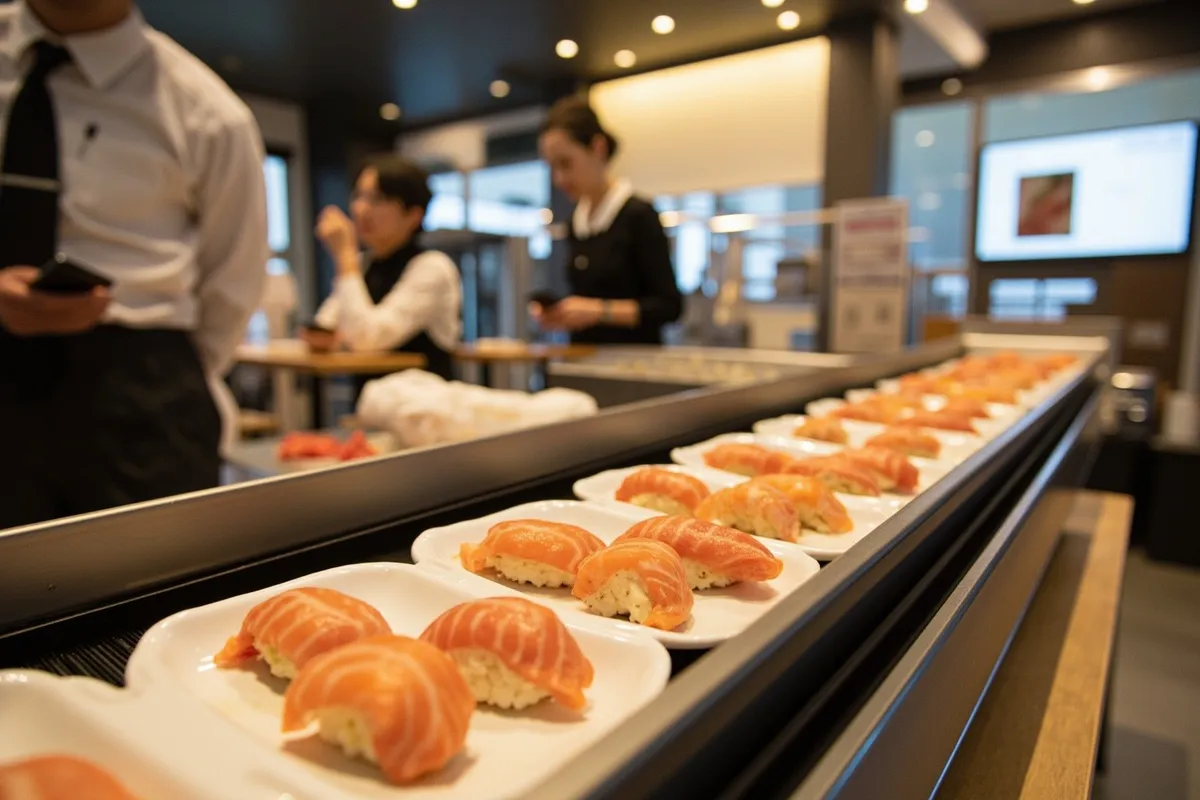
Sushiro conveyor belt sushi still runs on the idea that made it famous: a fixed price per plate, so the belt can be read like a menu and eaten without asking anyone what anything costs. A plate starts at ¥120 with tax, which is about $0.80, and an ordinary lunch lands somewhere between $8 and $13 a head before drinks. Tokyo has 72 Sushiro branches.
I have eaten at enough sushi counters to know the format matters more than the company name. On some branches you lift plates off a moving belt; on others you tap a screen and the food arrives down a personal lane to your seat. Both work, both cost about the same, and both need planning: the queue lives in the app, Suica and the other IC cards are dead in the water, and the same shrimp plate is ¥120 in the suburbs, ¥150 in the centre and ¥170 in Dotonbori. There is no Akasaka branch either. The closest central ones are aune Yurakucho and Sushiro Yurakucho.
Sushiro conveyor belt sushi: the chain, the formats and the branches
From Toyonaka in 1984 to tiered plate prices
Sushiro began in Toyonaka, Osaka, in 1984, and the price idea arrived in 1996: ¥100 exactly, every plate, no exceptions. That was the whole trick. With a fixed price you stop ordering like a restaurant guest and start eating like a canteen customer, taking what you want off the belt and counting plates at the end.
What has changed is the number, and the way it is applied. Sushiro's English menu page gives the starting price as ¥120 with tax and adds that composition and prices differ at some branches. The base price also depends on where the branch sits: suburban and roadside branches start at ¥120, the middle tier is ¥130, central and station branches are ¥150, Dotonbori and Kyoto Gion run at ¥170. That tier is the number that decides what a plate costs.
The menu runs to more than 100 items, sushi and hot food side by side, which is how one table ends up with egg and tamagoyaki next to the tuna.
Belt, touchscreen, or the Auto Waiter lane
Two ways to eat, and the difference matters. On the classic format a belt runs around the room and you take a plate as it passes. On the digital format, called Digiro, you order on a large touch screen at your seat and the food comes along a separate personal lane, the Auto Waiter, with a small screen at the counter telling you what is on its way.
The company says Digiro is expanding and has never announced that physical belts are going away, so both are still running in Tokyo. When a branch listing shows a touchscreen on a stand beside the seat, that is Digiro; a belt in the middle of the room is the older format. I would look at the listing photos before choosing a branch, because the two eat very differently.
The ordering panel handles English, Simplified Chinese and Korean, which saves a lot of pointing at pictures of fish.
Where the Tokyo branches sit, and the Akasaka branch that is not there
The English branch list counts 72 Sushiro branches in Tokyo, and there is nothing in it called Akasaka. If a guide sends you to Sushiro Akasaka flagship, it sent you to a place that does not exist. The nearest central branches are aune Yurakucho on the second floor of 2-3-5 Yurakucho and Sushiro Yurakucho on the sixth floor of Bic Camera Yurakucho, both a short walk from Tokyo Station. The full Tokyo list sits on Sushiro's Tokyo branch page.
Three central branches carry their own warning that composition and prices differ from the standard menu, so I would not budget for them on the tier of their neighbourhood:
| Branch | Address and floor | Phone | Official note |
|---|---|---|---|
| Shibuya-ekimae | 6F Haimanten Bldg., 23-5 Udagawa-cho, Shibuya-ku | 03-5784-2357 | composition and prices differ |
| Gotanda | B1, Gotanda PLACE Building B, 1-3-8 Nishi-gotanda, Shinagawa-ku | 03-5436-8146 | composition and prices differ |
| Asakusa-rokku | 3F Tokyo Rakutenchi Asakusa Bldg., 2-6-7 Asakusa, Taito-ku | 03-5830-1107 | composition and prices differ |
What a branch name will not tell you is which price tier it belongs to, and that number sets the price of every plate you take. Each branch has its own menu with the items that are not served there marked, so the tier can be pinned down before you travel.
Sushiro prices: what a plate costs and what the bill comes to
Base price by branch tier
Four tiers, and the tier follows the neighbourhood rather than the restaurant. All prices include tax. The dollar figures use a rounded ¥150 to the dollar, which moves daily, so read them as a sense of scale rather than as a quote.
| Tier | Base plate | Shrimp, squid, egg | Fresh salmon, albacore | Ten plates |
|---|---|---|---|---|
| Suburban and roadside | ¥120 ($0.80) | ¥120 ($0.80) | ¥180 ($1.20) | about ¥1,400 (about $9) |
| Middle tier | ¥130 ($0.87) | – | – | – |
| Central and station branches | ¥150 ($1.00) | ¥150 ($1.00) | ¥210 ($1.40) | – |
| Dotonbori and Kyoto Gion | ¥170 ($1.13) | ¥170 ($1.13) | ¥230 ($1.53) | about ¥2,000 (about $13) |
The same fish dish runs from ¥120 to ¥170 depending on the branch, and the gap between the cheapest and the dearest range for one dish is about 40 %. Ten plates at a suburban branch come to roughly $9; the same ten plates at Dotonbori come to roughly $13.
The middle tier has a base price of ¥130 and no totals I can quote honestly, so those cells stay empty rather than invented. Branch names do not carry their tier, so treat the table as a range rather than a lookup.
What a plate includes, and the price change that landed in July 2026
A plate is sushi rice plus one piece of fish or a hot dish, with tax already inside the number. Every item prints its calorie count, which is the only nutrition information on the menu: no salt figure, no macros, nothing beyond that.
Drinks and desserts sit outside the plate price. They are separate lines on the bill at their own prices, so read the menu rather than assume a drink came with the plate.
The latest change came over the summer. Sushiro announced on 15 July 2026 that part of the lean-tuna range would move from ¥120 to ¥150, effective 22 July, while salmon, squid and shrimp stayed at ¥120. The company gave logistics, labour costs and catch swings as the reasons, and said the rice remains fully Japanese rice, which matters: it is still one small piece of nigiri on a proper bed of rice, not a rice bowl with fish laid on top.
What one person actually spends
Work the budget out from plates, because no single set price holds across branches and the tier sets everything. Twelve plates at the ¥150 central tier is ¥1,800, roughly $12 before drinks. Ten plates at the ¥170 Dotonbori tier is about ¥2,000, roughly $13, and ten plates at a ¥120 suburban branch is about ¥1,400, roughly $9.
For a table of four ordering twelve plates each at the central tier, that is ¥7,200, roughly $48 with no drinks on the bill. Add beers and the total moves again, since drinks carry their own price.
So I would tell a group to plan on $8 to $13 a head without drinks, and to remember that the number moves with the tier of the branch they walk into.
Getting in: addresses, trains, the app and the queue
Finding the door
The three central branches worth putting in an itinerary all sit on top of, or underneath, something else: Shibuya-ekimae on the sixth floor of a building on Udagawa-cho, Gotanda in the basement of the Gotanda PLACE building, Asakusa-rokku on the third floor of the Tokyo Rakutenchi building inside the Asakusa Rokku mall.
From the nearest station, with the entrance detail that matters:
| Branch | From the station | Where the door is |
|---|---|---|
| Shibuya-ekimae | Shibuya Station, 5–10 min | 6F Haimanten Bldg., 23-5 Udagawa-cho |
| Gotanda | Gotanda Station, 3–5 min | B1, Gotanda PLACE Building B, 1-3-8 Nishi-gotanda |
| Asakusa-rokku | Asakusa Station, 5–10 min | 3F Tokyo Rakutenchi Asakusa Bldg., inside Asakusa Rokku mall |
All three are upper floors or basements in dense blocks, so I would take the train and walk rather than plan around parking: Gotanda is below street level and Asakusa-rokku is inside a mall, and neither sits at the kerb.
The Yurakucho pair is the easiest of the lot. aune Yurakucho is on the second floor a couple of minutes from Tokyo Station, and Sushiro Yurakucho is on the sixth floor of Bic Camera.
The app is the only door
Booking and queueing happen inside the Sushiro smartphone app, and nowhere else. No phone bookings, no laptop. The going-now mode hands you a remote number on the screen and you wait nearby until it is called; the later mode books a slot up to a month ahead. Both need an account, which is the price of entry for everything else.
Two rules are worth memorising. If you do not check in within 30 minutes of your slot, the booking cancels itself. And the reservation system is offline for roughly four hours every night, between 2am and 6am, so an early table is an app task at an ungodly hour rather than something to sort out on a website.
For a fixed plan, use the later mode a few days ahead rather than a going-now number. The remote number is a queue position, not a table promise, and I would not hang a group dinner on it.
The same app handles takeaway. If a guide tells you to pick up a Maido Point card at the door, skip that step: the loyalty scheme ended in May 2026. Sushiro also does not take private hires or large group events, so a table of ten will not get a private room.
Opening hours and the queue at the door
The app is where the hours live, per branch. For Asakusa-rokku, the mall's own directory lists 11:00 to 23:00 on weekdays and 10:30 to 23:00 at weekends and on holidays, with the last order half an hour before closing. Branches inside towers and malls keep their host building's rhythm, so the listing in the app is what to trust on the day.
Expect the queue to be longest at lunch and in the early evening, when office workers, students and tourists want the same ¥150 plate at the same moment. The digital-format branches usually move faster than the belt rooms, because nobody is waiting for a plate to come round.
Every branch is non-smoking, heated tobacco included, so there is no smoking corner to slip into while you wait.
Sushiro menu guide: a workable first order
The plates I would order first
I would not try to be complete. The menu has more than 100 items and the belt rewards greed, so a first visit is really about the first six plates.
- One lean-tuna nigiri. Part of this range now starts at ¥150 rather than ¥120.
- One shrimp nigiri, ¥120 to ¥170 depending on the branch tier.
- One salmon nigiri: ¥180 in the suburbs, ¥210 in the centre, ¥230 in Dotonbori.
- One egg nigiri, ¥120 to ¥170, and the plate to pick for anyone who does not want raw fish.
- One seared plate, tataki of seared fish at 83 kcal or seared salmon belly at 103 kcal.
- One tamagoyaki at 122 kcal, then an udon or a pudding to close.
There is no bestseller ranking to copy, so treat this as a working order rather than a ranking. Every plate prints its calorie count, which is the part of the menu I read first, since I keep a food journal at home and printed numbers beat guessing.
Availability is not universal: shrimp tempura nigiri is not served in Aichi, Gifu or Mie, nor in Dotonbori, and the menu flags a few items that are not served in every branch. Each branch has its own menu with those items marked.
Hot dishes, sides and the calorie numbers
Nigiri is only part of it. Hot plates, sides and desserts sit on the same list, and each one prints its own calorie figure:
| Dish | Calories |
|---|---|
| Fresh shrimp | 68 |
| Lean premium tuna | 81 |
| Tataki of seared fish | 83 |
| Fatty albacore | 84 |
| Salmon | 91 |
| Seared salmon belly | 103 |
| Tamagoyaki, rolled omelette | 122 |
| Natto gunkun | 174 |
| Classic pudding | 194 |
| Mozzarella in tempura | 217 |
| Fries | 218 |
| Kitsune udon | 315 |
Read those numbers against the format: Sushiro is a shop for many small plates rather than two large ones, and the hot dishes are where the calories pile up. The kitsune udon at 315 kcal is the heaviest item on the list by a distance, and the classic pudding at 194 kcal carries more calories than two plates of fresh shrimp.
Two items carry a note that they are not served everywhere, mozzarella in tempura and the fries. Topping udon is a weekday-only dish.
In a digital branch, the hot plates come down the personal Auto Waiter lane to your seat rather than drifting past on the belt.
Regional menus, allergens and diet questions
Menus differ from place to place. Dotonbori runs its own menu with its own allergen file, precisely because it is not the standard list, and the regional gaps are real: shrimp tempura nigiri is not served in Aichi, Gifu or Mie.
For allergies, the file to open is the bilingual Japanese-English PDF covering 28 items, updated 17 August 2026. Eight of them are the allergens Japanese law requires to be declared and twenty are recommended ones, and for each dish the file marks both the ingredients actually used and the ones sharing a production line. That second marking is the one people miss, and it is the one that matters for sesame, soy, shellfish and wheat. The per-branch menus and allergen files sit on Sushiro's English site.
On diet labels, I would not lean on the menu. There are no vegan, vegetarian or halal markers on it, so a fish-free plate cannot be confirmed from the list alone: ask at the counter and read the allergen file for your branch.
Inside the room, and what guests actually say
Two formats, one menu, no smoking
Same chain, two rooms. The belt room has you reaching for plates that come round the loop. The Digiro room replaces that with a touch screen at the seat, a small screen at the counter and a dedicated lane that brings the order over. Both serve the same menu, and the ordering panel runs in English, Simplified Chinese and Korean.
Comfort here is functional rather than cosy: stools and booths, small plates, a bill that follows the number of plates you took. That suits a fast lunch better than a long evening. Every branch is fully non-smoking, heated tobacco included, which matters if you are bringing children.
There is no private hire and no large-group booking either. If you want a quiet table for two, you get a quieter corner of a busy room, and Ichiran Shibuya solves the same hunger with a booth to yourself.
What the reviews keep coming back to
Reviews posted through 2026 on Google Maps and Tripadvisor for the Tokyo branches keep circling the same handful of points, and any score quoted in a guide goes stale fast. The praise is mostly about speed and price, plus the breadth of the belt: two people can sit together and eat very different things.
The complaints are just as consistent. The queue at peak hours comes first. Then noise, which is what a full room sounds like with orders being called over a hum. Then plates that sit on the belt too long before somebody takes them, which is what a belt does when it is busy and you cannot read how long a plate has been going round. And then price: the same dish at ¥120 in one branch and ¥170 in another reads like a trick when nobody mentioned the tier existed.
One more recurring grumble is the branch you planned having no belt, only a screen and a lane. That is the Digiro format, and it is a different experience rather than a worse one, because you eat what you ordered instead of what the belt offers.
The honest cons, and who it suits
Cons first. You pay for the tier you sit in, and the fish follows the price, so the belt in a ¥120 branch is not the belt in Dotonbori at ¥170. Allergies are a documentation job: the branch PDF plus a question to the staff at the counter, nothing more. There is no private table, no group booking and no quiet room. IC cards do not work, so a physical credit card has to be in your pocket. Booking is app-only, with a 30-minute check-in rule and four hours of nightly downtime when the system is off.
Who it suits: families with children, since a plate is small enough for a child and the pricing is per plate. Solo diners who want to be fed quickly. Travellers working to a dollar budget, since $8 to $13 a head without drinks is a number you can plan a whole trip around. And anyone who wants to try many kinds of fish without committing to a set menu.
Who should skip it: people who need written guarantees about raw fish or allergens, groups expecting a private table, and anyone planning a fixed set price that holds the same everywhere. If you want a tasting menu instead, Sushi Saito in Azabudai is the other direction to travel in.
Around the branch, the practical bits and the call
What is around the three branches
| Branch | On foot | By train or bus | Note |
|---|---|---|---|
| Shibuya-ekimae | Shibuya Crossing, Hachiko, Scramble Square, Shibuya Sky; Harajuku and Meiji Jingu from the Shibuya side | Shibuya sits on the Ginza, Hanzomon, Fukutoshin, Yamanote and Saikyo lines | easy to combine with a Shibuya and Harajuku evening |
| Gotanda | Shinagawa Station and the Takanawa Gateway area, Musashi-Koyama | JR Yamanote and Asakusa lines | quieter streets than Shibuya |
| Asakusa-rokku | Senso-ji and Nakamise-dori, Tokyo Skytree | Ginza line to Asakusa, plus the Tsukuba Express for Haneda and Narita | the mall covers a sightseeing day without going outside |
These are rough bearings rather than distances, and walking times shift with the exit you come out of and the floor you are on. The Yurakucho branches put the Marunouchi side within reach: Tokyo Station, the Imperial Palace gardens and Ginza are all a short walk away.
Paying, language and takeaways
No IC cards, no exceptions: Suica, PASMO, ICOCA and the rest cannot be used in Sushiro. Credit cards work at every branch, with Visa, Mastercard, JCB, American Express, Diners Club and Discover accepted, so a physical card is the baseline for the visit.
QR payment exists, and the list of accepted apps changes from branch to branch. The confirmed examples are Osaka branches: Universal CityWalk Osaka takes PayPay only, Stellartown takes PayPay, Rakuten Pay, dPayment, auPAY, Merpay, Smart Code, WeChat Pay and Alipay+, and Asunal Kanayama takes a longer set still. For a Tokyo visit I would not build the day around scanning a code.
The ordering panel is in English, Simplified Chinese and Korean, so language is no longer the barrier it was. Takeout is ordered through the same app as tables, and QR payment for takeaway does not work at every branch.
Two small things to carry: the allergen file for your branch on your phone, and the floor number of the branch, since Gotanda sits on B1 and Asakusa-rokku on the third floor of a building with plenty of other food on the way up.
What to check before you travel
- Your branch's base price. Branch names do not carry their price tier, and Sushiro warns that composition and prices differ at some branches, so read the per-branch menu for the number you will actually pay.
- Opening hours and the last order for your branch, which the app listing carries.
- Whether the branch has a physical belt or the Digiro screen, from the listing photos.
- Your allergen file, updated 17 August 2026, and a question for the staff about anything the menu does not answer; there are no vegan, vegetarian or halal markers on the menu.
- Payment and billing: a physical credit card, since no IC card works anywhere, and the branch menu for which hot dishes count as a plate on the bill.
Is it worth it? A decision list
| Situation | My call |
|---|---|
| Fast lunch, budget in dollars | Go, $8–13 a head without drinks |
| Family with children | Go, small plates priced individually |
| Trying many kinds of fish | Go, the belt rewards a greedy first round |
| A fixed set price planned around | Skip, pricing follows the branch tier |
| Written guarantees on raw fish or allergens | Skip, read the PDF and ask staff |
| A private table or a group of ten | Skip, no private hire and no group bookings |
| A quiet conversation | Skip, the rooms fill up and the noise goes with them |
| The best fish money can buy | Skip, that is a different budget |
| Paying with Suica only | Skip, bring a physical credit card |
One last thing before you commit: work out which tier your branch sits in, because that number sets the price of every plate and the gap between the cheapest and the dearest range runs to about 40 %. For the wider view of eating cheaply in the city, my Tokyo on a Budget guide covers the rest of it.
Quick questions
Six questions that come up most often at the counter and on the forums:
| Question | Answer |
|---|---|
| Do I need to book? | Only in the Sushiro app, with no phone or laptop bookings. Going-now gives a remote number, later mode books a slot up to a month ahead, and the system is offline between roughly 2am and 6am. |
| Can I pay with Suica or by phone? | No IC card works anywhere in the chain. Bring a physical credit card: Visa, Mastercard, JCB, American Express, Diners Club and Discover are accepted at every branch, and QR coverage varies by branch. |
| How much per person? | Roughly $8–13 without drinks, which is ¥1,200–2,000 depending on the branch tier and how many plates you take. |
| Is there a Sushiro Akasaka branch? | No. The list of 72 Tokyo branches has no Akasaka in it. The nearest central ones are aune Yurakucho on the second floor and Sushiro Yurakucho on the sixth floor of Bic Camera. |
| Which branches still have a conveyor belt? | Both formats run today, the physical belt and the Digiro touch-screen format with a personal delivery lane. Photos in the branch listing show which one you are getting. |
| Can I order takeaway? | Yes, through the same app as table bookings, though QR payment for takeaway is not available at every branch. |
If a group is coming, make one person responsible for the app and the numbers, and let everyone else eat without phones.