
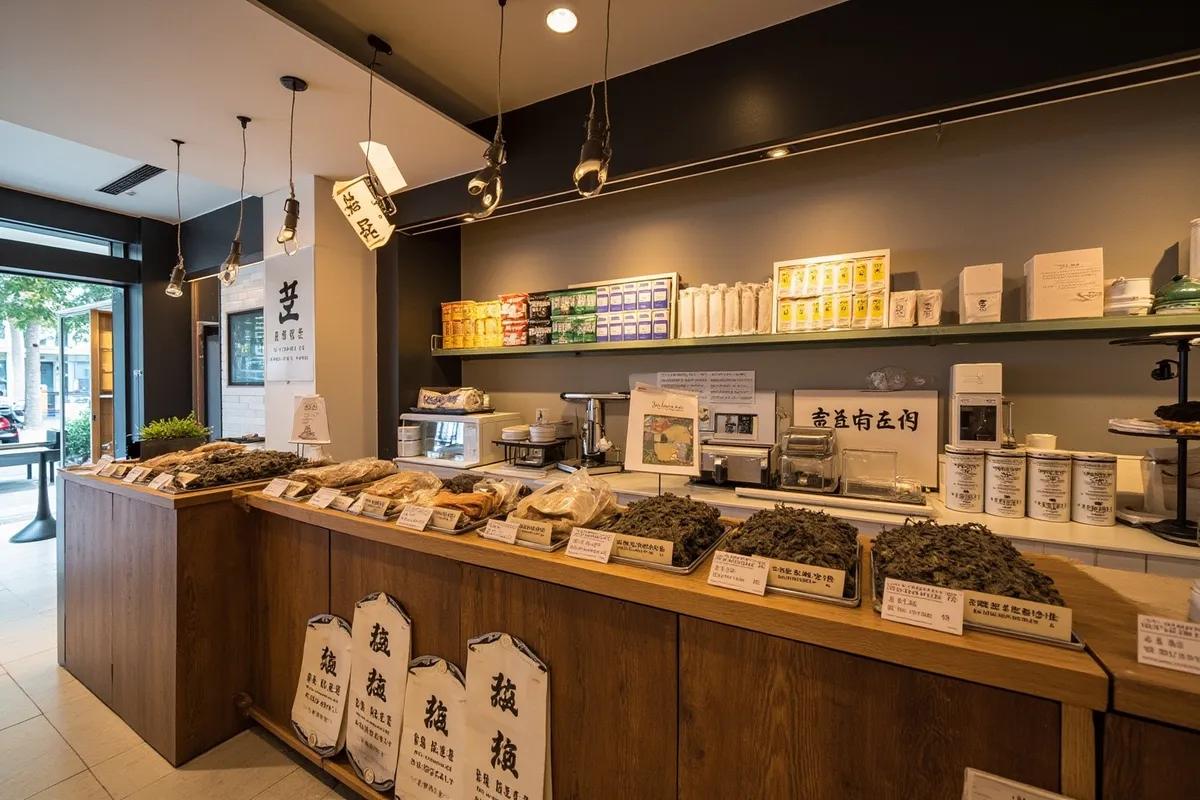
Search for the Ninben Ningyocho main store expecting sencha and a slice of cake, and the first thing you meet is the smell of boiling katsuobushi, dried bonito shaved to order and simmered with kombu. That is what this company has done since 1699, when it began as a Nihonbashi stall with wooden boards of dried fish laid out in the street. The flagship today sits on the first floor of COREDO Muromachi 1, and the old coffee shop and tea house behind the headline are a short walk away in the same part of central Tokyo.
Worth knowing before you plan the trip: the tea and coffee in the title are real, but they sit a few streets from the dashi shop. A cup of katsuobushi dashi is ¥150 and a dashi lunch plate starts at ¥420. I would split the day in two, the counter and the shelf at Ninben, then a kissaten or a tea room nearby, because together they make an easy lunch stop and separately they are two different kinds of shop.
Green tea and coffee in Tokyo: what actually surrounds the Ninben main store
From a 1699 Nihonbashi stall to today's head store
Two companies answer to the name Ninben in Japan. 株式会社にんべん is the dashi and katsuobushi house that dates back to 1699; 株式会社ニンベン is an unrelated seafood business. The counter on the first floor of COREDO Muromachi 1 belongs to the first one, so check which one you are looking at before you order bonito online.
The shop has come a long way from a street stall. In 1699, in the Genroku era, Ninben began as a Nihonbashi trader laying wooden boards of katsuobushi and dried fish in the street. The head store 日本橋本店 opened in 2010 inside COREDO Muromachi 1, and that one floor now carries three jobs: a retail wall of dashi and seasonings, a counter where bonito is shaved in front of you, and a standing bar that sells the result. Ninben's own store page carries the address and hours.
The address is 東京都中央区日本橋室町2-2-1 COREDO室町1・1F, Chuo-ku. That matters for the headline: the shop is in Nihonbashi Muromachi, and Ningyocho, the neighbourhood in the title, is the next one over.
Why the standing bar's menu has no sencha and no coffee
The standing bar 日本橋だし場 pours a short, single-minded list: katsuobushi dashi, katsuobushi with kombu, tomato, cream and miso-style dashi, dashi soups, rice bowls, oden, katsuo-man, pumpkin potage, dashi amazake and a drink made from black vinegar. Tea and coffee are not on that list. The counter's own idea is 一汁一飯, one soup with one bowl of rice, which leaves no room for a flat white and never intended to.
The bar says it has served more than 1.1 million cups of katsuobushi dashi since it opened, by the company's own count, which tells you how much traffic one narrow counter takes. The broth is the reason people come. The shelf behind it is how the same flavour gets home in a box.
Where the title's tea and coffee actually are
Both places sit inside a short walk. 喫茶去 快生軒 has poured coffee since 1919, when it opened as a milk hall, and stands at the Amazake Yokocho junction by Ningyocho Station. ふじヱ茶房 is the tea room of 山本山, a tea and nori house whose own history starts in 1690, on the ground floor of the Nihonbashi Takashimaya Mitsui Building.
| House | Since | What it is | Address | On foot |
|---|---|---|---|---|
| 喫茶去 快生軒 | 1919 | Milk-hall coffee shop, still a pure coffee house | 1-17-9 Nihonbashi Ningyocho | about 8 to 9 minutes |
| ふじヱ茶房 (Yamamotoyama) | 1690 | Tea room with sencha, matcha and nori plates | 1F, Takashimaya Mitsui Building, 2-5-1 Nihonbashi | about 6 to 7 minutes |
The route reads easily on a map and slightly awkwardly on the ground, so give yourself ten minutes rather than five. Both houses work as stops on the way to somewhere else, which is how I would use them.
The Ninben main store: address, counters and the walk from the station
One floor, three jobs
Walk in and you meet three businesses in one open floor. Straight ahead is the retail wall: dashi in sachets and bottles, bonito salt, chilli oil, seasonal jars. To one side is the 日本橋削り場 counter, where staff shave a block of dried bonito on a kezuriki in front of you. At the end of the room is the 日本橋だし場 standing bar, where the broth is boiled.
Two more counters share the space, all built on the same dashi. 一汁旬菜 is a deli of soups and seasonal small dishes, OBENTO sells bento and deli plates made around the smell of the broth, and 日本橋だし場 はなれ is the sit-down 和ダイニング room with alcohol, sweets and desserts. If you want a table and a plate rather than a bowl and a cup, that is the room to walk into.
Two stations, one minute each
Mitsukoshimae on the Ginza and Hanzomon lines, Exit A6, and Shin-Nihombashi on the JR Sobu Line, Exit A6, both put you at the door in a minute. I would add a couple of minutes to any map estimate in this district, because the blocks around the Nihonbashi bridges do not read the way they look.
| From the counter | Walking time | Note |
|---|---|---|
| Mitsukoshimae Station, Exit A6 | 1 minute | Ginza and Hanzomon lines |
| Shin-Nihombashi Station, Exit A6 | 1 minute | JR Sobu Line |
| 日本橋髙島屋三井ビルディング | about 6 to 7 minutes | Where ふじヱ茶房 sits |
| Ningyocho Station, Exit A2 | about 6 to 7 minutes | Also the exit for 快生軒 |
| 甘酒横丁 junction and 快生軒 | about 8 to 9 minutes | Old 玉ひで and 来福亭 on the same corner |
| Tokyo Station | about 8 to 10 minutes | Two metro lines away |
There is no parking of the store's own. Visitor parking in the building runs on COREDO Muromachi 1's own terms, so read its rates and hours before you drive in, and weigh that against two metro lines and a one-minute walk.
The hours that change your plan
Two schedules run side by side. The retail floor opens 11:00 to 19:00 on weekdays and 10:30 to 19:00 on Saturdays, Sundays and public holidays. The standing bar shuts at 18:00 and serves its lunch menu only from 11:00 to 14:00. Come for lunch and let the shop open up around you.
The shop follows the building's calendar and stays open all year except 1 January. The osechi boxes for New Year come in one-tier, two-tier, multi-tier and single-person sizes with a limited quantity, the ordering window closes when the stock runs out, and the announcement for this year's batch went out on 16 October. It is an annual event and it needs planning earlier than you would think.
Bring cash and an IC card. A single-point counter is no place to find out that a foreign card does not work, and expect the boards to be in Japanese. Ninben keeps an English version of its site for the basics.
The dashi bar and the shelf: what to drink, what to buy, what it costs
What the dashi costs, to take away
The standing bar publishes its own take-away sheet, and it is the cheapest way to try the house style. Katsuobushi dashi, 110 ml, is ¥150, the katsuobushi and kombu version costs the same, and tomato, cream and miso-style dashi are ¥200.
| Item | Portion | Price, take-away with tax | What you get |
|---|---|---|---|
| Katsuobushi dashi | 110 ml | ¥150 | Clear bonito broth, the house style |
| Katsuobushi and kombu dashi | 110 ml | ¥150 | Kombu for more body |
| Tomato, cream or miso-style dashi | 110 ml | ¥200 | Three house variations |
| Dashi oden | bowl | ¥450 | Simmered skewers in dashi |
| Katsuo-man | bun | ¥500 | Bun packed with bonito flakes |
| Seasonal pumpkin potage | bowl | ¥300 | Thick soup, changes with the season |
| Dashi amazake | cup | ¥300 | Sweet rice drink with dashi |
| Katsubushi-meshi with daikon leaves and chirimen anchovy | bowl | ¥550 | The monthly rice for November 2026 |
Those are take-away prices with tax. The counter prices differ, because Japan taxes food and drinks at different rates, so the two lists are not interchangeable and I would not add one to the other when working out a meal. The dashi bar page carries the current sheet.
Eating in, 11:00 to 14:00
The same broth becomes a meal between 11:00 and 14:00. A 250 g dashi soup is ¥420. The rice bowl comes in three sizes: katsubushi-meshi at 100 g is ¥240, 150 g is ¥300, 200 g is ¥360. A weekday mixed rice is ¥460, and だし焼玉子, egg dropped into dashi, is ¥220.
The order of operations is easy to work out. Have the cup at the standing bar first, then the rice bowl if you are hungry, then a pack of shaved bonito for your own pot. The counter's framing is 一汁一飯, one soup and one bowl of rice, a smaller meal than a Western lunch and, for me, the reason I would feel fine afterwards.
On portion size, 腹八分目, eating to about 80 per cent full, is a general Japanese habit rather than a rule of this shop, and the three rice sizes let you pick your own point on that scale. The 80 per cent rule is worth reading first, but nobody here will police your bowl.
The shelf: what to take home
The head store sells a few lines of its own. For a gift, freshly shaved 本枯鰹節 in 15 g and 50 g packs, plus かつおおかかラー油, a bonito chilli oil, and かつおおかかナッツ, the same idea in nut form. The 15 g pack is for seeing the flakes, the 50 g for a kitchen that cooks dashi every week.
For home cooking, 飲むおだし is the one to reach for: drinkable honbushi dashi in 6 g sachets, five to a box, hot water in and broth out. There is also だしを愉しむ 鯛めしの素 for sea bream rice and the two salts from the bar. The online shop carries 薫る味だし かつおと昆布 in 20-sachet boxes for the cupboard.
Two practical notes. Staff at the counter will show you how to shave a block of bonito, and the kezuriki, the thin-bladed knife, changes the result more than any other tool in the drawer. And the same lines appear at department-store counters across Japan under にんべん デパート売場, so you can buy the dashi near home and save the trip for the live shaving.
Old coffee and tea in Ningyocho: Kaiseiken and the ふじヱ茶房 tea room
Kaiseiken: a 1919 milk hall still pouring coffee
The old coffee shop behind the title is 喫茶去 快生軒 at 1-17-9 Nihonbashi Ningyocho. It opened in 1919, in the Taisho era, as a ミルクホール, the early Japanese coffee bar built around milk coffee, and it is still a pure coffee house rather than a café that drifted into brunch. The name is shop lore: the second owner gave his regulars the Zen invitation 喫茶去, do have some tea, and joined it to 快生, born happily, after nearby Sui Tenjin.
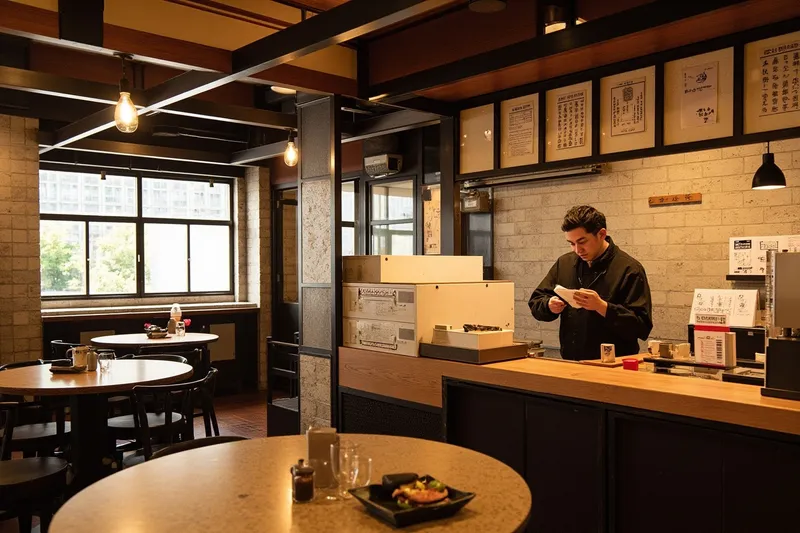
It stands where the Amazake Yokocho lanes meet, with the old 玉ひで chicken shop and 来福亭 on the same corner, one minute from Exit A2 of Ningyocho Station. The Nihonbashi district guide has the longer history. It is a separate business from the dashi shop, and the eight minutes between them is the easy part.
Fujie tea room: sencha, matcha and nori plates
The tea room is ふじヱ茶房, run by 山本山, a tea and nori house in Nihonbashi whose own story starts in 1690, in the Genroku era, when the founder wanted more people drinking good tea instead of leaf that had been sitting too long. Japanese tea houses have a history of their own, and this is one of the older names in it. The room is on the ground floor of the Nihonbashi Takashimaya Mitsui Building at 2-5-1 Nihonbashi.
It is the quiet option. They brew from the company's own leaves, sencha and matcha among them, serve nori-based plates, and sell the same leaves, nori and tea ware on the way out. Table reservations for afternoon tea in the room and takeaway orders are taken online through the tea room's own site, where a person confirms rather than an automatic answer, so a same-day plan needs the phone: 03-3271-3273.
Drinking notes if you are counting
Two things are worth knowing before you order. Tea carries tannins, so drinking it with a meal is a poor idea if iron absorption is a concern, and the stronger the cup the worse it gets. Caffeine has a half-life of about five to six hours in most adults, so an afternoon matcha still counts at dinner. For most people tracking what they drink, an unsweetened sencha or a plain coffee leaves you steadier than a café latte with syrup. How green tea and matcha work covers the rest.
Standing bar, live shaving and the lunch rush
What a 一汁一飯 standing bar is in practice
A standing bar is a counter you drink at, not a venue you settle into. You order, you drink the cup, you leave. The counter at 日本橋だし場 follows the 一汁一飯 idea, one soup and one bowl of rice, the old shape of a meal that fills you without weighing you down. Everything about the room is built for speed, with the dashi boiled to order and the retail shelf a couple of steps behind you.
That suits a solo lunch or a quick stop between shops. It does not suit a long conversation, a laptop, or a child who needs a chair, since the counter is the seating. The はなれ room is the answer for a meal that takes an afternoon.
The shaving counter, the workshop and the noon window
The live shaving is the part I would not skip. A block of dried bonito goes on the machine at the 日本橋削り場 counter and comes off as flakes, and the staff will talk you through doing it yourself and through judging a good block of katsuobushi when you buy one. Fresh flakes in warm water taste sweeter and cleaner than flakes out of a jar, which is the whole argument for buying them here.
You can practise: Ninben runs かつお節体験教室, katsuobushi workshops, booked through the workshop page on the company site, where the session length, the price and the group size are all handled.
One note on timing: the bar's lunch runs 11:00 to 14:00 and the bar closes at 18:00, while the retail floor stays open until 19:00 on weekdays. That single lunch window makes the busiest stretch predictable, so for anything that needs a seat or a slot, the はなれ room or a workshop booking is safer than turning up at noon.
What the schedule and the shelves already tell you
The published facts write the trade-offs for you. The pluses: the smell of freshly boiled dashi at the counter, a shaving demonstration you can watch and ask questions about, a house drink at ¥150 for 110 ml, a lunch that stays light, and seasonal boxes with a fixed calendar. The bar says it has served more than 1.1 million cups of katsuobushi dashi, which is the company's own count of how much traffic one counter takes.
The other side: the bar and the shop keep different hours, the bar is standing room only, the retail floor and the bar share one floor and one door, and everyone wanting fresh flakes queues at the same single counter. The New Year osechi are limited in number, so that plan needs making early.
What I would change about a visit is the order. Buy the bonito first, drink the dashi while the room still smells of it, and leave the coffee and tea for the next street, where both are done properly.
Buying, booking and who should skip it
Where to order, and what to ask for
There are several ways to buy. The counters at the head store sell the retail lines and the dashi in person. The company runs an online shop for packaged dashi and seasonings, a free-call order line on 0120-26-0241, and a store number on 03-3241-0968 if you would rather ask a person in Japanese. Department-store counters nationwide carry the same lines under にんべん デパート売場, the katsuobushi workshops have their own booking form, and the tea room takes its reservations separately on its own site.
There is also a customer card with no joining fee and no annual charge, worth having if you are a regular: on the 24th of every month, the shop's ふしの日, cardholders collect double points. For the seasonal boxes the only rule is quantity, since the New Year osechi come in limited numbers and the window closes when the stock runs out.
Who it suits, and who should skip it
Two columns, and no need for more than that.
| Go if you... | Skip it if you... |
|---|---|
| cook with kombu and bonito at home and want the good stuff | came for matcha or coffee inside the shop |
| want a proper dashi lunch between 11:00 and 14:00 | want a long meal with table service and a coffee list |
| are buying katsuobushi and dashi for the kitchen | are driving in without a parking plan |
| like compact savoury food that keeps the meal light | need a chair rather than a counter |
| plan to walk on to a 1919 coffee house afterwards | expect one set price for a meal |
On money, the numbers are simple: a glass of dashi is ¥150, a dashi soup at lunch is ¥420, だし焼玉子 is ¥220, the monthly rice bowl is ¥550 to take away, and the cheapest item anywhere on the menu is a 120 ml black-vinegar drink at ¥110. If you want more on the pattern behind the counter, the Japanese diet explains the shape this meal comes from.
Should you go, and when to come
The short version
Ninben is a dashi and katsuobushi house that has traded since 1699 and now runs its flagship on the first floor of COREDO Muromachi 1, with a standing bar, a live shaving counter and a retail wall worth a proper look. Go for the dashi lunch, the fresh flakes and the shop itself. Give it a miss if the plan was a cup of sencha, a coffee and a chair, because the counter will not give you that.
| If you want | Go to | Timing |
|---|---|---|
| Dashi and a lunch built on it | 日本橋だし場, the standing bar | Lunch 11:00 to 14:00, bar open to 18:00 |
| Coffee from a century-old kissaten | 喫茶去 快生軒, Ningyocho 1-17-9 | Daytime, a minute from Ningyocho Station A2 |
| Sencha, matcha and a sit-down tea break | ふじヱ茶房, Takashimaya Mitsui Building | Reserve online first |
| Katsuobushi and dashi for your own kitchen | The retail floor, or the online shop | Store 11:00 to 19:00 weekdays, 10:30 to 19:00 at weekends |
The headline works on one condition: you are willing to walk the extra eight minutes to the coffee house or six minutes to the tea room. If you only have time for one counter, that counter is a dashi bar, and the tea and coffee are done better next door.
What to check before you go
Five small things, none of them a phone call unless you want to make one.
Before you go
- If you are driving, read the COREDO Muromachi 1 visitor parking rules first; the store has no parking of its own and both nearby stations are a one-minute walk away.
- Check the osechi order page before the New Year period: quantities are limited and the window closes when the stock runs out.
- Book the katsuobushi workshop through its own form instead of turning up, and allow the tea room's online reservation a couple of days to be confirmed by a person.
- Bring cash and an IC card; a single-point counter is a poor place to find out that a foreign card does not work.
- Allow ten minutes rather than five for the walk to Kaiseiken or the tea room, and look at the route on a map before you set off.