
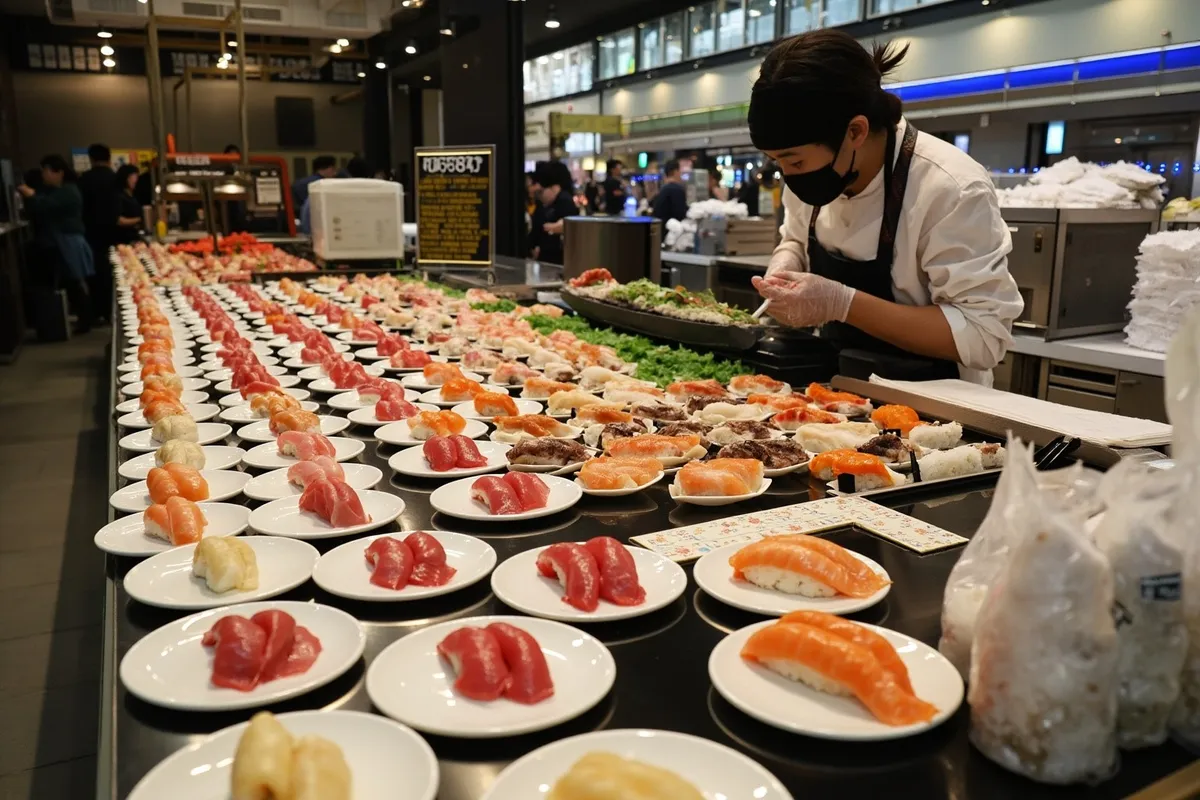
Sushi Zanmai Honten in Tsukiji is the sensible pick when you want market tuna without a fixed set price and without the multi-hour wait a few stalls down the arcade have made famous. Sushi starts at about ¥198 a piece, and a filling meal lands around ¥2,000–¥4,000 a head.
Booking is not part of the deal: you walk in, staff seat guests in arrival order, and because the shop never closes – 24 hours, 365 days a year – the way through the queue is timing. Come in the early morning around 6–8am or late in the evening, and keep away from the midday lunch peak.
Sushi Zanmai Honten in Tsukiji Outer Market
A 24-hour sushi counter on the market floor
Two Zanmai shops sit inside Tsukiji Outer Market, so check the address before you walk in. The Honten is at 4-11-9 Tsukiji, Chuo-ku; Bekkan is a separate door, and it is easy to end up at the wrong one. The market's own shop list puts the Honten in the sushi category, which is the quickest way to be sure you are in the right place.
The hours are what set it apart. Twenty-four hours a day, 365 days a year: a counter seat at seven in the morning, at two in the afternoon, or at three in the morning. For anyone staying near the market it also removes the last-train scramble – eat first, walk back to the hotel afterwards.
4-11-9 Tsukiji, Chuo-ku · open 24 hours, 365 days · listed in the market's official sushi category · the Honten is the flagship, and Sushi Zanmai Bekkan is a separate shop.
The tuna story: Kimura, Toyosu and the ¥510.3 million fish
The owner, Kiyoshi Kimura, runs Kiyomura Corporation and is known as the “Tuna King” for repeatedly taking the top lot at the Toyosu auction. By its own account the shop opened in April 2001 as store No.1 and was the first in Japan to stay open 24 hours a year round. Every January the year's first bluefin is hammered down at Toyosu Market, with the auction running into early March.
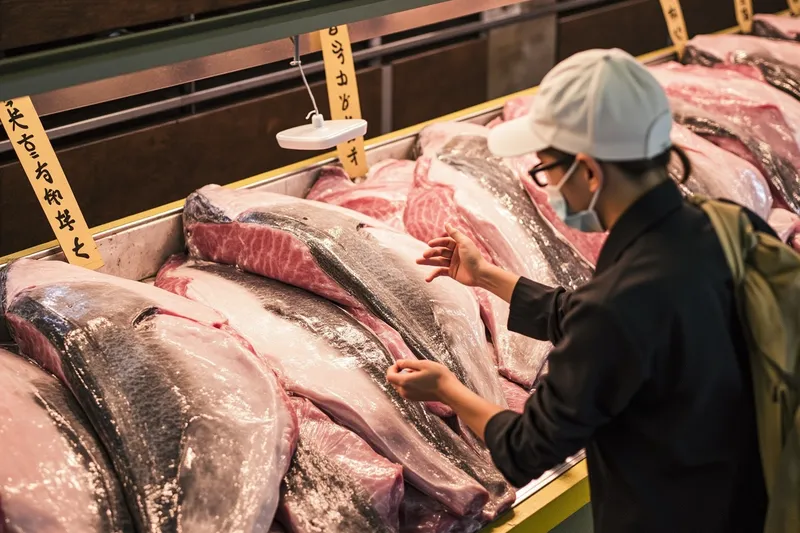
In January 2026 Kimura paid a record ¥510.3 million for that opening lot and says it is served at the shop's normal prices. That fish is long gone, and nothing on the menu changed because of it. The useful part is simpler: the buyer at the top of the auction chain owns this counter, and the menu is priced like an ordinary sushi bar rather than a trophy case.
Getting to 4-11-9 Tsukiji
Three subway lines, three minutes from the door
Three subway lines put the door three minutes away, which makes this the easiest of the serious sushi places in the market to reach. Tsukiji Station on the Hibiya Line, Higashi-Ginza on the Ginza Line and Tsukiji Market on the Toei Oedo Line are all the same short walk, and the covered arcade of the market itself is 300 m away. The rest of the market's stalls are worth a separate wander.
| From | How | Time |
|---|---|---|
| Tsukiji Station (Hibiya Line) | Walk | 3 min |
| Higashi-Ginza Station (Ginza Line) | Walk | 3 min |
| Tsukiji Market Station (Toei Oedo Line) | Walk | 3 min |
| Tsukiji Outer Market arcade | Walk | 300 m |
| Toyosu Market | Oedo Line, 4 stops from Tsukijishijo | about 8 min plus the walk |
| Ginza | One stop from Higashi-Ginza, or on foot | about 2 min by train, 12–15 min walking |
| Tokyo Station | Hibiya Line to Otemachi, then the underground walk | about 15–20 min |
The Oedo Line run is worth remembering if you want to see where the fish comes from: Toyosu Market is four stops along the same line, so an early morning at the auction and a plate of tuna afterwards fit comfortably into one day.
Entry, payment and what to bring
There is no reservation system and no booking, so the only language you need is for ordering. Picture menus and English menus sit at the counter, which makes pointing at the right row of nigiri easy enough for anyone.
Payment takes the stress out of a 3am visit. Cash and credit card work (VISA, Mastercard, JCB, American Express, Diners, UnionPay), as do transport IC cards such as Suica, Rakuten-Edy, nanaco, WAON, iD and QUICPay, and QR payments including PayPay, d Barai, Rakuten Pay, au PAY, Alipay and WeChat Pay. The room is non-smoking and the Wi-Fi is free.
- Bring a card or a Suica, plus a backup method for when a terminal is busy.
- Skip booking apps; every seat is walk-in.
- Leave the car at home – there is no parking, so use a station locker for luggage.
- Ask for half the usual rice if you are keeping an eye on your plate size.
Sushi Zanmai menu price: what a piece of tuna costs
The price list that matters
The shop's own menu runs to more than 150 items, and the official menu page is where the current range lives, including the cheap side dishes that never make it onto anyone's highlight reel. The headline numbers: sushi starts at about ¥198 a piece, and bluefin is priced by grade, with akami at roughly ¥248, chutoro at ¥398 and otoro at ¥498, all quoted before tax.
Those per-piece tuna figures come from the wherebest price summary. Read them as a picture-menu price rather than a printed card, because the board in front of you has the last word. A mixed maguro set is listed at about ¥4,800, and there is a takeaway menu if you would rather eat standing up elsewhere in the market.
| Item | Price | Note |
|---|---|---|
| Sushi, entry price | about ¥198 a piece | where the counter list starts |
| Akami | about ¥248 | before tax |
| Chutoro | about ¥398 | before tax |
| Oboro | about ¥498 | before tax |
| Maguro set, mixed tuna | about ¥4,800 | as listed |
| Takeaway menu | available | order at the counter |
Ordering à la carte, one piece at a time
Ordering is à la carte and built for single pieces. You can start with one piece of your favourite topping and ask the chef for a smaller portion of rice, half the usual amount, which matters if you want to taste the tuna rather than the rice.
The registered menu lists 46 food items and 19 drinks, with no set menu and no lunch menu at all, so nothing arrives as a composed sequence unless you build it yourself. The mechanic is simple: point at the photo menu, name the topping, ask for half the rice, and the plate comes one at a time. Four people who each want three pieces is twelve plates spread across the meal.
The common misreading is to order for the table as if a set were on its way. There is no set on the list, so every plate is counted and priced on its own. The Edomae shorthand people expect, a fixed progression of nigiri chosen by the chef, belongs to a different shop.
Beyond the sushi: sashimi, tempura and breakfast
The range runs past sushi plates into sashimi, tempura and grilled items, and the kitchen is seafood all the way down. There is no vegetarian and no vegan menu, which matters if you are dining with someone who does not eat fish. Miso soup, gunkan rolls and seaweed starters are worth a look on the board, but check the current menu for their prices.
Breakfast is the best argument for coming early. A Tabelog review from the summer of 2026 describes eating at the counter before 8am and calls it the best breakfast in crowded Tsukiji. It is not the usual Japanese breakfast spread, and it starts before the stalls fill up.
There is no allergen chart, so point at the picture menu, say which item you mean, and ask what is in it before you order.
How to get a seat at Sushi Zanmai Honten
How the walk-in queue works
Seats are first come, first served, and the room is big enough that the wait tends to be short. The main store fits 144 people over three floors: 37 on the first floor (a 23-seat counter and 14 tables), 41 on the second (a 19-seat counter and 22 tables) and 66 table seats on the third. That is why you are not queuing for an hour while a stranger's omakase set finishes.
There is no private room, no buy-out of the whole shop and no online reservation. The booking line on Tabelog, 050-5869-0588, takes inquiries rather than holding tables, so staff seat guests in arrival order and you take what is free: a counter seat, a shared table, or a short wait.
Coming as a group of eight or more, split the party or come near opening. The tables are shared, and a wall of ten arriving at once is a lot to hand to a busy floor.
Early morning or late evening
The shop never closes, so the timing advice is short: early morning, roughly 6–8am, or late in the evening, and stay away from the midday lunch peak. Those are the windows where the market is quiet enough to walk straight to the counter.
Picture it (illustration): a 7am weekday breakfast at the counter with the stalls still setting up around you, against the same room at 12:30 on a weekend with tour groups and strollers in the arcade. I would take the early seat every time; sushi before the market wakes up is the better version of the same fish.
Two cautions. Last orders and kitchen hours are not posted, so read the board in front of you: the menu narrows late at night and a grilled dish may be finished. And weekends are when the midday window is least forgiving.
Three floors, market noise, shared tables
Only the third floor is tables-only. The counters are on the first and second floors, and if you want to watch the chef shape each nigiri in front of you, ask to be seated at the counter rather than at a table.
The room is market-style and loud, which is not the hushed atmosphere of a formal omakase counter. This is a busy shop where the chef works in the open, counter seats sit close together, tables are shared, and with 144 people over three floors the noise spreads. It is part of what the entry price buys.
If you need step-free access, ring 03-3541-1117 before you come and ask for a seat on the first floor, where the counter and 14 tables sit at street level.
What a meal costs and what the price includes
Real spend per person
The bill follows the number of plates rather than a set, so plate count is the honest way to think about it. The average recorded for the shop sits in the ¥1,000–¥2,999 band, while diners themselves report spending ¥3,000–¥4,999 a head, which tells you the light end is a snack rather than a meal.
| Scenario | What you order | Per person |
|---|---|---|
| A single piece | Sushi at the entry price | about ¥198, plus whatever you add |
| Ten pieces of lean bluefin | 10 × ¥248 | about ¥2,480 (arithmetic, not a menu set) |
| Ten pieces of medium-fatty | 10 × ¥398 | about ¥3,980 (arithmetic, not a menu set) |
| Mixed maguro set | The listed set | about ¥4,800 in total, so it depends how many of you share it |
| A filling meal | Several pieces plus hot dishes | about ¥2,000–¥4,000 |
Ten pieces of akami is a useful comparison against the mixed set: for a little under ¥2,500 you get the same fish in ten separate plates, and you choose every one of them. That is the version I would order.
Tax, seasonal specials and what is not on the bill
No service charge is listed for the main store, and the per-piece tuna prices are quoted before tax, so the till runs a little above the menu figures. Tabelog's translated note tells you to check the bill with the restaurant, and on a per-plate order that habit is worth keeping.
Seasonal specials sit on dated windows: one early-November special was advertised from the 4th to the 9th, until sold out. The date matters more here than usual, because by the time you have read about a special it may be gone, and there is no way to reserve one.
What you are not paying for is worth knowing too: no cover, no service charge, no set price. Every line on the slip is a plate you asked for, plus tax.
What guests say
The praise that keeps coming back
Across 1,498 reviews on Tabelog the shop sits at 3.42, a mid-range score, so the good comments are specific rather than general.
Value at the counter comes first on Tabelog: per-piece prices, a half-rice option the shop itself promotes, and reviewers whose own spend lands in the ¥3,000–¥4,999 range. Freshness comes next, with the summer 2026 review praising a counter seat before 8am and the wherebest summary singling out the tuna as the reason to come.
Speed is the third: the wherebest summary says the way through the queue is to arrive early or late and to dodge the midday peak, and with 144 seats that holds up. Service is the fourth, and the smaller rice portion is a normal request rather than a special favour.
The complaints, and what the layout explains
The 3.42 on Tabelog has a shape to it. The room is the first thing that comes up in the criticism: an open counter, 144 seats over three floors, a busy market arcade outside and shared tables. It is cheerful and it is loud, and anyone who wanted a hushed counter will not enjoy it.
The bill comes next. Ordering piece by piece means the final number depends on how many plates you actually wanted, and diners report spending more than the recorded average. Four people each adding three pieces doubles the order without anyone noticing.
Third is pace and attention. A counter seat on the first floor and a table on the third are different experiences, the counter closest to the chef and the upper tables furthest from it. None of this is a complaint about cleanliness or about the fish; it is a shop built for volume, and the score reflects the room rather than the tuna.
The other sushi shops in the same market
The comparison worth making is with Sushi Dai, a few doors away in the same market. Dai is a small shop serving one fixed chef's-choice omakase set, and the wherebest summary reports queues there running for hours and a higher price per set. Zanmai runs the opposite model.
| Shop | Format | Spend | Waiting |
|---|---|---|---|
| Sushi Zanmai Honten | À la carte, 144 seats over three floors | from about ¥198 a piece; about ¥2,000–¥4,000 for a filling meal | usually short outside the midday peak |
| Sushi Dai | Fixed chef's-choice omakase set | higher per set | queues reported to run for hours |
Same market, same fish on the block, two different decisions. If you want the set, Dai does that. If you want to pick your own pieces and keep moving, this counter is the better fit. Prices around the market are compared in Tokyo on a Budget.
Who should eat here and who should walk past
Who it suits
The shop suits people who want sushi without a ceremony. The photo and English menus mean you can order without Japanese, single pieces make children and mixed appetites easy to feed, and the smaller rice portion lets you taste bluefin without committing to a full plate of rice.
- First-time visitors who do not read Japanese and want nothing to book.
- Families with children: one piece each, no pre-order, no waiting for a set to finish.
- Groups who want to eat and carry on rather than queue for a fixed menu.
- Early birds turning the market into a breakfast stop.
- Anyone after market tuna at à la carte prices, happy with a lively room instead of a silent counter.
Add the practical bits: cash, credit card, transport IC card and QR code all work, the Wi-Fi is free, the room is non-smoking, and at three in the morning the door is still open.
Who should walk past
Walk past if you want a quiet, ceremonial counter with a chef deciding what you eat, if you want a fixed omakase progression and a known price, if you need a private room for a company dinner, if you are eating plant-based, or if you need a table guaranteed in advance. None of that is on offer here, and pretending otherwise costs you money and time.
For the omakase version of the trip, Sushi Dai in the same market is the comparison. For a plant-based breakfast or lunch, the market's shop list breaks the stalls down by category, so you can pick one from there.
If the goal is the cheapest sushi in Tsukiji, start from about ¥198 a piece and check the current menu page for the smaller plates and side dishes around it.
Practical details
- 4-11-9 Tsukiji, Chuo-ku, inside Tsukiji Outer Market
- Open 24 hours, 365 days
- Main line 03-3541-1117
- Inquiries 050-5869-0588; walk-in only, no reservations
- Cash, credit card, transport IC card and QR payments
- No parking; free Wi-Fi; non-smoking
- Tsukiji, Higashi-Ginza and Tsukiji Market stations, three minutes away
- Do I need to book? No – every seat is walk-in, and the phone line takes inquiries rather than reservations.
- How much is a piece of sushi? From about ¥198, with bluefin by grade: akami about ¥248, chutoro about ¥398, otoro about ¥498, before tax.
- What does a meal come to? About ¥2,000–¥4,000 per person for a filling one, and more if you keep ordering.
- When does the queue clear? Early morning around 6–8am or late in the evening; the midday peak is the window to skip.
- Can I park? No. There is no parking on site, so use a station locker or a taxi drop-off.
What to check before you go
- Read the current menu and prices on the shop's official site, including the side dishes.
- Check the seasonal board: specials run on dated windows and sell out.
- If you need step-free access, ring 03-3541-1117 in advance and ask for a first-floor seat.
- Bring a backup payment method for the small hours.
- For a big group, split the party or come near opening – no reservations, no private room.