
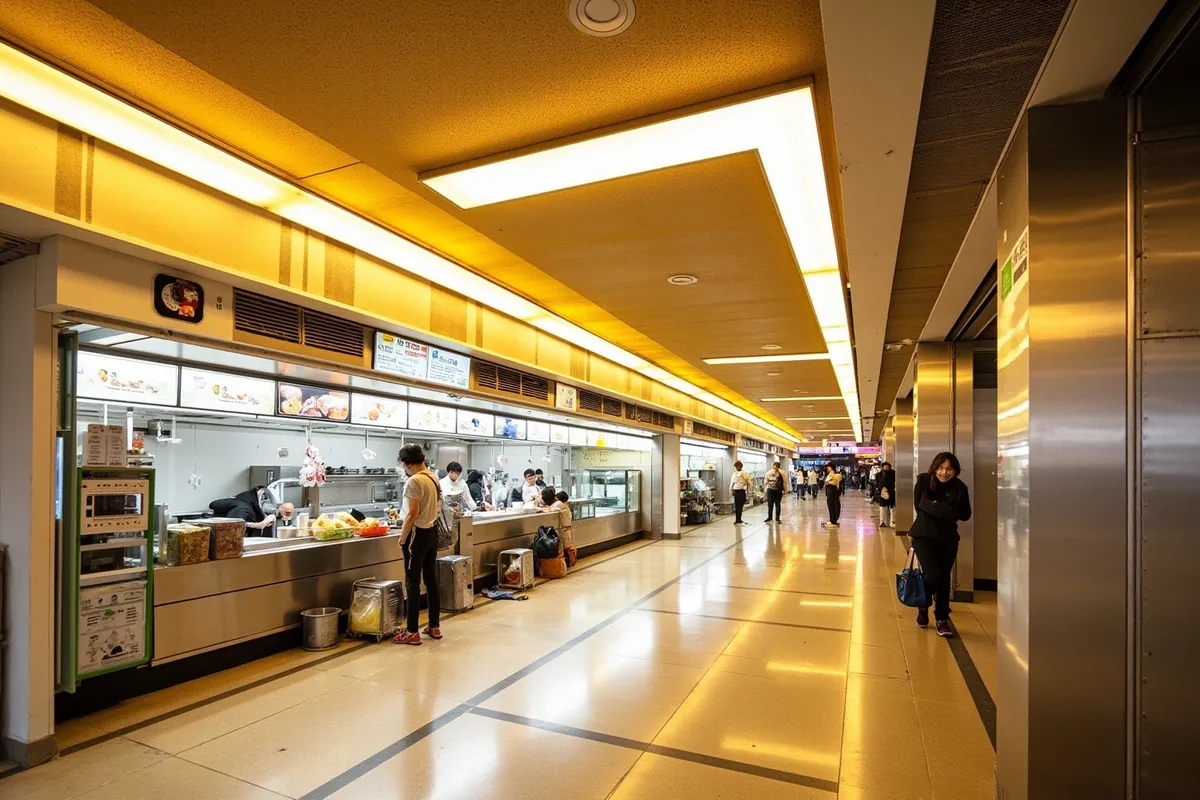
If you type “yurakucho marui food hall” into your phone expecting one hall full of counters, you will find two buildings. Yurakucho Marui is an eight-storey department store at 2-7-1 Yurakucho, Chiyoda City, one minute on foot from JR Yurakucho Station, and the basement food level belongs to ITOCiA, the building next door. The plate of rice with warm miso and a few small vegetable dishes that most people mean by a light Japanese lunch sits on the 5F of Marui itself.
Three places are worth knowing before you arrive: the 1F take-away counters for pastry and coffee when you have ten minutes, 24/7 cafe apartment on the 5F for a sit-down set lunch, and B1F ITOCiA Food Avenue for the depachika basement browse. Two separate buildings, two separate receipts, and a lunch hour that behaves differently depending on which door you come through.
The Yurakucho Marui food hall is the ITOCiA basement
B1F Food Avenue: 25 counters and a game hall
Marui's own floor guide labels the basement “B1F (ITOCiA)” and sends basement shoppers next door. The Food Avenue on that level runs as its own operation, separate from ITOCiA Plaza, so the receipts and the rules are separate too. The ITOCiA B1F floor guide numbers 25 shops on that floor and lists the UNO pachinko-and-slot hall as outlet 42. Expect a mixed basement: deli counters, sweets, drinks, a convenience store and a game hall, not a hushed canteen.
| What you want | Where it is on B1F |
|---|---|
| Japanese dishes | Yurakucho Umaya no Rakuya |
| Rice bowls, brown rice | Genmai Rice (玄玄米米) |
| Salad bowls with greens | WithGreen |
| Soup over rice | Dashi Chazuke En |
| Cold-pressed juice | Gooday Juice |
| Doughnuts | Crispy Cream Doughnuts |
| Ready-to-eat, grab and go | 7-Eleven, Natural House |
| Chocolate | GODIVA |
| Tea | THE ALLEY |
Ginza Station exit C9 opens right onto the ITOCiA Food Avenue entrance, so if the basement is the plan, start there. One bit of arithmetic before you park: spending in Food Avenue or ITOCiA Plaza does not count toward Marui's parking discount, so a basement lunch and a store receipt do not add up to free parking. The same format at another department store is in my Shinjuku Takashimaya depachika piece.
How the basement runs at lunch time
Down there you buy at counters rather than order a meal: queue, choose, pay at the register, eat where you stand or take it with you. ITOCiA keeps the Food Avenue on its own hours, so check them on the floor guide instead of assuming the department store's clock applies.
Around midday the basement pulls people off trains and out of the offices around the station, which is my own impression of the room rather than a measured count. The choice is enormous, but it is deli food, sandwiches, sweets and drinks. Rice, miso and small vegetable dishes eaten off a tray is the 5F's job, not the basement's. It is a long floor to cross with a tray in your hands, so decide what you want before you come down.
The 1F counters when you have ten minutes
Six take-away gourmet counters sit on the 1F: Almond Meister Refine, Canelé Lite, COCOLO KYOTO, Patisserie MAGNOLIA, Press Butter Sand and Lintz Chocolate Boutique. They are takeaway rather than seating and each keeps its own opening times, so if you want a specific canelé late in the evening, look at the stall's board first. The MARUI food directory lists the cafés and restaurants floor by floor, with Randy's Donuts on the 1F running 11:00 to 20:00.
Two more things on that floor. Curandarium, the curry counter, runs three units (F02, F03, F05) with a limited-run protein menu through late 2026; the store's own restaurant list does not include it, but you can eat there. And Lintz Chocolate Boutique shut for refurbishment for a month and has just reopened, a good reminder that a counter you had your eye on can disappear for weeks.
My rule for the 1F: coffee and something sweet when you have ten minutes. A hot lunch needs the 5F.
Lunch near Tokyo Station: how to reach Marui and where to park
Three stations, three walks
All three nearby stations are close, and the walks differ enough to matter. JR Yurakucho is a minute away, Metro Yurakucho five, Metro Ginza seven. The MARUI access page spells out the step-free routes, worth reading if you have a suitcase or a pram.
| Station | Route | Where it drops you | Time |
|---|---|---|---|
| JR Yurakucho | Central gate, left, about 50 m | 1F main entrance | about 3 minutes |
| Metro Yurakucho | D7 exit with lift, 70 m then 100 m | 1F entrance | about 5 minutes |
| Metro Ginza | C9 exit | ITOCiA Food Avenue entrance | about 8 minutes |
Basement lunch, come from Ginza C9 and you are at the Food Avenue door; Marui upstairs, come from JR Yurakucho. With luggage, the D7 lift at Metro Yurakucho is the gentlest approach. If you need a lift confirmed for the 5F or for the basement inside the building, ring the store on 03-3212-0101 first, because the published routes only cover station to entrance.
Parking, bicycles and the receipt that does not count
Cars go to Times Station Itocia, open 24 hours: ¥400 per 30 minutes, dropping to ¥100 between midnight and 08:00, and ask at the gate what unit that night rate covers. Spend ¥3,000 in Marui stores and you get one free hour, ¥5,000 buys two, capped at two hours per ticket. Bicycles park at Cycle Times Yurakucho Itocia: first two hours free, then ¥100 per six hours, bicycles only.
For a basement lunch the receipt matters more than the rate. Food Avenue and ITOCiA Plaza spending does not count toward the Marui total, so parking for an underground lunch is paid parking at the full rate; if the parking discount is the plan, eat upstairs. Both car parks run around the clock, which makes the store's closing time the only real deadline for a day visit.
Hours and the last-order trap
Marui opens 11:00 and closes 20:00. The food floors run on their own clocks, and every one of them has an earlier cut-off than the front door suggests.
| Floor | Place | Hours and last order |
|---|---|---|
| 1F | Randy's Donuts | 11:00–20:00 |
| 3F | PROPORTION allure cafe | 11:00–20:00, eat-in order 30 minutes before closing |
| 5F | 24/7 cafe apartment | 11:00–21:00, last order 20:00 |
| 7F | Coffee Gallery | 11:00–20:00, last order 19:45 |
| 8F | Share CAFE / 洒落CAFE | food 19:00, drinks 19:30 |
Two traps in that table. The name 24/7 says nothing about the hours: that restaurant opens at 11:00 like everything else and simply happens to be the one place still serving after the store's 20:00 close, until 21:00. And the restaurant follows the department store's closing days, which change month to month; when Marui shut for a day, 24/7 cafe apartment shut with it.
Rule of thumb: walk in ten minutes before the restaurant's last order, not ten minutes before the building closes. The 1F Epos Card Centre also stops taking applications at 19:30.
Yurakucho department store food: what a light Japanese lunch costs
Rice, miso and small dishes
What most people mean by a light Japanese lunch arrives on one tray: rice, a bowl of warm miso soup, one to three small vegetable dishes, tea or coffee. At 24/7 cafe apartment the signature plate is 至福のごはん (shifuku no gohan), a blend of black rice, glutinous rice and brown rice served with warm miso, several vegetable side dishes and hojicha from the Kyoto tea house Fujii Chaan. The average spend is ¥1,500 per person, with no cover charge and no service charge on top.
The Japanese grammar for this is teishoku, a set meal, and it describes the tray format rather than a list of courses. The older phrase ichiju-sansai, one soup and one dish, and its fuller three-vegetable version are general conventions, not a description of what lands in front of you here. Genmai, the brown rice you also meet in the ITOCiA basement, is denser and nuttier than white; bowl size does more for a light lunch than the label does, and there is a useful piece on rice and portion size.
And the reason the tray looks modest: hara hachi bu, the old habit of leaving a little in the bowl. My hara hachi bu article covers what the evidence supports and what is mostly custom.
The November 2026 menu PDF is where the prices live
The operator keeps the current à la carte menu as a PDF, the November 2026 edition, on the 24/7 cafe apartment page. That document is the only place the dish prices live: the building's floor guide will not give them to you and neither will a board in the basement. Open it before you go and check that the dish you want is on the current sheet, at the price you expect.
Older posts on Marui's own channels still circulate, and they explain much of what you read online: a “choose one soup and one side” set, tea pork shogayaki from Kagoshima, a tuna and avocado mentaiko donburi, a cream croquette from the sea. Those are snapshots from 2019 and 2020, which is why the same dishes turn up in old blog posts. Today's list is the PDF.
One habit worth keeping from Japanese set-lunch places: many run lunch menus in limited quantity and finish them before dinner service starts. Arriving near 12:00 is safer than arriving at 13:30.
Basement prices and what the guide does not say
Down in ITOCiA the floor guide gives shop names and categories, nothing more: no prices, no set combos. Every yen figure in the basement comes off the counter board, and counter prices can include consumption tax, so read the wording on the sign instead of assuming. Guides to Tokyo depachikas often mention end-of-day markdowns; I would not build an afternoon around them here without seeing the counters myself.
For planning, the one fixed number is the ¥1,500 average for the 5F set lunch; the basement is priced like a department store food hall rather than a street. If you want the same shopping trip for less, my Ginza Mitsukoshi depachika guide shows what a basement run looks like nearby.
Paying, booking, and the queue you cannot reserve
How you actually pay
At the 5F restaurant the till takes VISA, Mastercard, JCB, AMEX and Diners, transport IC cards including Suica, Rakuten Edy, nanaco, WAON, iD and QUICPay, and QR payments including PayPay, Rakuten Pay, WeChat Pay and Alipay. Receipts can be issued to meet invoice requirements. Set up Suica before you travel: it works on iPhone and Apple Watch through Wallet, and on Android through the operator's app, and the steps change often enough to check on the morning.
That is the restaurant's list, and it does not automatically apply to the basement counters or the 1F stalls, where the payment icons on the case are the guide: cash and IC cards are common, QR is not everywhere. Tax-free treatment for visitors is a separate question from invoice receipts, and for a meal I would ask before ordering.
Booking a table, and what a booking does not fix
Tables at 24/7 cafe apartment are booked online through Tabelog on weekdays and weekends, or by phone on 03-6259-8620, a weekday line. A booking covers sitting down and eating; it does not cover purchases at any counter.
The room seats 60 guests across tables, sofas and semi-private booths, has no private rooms and is non-smoking throughout. For a group larger than that, ring the restaurant directly. Allergies are the part I would flag: the menu is in Japanese, so ordering dish by dish with the staff is more practical than sending a list of restrictions in advance.
What booking cannot do is stop you queueing for basement food; those counters take walk-ups only. If you are eating upstairs, the 1F counters are the quickest option.
Reviews and the friction the building explains
Reading recent reviews properly
Reviews of this place sit on three platforms: Tabelog for the 5F restaurant, Google Maps and Tripadvisor for the store itself. They age fast in a building like this, because counters open, close and change. I would read them by date and by dish rather than by score, because an average tells you nothing about whether the mentaiko donburi is still on the menu or whether the basement queue has grown. Look at the last few months, then at the specific thing you actually care about: the 12:30 queue, the 20:00 close, the signage downstairs.
One piece of friction is predictable from the layout alone: people arrive looking for Marui's food hall, discover that the basement belongs to ITOCiA, and some of them leave without eating. The building's own guide tries to help by labelling the floor “B1F (ITOCiA)”, but the mental map still runs “Marui equals everything here”.
How the layout explains most of the friction
Nearly every practical annoyance here comes down to one design decision: two buildings that most people read as one. The basement is ITOCiA's, with its own entrance from Ginza C9 and its own receipts. Twenty-five shops plus a game hall need a floor plan rather than a guess, and the pachinko hall keeps the basement from being a quiet place to sit. The restaurant follows the store's monthly closing days, so a day off on one calendar hits both. Parking discounts count Marui spending only. And the store closes at 20:00 while the 5F restaurant serves until 21:00, so the last order, not the door, is your deadline.
The 8F catches people out most easily. Share CAFE / 洒落CAFE takes food orders until 19:00 and drinks until 19:30, a good hour before the building shuts, and the same floor runs seasonal events and anime pop-up spaces, so it can be busy and partly given over to a theme at once.
Who should come, and who should skip it
Come if
It suits a fairly specific set of appetites.
- You want a hot Japanese lunch with soup, vegetables and a predictable spend: 24/7 cafe apartment on the 5F, lunch 11:00 to 17:00.
- You need to book and be on time: Tabelog, or the phone line on weekdays.
- You have ten minutes: the 1F counters for coffee and pastry.
- You want the depachika experience: B1F ITOCiA Food Avenue, remembering it is the next building and a separate receipt.
- You want a non-smoking room with real seating: the 5F restaurant, 60 seats, no private rooms.
- You want curry instead of a tray lunch: Curandarium on the 1F.
Skip it if
Some plans collide with the building's shape.
- You need breakfast. Everything opens at 11:00, and the 24/7 in that restaurant's name is no promise of round-the-clock service.
- You need a late dinner. The house closes at 20:00, the 3F café takes eat-in orders 30 minutes before closing, the 7F stops at 19:45, the 8F food at 19:00 and drinks at 19:30. Only the 5F restaurant runs to 21:00, with last order 20:00, and it closes when the building closes.
- You need silence or a private room: there are no private rooms, and the basement has a game hall next to the food.
- You need a smoking area: the 5F restaurant is non-smoking.
- You want the cheapest lunch around: this is department store pricing, and my Tokyo on a budget guide covers cheaper ground nearby.
- You have allergies and need an English allergen list: the menu is in Japanese, so ask at the table.
- You planned to eat downstairs and still use the parking discount: Food Avenue spending does not count.
What I would do with an hour in Yurakucho
The short answer
Marui is a department store, and the basement food hall belongs to ITOCiA next door. For a light Japanese lunch with rice, warm miso and small vegetable dishes, go up to 24/7 cafe apartment on the 5F: lunch from 11:00 to 17:00, average spend ¥1,500 a head, tea included. For ten minutes and something sweet, take the 1F counters. For a depachika afternoon, wander B1F ITOCiA Food Avenue from the Ginza C9 entrance, but plan it as a separate building with its own receipt.
My own timing rule: come at 11:00 to 11:30 if you want a table without waiting, and treat the restaurant's last order, 20:00 for the 5F, as the real deadline rather than the store's closing time.
Price, hours and contacts at a glance
Everything above in one table, for a phone screen at the entrance.
| Average spend, 5F set lunch | ¥1,500 per person, no cover or service charge |
|---|---|
| Basement prices | On the counter boards; the floor guide lists no prices |
| Store hours | 11:00–20:00 |
| 5F lunch service | 11:00–17:00, dinner to 21:00, last order 20:00 |
| Booking | Online through Tabelog; 03-6259-8620 on weekdays |
| Store telephone | 03-3212-0101 |
| Parking | Times Station Itocia, ¥400 per 30 minutes, ¥100 between 00:00 and 08:00 |
| Bicycle parking | Cycle Times Yurakucho Itocia, first 2 hours free |
| Basement entrance | Ginza Station exit C9 |
| Roughly in your currency | ¥1,000 ≈ $6.31 ≈ £4.69 ≈ C$8.81 ≈ A$9.01 |
The conversions follow the ECB reference rates for 2026; check the rate on the day you pay, because the menu is priced in yen and your card settles in your own currency.
Five things to check before you go
- Open the November 2026 menu PDF on the restaurant page and confirm your dish and its price are on the current sheet.
- Look up ITOCiA's B1F Food Avenue hours; they run separately from the store's 11:00 to 20:00.
- Check this month's closing calendar for the building; the 5F restaurant closes on those days as well.
- If you need a lift inside to the 5F or the basement, ring 03-3212-0101, since the published step-free routes cover only station to entrance.
- If allergies matter, ask the staff at the table; the menu is in Japanese.