
Sushi Saito has two counters that get talked about, and the one that fits a trip is the one fewer people mention: twelve seats in the basement food hall of Azabudai Hills Market, one evening seating, no walk-ins. A Sushi Saito booking runs through OMAKASE or Tabelog only, and seats go live on the 1st of each month for two months ahead, at 00:00 JST.
Lunch is a nigiri course at ¥16,500 with tax, roughly $104 on a rough conversion, and dinner an omakase course at ¥38,500, roughly $243 – both on the OMAKASE listing. Closed on Sundays and Japanese public holidays, with seatings at 12:00, 13:30 and 18:00. Kamiyacho Station is a couple of minutes away. The counter is serious; winning the seat is the hard part.
Sushi Saito Azabudai Hills: the counter under the towers
A 12-seat counter on the B1F floor of Azabudai Hills
The Azabudai branch is a sushi counter: 12 seats along a single bar, no private rooms, non-smoking. The address is Garden Plaza C on the B1F of Azabudai Hills Market, unit B2E-B1-4-27, 1-2-4 Azabudai, Minato-ku, Tokyo. It opened on 13 March 2024, the morning the market itself opened.
Garden Plaza C holds several fish counters, so the landmark worth trusting is the neighbouring Yamako tuna stall. The sushi counter sits right beside it, and the tuna next door is part of the supply chain. My guide to the wider Azabudai Hills food district covers the rest of the market if you are planning a morning there too.
At a glance: 12 counter seats, seatings at 12:00, 13:30 and 18:00, closed Sundays and Japanese public holidays, booking only through OMAKASE and Tabelog.
Sushi Saito, Sushi Tsubomi and the Roppongi original
Azabudai is a directly run Sushi Saito branch, and the Roppongi counter is where the long history sits. Chef Junya Takimoto trained at Saeki in Kitashinachi and joined Sushi Saito in 2018; before that he was taisho, the head chef at Sushi Tsubomi, where Keiya Kawaguchi runs the kitchen now. Saito-san oversees Sushi Tsubomi and 3110NZ by LDH Kitchen as well, though he was never their head chef.
The Azabudai course keeps the structure of the parent counter's omakase and varies the temperature of the rice (shari) around it, so the two feel like relatives rather than copies. Its own record is short, a couple of years of booking battles, and the Tabelog 100 list for 2025 is the recognition it has picked up so far.
Sushi Saito booking: how to get one of the twelve seats
Booking channels and the ¥390 per-seat fee
Booking is compulsory: the counter is reservation only and there are no walk-in seats. Two channels work.
- OMAKASE is the main one. The OMAKASE booking platform holds the restaurant's own listing with prices, address, house rules and cancellation terms, and adds a ¥390 booking fee per seat – two people together pay ¥780 on top of the course. Favouriting the counter means you get alerted when a seat comes back, and there is no limit on how often you may book.
- Tabelog is the second route, and the Tabelog reservation service is where the reviews live too. Its English listing carries the reservation button; when that misbehaves, the OMAKASE page works in any browser.
The number in the Azabudai Hills directory, 03-6441-0902, is answered in Japanese only, so it is no use as a booking line for most readers. Book on the platforms and keep the confirmation screenshot.
The release rhythm: the 1st of the month, two months ahead
Seats release on a fixed grid, and the release day repeats every month.
| Release moment | What opens | Notes |
|---|---|---|
| 1st of each month, 00:00 JST | The whole month, two months ahead | Same rule on both channels |
| 1 December 2026, 00:00 JST | February 2027 | The next release |
| Booking window to 31 January 2027 | Everything up to that date | The window open at the time of writing |
One thing to hold onto: the platform opens a full month of dates at once, yet seats at this counter tend to appear about two weeks ahead, and most successful bookings come from places being cancelled. Building a trip around the 1st of the month is not a plan that works; watch for returns instead.
On time zones: 00:00 JST lands the previous afternoon in London, late morning in New York and early morning on the US west coast, with the exact hour shifting by daylight saving. Japan keeps standard time all year.
Cancellation: 50% or 100%
The counter charges for late changes, and the gap between the two rates is wide.
| When you cancel | Charge | What to know |
|---|---|---|
| Three or more days before | 50% of the course price | The softer of the two |
| From the day before | 100% of the course price | Covers the day of the visit too |
| Allergy or dislike covering two or more items | Counted as a cancellation | Raise it when booking, not at the counter |
Everyone at the counter is served the same course at the same moment, so lateness has its own cost: arrive five minutes late and you lose a piece of the meal. If you have an allergy or refuse some items, say so while booking, because a request covering two or more items reads as a cancellation from the kitchen's side.
The Sushi Saito tasting menu order: what you eat and in what order
Lunch nigiri course versus dinner omakase
Lunch is a nigiri course at ¥16,500 with tax, roughly $104 on a rough conversion; dinner is a full omakase course at ¥38,500, roughly $243. Both figures, with tax, sit on the OMAKASE listing. There are two lunch seatings, 12:00 and 13:30, and one dinner seating at 18:00. Sake and wine are available at the counter for either format.
| Lunch nigiri course | Dinner omakase course | |
|---|---|---|
| Price, tax included | ¥16,500 (about $104) | ¥38,500 (about $243) |
| Seating starts | 12:00 and 13:30 | 18:00 |
| Length | About 90 minutes (measured, April 2024) | No fixed number – the room is served in one sitting |
| What arrives | Around 11–12 pieces of nigiri, then soup and warm egg custard | A longer course in the parent counter's structure |
| Extra nigiri at the end | Not possible | Not possible |
| Included | Course, tax, tea and water | Course, tax |
The 13:30 slot is a start time, not the end of lunch. Extra pieces at the end are not an option either: the fish is prepped at the main shop, so the counter runs on what has already been planned.
The course, item by item
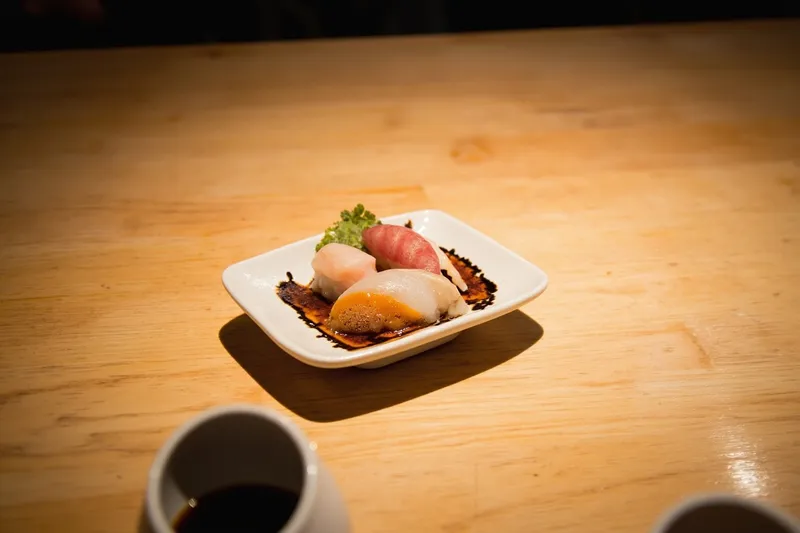
A recorded serving from April 2024 shows the logic of the meal better than any menu sheet.
- tai-noko – the first lean, clean bite.
- amadai – sweet white fish, barely cooked.
- kinmedai – deeper and oilier, resets the palate.
- kohada – gizzard mackerel, the first acidity.
- kasugo with a bainiku topping – young sea bream with liver on top.
- akami zuke – lean marinated tuna, the first tuna.
- chutoro – medium-fatty tuna, where the fat starts working.
- hotate – scallop, cool against the warm tuna.
- sumi ika – cuttlefish, ink and lime.
- kuruma ebi – tiger prawn, lightly cooked.
- uni mini donburi – sea urchin, the high point.
- anago – simmered conger eel, soft and smoky.
Then miso soup, half a torutaku and a warm tamago-yaki steamed egg custard to finish. The order is textbook: light white fish first, then the neta-mono and fatty tuna, uni as the peak, grilled and simmered items after, something warm and soft to close.
This is a recorded serving; the sheet moves with the season and with what the market has that morning. The branch also plays with the temperature of the rice (shari) against the parent counter's style, and the amount of rice per nigiri is left to you. Nutritionally it is a lean-protein meal built on tuna, with most of the salt arriving through the soy sauce and the miso soup.
Sake, wine and the drinks on top
Nihonshu sake and wine are the drinks the counter works with, and both sit outside the course price. That is why the average dinner spend on Tabelog lands in the ¥40,000–49,999 band while lunch sits in the ¥15,000–19,999 band: tea and water come with lunch, and a dinner with a sake pairing adds a layer the menu price hides. Own bottles are not allowed.
The bill stacks up in this order: the course, the ¥390 per-seat booking fee, then drinks. Tax is already inside the course price.
What the price covers and what the bill looks like
What the course price includes
Roughly $104 at lunch and $243 at dinner on a rough conversion without a fixed rate, so plan with the yen figures, which are on the OMAKASE listing, tax included. The course and the tax sit inside the number, and tea and water come with lunch.
Kept outside it:
- the ¥390 booking fee, charged per seat;
- sake, wine and other drinks;
- transport to Azabudai and parking;
- anything you buy at the neighbouring counters.
Payment is by credit card, from a listed set of brands: VISA, Mastercard, JCB, American Express, Diners and UnionPay. IC cards and QR-code payments are not accepted, so Suica and phone pay are no backup here. Turn on foreign transactions before you fly, keep the PIN in mind, and do not count on a tap. Children are welcome only if they eat the same course, so budget a full seat for them.
Prices move with the season
Seasonal fish pricing is the rule. The counter opened in March 2024 and prices rose on 1 April 2024: the dinner course was ¥33,000 from that date, so today's ¥38,500 is ¥5,500 more than a first-year guest paid. Lunch has held steady, at ¥16,500 then and still ¥16,500 for a lunch guest in autumn 2026.
Both numbers are on the OMAKASE listing and both move with the ingredients. For a trip budget, treat the lunch as the cheap way to test the counter: if the nigiri course lands well at ¥16,500, the evening course is a bigger bet on the same kitchen.
How to reach Sushi Saito Azabudai Hills Market
Two stations, one market, one floor down
Get off the train, find the market, go down one level and look for the Yamako tuna stall – the sushi counter is right beside it. Garden Plaza C holds several counters and it is easy to land at the wrong one, so the tuna supplier is the signpost worth trusting.
Two stations serve it. Kamiyacho Station is the closer one: exit 5, then two to three minutes on foot. Roppongi-itchome Station takes four to five minutes, 383 metres. Kamiyacho is on the Toei Hibiya Line, Mita Line and Oedo Line; Roppongi-itchome adds the Tokyo Metro Namboku Line, and the Toei station guide with the Tokyo Metro station guide have the exit maps. The nearest car parks are Azabudai Hills P2 and P5, though with a fixed seating time a car that has to be paid for twice is a poor way to arrive.
Walking times, and the eight-minute surprise
Official walking times and guest impressions do not quite agree, so leave yourself room.
- Kamiyacho Station, exit 5 – 2–3 minutes. A Tabelog guest in October 2026 put the same walk at roughly 8 minutes; the difference is the exit you use and how far into the market you go before the stairs.
- Roppongi-itchome Station – 4–5 minutes, 383 metres, and a quieter approach.
- After the meal – the market's public area and the plaza above are a couple of minutes away, so a meal here fits an evening with a walk afterwards and no extra train ride.
- By car – P2 and P5 are closest, but the seating time is fixed and the car waits for you.
Ten minutes early: entry control, bags, perfume
Azabudai Hills Market limits entry when it is busy, and what gets you through is your booking screen: staff admit guests who show the OMAKASE reservation. So screenshot the confirmation on your phone, and if you booked through Tabelog alone, check that screen is accepted too before you travel.
Two house rules change what you pack: skip strong perfume and fabric softener, and leave carry-on cases and large bags at the hotel, since the counter has no luggage space. Then be at your seat on time – the whole room is served one course at a time, so a late arrival means missing part of it. Closed Sundays and Japanese public holidays.
What guests say and what first-timers get wrong
The praise, from recent seasons
- The food scores highest. On Tabelog, food-and-taste marks reach 4.3 in reviews from autumn 2026, and the counter holds 3.77 from 423 reviews overall.
- It made the Tabelog 100 list for 2025, which is why it keeps showing up when people ask for the best sushi restaurant Tokyo.
- The fish comes from next door. Reviews in autumn 2026 point to the neighbouring Yamako tuna supplier and a course structure close to the parent counter's.
- It feels hidden. Tabelog tags the location as a hideout, and a guest in autumn 2026 described a sushi counter tucked into a corner of the market.
- The format works. A first-visit write-up from April 2024 timed the lunch as a full sitting rather than a snack stop, which tells you how to plan the afternoon.
The complaints, and what the design causes
- Value for money scores lower than the food. On Tabelog in autumn 2026, cost-performance marks run from 3.0 to 4.2 and often sit below the food score, because a dinner course of this price gains a drinks tab on top.
- Seats are hard to get. The recurring note in autumn 2026 reviews is that places fill quickly and cancellations are the way in; twelve seats, one seating and no walk-ins explain that. It is a capacity problem.
- Busy days can close the door. Entry control at the market turns up in autumn 2026 reviews as a source of stress, and it has nothing to do with your reservation unless you have the booking screen to show.
- The final bill surprises people. Tabelog's dinner average sits in the ¥40,000–49,999 band, mostly because sake and wine are counted on top of the course.
- The room is quiet. Twelve seats, one course, one conversation across the counter – focused and intimate rather than loud and social.
Rules that change what you do
- Allergies and dislikes: raise them when booking, not at the counter. Two or more items count as a cancellation.
- Payment: bring a card that works in Japan; IC cards and QR payments are not accepted.
- Luggage: leave the suitcase at the hotel, there is no bag space at the counter.
- Drinks: your own bottle is not allowed, so budget for sake and wine.
- Calls: the directory number is answered in Japanese only; everything runs through OMAKASE and Tabelog.
- Timings: one evening seating at 18:00, two lunch seatings at 12:00 and 13:30, closed Sundays and Japanese public holidays.
Two mistakes cost readers the most. The first is assuming plenty of seats appear in the first minutes of the release window: build the trip around that and you end up without a table. The second is arriving after your seating time, because the whole room is served in one go.
Is a Sushi Saito booking worth the fight?
The honest downsides
- The seat is the problem, not the food. Twelve places, one evening seating, no walk-ins, and the seats that appear tend to appear late.
- You pay by card from a limited brand list, and IC cards and QR payment do not work, so a card that fails leaves you with no second option.
- Cancelling costs half the course price close to the date and the full amount once it is the day before.
- The counter is served in one sitting for everyone at once. Nobody waits for you and nobody catches you up.
- No private room, no space for a suitcase, and one evening seating per night.
- It is a basement food hall counter: focused and quiet rather than a destination evening with a room of its own.
Who it suits
It suits a traveller who plans weeks ahead, watches the release calendar and wants the Saito name two minutes from a station. It suits people glad to buy one expensive lunch instead of two omakase dinners, since the entry point is the ¥16,500 lunch (OMAKASE listing), and who accept the evening course as a targeted spend.
It does not suit anyone hoping to walk in, anyone on a tight budget, or anyone chasing the pedigree of the Roppongi original and its Roppongi sushi tasting menu reputation. It also does not suit a loud group or a first date: twelve seats, one conversation, no privacy.
Elsewhere in the group, Sushi Tsubomi and 3110NZ by LDH Kitchen sit under the same oversight, and the Roppongi Sushi Saito counter is the one to try if the history matters more than the geography. For a different kind of evening, Sushi Zanmai in Tsukiji is cheap and famously reservation-free, while Sukiyabashi Jiro is the harder ticket.
Verdict and the booking checklist
Azabudai is a serious counter with young fish, a tight room and a price that does not pretend to be cheap. Guest reviews rate the food above the value for money, so I would not call it a rational-value meal – it is a target you decide to spend on. If the budget decides, take the lunch.
- Favourite the counter on OMAKASE and set an alarm for the next release, 1 December 2026 at 00:00 JST, which opens February 2027 dates.
- Pick two backup dates and check them daily for cancellations.
- Keep to hand a card that works in Japan, foreign transactions on, PIN remembered.
- Screenshot the booking confirmation – market staff look for it on a busy day.
- Arrive ten minutes before your seating, without a suitcase.
Book on the OMAKASE listing or through Tabelog. The next release opens February 2027 dates on 1 December 2026 at 00:00 JST.
What to check before your trip
- Open the OMAKASE listing and confirm the lunch and dinner prices for your visit date – both move with the season.
- Set an alarm for the next release on 1 December 2026, 00:00 JST.
- Make sure your date is not a Sunday or a Japanese public holiday.
- Check that your card works in Japan and that foreign transactions are enabled.
- Take a screenshot of your booking confirmation before you travel.
Questions readers ask
Can I walk in to Sushi Saito Azabudai?
No. The counter is reservation only and has no walk-in seats. Book through OMAKASE, which adds a ¥390 fee per seat, or through Tabelog.
How much is the cheapest way to eat here?
The lunch nigiri course at ¥16,500 with tax, roughly $104 on a rough conversion – the exact figure for your date is on the OMAKASE listing. The published price moves with seasonal ingredients.
When do bookings open?
On the 1st of each month at 00:00 JST, the whole month two months ahead goes live. The next release opens February 2027 dates on 1 December 2026, and the booking window runs to 31 January 2027.
What time are the seatings?
Lunch at 12:00 and 13:30, dinner at 18:00. The counter is closed on Sundays and Japanese public holidays.
Which station is closest, and can I pay with my phone?
Kamiyacho Station, exit 5, two to three minutes on foot; Roppongi-itchome Station is four to five minutes away. Payment is by credit card from a listed set of brands, and IC cards and QR-code payments are not accepted.
What if I have to cancel?
Three or more days before, you pay 50% of the course price; from the day before, the full course price. Allergies or dislikes covering two or more items count as a cancellation, so raise them when you book.