
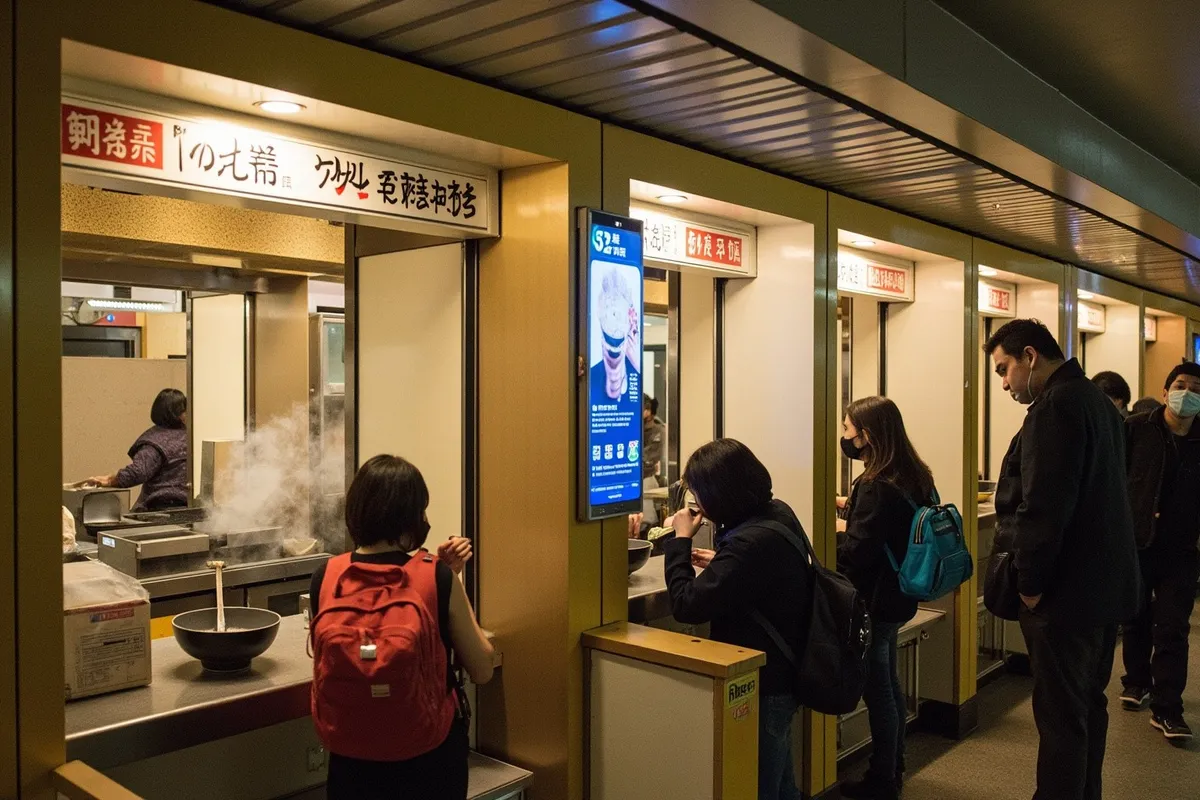
A Tokyo ramen guide usually lists twenty counters and leaves you with the same problem: every bowl arrives with broth, tare, oil, noodles and toppings, and no counter prints a calorie count for it. So I pulled the numbers on the places I would actually send a friend to – what the dials change, what the set contains, what the whole meal costs, and whether you can eat there on your own. Twelve counters, stalls and food halls made the cut.
Here, light means the shape of the order: less fat, less salt, less fried, smaller portion. Calories stay off the page, because no venue in this guide prints them for a bowl. That matters more than it sounds. A bowl of ramen is five parts – tare, aroma oil, broth, noodles, toppings – and the salt and fat ride in on two of them, which is exactly where an order can be changed.
The counters I compared, and the six rules that decided it
Selection criteria and what I left out
Tokyo has roughly 5,000 ramen shops and Japan more than 24,000, so a list without rules is just a list of names. These six decided what made it in.
- Tokyo only, walk-in, and a counter or stall where you order from yourself.
- A real lever to lighten the order: broth strength, fat level, noodle thickness, portion size, or a set you can edit when you order it.
- Something orderable without deep-frying, or a lighter option sitting right next to the heavy one.
- The full meal priced in yen: the bowl or set plus the extras the venue actually sells.
- Hours that fit an ordinary weekday.
- Counters whose own menus spell out their knobs, because that is what makes a light order repeatable.
What I left out: Kuromon, a market in Osaka rather than Tokyo. Kappabashi, a kitchenware street with no meal worth the detour. Sukiyabashi Jiro and Sushi Saito, where the seat comes through a hotel concierge or a booking and nothing on the menu can be edited at the counter. And tour brokers, who sell somebody else's meal. Two parks come back at the end of the article, but as a walk between meals rather than as a counter.
How I compared bowls, sets and counters
For every ramen counter I read the same four things. The dials: most menus let you set broth strength, fat level and noodle thickness, and the three names are identical from one board to the next, so bowls can be compared on one scale. The extras: a bowl is not a meal, so I priced what the venue sells beside it, because that is where the yen goes.
Then the mechanics, which change what you order: a ticket machine, a slip of paper, a number to wait for, a queue at the door. A hurried order is a heavier order.
And the salt. It hides in the broth, under the tare and the aroma oil that float on top. Two Japanese ideas help here: hara hachi bu, eating until you are about 80% full, and ichiju-sansai, one bowl of rice, one soup, one plate of protein and three small vegetable dishes. Both are about structure rather than a diet sheet, and the food culture galleries at the Edo-Tokyo Museum are worth a stop if you want the history behind the plate.
The shortlist side by side
Twelve rows, ordered by area so the geography holds together. The price column is what a full meal costs now, tax-inclusive where the venue says so; where a food hall prices each counter separately, the cell says that instead of a number. The light lever is the thing you can change when you order. Two more places sit in this article but not in the table: Tsukiji Outer Market, where you eat standing, and Ninben in Nihonbashi, a katsuobushi and dashi shop worth a stop before a ramen counter rather than a meal of its own.
| Counter | Area | Type | Full meal from (tax incl.) | Light lever | Hours | Watch-out |
|---|---|---|---|---|---|---|
| Ichiran Shibuya | Shibuya | Ramen counter, solo booths | from ¥1,180 | Order slip: broth strength, fat, noodle firmness, spice | 10:00–22:00 | Pork broth; not halal |
| AFURI Ebisu | Ebisu | Ramen shop, yuzu shio | from ¥1,290 | Yuzu shio instead of tonkotsu | 11:00–05:00 | Yuzu is sharp and salty |
| Tokyo Station Ramen Street | Marunouchi | Ramen food court, B1 | from ¥850; sides from ¥120 | Three dials printed on every menu | 10:00–20:00 | The Hasegawa pop-up ends 23 November 2026 |
| Tempura Kanda Honten | Kanda | Tempura set restaurant | from ¥1,050 weekday lunch | Skip the second rice round | Weekday lunch seat, then dinner | Free rice refills if you let them |
| Tonkatsu Maisen Aoyama Honten | Aoyama | Tonkatsu counter | from ¥1,990 a set | 100 g tenderloin or 130 g loin | Lunch and dinner | Sauce and salt arrive with the tray |
| Shinjuku Takashimaya food hall | Shinjuku | Depachika food floor, B1 | Priced per counter | Set lunch instead of a feast | 10:30–19:30 | Closed 1–2 January, shorter hours late December |
| Ginza Mitsukoshi food floors | Ginza | Depachika, B2 and B3 | from ¥150 for a drink | Bought-to-eat bakery items | Food floors into the evening | B1 is cosmetics, no food |
| Yurakucho Marui ITOCiA Food Avenue | Yurakucho | Food hall, B1 | Priced per counter | One dish instead of a set | Food hall into the evening | Pachinko hall next door |
| Daimaru Tokyo food hall | Marunouchi | Depachika food floor, B1 | from ¥1,000 a set | Regional set menus | Food floor into the evening | Connects straight to the trains |
| Azabudai Hills Market | Azabudai | Food hall, Garden Plaza C | from ¥391 | Choose a bowl over a plate | 10:00–20:00 | Each counter keeps its own hours |
| FamilyMart | Nationwide | Convenience store | from ¥138 a meal | kcal printed on the pack | 24 hours | Microwaved items add oil and salt |
| Sushiro | Nationwide | Conveyor sushi | from ¥120 a plate | Take one or two plates, no set | Seats into the night | Sets, not plates, are the expensive part |
How to eat ramen in Tokyo when you are watching your weight
The three dials: broth strength, fat level, noodle thickness
Most Tokyo ramen counters let you set three things, and the words are printed the same way on the boards: 薄め / 普通 / 濃いめ for broth strength, あっさり / 普通 / こってり for fat level, 細め / 普通 / 太め for noodle thickness. Ask for the first of each and you get the lightest version the shop knows how to make.
The families underneath those dials matter more than the labels. A shio bowl, whether yuzu shio or plain salt ramen, stays clear because pork bones, where used, are not simmered for as long as they are for tonkotsu. A chintan is a clear broth with a lighter body. Paitan is a white, opaque broth with fat on the surface. Tonkotsu is simmered hard and comes with the heaviest aroma oil of the lot. Order usume thin broth and assari light oil and you have a shio or chintan bowl with a lighter finish.
What to leave out: extra noodles (katemama), a second round of chashu, and any added oil that arrives as a slick on top.Cutting salt without losing flavour starts in exactly these three lines.
One sentence covers the whole order: 薄め (mild), あっさり (light), 細め (thin). Point at the line on the board. At Ichiran the ticket price stays the same whatever you choose.
AFURI Ebisu yuzu shio ramen as the lightest bowl to start with
If you want one bowl to start with, take the yuzu shio at AFURI Ebisu. It sits on the first floor of the 117 Building, a short walk from JR Ebisu Station, and the shop runs from 11:00 until 05:00, so it also covers the late end of an evening. The AFURI Ebisu shop page has the current menu and the route from the station.
The lightness here is structural rather than a claim on a poster. Yuzu shio carries less rendered fat than tonkotsu and less salt than a shoyu bowl drowned in tare and aroma oil, and the toppings are the ones that add volume rather than oil: chashu slices, menma bamboo shoots, nori sheets, spring onion and negaki. Add an ajitama egg if you want more protein without more fat.
What I would do: order the yuzu shio with the standard toppings, skip the extra chashu and any added oil, and leave the rest of the bowl alone. On my taste the yuzu is sharp enough that I would not build on it. Two cautions: the shop sits near the Ebisu evening crowd later on, and the yuzu itself is salty, so I would drink water rather than order a second bowl.
Ichiran Shibuya: solo ramen from a meal ticket machine
Ichiran Shibuya is the cleanest answer to eating a bowl of ramen alone. You buy a ticket from the machine, fill in an order slip, hand both to the attendant, and the curtain of your booth closes. The bowl comes from behind it. The booths take one person; there is no table seating and no private room. More of the solo-dining options around the city are in eating alone in Tokyo.
The slip is the menu. You tick broth strength, fat level, garlic, green and white onion, pork slices, spice level (karashi) and noodle firmness, and the price does not move for any of those. Only more than one clove of garlic, or spice above the standard level, costs extra. A lighter Ichiran bowl is therefore a slip, not a negotiation: light broth, less fat, no extra pork, standard spice.
Two practical details. Refills and extras go on a paper form pressed with a button at the table, and every booth has its own water tap, so you can drink as much water as you like without catching anyone's eye. And on the broth: Ichiran runs No Pork branches that swap in chicken and a dashi made without alcohol-based soy sauce or mirin. The ramen is not halal.
Would I skip it? If you want the counter theatre and the real tonkotsu, no. If the week is about keeping the sodium and salt in broth down, a tonkotsu bowl stays a heavy object even dialled down, because the fat is the point of that broth.
Tokyo ramen food courts and the department store basements
Tokyo Station Ramen Street: ten counters on B1 of First Avenue
Ramen Street sits on B1 of First Avenue, on the Yaesu side of Tokyo Station, outside the JR ticket gates, so you can reach it without a platform ticket. Ten kitchens line it: nine regular counters and one pop-up. Each counter has its own menu board and its own queue, so it works like a food court rather than one big shop. First Avenue's Ramen Street guide lists each counter with its own factsheet.
The nine regular names: Tokyo Niboshi Ramen Gyoku, Sora no Iro NIPPON, Rokurinsha, Shio Ramen Senmon Hirugao, Tonkotsu Ramen Oreshiki Jun, Tokyo Station Ikaruga, Hanamichian, Kakushinka TOKYO and Tsugaruniboshi Hirakoya. The tenth, Shokudo Hasegawa from Kitakata, is a temporary pop-up whose run ends on 23 November 2026. Lineups in a food hall shift, so read the board on arrival.
Every counter here prints a ramen factsheet with the same three dials, and two of them put extra weight on what they offer. Hirugao states that its shio ramen uses natural ingredients only, with no chemical seasonings. Sora no Iro NIPPON lists a gluten-free and a vegan ramen alongside shoyu, shio and vegetable soba. Oreshiki Jun simmers its tonkotsu in store for 24 hours, lets you pick extra firm, firm, normal or soft noodles, and serves the seasonings on the table so you can adjust the broth yourself.
The side dishes are the value part: melt-away bonito shavings over rice ¥350, a pork-and-burdock onigiri ¥120, a three-topping set ¥250, tonkotsu curry ¥380 and a chicken-and-egg rice bowl ¥380, plus two ¥480 plates of braised pork cubes and seared chashu. A bowl plus the ¥120 onigiri and a drink is still a cheap lunch in a building where most other meals cost three times that.
Depachika basements: Shinjuku Takashimaya, Ginza Mitsukoshi, Yurakucho Marui, Daimaru Tokyo
A department-store basement adds what a ramen counter does not have: a table, a chair, and a floor of choices that lets you build a light meal out of pieces. Shinjuku Takashimaya's food floor is on B1, Grocery and Gourmet Square, open10:30 to 19:30, with shorter hours in late December and early January and the store closed on 1 and 2 January. Ginza Mitsukoshi keeps its food on B2 and B3; B1 is the cosmetics floor, so if you are following the smell of a bakery you are on the right level and the wrong floor number.
Yurakucho Marui's food hall is ITOCiA Food Avenue on B1 of the building next door, 25 counters with a pachinko hall on the same floor: loud, bright and full of things you did not plan to eat. Daimaru Tokyo's food floor on B1 connects straight into Tokyo Station, which makes it the easiest of the four when you are catching a train afterwards.
What each is good for: Takashimaya for a sit-down set lunch, Mitsukoshi for confectionery and bought-to-eat bakery items at the counter, Yurakucho for a quick single dish while you wait, Daimaru for regional set menus from around Japan. Set menus in these basements are sold at lunch and only while the trays last, and side dishes are often ordered separately from the main counter, which is how a light order happens here: one main, one vegetable, nothing fried.
Order-flow quirks that change what you order
Five things decide what lands in front of you, and they are the reason a quick ramen and a careful ramen can be so different.
- A ticket machine at the door means you commit to a bowl before you see the queue. At Ichiran you have already chosen broth and toppings by the time you hand the slip over.
- Per-counter hours in a food hall. Azabudai Hills Market runs 10:00 to 20:00 and each counter inside keeps its own times, so a stall that looks open at 19:00 may have closed at 18:00.
- Set menus sold only at lunch, and only while the trays last. Miss the window and the same counter will sell you à la carte at a different price.
- Side dishes ordered separately. At a ramen counter the chashu, the egg and the extra noodles are additions; at a depachika the vegetable and the soup are additions. The main is where the set lives.
- Menus that shift. Lineups and prices in a food hall change without notice, so the board at the counter beats the list saved on your phone.
Tempura: keeping the meal light around the dipping sauce
Tempura Kanda Honten: weekday sets with refills
Tempura Kanda Honten does weekday lunch sets from ¥1,050, with rice, miso, tsukudani and pickles, and dinner sets at ¥2,200. That set is the useful part, because the light decision has already been made for you and the only real question left is how much rice you take.
What arrives is a small basket of battered pieces, shrimp and fish and vegetables, dipped rather than poured over. There is no panko in the batter, and that is the structural difference from a tonkatsu cutlet, where the crumb is the part that soaks up oil. Tempura also has an Edo pedigree: it was sold from outdoor yatai stalls along the riverside near the fish market, because frying indoors was treated as a fire hazard. You can follow that thread in the history of tempura, and the set on the table is that Edo habit in a modern tray.
The light edit is boring and it works: take the vegetable tempura and the shrimp, skip the second rice round, and treat the pickles and tsukudani as the vegetable part of the meal rather than as extras. The rice refills are free, which only means the price does not change if you take more, not that taking more is a good idea.
How a tempura order is built: sauce on the side, daikon on the plate
Order mechanics matter here more than at a ramen counter. You choose pieces from the counter, they are fried to order, and they come with a small dish of tentsuyu, a dipping sauce made from dashi, mirin and soy sauce, into which you grate daikon with the little grater on the plate. The daikon goes into the sauce. It is not a side vegetable.
That gives you three levers. Take fewer pieces and add vegetables. Grate a lot of daikon and use less sauce per piece, since most of the salt in a tempura meal arrives in that dish. And do not pour the leftovers over the rice, which is the quickest way to turn a light set into a salty one.
Structurally, a tempura set carries less weight than a breaded cutlet with rice, miso and sauce on the tray. The pieces are lightly battered, there is no crumb to soak oil, and the liquid comes in a cup you can leave. I would order the vegetable and shrimp pieces, one bowl of rice, and let the leftover sauce go on the vegetables.
Tonkatsu: a fried set that still fits the day
Tonkatsu Maisen Aoyama Honten: what the cutlet set costs
A tonkatsu set is the heaviest thing on this list, so start with the number: a set with a 130 g Chami pork loin cutlet is ¥1,990, and a 100 g tenderloin set is on the menu as well. The tray arrives with the cutlet, a bowl of rice, miso soup, a pile of shredded cabbage and a small pot of tonkatsu sauce.
What the dish is: a slice of pork, breaded in panko and deep-fried, eaten with shredded cabbage and sauce. Modern tonkatsu dates to the Meiji period, with a pork katsuretsu credited to Rengatei in Tokyo in 1899, as described in the history of tonkatsu. The set around it is the Japanese meal template: rice, soup, a vegetable and the main.
Two cuts are on the menu, and the small one is the sensible order when the day has already been heavy: the 100 g tenderloin set. Same tray, less pork. The cabbage and the miso are the parts that carry fibre and liquid, and the sauce is the part that carries the salt.
Honest note: this is a heavy meal, and it does not pretend otherwise. It fits a day because of what happens around it, not because of what is on the tray. How a smaller rice bowl changes a meal is the other lever, and it works here too.
Katsudon, katsu curry and katsu-sando: the same cutlet in other shapes
Three other ways to eat the same cutlet, and the sauce changes the salt load more than the pork does.
- Katsudon: the cutlet cut into strips under hot broth with egg over rice. No separate rice dish and no cabbage, so the whole plate drinks the sauce through the rice.
- Katsu curry: the cutlet on rice under a second layer of curry sauce. Two sauces on one plate, and curry salt sitting next to tonkatsu sauce.
- Katsu-sando: one breaded cutlet in a bun with shredded cabbage and sauce, no rice at all. The lightest of the three by structure, and the easiest to eat standing up.
The third one is what I would choose on a hot day, and the konbini version is worth knowing: FamilyMart sells katsu-sando and katsu curry with the calories printed on the pack, which saves you the guesswork a restaurant menu never gives you.
How the plate gets eaten at a tonkatsu counter
The light edit happens at the order, not at the table, but the table is where you can still steer it.
- Keep the cutlet and the rice apart for the first few bites, so the rice does not soak up the sauce.
- Put the shredded cabbage on the side rather than under the cutlet. Cabbage under a hot cutlet steams, softens and goes with the sauce, and you lose both the crunch and the volume.
- Let the miso be the liquid. It is the lightest thing on the tray, and it replaces the sauce as the drink with your food.
Two Japanese ideas sit well here. Hara hachi bu, stopping at roughly 80% full, is the easiest rule to keep at a counter where the set arrives complete. Ichiju-sansai, rice and soup and one protein and three small vegetable dishes, is the shape the set is borrowing from, and the cutlet is the protein.
Not ramen: konbini counters, market stalls and standing counters
FamilyMart healthy meals: counting calories before you pay
A konbini is the easiest light meal in Tokyo because the numbers are on the pack. FamilyMart says 215 of its 286 ready meals come in under 500 kcal, with a chain average of 392 kcal a meal. The counts move as meals are reformulated, so read the pack rather than trusting the average.
How I read a konbini label in ten seconds: kcal per 100 g first, because two items that look the same size can differ by 150 kcal; then sodium in mg, which matters more on a ramen day; then protein, which decides whether the meal will hold until dinner. Onigiri are the reliable choice. The microwaved items are where the weight hides, because a hot rice and a hot sauce bring their own oil and salt.
What I skip at the till is the drink. A canned coffee or a sweet tea can carry more sugar than the meal you just assembled.
Tsukiji Outer Market: a standing breakfast and dashi to take home
Tsukiji Outer Market is where I would start a morning, not where I would sit down for lunch. The outer market's shops welcome visitors from around 09:00 to 14:00, and after 14:00 each stall sets its own hours, so the cooked breakfasts sell out through the day. What is worth stopping for: tamago on a skewer, a bowl of chashu over rice, grilled fish, and the dashi shops.
Ninben is the dashi stop. Its head store is on the first floor of the COREDO Muromachi 1 building in Nihonbashi, and the company has sold katsuobushi and dashi since 1699. A bottle of dashi is not a meal, but it is what to buy before a ramen counter, because it changes what you order there.
Sushiro conveyor sushi and the Azabudai Hills food market: eating standing
Two more ways to eat without sitting down. At Sushiro a plate starts at ¥120 including tax, and the cheapest item on the belt is a small single piece; the price climbs by branch tier, and branches in central Tokyo sit above the entry level. Because you take plates one at a time, the set is opt-in, which is what makes it easy to stop at three pieces and walk away.
Azabudai Hills Market is the other. It is a food hall of 33 counters in Garden Plaza C, open 10:00 to 20:00, and each counter keeps its own hours, so a short visit is easy to plan: read the boards, pick a bowl rather than a plate, and eat it standing in the plaza.
Where to eat light in Tokyo, by scenario
Twenty minutes, under ¥1,500, on your own
The fastest light meal in the city: Tokyo Station Ramen Street. Ten kitchens on one floor, a ticket or a queue at the counter, and a bowl you can order thin, light and mild. The published sides make the arithmetic easy, since a pork-and-burdock onigiri is ¥120 and a three-topping set is ¥250. A bowl from ¥850, the ¥120 onigiri and a drink sit under ¥1,500, and the ¥250 topping set still fits inside that.
The runner-up is a convenience store. A FamilyMart meal from ¥138, with the kcal on the pack, beats any ramen when you have fifteen minutes and no patience for a queue.
A seated dinner when you want the real tonkotsu
For the one heavy dinner of the day, Ichiran Shibuya beats the counter at Maisen on control. You set the broth strength and fat level yourself, the ticket price does not move, and you eat alone in a booth with a curtain and a water tap of your own. Maisen is the better food and the worse deal for the day: a 130 g loin set at ¥1,990 arrives with rice, miso, cabbage and sauce, and the sauce is where the salt is.
My rule: if the day has been light, take the Maisen set and eat the rice with the cabbage and miso instead of the sauce. If the day has already been heavy, go to Ichiran, order it light, and stop there.
A whole day of eating out that stays light
One route that works, rather than a list of places. Stand for breakfast at Tsukiji Outer Market, then walk to Hama-rikyu Gardens, where adult admission is ¥300 and the tea houses are a quiet stop if you want to sit with something warm. Midday, a tempura set near Kanda at ¥1,050 and the afternoon in a park rather than another bowl.
In the evening, a depachika bite at Shinjuku Takashimaya, open on B1 until 19:30, or at Ginza Mitsukoshi, and Shinjuku Gyo-en National Garden afterwards, where entry is ¥500 for an adult and free for children under 16. Walking the garden on the way back is worth more than the second bowl would be.
Quick answers before you go
- How do I ask for a lighter bowl when the menu is in Japanese? Say 薄め (mild), あっさり (light) and 細め (thin). Every Ramen Street counter prints those three settings.
- What does a full meal cost with rice, miso and sides? A Ramen Street bowl from ¥850 plus a ¥120 onigiri; a Kanda tempura lunch set from ¥1,050; a Maisen cutlet set at ¥1,990.
- Can I eat alone? Yes. Ichiran Shibuya has single-person booths with a curtain, most counters have stools, and a food hall is the easiest option of all.
- Do I need a ticket, a number or a booking? A ticket machine at Ichiran, a queue everywhere else. Bookings belong to the sushi counters, not to ramen.
- Halal, no pork, vegan, gluten-free? Ichiran's No Pork branches use chicken broth and alcohol-free dashi, and the ramen is not halal. Sora no Iro NIPPON at Ramen Street lists a vegan and a gluten-free ramen.
- What if a counter offers no light option? Order the shio or chintan, leave the tare and the fried sides, ask for less if they offer it, and add a vegetable dish.
- What changes under you? Food hall lineups and prices move without notice, the Hasegawa pop-up's run ends on 23 November 2026, and Ichiran's 24-hour Dotonbori branch has been closed since a fire in August 2025.
What to check before you travel
- Read the price board at the counter on the day: bowls, sets and food hall stalls move.
- Check the hours of the specific counter, not the building. AFURI Ebisu runs into the early morning, Ramen Street and Azabudai stalls each keep their own times, and depachika food floors close around 19:30.
- Look for Shokudo Hasegawa at Ramen Street before you build a plan around it, since the pop-up's run ends on 23 November 2026.
- Check that the Ichiran branch you want is open, since the 24-hour Dotonbori main branch has been closed since a fire in August 2025.
- Set menus and garden admission change with the season and with events, so read the sign at the stall or at the gate.