
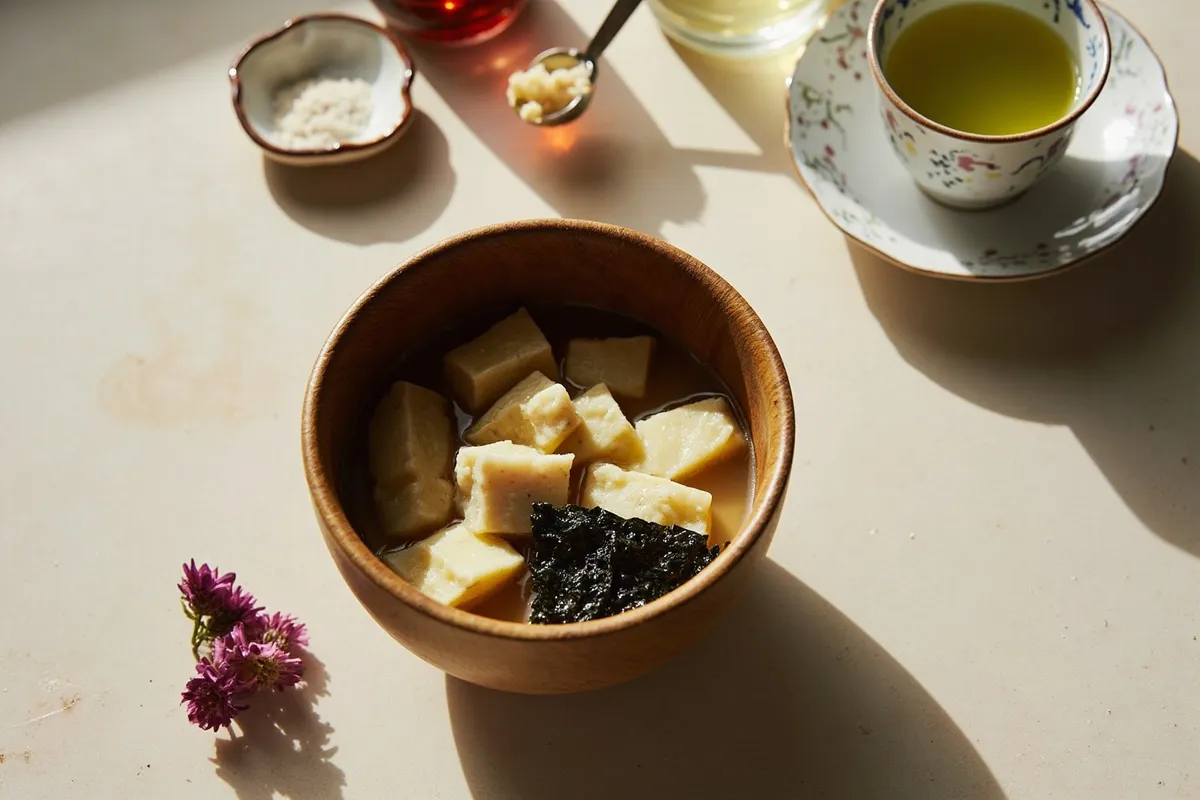
A low sodium Japanese diet is mostly a dashi problem, not a willpower problem. One US teaspoon of table salt holds about 2,400 mg of sodium, more than the federal limit of under 2,300 mg a day for teens and adults, and the average American intake sits above 3,300 mg with soups, sauces and deli-style sandwiches leading the list.
Globally the picture repeats: WHO's most recent estimate puts adult intake at 4,278 mg of sodium a day in 2021 against a target under 2,000 mg, and an estimated 1.7 million deaths in 2023 were linked to eating too much salt. One detail trips people up. WHO's “about one teaspoon” means 5 g of salt, or 2,000 mg of sodium, while a US teaspoon of table salt is nearer 6 g, or 2,400 mg.
- A 7-day menu with a sodium number for every day and the counting method behind it.
- Dashi recipes with weights and times, including kombu-free versions.
- A label decoder for claims like “low sodium” and the sodium disclosure statement.
- A starter shopping list with US prices observed in 2026.
This plan is written for teens and adults; children's sodium limits are lower and different, and the basics of the Japanese diet explain the eating pattern behind it. It suits anyone told to cut sodium, and anyone who eats Japanese food most days and feels thirsty afterwards. The shape of it is a healthy Japanese meal plan with low salt: rice, three small dishes, and a broth you make yourself.
Anyone with kidney disease, on blood-pressure medication or on diuretics should talk to a doctor before changing salt intake, and before trying a potassium-based substitute. What follows is kitchen advice, not medical advice.
Every anchor here is a US one: the 2,300 mg federal limit, FDA labelling rules, USDA reference data. Elsewhere the label rules differ, and that has its own section.
Japanese Food High Sodium: Soups, Sauces, Pickles and Pantry Staples
Soups, Sauces and Pickled Sides: Where the Sodium Loads
Sodium in Japanese food arrives through a short list of carriers, and every one of them can be handled at the table rather than in the pantry. CDC's top-sources list names soups and processed poultry, and a Japanese meal is mostly broth, a sauce and something pickled beside it.
| Item | Sodium | Share of the 2,300 mg limit |
|---|---|---|
| Retail miso soup bowl, 168 g | 870 mg | 38% |
| Homemade bowl: 1 tsp miso in unsalted dashi | about 190 mg | 8% |
| Shoyu, 1 Tbsp (16 g) | about 880 mg | 38% |
| Miso paste, 1 Tbsp (17 g) | about 634 mg | 28% |
| Table salt, 1 tsp | about 2,400 mg | 104% |
Two of those rows are USDA category averages for soy sauce and prepared miso, not one brand, so they are not a brand comparison. The 870 mg figure is a single product's label for a 168 g bowl, not what every miso soup on a shelf contains. Brand-by-brand numbers sit further down.
- Broth and tare (shio, tonkotsu, tsu-shio). Order the seasoning base on the side, skip the refill, and leave some broth in the bowl.
- Miso. One teaspoon in two cups of homemade unsalted dashi, and no second spoonful dropped in at the end.
- Toppings (chashu, tsukune, marinated egg). Skip the marinated egg and the glazed chashu, or ask for one topping only.
- Tsukemono and soy dips. Take the pickles as a side rather than a garnish, and put any dip in its own dish.
Salt is not the only sodium source. Monosodium glutamate, baking soda and sodium nitrate all arrive with sodium attached, and the last one is used as a preservative in cured meat. On a label, “sodium” covers all of it.
The classic beginner's mistake is putting shoyu and miso in the same bowl and then adding a pickle garnish on top. Three carriers in one serving, and none of them measured.
Reading Food Labels on Japanese Groceries: Claims, Thresholds and the Sodium Disclosure Statement
Two different sets of numbers are printed on American packs, and they get mixed up constantly. One set decides whether a phrase like “low sodium” is legal. The other decides whether the pack has to admit how salty it is.
| Claim on the pack | What it means under 21 CFR 101.61 |
|---|---|
| Low sodium | 140 mg or less per reference amount customarily consumed (or per 50 g when that reference amount is 30 g or less) |
| Very low sodium | 35 mg or less on the same basis |
| Sodium free | less than 5 mg on the same basis |
| Reduced sodium / less sodium | at least 25% less than an identified reference food, with the reference food named and the percentage right next to the claim |
| No salt added / unsalted / without added salt | not a sodium claim at all; the panel must carry “not a sodium free food” or “not for control of sodium in the diet” |
| Product type | When “See nutrition information for sodium content” is required (21 CFR 101.13(h)) |
|---|---|
| Any food | more than 480 mg per reference amount customarily consumed, or per 50 g when the reference amount is 30 g or less |
| Meal products | more than 960 mg per labelled serving |
| Main dish products | more than 720 mg per labelled serving |
The 480 mg trigger is measured on the reference amount customarily consumed, while 960 mg and 720 mg are measured on the labelled serving. A product with a large reference amount can therefore sit above 480 mg quite legally, with no disclosure at all.
The rules live in 21 CFR 101.13, 101.61 and 101.62, and the sodium thresholds have not shifted: the claim rules in 21 CFR 101.61 and the disclosure rules in 21 CFR 101.13 have both been unchanged since 2017, with the last amendments to the disclosure rule filed in 2025.
For anything bought outside the US, convert instead of hunting for a US claim: 1 g of salt equals 400 mg of sodium. A jar labelled 2 g salt per 100 g is 800 mg of sodium per 100 g.
One habit pays for itself: in the Asian aisle, turn the packet over and read the reference amount before anything else. If it does not match the portion you would actually eat, every claim on the front becomes decoration.
Outside the US: The Same Rules Do Not Apply
Claim thresholds and daily targets are country-specific, so the number on the pack wins. In the EU, Regulation 1169/2011 Annex III sets “low salt” at 0.5 g salt per 100 g, “very low salt” at 0.125 g, “without salt” at 0.005 g, and “reduced salt” at 25% below the reference product.
| What the pack says | What it means in sodium |
|---|---|
| 0.5 g salt per 100 g | 200 mg sodium per 100 g |
| The same jar, a 150 g pot | 300 mg sodium in the pot |
US prices and label rules are the anchor here; prices outside the US are not quoted in this article, and the pantry workarounds live in the shopping list.
A Low-Sodium Japanese Diet Starts with Dashi You Make Yourself
Awase Dashi: Kombu Glutamate and Bonito 5′-Inosinate for Umami Without Salt
The broth is where the salt goes, so it is where the work goes. Awase dashi, the combined broth, needs two ingredients and about an hour of waiting, most of it unattended.
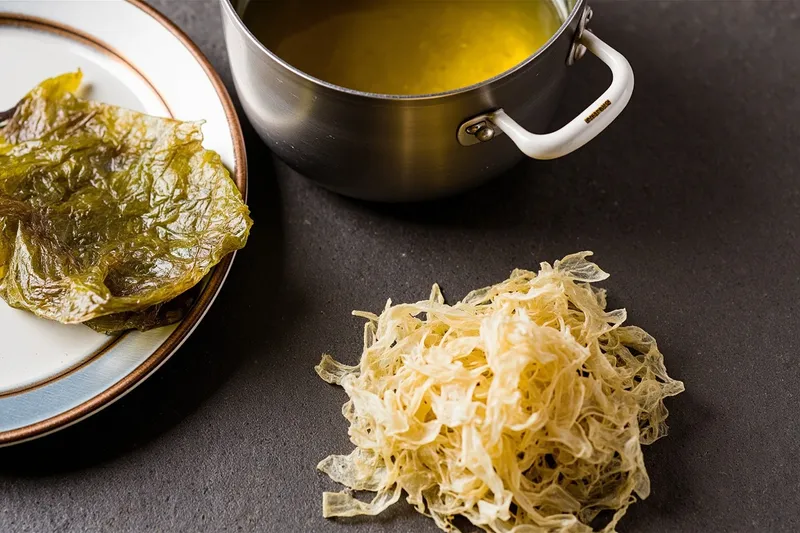
| Step | What I do | Time |
|---|---|---|
| 1 | Wipe a 10 g piece of kombu and put it into 1 L of cold water | 30 to 60 min, cold, never boiled |
| 2 | Lift the kombu out, add 10 g katsuobushi and take the pot off the heat | 1 to 2 min |
| 3 | Strain through a cloth without pressing the bonito | 5 min |
No salt goes in at any step. The only sodium in the finished bowl is what the kombu and the bonito bring with them, so I treat the result as unsalted and season the pot afterwards, not during.
Why two ingredients work: kombu is the glutamate side, with 1,200 to 3,400 mg of glutamic acid per 100 g of dried kelp, and bonito is the other side, with 470 to 800 mg of 5′-inosinate per 100 g of dried flakes. Mixed together they taste roughly 8 times stronger than glutamate alone. That is a claim about taste, not about sodium, and it is the whole trick.
Two ways to ruin it: boil the kombu and it goes bitter and slimy, and leave the bonito sitting in hot water for minutes and it flattens out into a tired fishiness. Cold water for the kelp, hot but not boiling for the flakes.
Kombu-Free Broths: Shiitake Dashi, Niboshi and Dried Porcini
Kombu is the easy one to get, so the interesting question is what to do when you want a different bowl, or when the kelp is expensive.
| Ingredient | Flavour it delivers | Sodium | Prep note |
|---|---|---|---|
| Dried shiitake | Its own glutamate plus 5′-guanylate, around 150 mg per 100 g | No added salt; the sodium comes from the mushroom itself | A real soak and a slow simmer, not a quick dunk |
| Dried porcini or morel | Stands in for the bonito side, deep and woody | No added salt; the sodium comes from the mushroom itself | Soak, then pour the soaking liquor into the pot |
| Niboshi (dried anchovy) | A cheap bonito stand-in with a strong fishy edge | No added salt; the sodium comes from the anchovy | Simmer, then strain twice, bones and all |
| Kombu plus dried shiitake | The simplest kombu-free bowl I cook | As above | Simmer the shiitake, add the kombu near the end |
Niboshi and dried fish give you fishiness, not the neutral body that kombu gives. If a bowl tastes thin and green rather than round and marine, that is usually the missing kombu, and more bonito will not fix it.
Dried shiitake given a brief rinse and ten minutes in the pot gives a pale, weak broth. Give it 30 minutes of soaking and a gentle simmer, and keep the liquor, because most of the flavour sits in the water.
A Low-Sodium Dashi Recipe: Scratch vs. Store-Bought Concentrate
Concentrate is not scratch dashi and it is not a flavouring drizzle. It is a shelf-stable stock concentrate that people keep using as if it were water.
| Scratch dashi | Concentrate | Blocks or powder | |
|---|---|---|---|
| Prep | 40 to 60 min, mostly waiting | 1 min | 1 min |
| Sodium | No added salt; only what the kombu and bonito bring | Read the label, then pour less than called for | The saltiest of the three in my kitchen |
| Flavour | Clean, lightly marine, very adjustable | Good and strong, easy to overshoot | Heavily seasoned, closer to a soup base |
| Salt you add | None | None if you use less than the label says | Usually none |
Reading a concentrate: take mg of sodium per serving, divide by the serving size in ml to get mg per ml, then multiply by the amount you actually pour. Kikkoman's Less Sodium soy sauce lists 590 mg per 15 ml, which is 197 mg for a 1 tsp pour. Cost works the same way: bottle price divided by servings per bottle, times the number of bowls you get from it. A 20 fl oz bottle at about $15.95 with 39 servings works out near $0.41 a tablespoon.
- Read the number per serving, not per bottle. The bottle total tells you nothing about a single pour.
- Use less than the label calls for, then season the bowl at the table.
- Rebuild the body with a piece of kombu if the concentrate tastes thin.
- Keep the soy sauce out of the pot and in a dish on the table.
Using a concentrate as if it were unsalted dashi is the standard mistake, and it is the reason restaurant soup at home tastes saltier than it did out.
Storage: homemade dashi keeps in the fridge for a few days, and I freeze it in ice-cube trays for longer. For beyond that I boil it down and freeze that, though I trust the ice cubes more than the concentrate.
Soy Sauce Alternatives for Japanese Cooking, Checked by the Numbers
Tamari, Shoyu and Reduced-Sodium Bottles by the Numbers
Switching to a lighter bottle only works if you know what the swap actually saves. Here is what the panels say.
| Bottle | Sodium | Taste and use | Gluten |
|---|---|---|---|
| Shoyu, USDA category average | about 880 mg per Tbsp (16 g) | The full-strength benchmark | Usually wheat |
| Kikkoman Less Sodium Soy Sauce | 590 mg per 15 ml, 26% of the daily value | Rounder and slightly sweeter; good in braises | Contains wheat |
| Kikkoman 50% Less Sodium Gluten-Free Tamari | 470 mg per Tbsp, 20% of the daily value | Smoother, less assertive | Labelled gluten-free |
The Kikkoman Less Sodium bottle lists water, soybeans, wheat, salt, alcohol and lactic acid, and finishes with more than 2% alcohol by volume from fermentation. That is a brewing artefact, not a drink.
- Stir shoyu in during the last third of a braise or soup, not at the start, so the flavour stays bright.
- About 1 Tbsp per pound of ground beef in a patty is the maker's own suggestion.
- Season to 1 tsp per serving rather than 1 Tbsp. That is about 197 mg of sodium, derived from the 590 mg per tablespoon figure.
- Refrigerate the opened bottle and use it within about a month.
- Choose tamari for gluten, but only the bottle that is labelled gluten-free. Tamari as a style is not automatically lower in sodium either.
The 470 mg tamari is lower because it is a specific reduced-sodium product, not because it is tamari. A regular tamari from the same shelf can sit well above the less-sodium shoyu.
The maker says roughly 40% of the salt is removed after fermentation and ageing are complete, and that this Less Sodium bottle has 38% less sodium than the regular soy sauce. Two numbers from the same label; the 590 mg per tablespoon on the front of the bottle is the one I check.
Miso: Shiro, Red and Shinshu as a Seasoning, Not a Base
Miso is the most concentrated salt in the average Japanese pantry, and it is used as a base when it should be used as a seasoning.
| Style | Colour and strength | Typical dish | Sodium note |
|---|---|---|---|
| Shiro miso | Pale, sweet, mild | Clear soups, dressings, light seasoning | Salt comes mostly from the fermentation |
| Red miso | Dark, salty, long-aged | Stews, marinades, red miso soup | Salt builds over the aging |
| Shinshu miso | Yellow-brown, punchy, high wheat | Curries, dipping sauces, hot pot | Wheat adds body and more baking |
The USDA figure for prepared miso is 3,728 mg of sodium per 100 g, which works out to about 634 mg per tablespoon of 17 g, or roughly 28% of the 2,300 mg limit. That figure has no split by style, so a per-style number has to come from the brand's own panel.
- One teaspoon of paste is roughly 5 to 6 g, so a bowl made with 1 tsp in 2 cups of unsalted dashi lands at about 190 to 225 mg. The 190 mg figure is the low end.
- Use 1/3 to 1/2 tsp in the bowl and keep the rest of the spoonful for cooking.
- Dissolve the paste in a ladle of hot dashi first, and never boil the finished soup.
- Buy a 270 g tub and refrigerate the opened jar.
For the full comparison: a homemade bowl sits near 190 mg of sodium, while a 168 g retail miso bowl carries about 870 mg. If you want the step-by-step version at home, the homemade miso soup recipe covers the pot side in detail.
If you want something from a cupboard instead, a reduced-sodium miso cup with 65% less sodium than the standard version, sold as a 4-pack for $5.19 on the brand's own store, is the one I keep at the office. It is a brand-store price, not a supermarket shelf price.
Other Salty Swaps: Ponzu, Furikake, Usukuchi Shoyu and Bottled Dressings
These are the quiet offenders, because each one adds salt to food that was already fine.
- Store-bought ponzu. Half ponzu, half rice vinegar, and a measured teaspoon of reduced-sodium shoyu at the end.
- Usukuchi shoyu. A lighter colour and a paler flavour, but not automatically less sodium. It is often sweetened, so read the panel.
- Store-bought furikake. Usually salted. Make your own from sesame, nori and dried bonito.
- Seaweed and crackers. Unsalted versions, straight from the packet.
- Pickled ginger and scallion. The finishing hit, with no added salt at all.
- Citrus. A squeeze of yuzu or sudachi does the work of another splash of shoyu.
WHO's own list for cutting sodium runs along the same lines: use herbs and spices instead of salt, and limit commercial sauces, dressings and instant products. The full list sits in the limits section, in one place.
Building a Low-Sodium Japanese Diet: A Healthy Japanese Meal Plan, Low Salt
The Plate Formula: One Bowl, Three Dishes and No Salt Shaker
Washoku as it was built in my grandmother's kitchen was not a low-sodium system. It was a low-salt one, because the seasoning was controlled by the cook and served in small dishes in the middle of the table. That is the version worth copying, and how a washoku tray is actually built is worth a separate read.
The formula is simple: one bowl of rice, three small dishes, and a set of salty carriers decided before you start cooking. The four carriers are shoyu, miso, dashi and the salt shaker, and the shaker gets removed from the table on day one.
Weekday breakfast, ten minutes: one onigiri with an unsalted filling, a small bowl of miso soup from a 1 tsp dab of miso whisked into hot dashi, and a slice of ginger. The miso and the onigiri filling are what count. Plain rice, water and green tea do not.
For protein, tofu is the cheapest anchor in the plan. Regular tofu prepared with calcium sulfate carries about 8.7 mg of sodium per half cup (124 g), and firm tofu about 17.6 mg per half cup (126 g). Salt the tofu if you like, but keep the soy sauce for the table, because a dip cancels the whole saving.
Seven-Day Menu With Sodium Numbers
How these numbers were counted: only items with a label or a published figure are counted, totals are rounded to the nearest 50 mg, and table condiments, drinks and restaurant items are excluded. Every daily total below is an estimate until it is recalculated against the packs in your own shop. Any day that lands above 2,300 mg gets re-cut before it goes out.
| Day | Breakfast | Lunch | Dinner | Daily sodium | Note |
|---|---|---|---|---|---|
| Mon | Onigiri, unsalted filling, 1 tsp miso soup | Grilled tofu, rice, 1 tsp shoyu on the side | Simmered salmon, spinach, rice | about 1,150 mg | Tofu carries the protein all week |
| Tue | Rice bowl with 1/2 tsp tamari | Leftover tofu and greens, no sauce | Oyakodon with one measured spoon of shoyu | about 1,400 mg | Oyakodon takes a spoon, not a pour |
| Wed | 1 tsp miso soup and rice | Sashimi with the soy on the side | Chicken steamed with ginger | about 1,250 mg | Nothing salted on the tray |
| Thu | Onigiri with no filling | Chilled tofu and unsalted edamame | Yakisoba with measured shoyu | about 1,700 mg | Noodles are a sauce dish, so measure it |
| Fri | Miso soup, 1 tsp, with rice | Bento packed at home, seasoning separate | Tempura with lemon and a measured pinch of salt | about 1,550 mg | A bought bento would eat this budget |
| Sat | Rice and soup | Sushi with soy on the side | Curry rice with a small ladle of sauce | about 1,900 mg | The sauce carries the salt, not the rice |
| Sun | Rice with miso soup | Nabe in homemade dashi | Grilled fish and pickled ginger | about 1,300 mg | Nabe broth is your own dashi |
| Instead of | Order or cook | What actually changes |
|---|---|---|
| Ramen with chashu | Same broth, tare and chashu on the side, half the noodles, smaller bowl | The sodium sits in the tare and the broth, so you control both |
| Store-bought onigiri | Homemade onigiri with an unsalted filling, no mayonnaise sachet | The filling carries the salt, the rice does not |
| Tempura with the tare | Tempura with lemon or yuzu and a measured pinch of salt | A bottled tare becomes a pinch you control |
| Inari sushi | Chilled tofu or unsalted edamame, seasoned rice on the side | The inari rice is salted and sweetened; the wrapper is not |
For bento, pack the seasoning separately and leave out the furikake and the kamaboko. A bento bought ready-made can rival the sodium of the rest of the day or exceed it, since the rice is usually seasoned with soy sauce and sugar before it goes in the box.
Two swaps that are not swaps: salted edamame is just edamame with salt, and the seasoning in inari sits in the rice, not in the wrapper. Swap the rice and keep the wrapper, and you have not changed anything.
The Starter Pantry and Shopping List: Kombu, Katsuobushi, Miso, Tamari
A working Japanese pantry for low-sodium cooking is seven items, and you can pick them up in one aisle trip plus the salt aisle.
| Item | What it is for | Price observed in the USA (USD, 2026) | Substitute if unavailable |
|---|---|---|---|
| Dried kombu | Glutamate for dashi | about $4.98 per 1.76 oz pack, about $10.00 per 4 oz pack | Dried shiitake and dried porcini |
| Dried katsuobushi flakes | The bonito half of awase dashi | about $11.39 per 100 g, about $12.99 per 20 g | Niboshi |
| Kikkoman Less Sodium soy sauce, 20 fl oz | Table soy at 590 mg per 15 ml | marketplace listings from $15.95 | Tamari with a gluten-free label |
| Reduced-salt miso paste | Seasoning, 270 g pots | about $42.66 for two pots | Plain miso, used in smaller amounts |
| Potassium-based salt substitute | The shaker replacement, if a doctor clears it | about $6.22 per 11 oz bottle, about $6.34 per 3 oz tub | Plain salt, used sparingly |
| Reduced-sodium miso cups | Cupboard soup | $5.19 per 4-pack on the brand's own store | Make a batch of dashi and freeze it |
- Buy once: kombu, katsuobushi, dried shiitake, rice vinegar, miso, one reduced-sodium shoyu and a bottle of toasted sesame oil.
- Check on the pack: sodium per serving, the serving size, the percentage daily value, and whether the reference amount matches the portion you really eat, a whole package or a restaurant bowl included.
If your shop has no low-sodium version of something, the workarounds are simple: dried shiitake and kombu instead of a ready-made stock, rice vinegar plus roasted sesame instead of bottled dressings, reduced-sodium miso from the Asian aisle, and a potassium-based substitute in the ordinary salt aisle.
US prices, observed in 2026; they move by store and city. Prices outside the US are not quoted here, so check your own supermarket. One retailer stocks a garlic-flavour variant of the less-sodium soy sauce but shows no price for it.
Eating Out: Reducing Salt in Japanese Food Without Losing the Meal
Ramen, Soup and Rice-Bowl Orders: What to Ask For
Reducing salt in Japanese food when you are eating out is a matter of where the seasoning sits, and most kitchens will move it if you ask in the right way.
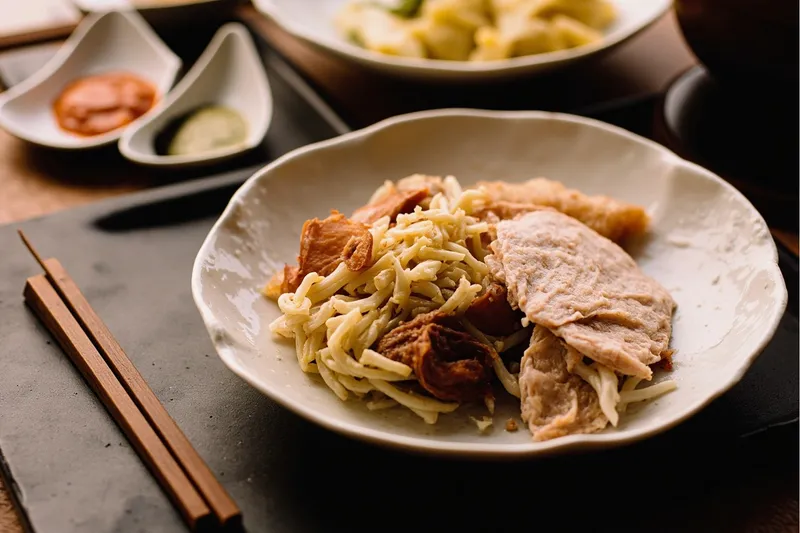
- Order shio ramen with the tare, the seasoning base, served on the side.
- Ask for a smaller bowl with half the noodles.
- Order dipping noodles with a small cup of concentrated dipping broth, and leave the soup behind.
- Skip extra chashu and the marinated topping on the boiled egg.
- Have the gyoza steamed rather than pan-fried. The sauce is the salt, not the cooking method.
- Ask for extra shoyu and the pickles on the side.
Phrases that work, with the Japanese to show the server: あっさりお願いします (assari onegaishimasu, light please), 醤油は別々に (shōyu wa betsu ni, soy sauce on the side), 塩は控えめに (shio wa hikaeme ni, go easy on the salt). For ramen, 味汁は別々でお願いします (ajishiru wa betsu ni onegaishimasu, the seasoning base on the side please). A busy kitchen may hear “taste on the side” and hand you the stock, so the English fallback matters: “Could you put the seasoning base in a separate bowl and I will add it myself?”
None of the label rules work here. A restaurant bowl can carry a whole day's sodium, and there is no panel to check it against. A 168 g retail miso bowl alone shows 870 mg, and a restaurant version is usually a larger version of the same thing.
Sashimi, Tempura, Tonkatsu and Inari: Which to Watch
Some dishes at a Japanese table are salty by construction, and some are only salty by accident. It helps to know which is which.
| Dish | Where the salt sits | The lighter version |
|---|---|---|
| Sashimi | Wasabi carries the heat, the soy carries the salt | Ask for the soy on the side |
| Tempura | Salt on the crust, bottled tare beside it | Ask for the tare on the side |
| Tonkatsu | Tartar sauce and the sauce under the cutlet | Tartar on the side, half the cutlet |
| Inari | The sushi rice is salted and sweetened, the wrapper is not | Ask for the seasoned rice plain, or take chilled tofu or unsalted edamame |
| Tendon and katsu-curry | The sauce and the curry roux | Ask for the sauce in a side dish |
| Chawanmushi | The topping cup | Skip the topping |
- Leave the salad dressing bottle alone, or take the leaves plain.
- Order chawanmushi without the topping cup.
- Skip the extra pickles, and do not let them replace a side dish.
- Take half of the simmered vegetables, which arrive in sauce.
Anyone with kidney disease or on diuretics should treat restaurant sodium as a conversation with their doctor rather than a menu puzzle. The limits section below covers who needs that caution.
Limits, Risks and the Verdict
Potassium-Based Salt Substitutes and Other Tools, With Their Limits
WHO's practical list for cutting sodium, applied to a Japanese pantry, runs to six steps and I keep it on the fridge.
- Eat mostly fresh, minimally processed foods.
- Take the saltshaker off the table.
- Cook with little or no added salt.
- Use herbs and spices instead of salt.
- Limit commercial sauces, dressings and instant products.
- Choose lower-sodium or low-sodium products.
Then there is the other list, the things that do not move the number much: kombu, katsuobushi and dried mushrooms; MSG in a normal amount; lemon, vinegar and ginger; seaweed. They add little or no salt compared with the shoyu or miso they replace, but “no added salt” is not “sodium free”, and any packaged seaweed, dashi or furikake still carries its own sodium.
Potassium-based salt substitutes are not a free swap. Anyone with kidney disease, on ACE inhibitors or ARBs, on potassium-sparing diuretics, or with high potassium should ask a clinician before using one. The product label and a clinician's advice come before anything written in an article like this.
Two more points from WHO. All salt that is consumed should be iodised, and kombu, while a natural iodine source, varies wildly from batch to batch, so a kelp-heavy dashi plan is not a replacement for iodised salt. Front-of-pack labelling is also one of WHO's four best-buy policies for sodium reduction, and it is not something you can do from your kitchen.
| Substitute | Price observed in the USA (USD, 2026) | Check on the panel |
|---|---|---|
| NoSalt Original, 11 oz bottle | about $6.22 | Sodium and potassium per serving |
| Nu-Salt, 3 oz tub | about $6.34 | Sodium and potassium per serving |
Both are potassium chloride products, so “sodium free” on the front does not mean potassium free on the panel.
FAQ: Portions, Substitutions and Ordering
How much miso goes into one bowl? About 1 teaspoon, roughly 5 to 6 g. Whisked into 2 cups of homemade unsalted dashi that lands at roughly 190 to 225 mg of sodium.
Is tamari lower in salt than shoyu? Not by itself. Tamari is a style, not a salt level. Kikkoman's 50% Less Sodium Gluten-Free Tamari lists 470 mg per tablespoon, against 590 mg for its Less Sodium Soy Sauce.
Can I use a dashi concentrate? Yes, but read the label: find mg of sodium per serving, divide by the serving size in ml, then multiply by what you actually pour in. Use less than called for and season the bowl at the table.
Is restaurant miso soup the same as mine? No. A 168 g retail miso bowl carries around 870 mg of sodium. A homemade bowl with 1 tsp of miso in unsalted dashi lands near 190 mg.
What if I need to stay below 2,300 mg a day? That target is set with your doctor. The Dietary Guidelines for Americans use 1,500 mg a day for people with hypertension, so ask for your own number before you start.
The verdict below turns this into a shopping list you can start this week.
The Verdict: What a Low-Sodium Japanese Diet Looks Like in Practice
Pick the version that matches your week rather than the strictest one on paper.
- The simplest version. Make one batch of dashi and cap the salty fourth at the table: shoyu, miso, dashi, and nothing from the shaker.
- A stricter target. A clinician sets it, often around 1,500 mg a day, and then miso moves to a third of a teaspoon and the shoyu goes on the side of the dish rather than into it.
- You eat out two or more times a week. Order the tare on the side, leave broth behind, and stop the double dip.
The numbers behind those choices: one tablespoon of shoyu averages about 880 mg of sodium, the global mean intake in 2021 was 4,278 mg a day against a WHO target under 2,000 mg, and an estimated 1.7 million deaths in 2023 were linked to excess sodium. WHO also estimates at least a 12-fold return for every dollar invested in sodium reduction programmes, which is its own global estimate rather than a promise to you.
Next seven days: make one batch of dashi and freeze half of it in ice cubes; move the saltshaker off the table; measure miso with a teaspoon instead of the spoon you dip in; read the sodium panel before you put anything in the basket; and review the numbers once, on the seventh day.
If you change one thing, change the broth. Everything else on this list gets easier once the dashi is already right, and the miso, the soy sauce and the tare stop being the problem.