
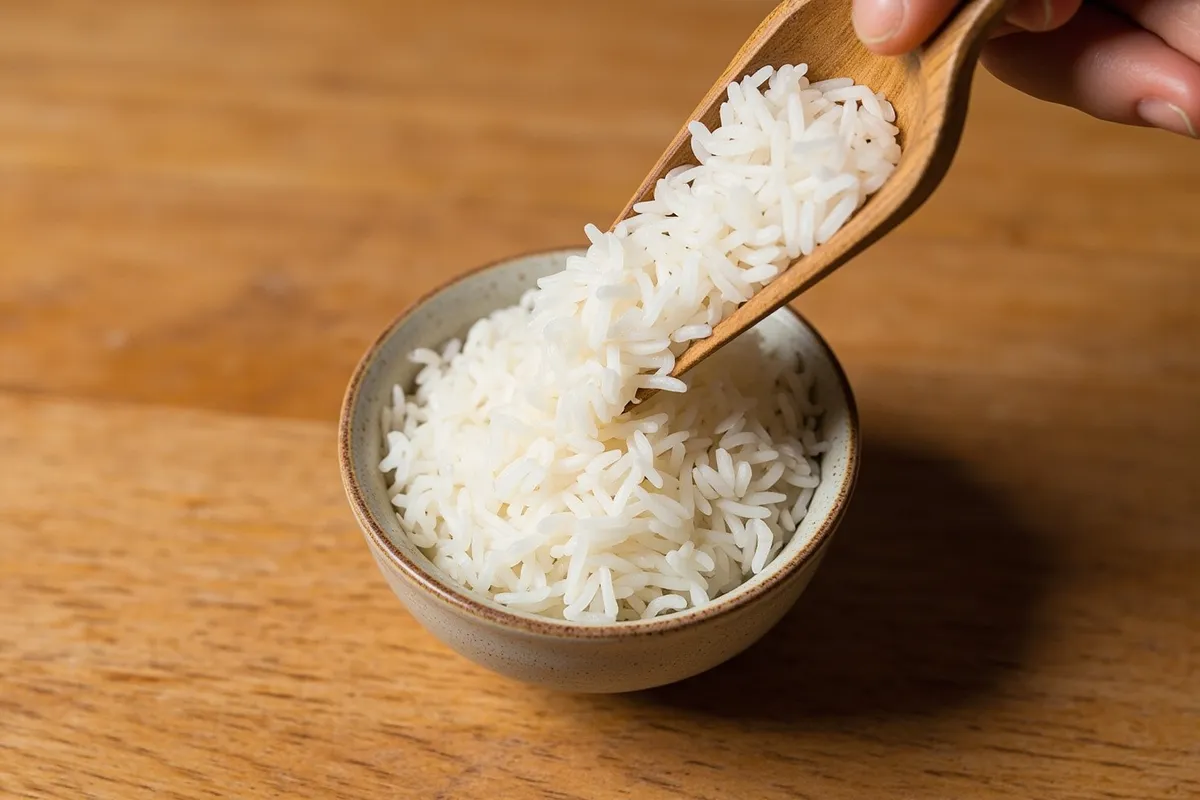
Most people measure rice by eye, and the eye is generous: a scoop that fills the bowl to the brim becomes a scoop that fills the bowl to the brim plus whatever the spoon carries back to the pot. If you are working on rice portion size for weight loss, the fix is boring and precise, a set weight of cooked rice in a bowl you know the weight of, plus a plan for what fills the rest of that bowl.
Here is the short version of what the evidence supports. The research on portion size says smaller portions get eaten less of. It says almost nothing about rice as a bad food, and no study has tested a rice bowl specifically. The measuring logic comes from Japan, where rice is dosed in gō (合) and served as part of teishoku, or ichijū sansai: rice, one soup, a main dish and vegetable sides. If you have diabetes, kidney disease or are pregnant, talk to your doctor before changing how much rice you eat.
Rice portion size for weight loss: what the evidence actually says
How much rice per meal: grams, cups and calories
One serving is a weight of cooked rice, and for most people it lands between 100 and 150 grams. A cup of rice is a volume, and it means something different in every kitchen. USDA FoodData Central lists a cup of cooked long-grain white rice at 158 g and 205 kcal, and the same cup of short-grain sushi rice at 186 g and 242 kcal, so one cup can be 37 kcal heavier before you have touched anything else.
| Serving | Cooked weight | Dry rice needed | Calories | Fibre | Protein | In cups |
|---|---|---|---|---|---|---|
| Half cup, long-grain white | 79 g | ~34 g | 103 kcal | 0.3 g | 2.2 g | 0.5 |
| One cup, long-grain white | 158 g | ~68 g | 205 kcal | 0.63 g | 4.3 g | 1 |
| One cup, short-grain, sushi type | 186 g | ~79 g | 242 kcal | – | – | 1 |
| One cup, brown long-grain | 202 g | ~86 g | 248 kcal | 3.2 g | – | 1 |
| Standard bowl | 150 g | ~64 g | ~195 kcal | ~0.6 g | ~4.1 g | ~0.95 |
Dry weights are calculated with the 2.34 times expansion factor from the gō yield, so brown rice and short-grain can differ a little. Fibre and protein on the standard bowl row are calculated from the long-grain white record. A dash means the record does not list that value.
Cooked rice comes out at about 2.34 times its dry weight, and that is how I get the dry amounts for the portion ladder: a starter bowl of 100 to 120 g cooked comes from 43 to 51 g of dry rice, a 150 g bowl from about 64 g, and a 175 g bowl from about 75 g. For water, follow the ratio in your own cooker manual. My cooker is not yours.
- Heaped versus level. A heaped scoop holds noticeably more rice than the same scoop flattened against the rim with the paddle.
- Dry weight read as cooked weight. One cup of dry rice, 240 ml, is roughly 185 to 200 g and lands as about three cooked cups. A recipe cup and a serving cup are different objects.
- Your bowl against the restaurant's. A takeaway rice bowl is built to look generous next to a small plate of sides.
- One cup “on the side” on a menu, where the sides are the same order of size as the rice.
Measure your bowl once. Fill it with cooked rice, put it on the kitchen scale, and write the weight on the bowl itself. Every bowl you own holds a different amount and yours is the only one that counts. After that, grams beat guesswork and the scale only has to appear once a week.
Every calorie number here is for plain cooked rice, the way USDA records it. Rice cooked with oil, and the fried rice in a takeaway, sit well above the row they came from.
What a smaller bowl actually does to your intake
Two cues do most of the work: the size of the bowl and the size of the plate. In a 2022 meta-analysis of 14 experiments, people served smaller portions ate about 235 kcal less per day (95% CI 168 to 303). A 10% smaller portion cut daily intake by 1.6%, and 100 kcal less food put in front of someone came back as 14 kcal less eaten. Weight moved with it, since participants served smaller portions finished 0.58 kg lighter than when the same food arrived in larger portions (95% CI 0.38 to 0.78).
The Cochrane review of portion size, packages and tableware, 72 randomised trials, put the adult gap at about 247 kcal a day (95% CI 215 to 279), which is 14.3% of a 1,727 kcal baseline. Children ate about 95 kcal more a day when the portions were larger.
Two caveats I would not skip. No study in that meta-analysis manipulated rice bowls, and the foods on the plate were snacks and main dishes, so the numbers describe portion size in general rather than dinner. About 42% of the reduction at the smaller meal also came back in other meals the same day. The trials ran with lab crockery and a fixed menu, which is a cleaner signal than a busy kitchen, so the bowl has to do the work at every single meal.
What the first week feels like: you finish the smaller bowl slightly hungry, you look at the pot more often than you used to, and for a day or two you eat something after dinner that you had not planned. That is the compensation showing up, not a failure of will.
The daily line: where the white rice risk signal starts
There is a daily line, and it sits higher than most people assume. A 2022 systematic review and meta-analysis of white rice intake found a higher risk of type 2 diabetes (pooled RR 1.16, 95% CI 1.02 to 1.32), with the excess appearing only above about 300 g of cooked white rice a day, roughly 1.9 cups. Above that line, every extra 158 g serving carried 13% more risk (RR 1.13, 95% CI 1.11 to 1.15). A single 158 g serving a day showed no raised risk (RR 0.97, 95% CI 0.92 to 1.02), though that compares intake levels rather than giving a clean all-clear.
An earlier BMJ meta-analysis from 2012 drew a harder line, 11% more risk per additional daily serving, and comparing the highest intake with the lowest it gave RR 1.27 overall and 1.55 in Asian cohorts where people ate three to four servings a day. The 2022 review replaced it with gentler numbers, and it is the one I would quote.
These are observational figures about daily intake, not about a single portion being dangerous, and they cannot separate rice from the rest of the diet. Inside that same review, the Japanese trials gave adults 150 g of cooked rice a day, one standard bowl, while one trial served 200 g at each of two meals, 400 g in a day, well past the threshold.
Two ways the same rice gets counted. Glycaemic load is the carbohydrate times the glycaemic index of that rice, so it climbs with the grams on your plate, and 300 g of the same rice carries roughly twice the load of 150 g. What the diabetes studies measured was daily intake, not the glucose curve of one serving, so a low-GI label on the bag tells you less than the weight of your bowl does.
The Japanese diet rice serving: gō, gohan and teishoku
What one Japanese diet rice serving weighs
The Japanese measure for rice is the gō (合): 150 g of uncooked rice, or 180 ml, which cooks down to about 350 g of cooked rice. One gō is not one bowl. A typical Japanese rice bowl holds 150 to 180 g of cooked rice, so one gō fills roughly two bowls, and the half gō most people eat at home is 75 g of dry rice turning into about 175 g cooked.
Manufacturers tried a 200 ml cup for a while and the rice came out soggy, so cookers went back to the 180 ml gō cup for dry rice and kept 200 ml cups for water. If your cooker has both, the smaller one is the rice cup. I mention it because the two look identical in the cupboard and nobody labels them.
| Portion | Dry rice | Cooked rice | Bowls | Calories | Grain cost in a US store, 2026 |
|---|---|---|---|---|---|
| 1 gō | 150 g | ~350 g | 2 | ~455 kcal | $0.35 to $0.37 long-grain white, $2.00 to $3.00 Koshihikari |
| ¾ gō | ~113 g | ~263 g | 1.5 | ~340 kcal | $0.26 to $0.28, $1.50 to $2.25 |
| ½ gō | 75 g | ~175 g | 1 | ~227 kcal | $0.17 to $0.18, $1.00 to $1.50 |
| One standard bowl | ~64 g | 150 g | 1 | ~195 kcal | $0.15 to $0.16, $0.85 to $1.30 |
A full gō eaten in one sitting is about 455 kcal. That is two large bowls, not one, and it is the most common way people overdo rice without noticing.
Keep the rule straight: gō is a dry weight, a bowl is a cooked weight. The conversion comes from a single industry explainer, the gō unit guide from ricejp, so treat it as a household convention rather than a legal standard and trust your own scale at the end of it.
Teishoku: rice, one soup, three dishes
The set meal I grew up eating is teishoku, or ichijū sansai: rice as the staple, one soup, a main dish of fish or other protein, and two vegetable side dishes. The useful part is not the ceremony. Rice sits in a five-slot frame instead of standing alone on the plate, half the volume is vegetables and soup, and the protein slot is what stops a small bowl of rice from leaving you short.
You can build it from an ordinary supermarket without a single import: a spoon of miso paste for the soup, firm tofu or two eggs for the protein slot, a pan of quick greens or frozen edamame for the vegetable slots, and a sheet of nori to add volume and salt. Japan's 2025 Dietary Reference Intakes work in a similar spirit, setting a reference amount of energy and 33 nutrients for a year of eating. The numbers are national guidance, while the shape of the meal, a staple in the middle and small dishes around it, is shared household practice.
Ten-minute weekday teishoku: rice from the cooker, miso soup with sliced spring onion, two eggs or a block of firm tofu, and a pan of greens cooked hard with a little soy. Assembly order matters more than the menu. Vegetables and protein first, rice last, so the rice is the last thing you finish and the easiest thing to stop.
Where the bowl size actually comes from
Your bowl size is mostly not yours. A takeaway rice bowl is chosen by the kitchen, a donburi is sized by the shop, a bento container sets the volume of a packed lunch, and an onigiri is a fixed object you hold in one hand. Short-grain rice also packs tighter in a cup than long-grain, which is why a cup of sushi rice weighs 186 g against 158 g of long-grain white.
A typical Japanese bowl holds about 150 to 180 g of cooked rice, and takeaway bowls are usually larger. There is no reliable published weight for an onigiri or a bento portion, so I weigh the ones in my own kitchen instead of quoting a number, and you would do the same with yours.
Hara hachi bu, eating to 80% full, is worth keeping for a different reason. Japanese health-promotion guidance has used the 80% line for adults with a BMI of 25 and over, and it makes a decent stop signal, because the bowl empties before you are full. It is a habit, not a weight-loss method on its own. I wrote about what hara hachi bu does and does not do separately, including where the evidence sits.
Swaps worth making: a takeaway rice bowl becomes a home bowl you have weighed, a bento becomes a two-tier container with the smaller tier for the rice, and two onigiri become one onigiri with a boiled egg or a block of tofu beside it.
Brown rice vs white rice: what actually changes
Side by side: calories, fibre, amylose and glycaemic response
Gram for gram, brown rice is the lighter and rougher option, and the differences are small enough to be honest about. A cup of cooked long-grain white rice comes to 205 kcal at 158 g, the same cup of short-grain sushi rice to 242 kcal at 186 g, and a cup of cooked brown long-grain to 248 kcal at 202 g. That works out at roughly 130 kcal per 100 g for both white rices and about 123 for brown, with fibre at about 0.4 g per 100 g in white against 1.6 g in brown.
| Cooked rice | kcal per cup | kcal per 100 g | Fibre per 100 g | Glycaemic index by variety |
|---|---|---|---|---|
| Long-grain white | 205 (158 g) | ~130 | ~0.4 g | basmati 43 to 69, jasmine 79 and up |
| Short-grain, sushi type | 242 (186 g) | ~130 | – | glutinous 75 to 98 |
| Brown long-grain | 248 (202 g) | ~123 | ~1.6 g | high-amylose brown 50 to 66 |
Brown rice carries more inorganic arsenic than white rice on average. The numbers and the cooking method that reduces it are in the storage section below.
Variety matters more than colour. A high-amylose white rice such as Doongara tested at GI 54 for a 220 g cup, high-amylose brown rice tested at 50 to 66 for a 210 g cup, and everyday white varieties spread much wider, from basmati at 43 to 69 up to jasmine starting at 79. In randomised trials comparing brown and white rice, waist circumference came out the same (minus 0.79 cm, 95% CI minus 2.11 to 0.53) and so did HbA1c (minus 0.05%, 95% CI minus 0.14 to 0.05).
Observational data pointed the other way. In the 2022 white rice review, more brown rice went with lower type 2 diabetes risk (RR 0.89, 95% CI 0.81 to 0.97), about 13% less per extra 50 g a day.
One caveat about how GI is calculated. It is measured on 50 g of available carbohydrate, so a per-cup figure from one variety cannot be compared with a per-cup figure from another. Read it as a ranking, and it matters most if you are managing diabetes or insulin resistance. Colour, meanwhile, is a rough label, and I choose on texture, price and what I will actually eat.
Chilled and reheated rice, and what resistant starch does
Cooked rice cools into a different state. As it sits, part of the starch rearranges itself into a form that is harder to digest, and reheating keeps much of that. In a small crossover trial in healthy adults, white rice chilled for 24 hours at 4 °C and then reheated produced a lower blood glucose response than rice cooked fresh that day.
The numbers were an area under the curve of 125 ± 50.1 against 152 ± 48.3 mmol·min/L (p = 0.047), which is a borderline result from a small sample, and I would not hang a diet on it. The protocol is the part worth borrowing, because it is the part that was actually tested: cool the cooked rice for 24 hours at 4 °C, then reheat it. Shorter cooling times were not studied, so I keep to that. It also suits a working week, since Friday's batch becomes Monday's lunch.
For storage, follow the food safety basics rather than the appetite. Get rice into the fridge within two hours, eat it within three to four days, freeze anything beyond that, and use a clean spoon rather than the one you have been serving from. The FDA guidance on leftovers covers the timings.
Small study, honest result. The chilled and reheated rice looked better on the glucose curve, but the sample was 14 healthy adults in a crossover design and p sat at 0.047. Use it as a way to plan Friday's cooking, not as a reason to reload your plate.
Practical swaps that keep the bowl balanced
My default in the kitchen is two thirds brown rice to one third white, measured by volume, rather than a 50/50 mix. A 50/50 bowl halves your whole grain share, and the 2025 to 2030 Dietary Guidelines for Americans point to 2 to 4 servings of whole grains a day, so a 150 g bowl at two thirds brown counts as about one serving of whole grain while a 50/50 bowl is about half of that. White rice still earns its place in curries, fried rice and onigiri, where it is doing a job rather than filling a gap.
Short-grain Koshihikari is my everyday pick on texture, and it is not a calorie story, because 150 g of short-grain white and 150 g of long-grain white come to about the same 195 kcal. What changes between varieties is chew, aroma and how fast the bowl empties. For brown rice at home, the water and the timing come from your cooker manual, and cooking the two rices in separate small batches and combining them in the bowl is easier to get right than one mixed pot.
Balanced rice bowl proportions: what belongs in the bowl
The proportions: a quarter, a half, a quarter
The proportions I use come from a plate, not a bowl: whole grains on a quarter, vegetables and fruit on half, protein on the remaining quarter, with refined grains like white rice kept in check. Harvard's Healthy Eating Plate sets it out that way, and it translates without much argument into a deep bowl.
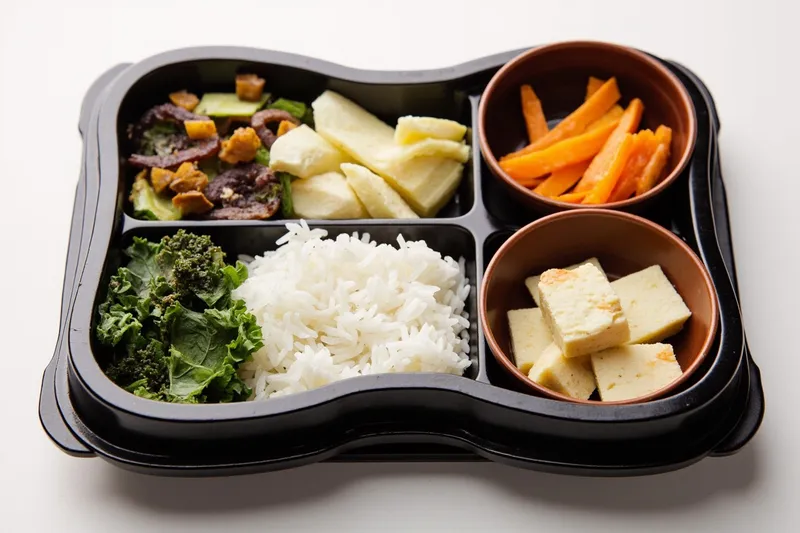
The current US guidance agrees with the geometry. The Dietary Guidelines for Americans 2025 to 2030, published on 7 January 2026, ask for 2 to 4 servings of whole grains a day and fewer refined carbohydrates. They also ask for 3 servings of vegetables and 2 of fruit a day, which is the vegetable half of a rice bowl, and they set a protein target of 1.2 to 1.6 g per kg of body weight per day.
For an adult of 70 kg that is 84 to 112 g of protein across the day, or about 28 to 37 g in one sitting. That works out as two eggs with a 150 g block of firm tofu, 120 g of chicken or tuna, 200 g of cottage cheese with an egg, or 200 g of Greek yoghurt with an egg and a spoonful of peanut butter. The figures are calculated from the guideline target. If you have kidney disease, that number is a question for your doctor and not for me.
Ounce-equivalents are the unit that makes labels readable. One serving of grains on a food label is an ounce-equivalent, and the Dietary Guidelines use them, so you can line your 150 g bowl up against the rice box at home. Nothing in the geometry needs shop ingredients, which is the point made at more length in what the Japanese diet and longevity research shows.
There is a physical test for the quarter that beats measuring. Fill your bowl with rice, then put the vegetables in the same bowl. If the vegetables do not fill it, there was too much rice. That is faster than any conversion table.
The same fractions work in a bowl: a quarter of the volume as rice, half as vegetables, a quarter as protein, with the soup alongside. I keep the rice in the smaller side of a divided plate at home, which makes the quarter visible without a scale.
A bowl built in ten minutes on a weekday
My weekday morning runs about ten minutes. Rice is in the cooker from the night before. I put a pan of greens on, boil two eggs in the same pan, slice spring onion and cabbage into a container with a spoon of miso paste for the soup, and weigh the rice into the box while the eggs finish. The bowl gets built in the order the set meal works: rice, soup, protein and two vegetable sides, all of them small, none of them a separate meal.
The shopping list for that is five lines: rice, a bag of frozen edamame or a cabbage, eggs or a block of firm tofu, miso paste, nori sheets. Keep it to five and the weekday version survives. If you want the same approach in a different meal, the Japanese breakfast is worth a read.
- Hot rice packed tight goes soggy and weeps condensation into the rest. Let it steam a little, vent the lid, pack the vegetables apart.
- Vegetables without salt are a punishment you notice after two days. Salt them while they cook.
- No protein in the box turns a balanced bowl into a plate of starch with something green on it.
- A bowl with an elastic band round it is a takeaway bowl in disguise, and it will behave like one.
Pack in this order: the hot component first, vegetables in their own section, sauce in a small pot with a lid. Rice keeps its texture if nothing is sitting on it and the box is not sealed while everything is still steaming. A minute of ventilation before closing saves you a wet lunch.
Starch swaps: barley rice and smaller-rice alternatives
Mugi gohan, rice cooked with barley, is the easy swap if you want more chew and more volume in the bowl. The catch is that the barley share varies by brand, so the label is where the real numbers live. I would not claim barley rice is dramatically lighter than rice, because it is not. The win is texture, chewing and how much the bowl holds, not a large calorie saving.
Two other swaps do the same job. A smaller serving of white rice with a double portion of vegetables keeps the meal familiar and cuts the rice at once. An onigiri with a protein side, an egg or tofu, turns a snack into a small meal. Nobody has to give up rice for any of this, and if you like rice you lose nothing by keeping it and shrinking the bowl. The Okinawa diet covers which parts of the Japanese plate are worth copying if you want the broader picture.
Shopping, cooking and what changes for US kitchens
What one bowl of rice costs at the store
A standard 150 g bowl needs about 64 g of dry rice. At the 2026 city-average shelf price for white long-grain rice, $1.06 to $1.12 a pound, that comes to $0.15 or $0.16 of grain. Japanese short-grain sits on a different shelf: Koshihikari was listed at $26.64 for a 4.4 lb bag and $19.99 for a 2.2 lb bag, which works out to $6.05 and $9.09 a pound, so the same bowl of short-grain rice runs about $0.85 to $1.30 in grain alone.
The grain is the cheap part of the bowl. A teishoku-style bowl with soup, fish and two vegetable sides costs several times the rice, so if something in the bowl has to change, the rice is a reasonable place to start.
Tools worth owning are a 180 ml cup for dry rice, a 200 ml cup for water if your cooker has both, a kitchen scale and a rice paddle to level the scoop. The packaging tells you one thing worth knowing: “1 cup” is a volume, so a cup of long-grain white rice weighs 158 g while a cup of short-grain weighs 186 g, roughly 18% more. Check the water ratio in your own cooker manual rather than trusting mine.
What changes for US kitchens: arsenic, labels and the new guidelines
Rice carries inorganic arsenic, and brown rice carries more of it than white. The FDA assessment put averages at 92 ppb in white rice and 154 ppb in brown, about one and a half times higher, and Consumer Reports testing found about 80% more in brown rice of the same type. The method the FDA recommends is cooking rice in a lot of extra water, six to ten parts water for each part of rice, and draining the excess, which cuts inorganic arsenic by 40% to 60% depending on the type of rice.
There is a price to that method. In enriched polished and parboiled rice, the same soaking and draining cuts folate, iron, niacin and thiamine by 50% to 70%. Rinsing rice before cooking changes very little about arsenic, while it does change the texture, and that is worth doing for its own sake. So choose by what you are cooking: brown rice benefits most from the drain, enriched white rice is the one where you are trading vitamins against arsenic, and rice eaten twice a week needs less of this than rice eaten daily.
On labels, use the ounce-equivalents of grains per serving and compare them with your 150 g bowl, so the bag at home becomes a number rather than an impression. For households where children eat rice often, the arsenic method is worth the extra minute of kitchen work.
Rinsing, cooling and storing leftovers
Rinsing rice under cold water pulls off surface starch, which is why the grains cook separate and slightly less sticky. It does very little for arsenic, and I rinse for the texture while skipping the pretence that it is a safety step.
Cooking once and eating it across the week is where the system pays off. Cool the rice quickly, spread it in a shallow container, get it into the fridge within two hours, and eat it within three to four days. Freeze what will not be eaten in that window and reheat from cold with a splash of water. The same 24-hour chill at 4 °C that the small trial used for glycaemic reasons is easy to hit at home if you cook on Sunday and eat on Monday.
- Leaving cooked rice warm on the counter all afternoon is the one habit to break.
- The serving spoon does not belong in the warm rice. Set it on a clean rest and get the rice into the fridge within two hours.
- Reheating the whole pot each time dries out the rice you keep warming.
- Portioning into one big tub instead of single meals means you reheat the same rice four times.
Evening routine for a pot of rice: weigh the dry rice, cook it, spread it on a flat tray so it cools fast, portion it into containers, label them with the date, and put them in the fridge. Ninety seconds of work, and Monday's lunch stops being a decision.
Putting it together: a rice portion size that supports weight loss
The three-bowl system and the decision rules
The whole method is three bowls and a short list of rules. You pick the bowl, then you fill the rest of it.
| Bowl | Cooked rice | Dry rice, approx. | Calories | What fills the rest |
|---|---|---|---|---|
| Starter | 100 to 120 g | 43 to 51 g | ~130 to 155 kcal | Double vegetables and a protein side |
| Standard | 150 g | ~64 g | ~195 kcal | Half the bowl vegetables, one protein, one soup |
| Large | 175 g | ~75 g | ~227 kcal | Same as standard, for an active day |
A full gō is 350 g of cooked rice, about 455 kcal, and fills two large bowls. That is two servings, not one, which is the single most useful thing to know about the gō.
The lever is the size of the bowl. Which grain you pick is second, and vegetables and protein decide whether a smaller bowl still fills you. Hara hachi bu fits in here as a stop signal rather than a system.
- If you are still hungry after a starter bowl, add protein or vegetables, not rice.
- On a day you trained or walked a lot, move up a bowl rather than taking seconds of the smaller one.
- When you want a change, change the grain first, brown for white in a two to one mix, before you change the quantity.
- If your daily rice runs past about 300 g cooked, that is where the type 2 diabetes signal starts to appear in the research, and the whole diet deserves a look rather than the bowl alone.
- When you start, weigh your bowl once and write the number on it.
The tools are cheap: a 180 ml gō cup for dry rice, a kitchen scale for the first week, and a paddle. A smaller bowl is easier to keep than a smaller appetite, and that is the whole trick.
What to expect over the first weeks
The research gives two numbers and no timetable. In the 2022 portion meta-analysis, the group served smaller portions finished 0.58 kg lighter (95% CI 0.38 to 0.78) than the same people served larger portions, and daily intake differed by about 235 kcal. Nobody in those studies ran for months on end through a takeaway-heavy week, so I would not put a weekly kilogram figure on it and I would not promise a date.
What I noticed in my own kitchen when I started weighing bowls instead of eyeballing them: the first few days I finished lunch and looked at the pot, and a couple of evenings had a biscuit I had not planned. Then the bowl itself began doing the work and the mid-afternoon hunger eased. Expecting the first week to feel like a small loss of freedom is fair. Expecting the mirror to change inside a week is not.
If the scale stops moving, look at three things before you cut the rice further: how much you scrape from the pot after serving, how dense the sides are, and whether other meals grew that same day, since about 42% of the reduction at the smaller meal turned up in later meals.
FAQ: rice portion sizes answered
- How much rice per meal should I eat to lose weight? 150 g of cooked rice is the middle of the ladder, about 195 kcal and 64 g of dry rice, with 100 to 120 g to start and 175 g on an active day. A cup is 158 g of long-grain white rice or 186 g of short-grain, so a cup is not a portion.
- Is a cup of rice a serving? It depends on the variety, since a cup of cooked long-grain white rice weighs 158 g and the same cup of short-grain weighs 186 g, about 18% more. Weigh your own bowl once and use that number instead of the cup.
- Brown rice vs white rice for weight loss: in randomised trials the two matched on waist (minus 0.79 cm) and HbA1c (minus 0.05%), while observational data linked brown rice to lower type 2 diabetes risk (RR 0.89, about 13% less per 50 g a day). Brown rice also carries about 80% more inorganic arsenic than white rice of the same type, and my default is two thirds brown to one third white.
- Does reheated rice really have a flatter sugar response? In a small crossover trial in healthy adults, rice chilled for 24 hours at 4 °C and reheated gave a lower glucose response than fresh rice, with an area under the curve of 125 ± 50.1 against 152 ± 48.3 mmol·min/L and p = 0.047. Small sample, borderline result, useful protocol.
- How much rice per day is too much? About 300 g of cooked white rice a day, roughly 1.9 cups, is where the signal in the 2022 review starts: pooled RR 1.16, and above that line each extra 158 g serving carried 13% more risk. A single 158 g serving a day showed no raised risk (RR 0.97).
- Do I need a kitchen scale? Not for the first week. A 180 ml gō cup for dry rice and a level rice paddle get you close, and grams matter most when you start comparing a 150 g bowl across rice varieties. Weigh your bowl once, and the scale can go back in the drawer.