
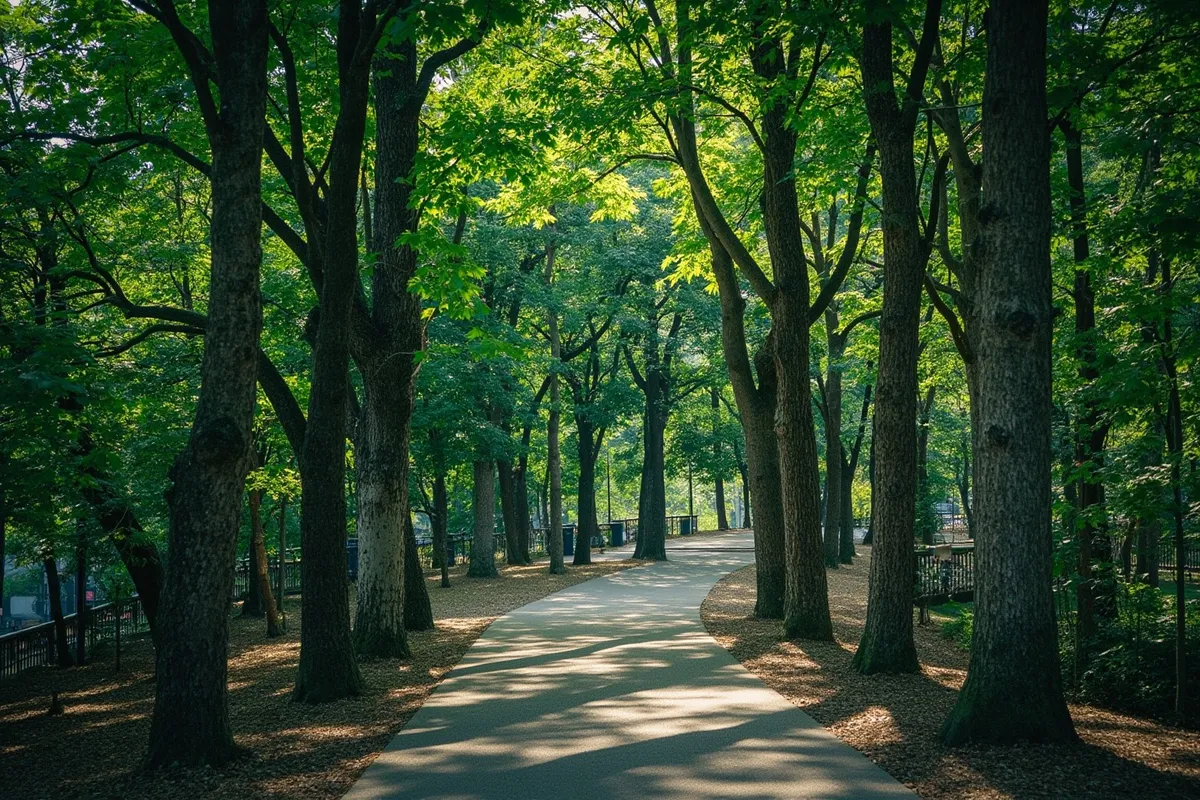
Yoyogi Park 代々木公園 is the easiest good morning in central Tokyo, and it takes no booking: entry is free, the gates are never shut, and three of the four stations that serve it stand three minutes from the park edge. The Yoyogi Park walking route starts at the Harajuku Gate entrance, runs the central lawns, follows the Zelkova Avenue and drops into the Area A forest, where Japan's first bird sanctuary sits behind the paths.
Two things decide whether the morning works: how early you leave, and which cafe you finish in. The cafes are not at the gate. They cluster off the park's south-west side around Yoyogi Station, so I would rather say that now than let you walk half a kilometre looking for coffee.
Getting to Yoyogi Park: four stations, one bus stop and 65 parking spaces
Address, service counter and the two halves of the park
A road splits Yoyogi Park in two. Area A, on the west side, is the forest park: bird sanctuary, dog run, cycling course, lawns and woodland. Area B, on the east, is the event plaza with the athletics stadium, the outdoor stage and the Zelkova Avenue. The addresses read Shibuya-ku Yoyogi Kamizonocho for Area A, and Jinnan 1-chome and Jinnan 2-chome for Area B.
The service counter is at 〒151-0052 渋谷区代々木神園町2-1, on 03-3469-6081. It and each individual facility close over the New Year holiday. The park itself is open 24 hours a day, all year, with free admission under the Tokyo Metropolitan Park Association.
At roughly 54 hectares it is the fifth largest metropolitan park among Tokyo's 23 wards. The ground remembers the Olympics: an army parade ground first, then US military housing called Washington Heights, then the 1964 Olympic village, and a public park from 1967.
Station exits, the bus stop and the best entrance for an early start
| Stop | Line | Walk | You reach first |
|---|---|---|---|
| Harajuku | JR Yamanote | 3 min | Harajuku Gate, lawns, Area B |
| Meiji-jingumae | Chiyoda C03, Fukutoshin F15 | 3 min | South side of the park |
| Yoyogi-Koen | Chiyoda C02 | 3 min | West side, Area A forest |
| Yoyogi-Hachiman | Odakyu | 6 min | South-west corner |
| Kokuritsu Yoyogi Kyogijo-mae | Toei and Hatchiko buses | bus stop | Area B |
Four stations plus one bus stop, and the park is right there. The three-minute walk applies to Harajuku, Meiji-jingumae and Yoyogi-Koen. Yoyogi-Hachiman on the Odakyu line is six minutes away, and the bus stop serves the Area B side.
Two figures for Harajuku look contradictory. The three-minute walk is station to park edge, while the roughly eight minutes on foot is from the west exit to the Area B plaza itself, which is the number to use if the outdoor stage is your destination.
For an early start I would use Yoyogi-Koen or Meiji-jingumae, both three minutes from the forest side. Harajuku Gate is the entrance to pick if you want the lawns straight away.
The 65-space car park and why weekends are the wrong day to drive
| Spaces | 65 |
|---|---|
| Payment | Paid parking |
| Hours | 24 hours |
| Fee | Set by the association, revised in 2025, so take the current rate for your visit date |
There is a car park, and I would not build the morning around it. The association revised metropolitan park car-park charges in 2025, so a figure from an old list may not be the figure you pay. The parking-fee notice is where the current rate lives.
The bigger problem is the road in front of the park. On weekends and holidays it congests, and parking entries can be restricted when the area is busy.
The walking route, the jogging loop and the exercise areas
Harajuku Gate, the lawns, Zelkova Avenue and the Area A forest
Enter at the Harajuku Gate and you are on the central lawns within a minute. This is the open middle of the park: wide enough for warm-up drills, wide enough for a family to sit without walking into anybody. The morning walk and jogging loop continues along the Zelkova Avenue past the outdoor stage, then crosses the road into Area A.
The surface changes underfoot: main paths are asphalt, forest paths are compacted earth. My rough count for one circuit is around 3 km, or about 5 km with the paved southern edge added, so treat both as estimates rather than distances on a signpost.
Two things on the way. The fountain area, three fountains of 15 to 30 metres and a water corridor, was finished in May 1991 and is fenced for works, with reopening planned for early November 2026, so the route bends around it until then. The 1964 Olympic village house by the gate now holds a cafe, the only one inside the park.
How long to allow: 30, 45 or 60 minutes
| Time | Route | What you get |
|---|---|---|
| 30 min | Gate, lawns, Zelkova Avenue, back | The open middle and the avenue |
| 45 min | Add the crossing into Area A | Forest paths, the bird sanctuary, the quiet half |
| 60 min | Full circuit plus the fountain detour | The whole park; the forest is the long part |
The lawns fill with school and office runners as the morning goes on, so the earlier you leave the more space you get. The forest paths stay the calm stretch even when the avenue is busy, and the bird sanctuary sits on that side, which is another reason to cross the road instead of turning back.
From the Harajuku Gate the walk out to the sanctuary is longer than the straight line on the map suggests, because you go round through the west side. Half an hour is enough for the gate, the lawns and the avenue.
The dog run, the cycle course and the sports park next door
- The dog run sits in Area A and is open to registered dogs only. Registration needs proof of that year's rabies vaccination, and it covers dog runs in 12 Tokyo metropolitan parks.
- The pedalico 代々木 cycling centre rents bicycles for ¥300 per hour on a course of about 2,000 m. It normally closes on Mondays, or on the Tuesday after a Monday holiday.
- The neighbouring Jinnan 1-chome urban sports park is not run by the association. It has its own site at yoyogi-cpark.com and its own line, 03-3460-5700.
Those two paid items are the whole list inside the park. The lawns, the forest, the sanctuary and the dog run cost nothing to use. The sports park next door is the alternative for court games, and it is a separate operator with separate charges.
One dated exception on the bikes: on Thursday 12 November 2026 the cycling centre is closed all day, bicycle rental is suspended and part of the park is restricted for the Forest of Lights event. The organising committee's notice gives 03-6705-5114, 9:00 to 17:00.
What is closed, banned or on a schedule inside the park
The athletics track and the basketball courts
The athletics stadium inside the park is Oda Field (織田フィールド), named for Mikio Oda, Japan's first Olympic gold medallist in the triple jump at the 1928 Amsterdam Games and later general manager of the national athletics team. It staged the opening ceremony and competitions of the 1964 Tokyo Paralympics.
The association has the track out of service from 1 July to 30 November 2026, and again from 11 to 17 December 2026, and the basketball courts are closed from 3 to 9 November 2026. Both sit on the association's notice pages: the track suspension and the courts notice.
If you need a marked track on a fixed weekday, the open courts are at the neighbouring urban sports park, which runs under a different operator.
What you cannot bring or start in the park
The rule list is long, and it decides what the morning looks like.
- Banned all year: barbecues, campfires, cooking, fireworks and generators.
- Prohibited even in hot weather: tents, tarps and sunshades.
- Not allowed: drones, radio-controlled toys, amplified music and DJ equipment, ball-game practice, skateboards and roller skates.
- Dogs are allowed on a lead, and you take the mess home with you.
Cooking is the rule that changes plans most. There is no burner, no charcoal and no tent to put up, so breakfast happens in a cafe rather than on the grass. In the warm months that leaves the forest paths as the only stretch with real shade, which is my reason to start early rather than carry a shelter that will not be allowed.
Each area's operator enforces their own rules, so nobody chases you round the park. They stop you at the entrance to that facility and move you on.
Fences, works and filming
The fountain area is the park's 1991 water feature: three fountains throwing water 15 to 30 metres high, with a water corridor between them. It is fenced for works, and the association plans to reopen it in early November 2026, so the morning route runs around the fence rather than through the plaza until then.
The same logic applies to the rest of the park's works. The association posts a dated notice for every area it closes, and the track and the courts are the two that matter most for a morning workout.
One more thing if you plan to film: shooting inside Yoyogi Park needs a shooting permit, and the association publishes its own application form. A sunrise lap on video means filing in advance, not asking at the gate.
Yoyogi Park cafes and breakfast around Yoyogi Station
The cafe map: 48 listings and the five closest to the station
Geography first, because this is where people get it wrong. Tabelog's English listings for the Yoyogi area run to 48 cafes and kissaten, and the five I can place are measured from Yoyogi Station, which is not one of the park's four stations. It sits off the park's south-west side, so the breakfast stop is a short walk from where the loop ends rather than a gate-side address.
| Cafe | Distance | Lunch | Dinner | Notes |
|---|---|---|---|---|
| DOUTOR COFFEE SHOP Yoyogi ten | 68 m | ¥999 or less | – | Sandwiches, smoking area |
| Kurobuta Hamburger steak Yocchan | 122 m | ¥1,000–1,999 | ¥3,000–3,999 | Multilingual menu, Wi-Fi |
| FARO Yoyogi honten | 124 m | ¥1,000–1,999 | ¥2,000–2,999 | Non-smoking, vegetarian options |
| Tonga coffee | 141 m | ¥1,000–1,999 | ¥2,000–2,999 | – |
| cafe&DINE in nope | 157 m | ¥1,000–1,999 | ¥1,000–1,999 | Multilingual menu, Wi-Fi |
| PRIME FIVE TULLY'S COFFEE Shinjuku Sazanterasu ten | 354 m | ¥1,000–1,999 | ¥1,000–1,999 | Wi-Fi |
For a pre-work morning I would take the chain coffee shop: 68 m from the platform, coffee and lunch at ¥999 or less, sandwiches, and a designated smoking area. The hamburger place is 122 m out with a multilingual menu and Wi-Fi, which suits anyone opening a laptop afterwards.
What a breakfast set costs and what is on the plate
The working budget for a sit-down breakfast in this stretch is the ¥1,000–1,999 band. The chain stop does coffee and a sandwich for ¥999 or less, which is the fast version of the same morning. The dinner bands in the listings, ¥2,000–2,999 and ¥3,000–3,999, are evening food and tell you nothing about an early plate.
The set itself is the standard format: rice in a bowl, miso soup, a small main dish such as grilled fish or egg, and a side of natto, tofu or seaweed. I would not put a price on any single dish, because the set is what gets priced. My Japanese breakfast guide goes deeper into the format.
Green tea or a matcha latte finishes it, and stopping at roughly 80 percent full comes easy when the plate is already small, which is the point of the hara hachi bu habit.
Closing days, and matching the cafe to your exit
Opening hours differ from place to place, so the closing day is what you sort out first. Three of the independents publish one:
| Cafe | Closed on | Breakfast fit |
|---|---|---|
| FARO Yoyogi honten | Mondays | Non-smoking, vegetarian options; my pick for a set breakfast |
| cafe&DINE in nope | Thursdays | Multilingual menu, Wi-Fi; good for a long sit |
| Tonga coffee | Sundays and public holidays | Evening-heavy, so not a weekend-morning stop |
A Sunday or public-holiday morning costs you one of the three, and a Monday or a Thursday costs you another. I would keep the chain coffee shop as the fallback, and check the card of the place you have in mind before walking over.
Match the cafe to the exit as well. The Yoyogi Station cluster serves the south-west side, while the cafe inside the park sits at the Harajuku Gate on the east side, where the loop starts and finishes. If you would rather not cross the road carrying a full breakfast, that is the one to aim for.
The crowd calendar: weekends, blossom season and the winter lights
Weekends, holidays and the Park de Walk campaign
Area B is an event plaza and it gets used. Festivals run there on many weekends from spring to autumn, so the eastern half of the route fills with stage crowds and the loop reads differently on a Saturday.
The association also runs a walking-and-relaxing campaign, Park de Walk & Relax Checker, open from 30 October 2026 to 11 January 2027, with entries accepted until 11 January 2027. It is aimed at people who come to walk and sit rather than to train, which describes a weekday morning here well enough.
Two weekend rules from the association: the road in front of the park congests, and parking entries can be restricted when the area is busy, so come by train.
Blossom season
Blossom viewing along the Zelkova Avenue pulls the heaviest crowd of the year, and weekend mornings in that window fill inward from the Harajuku Gate where the avenue starts. This is hanami season, and it changes what the loop feels like more than the weather does.
The trade is that the bird sanctuary area and the forest paths in Area A stay quiet even when the avenue is packed, so a blossom-season morning is better planned on the forest side. The window in Tokyo runs from late March into early April, every year, and the loudest weekends sit inside it.
I would start on the Area A side and come back through the avenue at the end of the run, when the light is better and the crowd has thinned.
The winter illumination is a separate paid event
In winter, the Forest of Lights runs inside the park as a separate paid event, with date tickets sold in advance only. The illumination is a separate ticket, and free access to the park at any hour stays as it is, so budget the lights apart from the free walk.
The same event is why the cycling centre closes all day on Thursday 12 November 2026, with bicycle rental suspended and part of the park restricted. The organising committee's notice of 21 October 2026 gives 03-6705-5114, 9:00 to 17:00 for that day.
Tickets go by date rather than walk-ups, so if the lights are the point of the visit, that is a booking to make in advance rather than a morning you improvise.
Who it suits, who should skip it, and what you actually pay
Who it suits
It suits anyone who wants a free morning out without booking a thing: four stations put you inside the park in three to six minutes, entry costs nothing around the clock, and the loop works as a walk or a jog depending on your week. The step-count side of it I have covered in walking for weight loss, where the difference here is that the walk is free and outdoors.
It suits dog owners who already have the current rabies vaccination certificate, because the run in Area A is the reason to come. And it suits anyone who wants breakfast in the same neighbourhood as the walk, as long as they accept that the cafe stop is a few minutes beyond the gate rather than at it.
Who should skip it
Skip the plan of grilling your own breakfast here. Barbecues, campfires, cooking, fireworks and generators are banned year-round, tents, tarps and sunshades are prohibited even in the heat, and amplified music, drones, ball-game practice, skateboards and roller skates are not allowed either. That kills the usual Tokyo park barbecue with friends.
Skip it if you need a marked athletics track on a fixed schedule: Oda Field is out of service for long stretches in 2026 and the courts close on their own dates. Serious training pushes you to the neighbouring urban sports park in Jinnan 1-chome, a separate operator with its own charges and its own line, 03-3460-5700.
And skip the cafe-and-walk plan if your only free days are Mondays, Thursdays or Sundays. Those are closing days for the independents in the Yoyogi cluster, and the service counter and each facility also shut over the New Year holiday.
What you actually pay
Park entry is free at any hour of any day. Inside the park you pay for two things only: ¥300 per hour for a bicycle at the pedalico 代々木 counter, and the winter illumination tickets, sold by date and in advance only. The cycling centre closes on Mondays and on the Tuesday after a Monday holiday, plus the event day noted above.
Breakfast is the only real line in a morning budget: coffee and a sandwich at ¥999 or less at the chain stop by the platform, or a set breakfast in the ¥1,000–1,999 band around the station. Dog-run registration needs your dog's current rabies vaccination proof, and filming needs a permit application filed in advance.
Before you go
- Car park: 65 paid spaces, and the association revised its tariff, so take the current rate for your visit date.
- Cafe hours: opening times differ across the cluster and several independents close on a fixed weekday. Check the card of the place you plan to finish in.
- Track and courts: Oda Field and the basketball courts go out of service on published dates, so read the notice for the dates you are there.
- Long or pre-dawn walks: look up the park's facility information on toilets, drinking water and night lighting before you head out.
- Filming: a shooting permit application has to be filed in advance.
Straight answers on the practical bits
Getting there, parking and the early start
Is the park open at night, and does it cost anything? Yes to both. It is open 24 hours a day, all year, admission is free, and only the service counter and the individual facilities close over the New Year holiday.
How do I get there for a very early start? Four stations: Harajuku, Meiji-jingumae and Yoyogi-Koen are a three-minute walk from the park edge, Yoyogi-Hachiman is six minutes, and Toei and Hatchiko buses stop at Kokuritsu Yoyogi Kyogijo-mae for Area B.
Is there parking, and should I drive? There is a 65-space paid lot open 24 hours, but the road in front of the park congests on weekends and entries can be restricted when it is busy, so train is the better bet.
Rules, dogs and breakfast
Can I cook, grill or put up a tent? No. Barbecues, campfires, cooking, fireworks and generators are banned year-round, and tents, tarps and sunshades are prohibited even in hot weather.
Can I bring my dog? Yes, on a lead, with you taking the mess home. The dog run in Area A is for registered dogs only, and registration needs proof of that year's rabies vaccination.
What does the cheapest breakfast near the park cost? Coffee and a sandwich at ¥999 or less at the chain stop by the platform, and sit-down breakfast sets in the ¥1,000–1,999 band. The only cafe inside the park is the 1964 Olympic village house by the Harajuku Gate.
Entry is free, the loop is free, and the breakfast bill comes down to which cafe you pick and which day you pick it. Start at the Harajuku Gate for the lawns, from the west side for the forest, arrive by train, and let the cafe's closing day decide where you eat.