
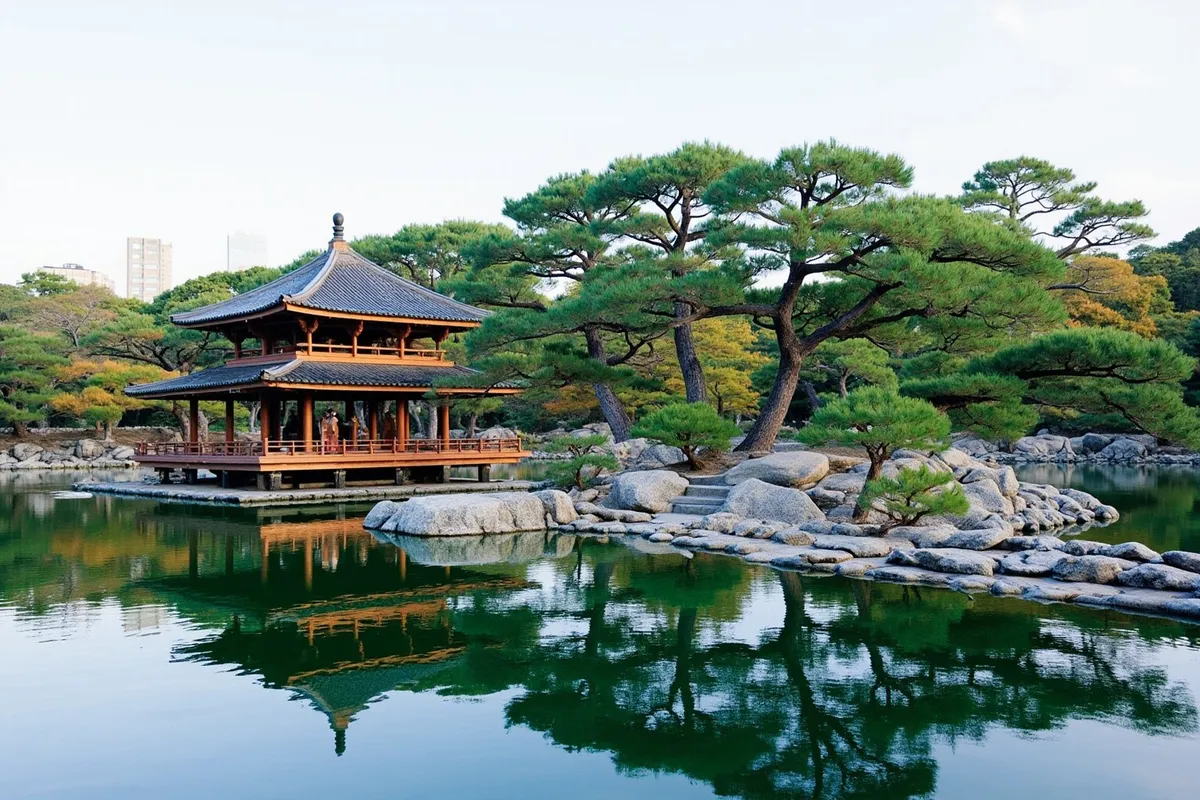
Hama-rikyu Gardens is 25 hectares of old daimyo land in Chuo-ku, Tokyo, wrapped around a tidal pond that fills with seawater from Tokyo Bay, and you can circle it on foot between three train stops and a water bus pier. Adult admission is ¥300. The second half of the decision is Nakajima-no-ochaya, the tea house on an island in the pond: whether to spend your lunch break on a matcha, and how much walking to fit around it.
The tea price is the part I would not fix in advance. Matcha sets there run roughly ¥500 to a little over ¥1,000 depending on what comes with the cup, and the menu board at the door is where today's numbers live.
Hama-rikyu Gardens: a tidal pond garden in Chuo-ku, and what it costs to get in
Twenty-five hectares ten minutes from Shimbashi, with a pond that breathes the tide. Getting in is simple and cheap. The fiddly part is deciding where to drink your tea and how long to stay.
Where it sits, what is inside the grounds, and which entrances to use
Hama-rikyu Onshi Garden (浜離宮恩賜庭園) covers 250,165.81 square metres of Chuo-ku, Tokyo, at 1-1 Hama Rikyu-teien, 104-0046, and the office answers on 03-3541-0200. The Imperial family handed the estate to the city in 1946, the public walked in on 1 April, and in 1952 it was designated a site of scenic beauty and of high historical significance. The Tokyo Metropolitan Park Association runs it.
- a tidal pond fed by bay water, with two duck hunting sites on the edges
- Nakajima-no-ochaya, the tea house on an island in the pond
- Hobai-Tei, a restored Meiji-era official residence
- Hana-mise, the shop near the gate
- two entrances, Nakanogomon and Otemon
There is no restaurant inside. The garden keeps 6,077 high trees and more than 30,000 low ones, with black pine, camellia, iris, hydrangea, crape myrtle, peony and Japanese red maple on the plant list.
Getting there: Shiodome E-19, Tsukiji-shijo E-18, Yurikamome and the water bus
Three stations sit at about the same distance: Shiodome on the Toei Oedo line (E-19), Tsukiji-shijo next along (E-18), and Shiodome on the Yurikamome people mover, each roughly seven minutes on foot from the gates. Shimbashi, with the JR Yamanote, the Ginza line and the Toei Asakusa line, is a ten-minute walk, too far if you are squeezing a matcha between two meetings. The garden's access page has the full list.
A water bus runs the Asakusa-Hama-rikyu-Hinode-Sambashi route and stops at the garden pier, a good way to arrive when the tide and the timetable agree. They do not always agree: sailings to the garden pier get suspended, so look up the operator's status before you plan around the boat, and check whether boats board at the pier or only set passengers down.
| Stop | Line | Walk | Note |
|---|---|---|---|
| Shiodome | Toei Oedo E-19 | about 7 min | Closest of the three |
| Tsukiji-shijo | Toei Oedo E-18 | about 7 min | One stop north, outer market close by |
| Shiodome | Yurikamome | about 7 min | Comes up from Hinode Pier |
| Shimbashi | JR, Ginza, Asakusa | about 10 min | Longer walk than the map suggests |
Admission: who pays what, and the two-garden ticket
The garden is open 9:00 to 17:00 with last entry at 16:30, and closes from 29 December to 1 January every year. Adults pay ¥300 and visitors aged 65 and over pay ¥150. Primary-school children and younger come in free, as do junior-high students who live in Tokyo or attend school here, so two adults with two small children pay the adult rate only. Groups of 20 or more get 20% off.
There is also a two-garden ticket for Hama-rikyu and Kyu-Shiba-rikyu: ¥400, or ¥200 for the over-65s, sold at either gate. Kyu-Shiba-rikyu sits about a minute from JR Hamamatsucho's North Exit, so the pair works as one walk. Hours and prices are on the garden outline page, the two-garden ticket on the Kyu-Shiba-rikyu page.
| Who | Price |
|---|---|
| Adults | ¥300 |
| 65 and over | ¥150 |
| Primary-school children and younger | Free |
| Junior-high students living in Tokyo or attending school here | Free |
| Group of 20 or more | 20% off |
| Hama-rikyu plus Kyu-Shiba-rikyu ticket | ¥400, or ¥200 aged 65 and over |
Tea house lunch at the Hama Rikyu tea house, Nakajima-no-ochaya
Forty seats, one island, water on all sides. The tea house is small on purpose, and that shapes everything about lunch here: how long you queue, what you order, what you do while you wait.
What a matcha order actually is, and how the menu board reads
Nakajima-no-ochaya (中島の御茶屋) stands on an island in the middle of the pond, and the building was first put up in 1704. It serves from 9:00 to 16:45, with last orders at 16:30, and closes over the New Year while the garden itself runs on to 17:00.
An order is a bowl of matcha plus a decision about what comes with it. What visitors order falls into a few shapes: matcha on its own; matcha with a wagashi sweet from the counter; or a fuller set that can bring nerikiri, a dorayaki, dango or daifuku alongside the cup. Treat the board at the counter as the only reliable menu.
If the crowd is the problem rather than the tea, Camellia Garden's tea ceremony and garden in west Tokyo is the quieter stop.
Why one price cannot be quoted, and a workable budget
There is no set price for the tea, and visitor accounts differ by a factor of two: a matcha set at around ¥500, matcha on its own at ¥500, a set with nerikiri just over ¥1,000. What you can plan with is the range, not a number.
Budget for a tea-house lunch: ¥300 admission plus roughly ¥500 to a little over ¥1,000 for the tea. Order before the late afternoon, because last orders come at 16:30, the tea house closes at 16:45 and the gates close at 17:00. A 16:30 matcha buys you a cup and a walk to the exit, not an afternoon.
That gap between the tea house's closing time and the gate's is the detail I would plan the day around. For a broader picture of where matcha is served across the city, the Tokyo Green Tea Trail covers the cafés.
Forty seats, a queue, and Hobai-Tei as plan B
Nakajima-no-ochaya holds no more than 40 people, Hobai-Tei (御芳屋) no more than 25. On blossom weekends the queue forms on the bridge and seats go fast, and that 40-seat ceiling is why the tea stop feels busy rather than the walk feeling long.
Hobai-Tei, the restored Meiji-era official residence, is run as a reservable gathering hall for tea gatherings and as a rest stop during a garden walk, not as a second tea room. If the tea house is full you have two sensible moves: reserve Hobai-Tei online and sit there instead, or walk the loop first and come back to the tea house later. Failing both, Hana-mise, open 9:00 to 16:30, is the only place in the garden to buy anything at all.
Tea house details and the residence booking sit on the garden facility page.
The best walking route through Hama-rikyu Gardens
If you are putting together a Chuo City garden walk, this is the one with water and an island you can eat on. My loop takes about ninety minutes with the tea stop, and the paths are easy once you know which gate you came in by.
The loop I would take: gate, pond edge, duck sites, island, far gate
Start at Nakanogomon and follow the pond edge rather than cutting across the middle. The pond takes in bay water, and the two duck hunting sites are where I would slow down. Continue past the sluice gate, along to the duck sites, then cross to the island with Nakajima-no-ochaya. From there you can loop back the way you came or carry on to Otemon, the exit nearest Shiodome and Yurikamome.
The garden's View Point page covers the pond, the island and the tea house in the order the garden presents them. My loop is a shortcut of what is actually there rather than the official scheme, so take the map with you.
| Waypoint | From the last stop | What it is for |
|---|---|---|
| Nakanogomon | Start | Entry and the Hana-mise shop |
| Pond edge and sluice | about 5 min | Bay water, first photo spot |
| Duck hunting sites | about 10 min | Where I would spend extra minutes |
| Nakajima-no-ochaya | about 10 min | Tea on the island, 40 seats |
| Otemon | about 10 min | Exit near Shiodome and Yurikamome |
Those minutes are my own estimates at a normal pace, nothing official.
How much time to build in: a short version, ninety minutes, a long visit
Three budgets work. Sixty minutes covers the pond edge, the island and the way out, which is what most people actually use it for. Ninety minutes is the full loop at a normal pace. Two hours lets you take the outer pond path, see Hobai-Tei properly and still have time in the shop.
The closing times bound all three: last entry 16:30, gates 17:00, last tea orders 16:30. Weekday mornings are the quiet version, and for a post-meal walk the pond edge alone does the job without turning lunch into an outing.
Read the garden's own walking estimate on the View Point page before you fix a schedule, because the ninety minutes above is my arithmetic rather than the garden's figure. On a first visit to Hama-rikyu gardens, a weekday morning is the easy slot.
Guided walks, tea gatherings and the season calendar
The garden runs free guided walks in Japanese and English on some days, and the tea house hosts a guided visit that explains the 1704 building and the room. The Association's grand tea ceremony appears on the same pages. The week's English calendar lists them, the schedule shifts with the season, and it is worth opening on the morning you go.
That calendar also covers the annual closings and the occasional special opening of the grounds, which is where the paid-entry days and free days show up. Hobai-Tei is the one piece you book ahead; everything else runs on arrival.
When to come: blossom crowds, summer heat, autumn colour
There is no month-by-month flower calendar to plan against, so the timing depends on what you want: crowds, shade or colour. The plant list is the fixed part, the calendar is the moving one.
Blossom weekends and the squeeze at the tea house
Japanese flowering cherry is the plant that pulls the hanami crowd, and the queue it creates is simple arithmetic: 40 seats, one teahouse everybody wants, and a bridge that turns into the waiting room. On the busiest weekends the tea stop is the slowest part of the visit, not the walk.
| Season | In flower | How busy | What to do |
|---|---|---|---|
| Blossom | Japanese flowering cherry | Heaviest crowds | Walk first, tea after |
| Early summer | Iris, peony | Busy on weekends | Shade at midday |
| High summer | Crape myrtle, cluster-amaryllis | Quiet on weekdays | Split the walk |
| Autumn | Japanese red maple colour | Steady | Best light comes late |
Summer heat, the autumn walk, and the empty weekdays
In the hot months the pond edge in full sun is the hardest stretch, and I would split the visit rather than push the whole loop in one go: tea at Nakajima-no-ochaya first, then the shaded paths near the residence and out to Otemon.
Autumn is the other good window. The Japanese red maple is on the plant list and does most of the colour work, and with 6,077 high trees and more than 30,000 low ones there is a lot of canopy over the pond in summer. The quiet stretch between blossom and autumn is the one I would pick for a working lunch.
Names like ginkgo, sulphur cosmos and red spider lily belong to the wider Tokyo autumn, so treat the garden's calendar as the word on what is inside the walls this week. The garden shuts from 29 December to 1 January every year, and the tea house and shop close for the New Year too.
Practicalities that decide the day
Distances from the gates, how the tickets work, and the small things that make the visit either easy or fussy.
How far is everything from the gates
| Destination | Walk | Measured by |
|---|---|---|
| Shiodome E-19, Tsukiji-shijo E-18, Yurikamome Shiodome | about 7 min | The garden's own figure |
| Shimbashi | about 10 min | The garden's own figure |
| Hinode Pier and the waterfront | about 10 min | My estimate |
| Tsukiji Outer Market | 12 to 15 min | My estimate |
| Ginza | 15 to 18 min | My estimate |
| Ariake and the Odaiba waterfront | 30 to 40 min on foot, or a few Yurikamome stops | My estimate |
The outer market is the obvious add-on: Tsukiji Outer Market food walk takes the other half of the day.
By car, park and walk: the blocks behind Shiodome or along the waterfront, then cover the last stretch on foot. The garden itself is walkable end to end, and it is the traffic around it you want to avoid.
Buying tickets and making reservations
Almost nothing needs booking. You pay admission at the gate counter on arrival, and the two-garden ticket is sold at either gate. The tea house is walk-up: no table to reserve, no list to join.
The one thing to book is Hobai-Tei, the restored residence, which you reserve online for a tea gathering or as a rest stop during your walk. The terms sit on the garden's facility page.
On cancellation, nothing to cancel for a gate ticket or a walk-up matcha. The residence booking is the only item with conditions attached, and a tea gathering in the house is a different commitment from a tea at the counter.
Coming from outside Japan: cards, IC, bags and paths
Bring a physical card and a Suica or Pasmo in your pocket. Mobile payment that works everywhere at home does not work everywhere here, and a tea counter in a park is a bad place to find that out. The gate and the tea house may not take the same methods.
Keep bags small. I would not plan to hand over a large suitcase inside the garden, and heavy shopping from the morning is better left at a hotel locker or a coin locker near Shiodome.
The parkland is level, but the paths are gravel rather than paving and the island is reached over a bridge, so a pushchair or a wheelchair is slower than the flat map suggests.
Who it fits, who should skip it, and the plan I would give a friend
Short version of the trade-offs, then the timing I would aim for.
Come if you want a tea with a walk attached
It suits a lot of short trips. A one-hour lunch break off a Ginza or Shimbashi working day, with the tea at the end of it, is the obvious one. It suits a cheap family outing, since children come in free and the pond is flat and hard to get lost in. It suits a photo walk, and a paired visit: Kyu-Shiba-rikyu is a minute from the North Exit at Hamamatsucho, so both run on one ticket.
If you want a long green walk instead, Yoyogi Park's walking route is a different animal, and Shinjuku Gyo-en's ponds and paths is the closer comparison.
Skip it if the day depends on things the garden cannot promise
Some plans do not survive contact with the place. A sit-down lunch is the goal: there is no restaurant. A blossom weekend with no patience for a queue: 40 seats is 40 seats. A connection built around the water bus: sailings get suspended. And if you need lifts or step-free routes on a tight schedule, or a car park at the gate, this is not the garden to test assumptions on.
| What you were planning | What you get |
|---|---|
| A sit-down meal | Matcha and sweets, or a shop counter. No restaurant |
| Tea on a busy blossom weekend | A queue and a 40-seat ceiling |
| Arriving by water bus | A route that exists and sailings that get suspended |
| Bag drop and an easy stroll | Level parkland, gravel paths, a bridge to the island |
| Driving up to the gate | Walking the last stretch from street parking |
The plan I would give a friend
Pay the ¥300, arrive just after the gate opens on a weekday, and walk the pond edge before you sit down. The tea house is the best part of the garden and the smallest, so let the walk fill the space between the gates and go to Nakajima-no-ochaya when you want the tea, not when the queue is worst. If the room is full, Hobai-Tei is your sit-down, and the pond is good enough on its own when it is not.
The thing that can actually go wrong is the tea house queue on a busy weekend, and less often the boat. Everything else is straightforward: flat parkland, three stations, one small bill at the gate.
Five things to sort before you go:
- Today's tea prices are on the board at Nakajima-no-ochaya, and they move with the set you pick, from roughly ¥500 to a little over ¥1,000.
- Carry a physical card and a Suica or Pasmo, and read the signage at the gate and the tea counter rather than relying on your phone alone.
- Seating and food rules inside the tea house are settled by staff on the day: shoes, the terrace benches, and anything you brought in yourself.
- Heavy bags, pushchairs and wheelchair users should read the garden's access information on the site first, including lockers, storage and wheelchair loans, and keep the bag light.
- If you are taking the water bus, look up the operator's sailing status and whether boats board at the garden pier, because sailings to the pier get suspended.