
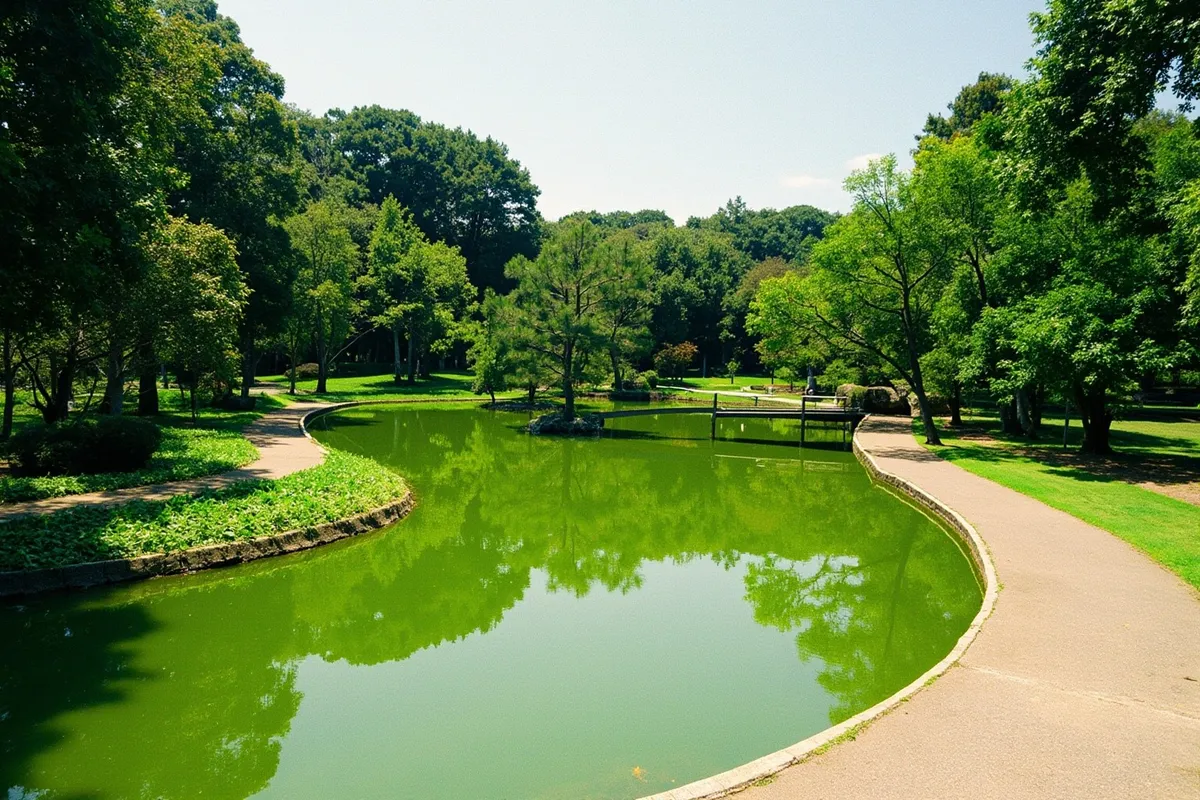
¥500 for the gate, a loop around a pond, flat paths, ten minutes on foot from Shinjuku Station. Shinjuku Gyo-en National Garden is the most honest way I know to spend two hours in Tokyo: nothing to rush for, nothing to order, no table to hold. You walk, you look at the water, you leave through whichever gate suits you.
The address is 11 Naito-machi, Shinjuku-ku, and there are three entrances: Shinjuku, Okido and Sendagaya. For me it is part of a sightseeing day rather than a separate attraction, two or three hours of even walking a couple of minutes from the metro, then back on the train. It is quiet on weekdays and closed on Mondays, and that second fact is the one to write into the plan first.
Shinjuku Gyo-en National Garden: address, gates and how to get there
Three entrances, and the one that fits your route
There are three ways in, and picking one before you leave the station saves you a detour around the wall. Times below are station to gate rather than square to gate, and they stretch a little in the rush hour.
| Entrance | Station | Walk |
|---|---|---|
| Shinjuku Gate | JR, Keio and Odakyu Shinjuku, South Exit | 10 min |
| Shinjuku Gate | Tokyo Metro Fukutoshin Line E5 and Toei Shinjuku Line C1/C5, Shinjuku-sanchome Station | 5 min |
| Shinjuku Gate | Tokyo Metro Marunouchi Line Exit 1, Shinjuku-gyoemmae Station | 5 min |
| Shinjuku Gate | Seibu-Shinjuku Station | 15 min |
| Okido Gate | Tokyo Metro Marunouchi Line Exit 2, Shinjuku-gyoemmae Station | 5 min |
| Sendagaya Gate | JR Sobu Line Sendagaya Station and Toei Oedo Line A5, Kokuritsu-kyogijo Station | 5 min |
| Sendagaya Gate | Tokyo Metro Fukutoshin Line Exit 1, Kita-sando | 10 min |
The garden sits under the Shinjuku Gyoen National Garden Office of the Ministry of the Environment, and the access details match the table above. If you are coming from Shinjuku-gyoemmae, the Marunouchi Line drops you five minutes from either Shinjuku Gate or Okido Gate, which is the easiest way in.
Parking at Okido, and why I would still take the train
The Okido parking area has 200 standard spaces and takes cars from 07:30 to 21:00. Garden visitors pay a different rate from people who only park, and the gap between the two is not small.
| Who | Rate |
|---|---|
| Car, garden visitor | ¥600 for the first 120 min, then ¥200 per 30 min, max ¥2,900 a day |
| Any other user | ¥300 per 15 min, max ¥3,400 |
| Passenger van (5 spaces) | ¥3,500 for the first 60 min, then ¥900 per 30 min, or ¥8,800 flat between 20:00 and 08:00 |
| EV or fuel-cell car, garden visitor | 2 hours free, not applied if you leave before 09:00 during 07:00 to 09:00 openings |
Vans get no discount and no free hours. Bicycle parking in front of each entrance is free while the garden is open, and the coin lockers by the ticket offices at Shinjuku, Okido and Sendagaya cost ¥300 for a small one and ¥500 for a large. Rates and opening times are set out on the garden information page.
During cherry blossom season and autumn foliage the garden office tells visitors to come by public transport, because the car park fills long before the gates do. With a suitcase I would take a taxi from the station once and skip the parking arithmetic entirely.
Opening hours by season, and the Monday problem
| Season | Hours | Last entry |
|---|---|---|
| 15 March to 10 June | 09:00 to 18:00 | 17:30 |
| 11 June to 31 July | 09:00 to 19:00 | 18:30 |
| 1 August to 30 September | 09:00 to 18:00 | 17:30 |
| 1 October to 14 March | 09:00 to 16:30 | 16:00 |
Monday is a closing day, and when Monday falls on a public holiday the following weekday closes instead. The garden also shuts from 29 December to 3 January. The exceptions are cherry blossom season, 25 March to 24 April, and the Chrysanthemum Exhibition, 1 to 15 November, when the garden opens every day including Mondays, so from 16 November 2026 to 24 March 2027 Mondays are closed.
Inside those two windows, weekends, national holidays and other busy days may need a booking made ahead. The facilities inside the garden keep their own hours, so build a half-day walk itinerary around them rather than around the gate times.
Tickets: what ¥500 buys and what it does not
Adult, child, senior and group fares
| Visitor | Entry |
|---|---|
| Adult | ¥500 |
| Group of 30 or more | ¥400 each |
| 65 and over, or students 16 and over | ¥250 |
| Children 15 and under | Free |
The ticket covers entry to the garden itself. A transportation IC card such as Suica or PASMO pays the admission fee directly at the entrance gates, so you skip the ticket window, and an annual passport is accepted there too. Rates sit on the official admission page.
Free entry for a caregiver applies only to holders of a Physical, Intellectual or Mental Disability Certificate issued in Japan. With a certificate from another country, two ordinary tickets are the straightforward option.
Buying ahead: e-tickets and the annual passport
| Option | How it works |
|---|---|
| Single ticket | ¥500 at the counter, or tap a Suica or PASMO IC card straight in |
| ASOVIEW advance e-ticket | Bought online on behalf of the Ministry of the Environment; scan the QR code at the gate; valid six months from purchase |
| Annual passport | ¥2,000 for adults, ¥1,000 for high school students; one year from issue; no transfer, no refund; counters sell it from 09:00 until an hour before closing |
The ASOVIEW ticket carries no date, which suits two or three visits in a row since the garden opens nearly every day except Mondays. Refunds on it follow ASOVIEW's own terms, so read those before paying. The annual passport cannot be refunded and can only be bought at the counter.
None of this needs a booking on an ordinary weekday. The exception is cherry blossom season, where weekends, national holidays and other busy days may require a reservation made ahead.
Inside the gate: where to sit, where to eat, what is not included
The facilities inside run on their own schedules, published separately from the gate times, and they close earlier than the garden in the cold months. Times below are given as hours and last entry.
| Facility | 15 Mar to 10 Jun | 11 Jun to 31 Jul | 1 Aug to 30 Sep | 1 Oct to 14 Mar |
|---|---|---|---|---|
| Greenhouse | 09:30 to 17:30 / 17:00 | 09:30 to 18:30 / 18:00 | 09:30 to 17:30 / 17:00 | 09:30 to 16:00 / 15:30 |
| Kyu-Gokyu-Sho Old Imperial Rest House and Shinjuku Gyoen Museum | 09:00 to 18:00 / 17:30 | 09:00 to 19:00 / 18:30 | 09:00 to 18:00 / 17:30 | 09:00 to 16:30 / 16:00 |
| Information Center and National Parks Discovery Center | 09:00 to 18:00 | 09:00 to 19:00 | 09:00 to 18:00 | 09:00 to 16:30 |
| Starbucks Coffee Shinjuku Gyoen, overlooking the Middle Pond | 09:00 to 17:30, last order 17:00 | 09:00 to 18:30, last order 18:00 | 09:00 to 17:30, last order 17:00 | 09:00 to 16:00, last order 15:30 |
Free seating is available in the Central Rest House and beside Restaurant Yurinoki Tsuburano, so a break that costs nothing is possible. The Shouten-Tei tea house does matcha and Japanese sweets, SASAYAIORI+ in the Central Rest House is takeout only, and NATIONAL PARKS CAFÉ Under the Tree sits in the Information Center. Lunch at Yurinoki Tsuburano runs 11:00 to 15:30. The facilities page has the full hours for each one.
What ¥500 does not buy is a meal. Cooking is not allowed anywhere on site, so a hot lunch means café food and a fairly café-sized bill. In winter the greenhouse shuts at 16:00 while the garden stays open to 16:30, so a winter half-day needs the indoors first and the loop after.
Walking paths in Tokyo: building a loop you will actually repeat
Ponds, moat and the Japanese strolling garden
The easy version starts at Shinjuku Gate, runs past the greenhouse and the Old Imperial Rest House, crosses the central lawn to the Middle Pond and carries on into the Japanese strolling garden, the roji area with its second pond and the moat, then out at Okido Gate. The museum and the Old Imperial Rest House open at 09:00 and the greenhouse at 09:30, so the whole loop fits inside the first half of the day.
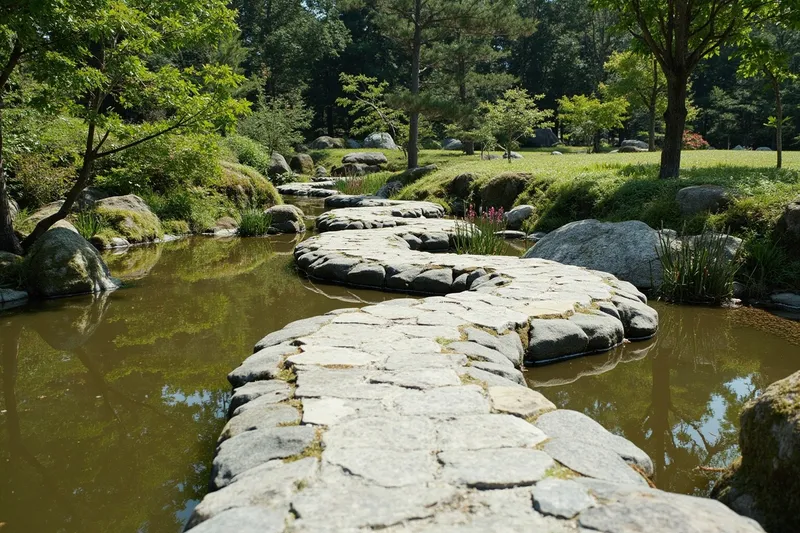
Swimming and playing in the ponds and the moat are not allowed, so the water is there to be looked at. Long-claiming one lawn or one bench is discouraged, which means a two-hour reading plan needs a second spot halfway through. My own estimate is that 15 to 20 minutes per pond adds up to a loop of roughly two kilometres, and that number comes from the map rather than from any published route length.
Steps per day and the calorie burn of walking
There is a marked jogging route, and jogging is allowed only on it, groups of ten or more runners are turned away, and from 25 March to 24 April jogging stops altogether. For a walking day that is a bonus, since the runners stay off the paths you would be using.
The numbers I would use: a stride of 0.70 to 0.75 m puts a 4 km walk at roughly 5,000 to 6,000 steps, and 4 km at a quick pace takes 50 to 55 minutes. At 70 kg and a MET value of about 4.3 that lands around 240 to 280 kcal of calorie burn. That is my own calculation by the MET method rather than a measurement, so treat it as a ballpark.
How I use it: choose the loop and the time first, then add the garden to whatever your steps per day already look like. Hara hachi bu, the habit of stopping at around 80 % full, has nothing to do with the garden, but it is the right size of meal next to a matcha and a sweet. What 10,000 steps can and cannot do covers the counting side, and what eating to 80 % full actually changes covers the plate.
Where to walk near Shinjuku when you want more distance
The extra kilometres in Shinjuku are not inside the garden. The paths in there are short and level, so a long walk means starting at a station and letting the neighbourhood do the work.
| From | Where the walk goes |
|---|---|
| Shinjuku Gate | Along Meiji-dori and the Gyoen Tunnel side road, the greenest approach from the centre |
| Okido Gate | The same tunnel-side road, quieter coming from Shinjuku-gyoemmae |
| Sendagaya Gate | Out past Kokuritsu-kyogijo toward Yoyogi and Meiji Jingu |
| Shinjuku-gyoemmae | Down the shopping streets and back to the metro, an easy extension on either gate |
My rule is that the extension comes from the stations, not from the garden. Two hours inside is plenty, and the walk out is where the neighbourhood hands you the extra steps.
A morning walk in a Tokyo garden: 07:00 openings and quiet weekdays
The days the garden opens at 07:00
Early opening runs as a limited programme with the Tokyo Marathon Foundation, on fixed dates only. Between 07:00 and 09:00 just the Shinjuku Gate is open, entry is by annual passport or transportation IC card, and normal hours resume at 09:00.
| 2026 | 2027 |
|---|---|
| 27 September, 11 October, 25 October, 8 November, 13 December | 24 January, 6 February, 28 February, 14 March |
Coming up after 1 November 2026: 8 November and 13 December 2026, then 24 January, 6 February, 28 February and 14 March 2027. All of them fall on weekends, with 6 February 2027 the one on a Saturday rather than a Sunday. The Tokyo Marathon Foundation notice carries the dates, and this is a fixed-date programme rather than a standing opening.
Keep in mind it is a winter window. From October the garden closes at 16:30, so an early entry means the first hours of a short day, which suits a walker who will be back at a desk before lunch.
An ordinary weekday: 09:00 to midday
This is the version I would build for a normal week. The first hours after opening are the emptiest, and a week without a Monday closure gives the steadiest crowd. The table is an order of attack rather than a schedule, and every facility inside keeps its own hours.
| Time | What fits |
|---|---|
| 09:00 | Information Center and NATIONAL PARKS CAFÉ Under the Tree, the Old Imperial Rest House and the museum |
| 09:30 | Greenhouse, then Starbucks Coffee Shinjuku Gyoen over the Middle Pond and the Shouten-Tei tea house |
| 10:30 | The loop across the lawn to the pond and the moat |
| 12:00 | Lunch at Restaurant Yurinoki Tsuburano, open 11:00 to 15:30, or the free area of the Central Rest House |
| 13:00 | Matcha and sweets at Shouten-Tei, then out through Okido Gate, five minutes from the Marunouchi Line Exit 2 at Shinjuku-gyoemmae |
If you want a coffee with a view rather than a queue, the matcha and green tea house nearby is worth a detour afterwards, but inside the garden the tea house is the cheaper, slower option.
Free things to do in Shinjuku while the garden is shut
When Monday gets in the way, or when you simply do not want to pay, there is free green space a couple of stops away. From Shinjuku Station the walk along Meiji-dori to the gates takes about ten minutes, passing the Gyoen Tunnel, and it is the approach I would pick anyway: green and without the traffic. Yoyogi Park and Meiji Jingu are free too and reachable by train from Shinjuku, which makes them a sensible plan for a closed Monday. A Yoyogi Park walking route for morning exercise covers that side of the map.
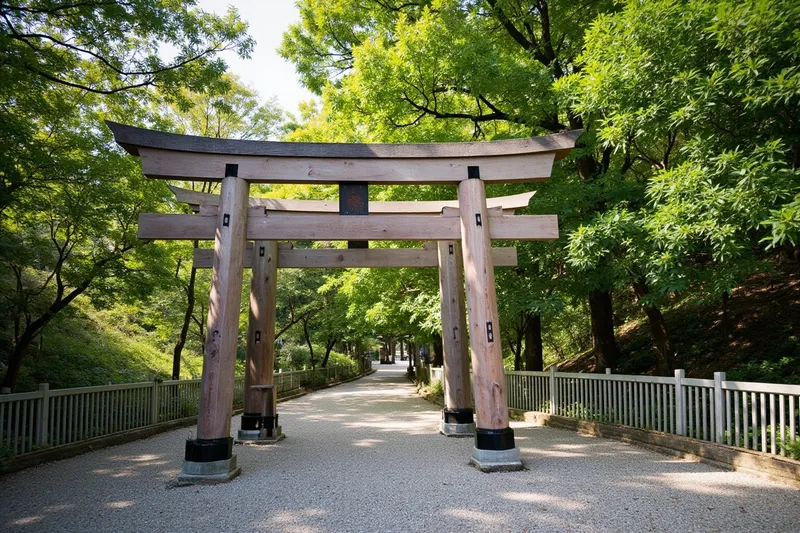
Inside the garden, the free rest areas at the Central Rest House and Yurinoki Tsuburano, the bicycle parking in front of each gate and the wheelchairs at every entrance and the Service Center all cost nothing, and a wheelchair needs no booking. Children 15 and under come in free, and the admission fee itself can be paid with an IC card at the gate.
Rules, comfort and the honest downsides
Picnic rules: what you can bring in
Food is the part people get wrong most often, so the rules are worth reading before you pack.
- Alcohol is not allowed inside the garden.
- Bonfires, portable stoves and any flame-producing equipment are banned, which rules out a cooked picnic entirely.
- Tents and parasols are not allowed, except children's tents of up to 150 cm a side in the Kids Area, and only from 7 May to 31 October.
- Smoking, electronic cigarettes included, is banned across the whole site, the Promenade and the parking area too.
- Animals other than assistance dogs are not admitted, while certified guide dogs, service dogs and hearing dogs for people with physical disabilities are welcome.
- Plants, drones, bug nets and cages, household rubbish, and bicycles or carts taking up 5 m² or more cannot be brought in. Swords and firearms are banned as well.
So bring cold food and a flask, leave the stove in the hotel, and take your rubbish back out with you. Professional camera gear is restricted during cherry blossom season and the Chrysanthemum Exhibition when specific people are being photographed, and the full set of rules is on the rules page.
Ponds, moat, benches and the jogging route
Swimming and playing in the ponds and the moat are off limits, so the water is scenery rather than a place to cool down. Holding one lawn or one bench for long is discouraged, which for a long reading plan means moving once. Running is allowed only on the marked jogging route, groups of ten or more are not, and from 25 March to 24 April running stops completely.
I would not call that a downside. For a two or three hour walk this is the point of the place: the garden is built for walking, not for training sessions, and the city starts again the moment you are through the gate.
The downsides worth knowing in advance
- Mondays are shut, and if Monday is a public holiday the next weekday is shut too, so a Monday morning simply does not work.
- Cherry blossom weekends may need a booking, and the car park at Okido fills early.
- There is little warm indoor space, so on a cold or wet day you end up sitting in a café with a coffee you had not planned on.
- Winter hours shrink: the greenhouse runs 09:30 to 16:00 with last entry 15:30, the garden 09:00 to 16:30 with last entry 16:00, so build the winter half-day indoors first.
- ¥500 a visit looks modest, and if you come often the annual passport at ¥2,000 for a year works out better. It cannot be transferred or refunded.
On access: wheelchairs at each entrance and at the Service Center are free and need no booking, and the free caregiver entry applies only with a certificate issued in Japan. For anything more specific, the Information Center next to the Shinjuku Gate is the place to ask before you start walking.
What a half-day here feels like
Quiet days and loud days
The quiet version is a Tuesday to Thursday, the first hour, and an overcast day outside the exhibition windows. A moat and a belt of trees separate the garden from the streets, and the gates keep the traffic out, so Meiji-dori and Yamate-dori barely reach you once you are past the entrance. Several garden styles sit close together, so a short loop does not turn repetitive, and the free rest areas give you somewhere to sit without paying.
The loud version is a weekend or a public holiday between 25 March and 24 April or between 1 and 15 November. Entry and parking fill up, and the queues at the gates stretch the first hour of the walk. I would not plan a car for those days, and I would not arrive at opening time if I wanted quiet.
What will get in the way
Two things, and both follow from how the garden is built. Queues at Shinjuku and Okido Gate during cherry blossom and chrysanthemum time: three entrances for a very large crowd. And food, since no cooking is allowed anywhere on site, so lunch is whatever the café menu says and the café is dearer than the shops outside the gates.
Then the surface details. Noise carries in on the outer paths where Meiji-dori runs past, and the open lawns have very little shade, which comes from the trees near the water. July heat is the one thing I would plan around: go early or go late and keep the middle of the day for the greenhouse and the museum.
Who should walk here
What you get for the ¥500
Flat paths, ponds, a moat, a greenhouse, a tea house and half an hour of quiet ten minutes from Shinjuku Station. The garden is open nearly every day except Mondays and 29 December to 3 January, and during cherry blossom season and the Chrysanthemum Exhibition it opens on Mondays too.
There are also fixed dates when the doors open at 07:00, which is the cheapest way to have the place to yourself. Two hours covers the full loop and a coffee, a half day adds the greenhouse, the museum and lunch. For me this is the most repeatable walking in central Tokyo: no special clothes, no booking, no food bill if you bring your own.
Who should give it a miss
Skip it if you want a real workout, because there are no climbs, no shower and no proper running circuit. Skip it if you are expecting a proper meal inside, since cooking is banned and the café menu is short and pricey. And skip the weekend of peak blossom unless you have booked, or you will spend the first hour in a queue instead of on a path.
What to do instead: take the annual passport if you plan to come regularly, pick a 07:00 date if you want the garden empty, and go to Yoyogi Park or Meiji Jingu on the days the garden is shut.
| Day | My call |
|---|---|
| Monday, outside 25 March to 24 April and 1 to 15 November | Not worth it |
| Tuesday to Thursday in the ordinary season | Worth it |
| Weekend during cherry blossom or the Chrysanthemum Exhibition | Only with a booking |
| November to March, weekdays | Worth it, but the garden shuts at 16:30 and the greenhouse at 16:00 |
| 8 and 13 November 2026 | The 07:00 opening days, the best of the lot for an early walk |
My rule is simple. Pick the day from the calendar first, walk the pond loop twice, then stop for a matcha.
Five things to check before you go
- The ticket price for your visit date: ¥500 for an adult, ¥400 each for a group of 30 or more.
- The 07:00 opening dates: the programme runs on fixed dates only, so confirm the next one before you plan the morning.
- Whether a booking is needed for a weekend in cherry blossom season, 25 March to 24 April.
- The entry conditions for the greenhouse and the museum: ask at the counter and keep some cash in hand.
- The hours of the individual facilities, since the greenhouse and the museum close before the garden in winter.