
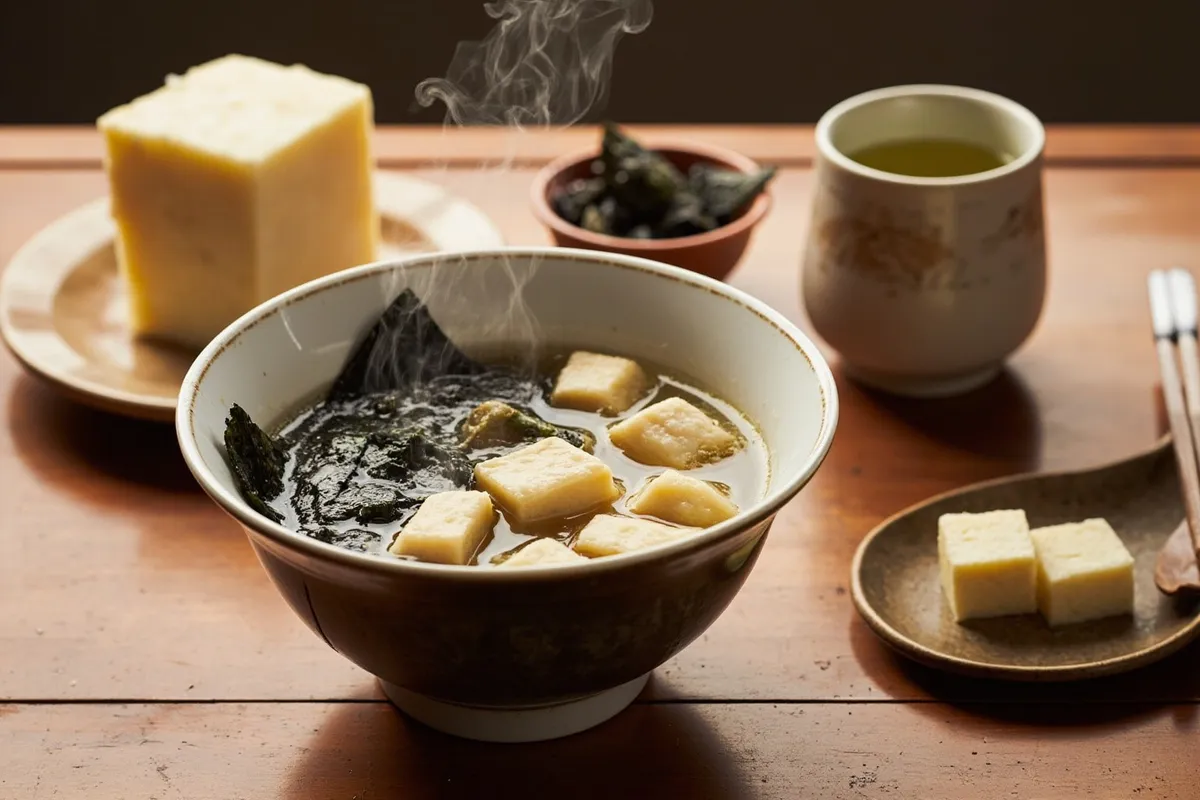
A japanese diet meal plan is mostly small numbers: 150 g of cooked white rice, one bowl of soup, one vegetable dish, one protein dish, three times a day. Every lunch and dinner in my week follows that shape, and the shopping list fits into twenty pantry items plus the normal produce, egg and tinned fish shelves.
This is the version I cook for myself, written for a healthy adult around 62 kg eating roughly 2,000 kcal a day. You get a 40-minute Sunday prep block for dashi and rice, a 20–30 minute walk after dinner, a way to price the shop from the shelf tag, and swap rules for allergies and for people on warfarin or thyroid medication. Calorie targets and weight-loss promises are not in here, and I would not trust them from a menu.
How a Japanese Diet Meal Plan Is Built
Ichiju-Sansai and Washoku: One Soup, One Vegetable Dish, One Main Dish
Washoku is a way of setting a table. Rice in the middle, and around it a soup, a small vegetable dish and a main dish with the protein in it. My grandmother's table had four or five small plates rather than three, but the core has barely moved in my family's cooking for three generations.
Ichiju-sansai – one soup, one vegetable dish, one main dish – is the traditional rule that decides what goes on those plates. I take it as a composition habit rather than a health claim: it puts vegetables and protein on the table every time instead of leaving them to chance.
Gohan, the rice, carries a meal in a way a sandwich never does, and every lunch and dinner in the table below fills the same three slots, so nothing has to be decided at six on a Wednesday. The pattern in full is in washoku, the traditional Japanese diet explained.
- Gohan – rice, about 150 g cooked
- One soup – miso, dashi or a clear broth
- One vegetable dish – simmered, dressed or pickled
- One main dish – fish, tofu, egg or chicken
Portions Without Scales: Rice Grams, Hand-Sized Protein and the Half-Plate Rule
Rice is the one number I would not change: a fixed white rice portion of 150 g cooked, weighed once at the start of the week and then judged by eye in your own bowl.
Protein is where beginners overcorrect, in either direction. The NIH Office of Dietary Supplements sets the adult requirement at 0.8 g per kg of body weight, about 50 g a day for a 62 kg adult. My targets sit above that floor: 12–15 g at breakfast, 20–25 g at lunch, 20–30 g at dinner, so roughly 55–70 g across the day. The per-meal anchor is what pushes the total past the requirement, not the rice.
Labels help less than people expect. FDA's Daily Value for protein is 50 g on a 2,000-calorie diet, and the %DV line appears on some tofu and fish packs but is optional on most, so I count eggs and tofu blocks instead of adding up percentages (FDA Daily Value and label rules). USDA FoodData Central has exact figures for a specific brand when a number really matters.
For the plate itself I use MyPlate's graphic: half vegetables, a quarter grains, a quarter protein. If you prefer portion by hand, weigh once and then use your own fist and palm (USDA MyPlate).
- Rice: 150 g cooked – about one small donburi bowl
- Protein: 100–150 g fish or tofu, or 2 eggs (one palm)
- Vegetables: 150 g, two fists
- Soup: one bowl
- Rice vinegar pickles: 30–50 g, one small handful
Hara Hachi Bu, the 12-Hour Window and the Evening Walk
Hara hachi bu is the Okinawan habit of leaving room at the table; the phrase is usually rendered as 'eat to about 80 % full'. I use it as a cue for portion size and nothing more – I have not measured anything it does. The research sits in what hara hachi bu actually does.
The 12-hour eating window here runs 7:00 to 19:00. That is my own timing structure, chosen because it survives a shift pattern, and I make no claim about what a window does metabolically. Breakfast lands inside two hours of waking.
The evening walk matters more than the rest. The CDC guideline for adults is 150–300 minutes of moderate aerobic activity a week plus muscle-strengthening on two days (CDC physical activity guidelines). Five walks of 20–30 minutes give 100–150 minutes, so the plan leaves you short – add two strength sessions. The walking needs no equipment; the strength days need ten minutes each.
- Breakfast inside two hours of waking
- Dinner finished about three hours before bed
- A 20–30 minute walk after dinner
The 7-Day Japanese Diet Menu: Breakfast, Lunch and Dinner
The Weekly Table: Seven Days, Three Meals, One Protein Anchor Each
| Day | Breakfast | Lunch | Dinner | Main protein sources |
|---|---|---|---|---|
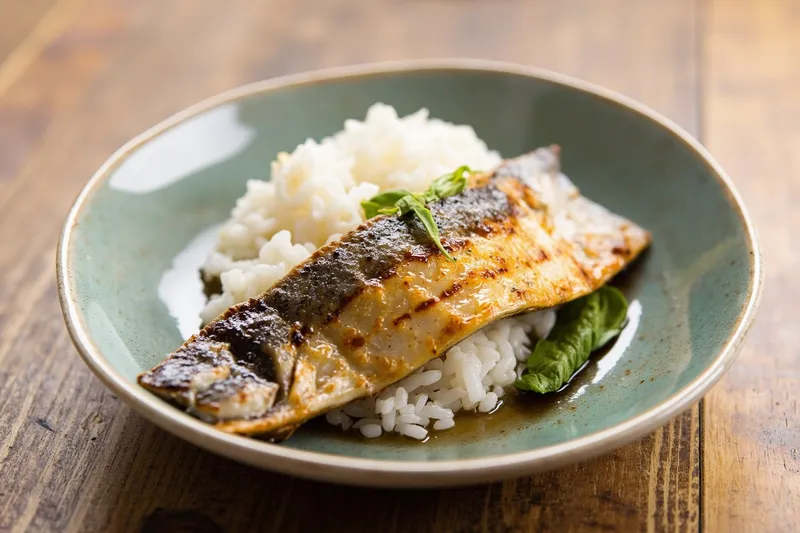
| Mon | Tamagoyaki (2 eggs), rice 150 g, green tea | Onigiri ×2 (tuna, plum), miso soup with tofu and wakame, sesame greens | Grilled mackerel (about 120 g), rice 150 g, simmered pumpkin and daikon | Egg, fish, soy |
| Tue | Natto (about 100 g) with soy sauce and spring onion, rice 150 g, nori | 100 % buckwheat soba (100 g dry), wakame, cucumber | Chicken yakitori (3 skewers, about 120 g), cabbage salad, rice 150 g | Soy, chicken |
| Wed | Kake gohan (2 eggs over rice), nori | Leftovers from Monday's mackerel, miso soup | Simmered tofu (about 150 g) with pumpkin and mushrooms, rice 150 g, rice vinegar pickles | Egg, soy |
| Thu | Tamagoyaki onigiri, green tea | Okonomiyaki (cabbage about 200 g, egg), miso soup | Salted salmon, rice 150 g, seaweed salad | Egg, fish |
| Fri | Kake gohan with nori (1–2 eggs) | Udon with kombu dashi and greens | Canned sardines in water, drained, rice 150 g, pickles | Egg, fish |
| Sat | Rice porridge (okayu), umeboshi, soft-boiled egg, nori | Tamago donburi with vegetables | Yakitori, edamame (about 100 g), rice 150 g, sesame greens | Egg, chicken, soy |
| Sun | Natto, tamagoyaki, rice 150 g | Leftover okonomiyaki, miso soup | Tofu and vegetable nabe, rice 150 g, pickles | Soy, egg, tofu |
Unless a cell says otherwise, rice means 150 g cooked. The week holds two home-cooked fish meals and one tinned fish meal, natto on two mornings (Tuesday and Sunday), miso on four lunches, and leftovers on Wednesday and Sunday lunch. No raw fish anywhere. By my own arithmetic on these portions, daily protein lands between about 55 g and 70 g.
Cooked rice goes into the fridge within two hours, because it can grow Bacillus cereus at room temperature (FDA information on Bacillus cereus). Leftovers keep 3–4 days in the fridge and 3–4 months in the freezer (FSIS leftover guidance).
Miso, tamari and pickles all push toward the 2,300 mg sodium daily value, so read the sodium line on every pack you buy.
Breakfasts You Can Make in 10 Minutes on a Workday
Breakfast is where the week succeeds or collapses, so I keep three repeatable moves and one slow option. A rolled tamagoyaki: two eggs, about a teaspoon of tamari, spring onion, rice alongside. Onigiri wrapped in nori around a filling cooked on Sunday. Natto stirred into warm rice with soy sauce and spring onion. At the weekend, okayu with umeboshi and a soft-boiled egg.
The workday timeline is 2 minutes for the rice out of the cooker, 5 for the pan, 3 for the wrap. Green tea replaces sweetened drinks at the table, and I keep a cold bottle for the afternoon.
Two habits matter more than the recipe. Put a protein item next to the rice rather than rice alone, and open a pack of natto the morning you eat it – it is a refrigerated food and I do not keep it around for days. More breakfasts are in simple Japanese recipes for beginners, and the fermented foods are covered in miso and natto: benefits, risks and how to serve them.
Dinner Plates: Where the Fish, the Chicken and the Tofu Sit
Every dinner fills the same three slots – main protein, vegetable dish, soup or pickles – and the week just rotates what lands in the first slot: mackerel Monday, chicken Tuesday, tofu Wednesday, salted salmon Thursday, tinned sardines Friday, chicken Saturday, tofu and vegetables Sunday.
Fish gets a hot pan or the broiler, not a fryer. Salted salmon is cured rather than raw, and it is salty enough to count against the sodium budget. Fish and seafood prices are forecast to keep climbing faster than their long-run average, which is why two home-cooked fish meals plus one tin is the shape I would keep even if prices were flat: fresh fish is priced by the pound and that tag moves week to week.
Okonomiyaki stretches a cabbage and an egg into a one-pan dinner, which is why it earns a Thursday slot. The Saturday donburi is the fridge-assembly dinner I cook after a Monday that ran long. On rice I alternate brown and white rather than defaulting to brown, because FDA's arsenic guidance recommends a variety of grains and found no level of inorganic arsenic in rice that posed a health concern (FDA guidance on arsenic in rice).
The Pantry and the Grocery Bill: What to Buy and How to Price the Week
The Starter Pantry: Twenty Items That Carry the Whole Week
The list splits cleanly. Dry goods – rice, noodles, dashi, tamari, vinegar, nori – sit on the international aisle of a mainstream supermarket; miso, tofu, natto and edamame sit in the chilled case, with mackerel and salmon in the freezer and sardines in the canned aisle. Buy the largest pack of each that your cupboard and your week can actually use, and write the price down as you go.
Two label checks before you buy. Bonito flakes are fish, so a dashi built on them is not fish-free. Some natto packs and seaweed salad packets are made with wheat starch, which matters more for gluten than the allergen line does.
No national price series covers miso, natto, nori or dashi, so the shelf tag is the only number for those four. The price column below is deliberately blank: fill it in from the shop, not from memory.
| Item | Pack size to buy | Price to note |
|---|---|---|
| Short-grain white rice | 2.27–2.3 kg bag | |
| Brown rice | 1 kg bag | |
| White miso paste | 454 g tub | |
| Red miso paste | 454 g tub | |
| Firm tofu | 396 g block | |
| Natto with straws | 3-pack | |
| Eggs | 1 dozen | |
| Frozen edamame | 500 g bag | |
| 100 % buckwheat soba | 400 g | |
| Dried udon noodles | 400 g | |
| Kombu | 100 g | |
| Bonito flakes | 100 g | |
| Dried shiitake | 100 g | |
| Dried wakame | 100 g | |
| Nori sheets | 10 sheets | |
| Tamari | 250 ml | |
| Rice vinegar | 355 ml | |
| Sesame oil | 150 ml | |
| Canned sardines in water | 1 tin | |
| Frozen mackerel fillets | per pack |
Cheap Protein: Eggs, Tofu, Canned Sardines and Frozen Fish
Eggs are the anchor I would protect first. USDA's Food Price Outlook forecasts egg prices down about 29 % for 2026, in a range of −31.6 % to −26.7 % (USDA Food Price Outlook). That makes the egg-and-rice breakfast the most predictable protein on the list, and predictable is what matters when you are planning a week on a budget.
The other three tiers: firm tofu from the chilled case or the freezer, frozen edamame, canned sardines in water, and frozen fillets of mackerel and salmon. Seafood prices rising in 2026 are the reason I keep two fish dinners at home in fillet form – fresh fish is sold by the pound and that tag moves, while a bag of frozen fillets keeps its price until you cook it.
Two practical details. Store-brand tofu and Asian-market tofu are often far apart in price, so compare the two tags on the day. And read the serving size before comparing two packs: a 396 g block and a 396 g tub are not the same number of portions, which is why I count tofu by the block rather than by the label.
- Tier 1 – eggs: the cheapest protein per gram and the most predictable
- Tier 2 – firm tofu and frozen edamame
- Tier 3 – canned sardines in water
- Tier 4 – frozen mackerel and salmon fillets
US Price Baseline, Label Rules and What to Verify Before Shopping
Here is the baseline for the shop. USDA's Food Price Outlook, updated in October 2026, forecasts US food-at-home prices up 2.3 % in 2026 in an interval of 1.9 % to 2.7 %, all food prices up 2.8 % (2.6 % to 3.1 %), and 7 of the 15 food-at-home categories growing faster than their 20-year average. The next outlook adds 1.0 % for food-at-home in 2027, in a range of −5.2 % to 7.5 %, so a vegetable-heavy week costs a little more than it used to and eggs a little less.
Label rules for the cart. FDA recognises nine major allergens – milk, eggs, fish, crustacean shellfish, tree nuts, peanuts, wheat, soybeans and sesame (FDA food allergy guidance). Sodium and protein %DV are read against daily values of 2,300 mg and 50 g on a 2,000-calorie diet. Buckwheat is not one of the declarable allergens in the US, the UK, Canada or Australia, so a soba packet may name it only in the ingredient list.
Use the worksheet below to price the week from the shelf rather than from a list. It is a shopping checklist, not a quotation: the five anchor prices and the weekly total are yours to write down, and the total stays on your receipt.
| Item | Typical US pack size | What to record | Cheaper swap |
|---|---|---|---|
| Miso paste, white or red | 454 g tub | Shelf price and price per 100 g | The larger tub on a discount shelf |
| Natto | 3-pack | Price per pack | Skip it and double the tofu |
| Firm tofu | 396 g block | Price per block | Store-brand block |
| Short-grain rice | 2.27–2.3 kg bag | Price per kg | A bigger bag if it fits the cupboard |
| Salmon fillet | Per pound, 453.6 g | Price per pound | Frozen fillets |
| Weekly total | Your own basket | Your receipt total | – |
Sunday Meal Prep: Batch Dashi, Rice and Freezer Portions
Batch Cook Dashi and the Miso Base
Sunday's block starts with dashi, because every soup depends on it. Cold water in the pot, a square of kombu in it, heat until the water just starts to soften, lift the kombu out and let the pot sit for twenty minutes. A second pot with dried shiitake gives you a vegetarian dashi with no fish in it at all.
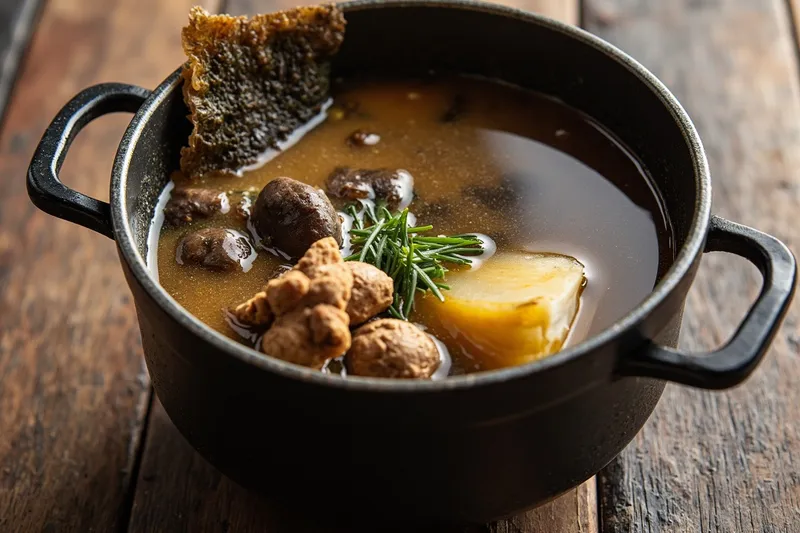
Bonito flakes go in off the heat for about thirty seconds and never boil, or the stock turns cloudy and bitter. My house ratio is roughly 10 g of kombu per litre and a pinch of flakes, which is a kitchen rule rather than a published one – taste and adjust. Kombu and dried shiitake make dashi kombu and a vegetarian stock from the same cupboard.
Freeze the stock in ice-cube trays, one cube per bowl, and keep miso out of the boiling pot: stir it in off the heat at the table, where each person can add more to their own bowl. This week has no raw fish in it – salted salmon is cured, not raw – and if you want sashimi at home, buy fillets sold for raw consumption and follow the parasite-destruction guidance in the FDA Food Code.
- Kombu dashi: cold water in, heat, steep, strain
- Dried shiitake in a second pot for the vegetarian version
- Cool the stock, pour into ice-cube trays, freeze
- Cook the rice batch and weigh it into 150 g portions
- Make one simmered dish – tofu, or pumpkin and daikon
- Mix the okonomiyaki base and wrap it for Thursday
Cook Rice in Batches and Freeze It Right
The arithmetic comes first. The week holds about eleven rice portions at 150 g, which is roughly 1.7 kg of cooked rice – so the batch is 8–10 cups of cooked short-grain grain from about 1.2 kg dry, not the 4–5 cups a first-timer cooks. Those cup-to-gram figures are my own kitchen conversions; weigh once and correct them.
Portion 150 g into bags or one lidded container, weighing once per batch. Cool the rice, then get it into the fridge within two hours: cooked rice left at room temperature can grow Bacillus cereus. The fridge holds leftovers 3–4 days and the freezer 3–4 months, which is the working-week window – cook and freeze on Sunday, thaw overnight in the fridge.
Keep brown and white rice in rotation so you do not eat the same grain seven days running, and check the bag at the shop: a 2.27 kg (5 lb) pack and a 2.3 kg pack are different products, and the serving size on the bag tells you which one you bought.
| Cooked on | Yield in 150 g portions | In fridge until | Freeze by |
|---|---|---|---|
| Sunday | about 11 | Thursday | Monday |
What to Make Ahead and What to Buy Fresh
Some things survive three days in the fridge and some do not. Dashi cubes, cooked rice, simmered dishes and the okonomiyaki base keep. Yakitori gets grilled the day you eat it, tamagoyaki is rolled to order so it stays soft, sesame greens are dressed at the table, and onigiri are wrapped at the last minute so the nori stays crisp.
Label and date every Sunday container, and finish a pack of natto the morning you open it. Keep miso and tamari out where people measure them with a teaspoon instead of pouring – that is where the sodium comes from, and a tablespoon of miso carries a large share of the 2,300 mg daily value.
- Dashi strained, cooled and frozen in cube trays
- Rice cooled, weighed and bagged in 150 g portions
- One simmered dish for Wednesday's dinner
- Okonomiyaki base mixed and wrapped
- Six eggs boiled for the week
- Tofu and mushrooms packed for Wednesday
- Spring onion, tamari and a teaspoon measured out
- Containers labelled with the day they are for
Swaps and Safeguards: Allergies, Medications and Weight Loss
Allergens: Wheat, Soy, Sesame, Fish and Shellfish
Five of FDA's nine major allergens show up in this plan – milk, eggs, fish, crustacean shellfish, tree nuts, peanuts, wheat, soybeans and sesame are the recognised nine (FDA food allergy guidance). So the swap list below is not decoration.
Tamari removes wheat from the seasoning shelf, though tamari still contains soy and the dish may carry wheat from elsewhere. Most soba contains wheat; only the 100 % buckwheat packs do not, and since buckwheat itself is not a declarable allergen in the US, the UK, Canada or Australia, a reader with coeliac disease reads the ingredient list rather than the allergen line. Udon is wheat and there is no gluten-free substitute on the shelf.
Nori and kombu are the safe corner of the plan. Bonito flakes are fish, which is why the vegetarian dashi route exists. Shellfish appears nowhere this week; adding it is a separate decision, not a swap.
| Item | Constraint | Direct swap | What you lose |
|---|---|---|---|
| Udon | Wheat | Rice noodles | The chew |
| Regular soy sauce | Wheat | Tamari | Slightly saltier, use less |
| Dashi with bonito | Fish | Kombu and dried shiitake | Less round, more mineral |
| Natto packs | Wheat starch in some | Edamame | The fermented bite and vitamin K2 |
| Miso soup | Soy, sesame, sometimes wheat | Plain dashi bowl, miso at the table | Depth for anyone avoiding soy |
Warfarin, Thyroid Medication and Daily Soy
Two medication checks, and I would make them before the first week rather than in it.
Warfarin first. The NIH vitamin K fact sheet sets an adequate intake of 90 mcg a day for women and 120 mcg for men. What matters for people on warfarin is consistency rather than avoidance, and natto is the richest everyday food source of vitamin K2. This plan serves natto on two mornings a week, in the same slots each time. A daily natto serving is a conversation with the prescriber.
Thyroid medication second. Soy can reduce thyroid hormone absorption and the adult iodine requirement is 150 mcg a day (NIH iodine fact sheet). Readers on levothyroxine who eat tofu, miso or natto daily should keep the timing of the pill and the soy consistent, and the drug's own prescribing information is where the separation rule comes from. More on that in who should ask a doctor before starting a Japanese diet.
Seaweed sits in between. Kombu and wakame carry very different amounts of iodine and the label does not say how much, so I keep one seaweed serving a day and skip a daily kombu soup. Green tea and leafy greens carry vitamin K too, so keep those steady rather than swinging them when you start.
- On warfarin: tell your prescriber you plan to eat natto twice a week and ask how they want your vitamin K tracked
- On levothyroxine: ask about timing around soy and tofu, then keep that timing the same every day
- If you plan daily seaweed, ask about iodine intake alongside your thyroid condition
- Bring the breakfast list – natto, miso, tofu – to the appointment; the prescriber works from the food, not the brand
A Japanese Meal Plan for Weight Loss: Scaling Portions and Watching Sodium
This plan is written for a healthy adult around 62 kg eating roughly 2,000 kcal a day, with no prescribed sodium limit. It gives you portions and a rhythm. It does not set a calorie target or promise a number on the scale.
What supports steady weight management is structural: half the plate vegetables, a fixed 150 g rice portion, a protein anchor at every meal, dinner finished about three hours before bed, and a 20–30 minute walk after dinner. The walk is the part people drop first, and the CDC guideline asks for 150–300 minutes of moderate activity a week plus two strength days, so five walks alone leave a gap.
Sodium is the quiet risk, because miso, tamari and pickles stack toward the 2,300 mg daily value. One bowl of miso a day on the four days the plan serves it, miso measured with a teaspoon, pickles rinsed, tamari used sparingly, and the sodium line read as a % of the daily value – 5 % DV or less counts as low. When two tubs of miso look identical on the shelf, USDA FoodData Central settles it faster than the packaging, because sodium differs a lot between a mild white paste and a punchy red one. If salt is the sticking point, the low-sodium Japanese meal plan handles that end.
- Fix the rice portion at 150 g cooked
- One soup a day, never two
- Rinse the pickles
- Keep the walk, and add the two strength days
Who This Plan Fits and Where It Falls Short
Verdict: Cost, Effort and What You Actually Get
What you get here is a portion framework, a Sunday prep sequence, a method for pricing the shop from the shelf, and a medication checklist. What you do not get is a strict menu to obey, a calorie target, or a promise about the scale.
The economics are workable. With food-at-home prices forecast up 2.3 % for 2026 and a further 1.0 % in 2027, a weekly Japanese meal plan built on eggs, tofu, rice and tinned fish is easier to repeat than one built on fresh fish. The Sunday block is about 40 minutes of active work plus cooling.
| Who this suits | Who should skip it |
|---|---|
| You cook rice most days and want one rule for a plate | You eat out for lunch every day |
| You want a cheap, repeatable protein anchor | You already eat well past 70 g of protein a day |
| You are tracking warfarin or thyroid medication | You need daily natto or daily kombu – that is a prescriber's plan, not a menu |
| You are watching sodium, with room to adjust | You have a prescribed sodium limit – build the week around your doctor's number |
| You are happy to add two strength sessions yourself | You want strength training built into the menu – it is not in here |
Alternatives and When a Simpler Routine Wins
Four simpler routes, each with one thing it costs you.
A Mediterranean-style week with the same protein-anchor structure and no imported pantry: easier shopping, less of this plan's identity – the comparison is in Japanese diet vs Mediterranean diet. A vegetarian build-up on kombu and dried shiitake dashi with eggs and tofu: no fish and less soy, but it drops the natto and seaweed and leaves iodine to think about. A no-cook week of onigiri, natto, egg rice and tinned fish for the weeks when Sunday prep does not happen: fastest to run, lowest in fibre. And a lower-sodium version where miso comes out and a plain dashi bowl goes on the table with salt added at the table: the same shape, less depth.
If weight is the goal, keep the walk and add the two resistance sessions. The menu does not replace them.
Frequently Asked Questions
- How much rice per meal? 150 g cooked, about one small donburi bowl. Weigh it once, then judge by eye in your own bowl.
- Can I eat brown rice every day? Better to alternate. FDA's arsenic guidance recommends a variety of grains and found no level of inorganic arsenic in rice that posed a health concern.
- Is miso soup twice a day allowed? On this plan, one bowl a day on the four days it appears. The 2,300 mg sodium daily value is a ceiling, not a target to reach.
- How often can I eat natto? Twice a week here. Natto is the richest everyday source of vitamin K2, so a daily serving needs your prescriber's view.
- How long do leftovers last? 3–4 days in the refrigerator and 3–4 months in the freezer.
- Can I freeze cooked rice? Yes – cool it first, then refrigerate within two hours so Bacillus cereus gets no chance.
- Is soba gluten-free? Only the 100 % buckwheat packs. Buckwheat is not a declarable allergen, so read the ingredient list rather than the allergen line.
- How much protein per meal, and does it cover the RDA? 12–15 g at breakfast, 20–25 g at lunch, 20–30 g at dinner, so about 55–70 g a day against an RDA of roughly 50 g for a 62 kg adult.
- What do I buy on the first shop? Eggs, rice, tofu, miso, dried soba, wakame, nori, tamari and one tin of sardines. The rest is in the pantry table above.
The plan breaks first in two places: the sodium in the soup and the import shelf. Fix the miso measure and the shopping list before you change anything else.