
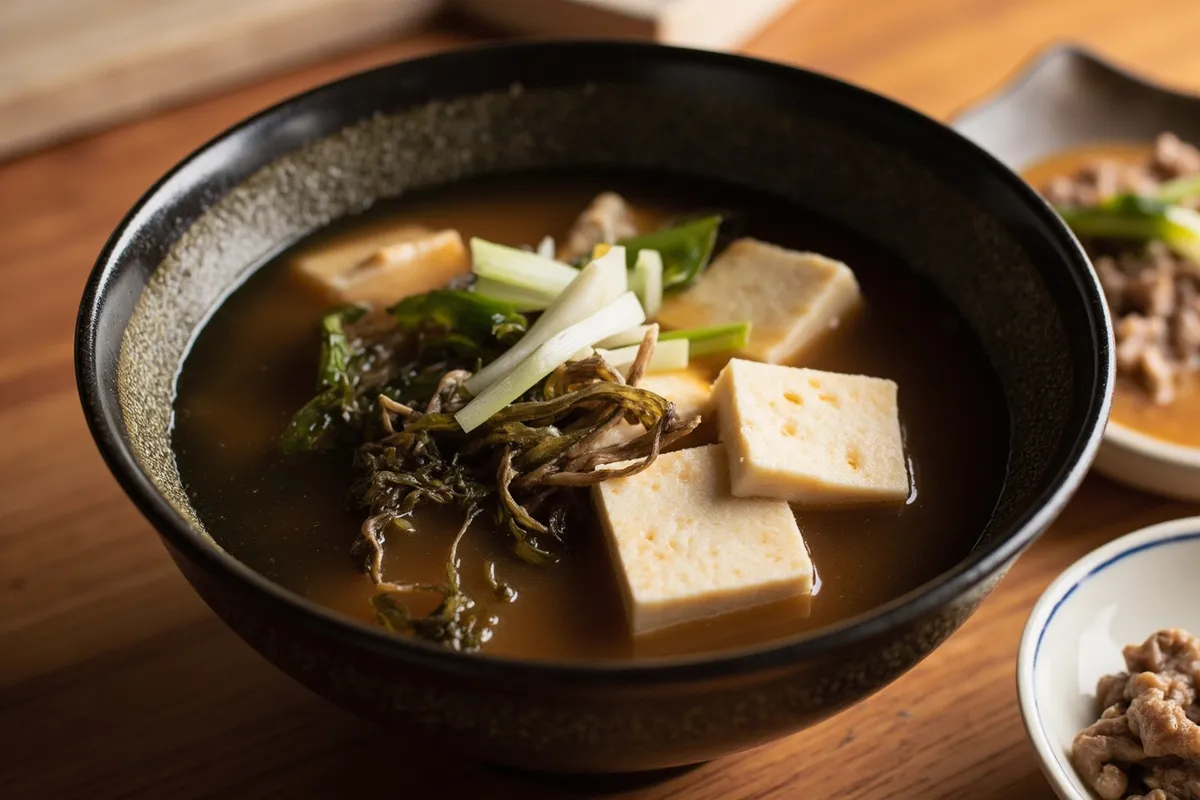
Miso soup benefits and is natto healthy are both questions you answer with the label in your hand. A teaspoon of table salt carries about 2,400 mg of sodium, and U.S. federal guidance keeps the whole day under 2,300 mg for teens and adults. Both foods are fermented soybean products, so both add flavour and protein to a meal with little cooking, and both can quietly eat a large slice of that daily salt budget.
I cook both in my own kitchen and read the tub and the pack before I buy them. The three decisions that matter: how much of the budget one spoonful of paste uses, who should leave natto alone, and what to put in the basket. The answers are all here, so there is no need to go looking elsewhere.
Miso Soup Benefits: What a Bowl Actually Gives You
What one bowl actually contains
A bowl of miso soup is one tablespoon of paste, a cup of broth and whatever you float in it. Fix that definition and the rest is easy, because after it the paste is the only part of the bowl you can change the salt in.
Two numbers decide whether the bowl is worth it: calories per bowl and sodium per bowl. Both come from a specific place, a FoodData Central record for miso soup made from paste, hot water and dried bonito, plus the Nutrition Facts panel on the tub you buy. I read the tub, because two pastes sold under the same name can differ.
Miso soup is light on calories and fat, and it is not a protein anchor. The protein in a bowl sits next to a block of tofu, two eggs or a pot of yoghurt, so treat the soup as a seasoning delivery vehicle with a hot savoury broth.
One tablespoon of paste seasons three to four servings of dashi. If the soup tastes too strong, halve the paste and add volume with the toppings instead of reaching for the salt jar.
| Component | Typical amount | What it adds | Where its sodium sits |
|---|---|---|---|
| Paste | 1 tbsp | Fermented soy, umami | The tub's per-tablespoon line |
| Broth | 1 cup | The base: kombu and bonito | None if you add no salt |
| Silken tofu | A few cubes | Protein and body | None |
| Wakame | A small handful | Volume, seaweed flavour | None |
| Spring onion, grated daikon | A spoonful each | Aroma and bulk | None |
Dashi: kombu and katsuobushi do the work
The broth is the dish. Kombu brings glutamate, bonito flakes bring inosinate, and together they let the paste do less work, which is the sodium lever for everything else here: a salt-free dashi means you can use less paste.
Toppings that add volume without salt: wakame, silken tofu, spring onion, thin slices of potato or daikon. Raw bonito flakes scattered on top at the table are a garnish, not a cooking step.
Two things before you start. Katsuobushi is bonito, a fish, so anyone with a fish allergy cooks a kombu-only dashi and skips the flakes. Kombu is seaweed, and NIH guidance on iodine notes that content varies widely between species and batches, which matters if you watch thyroid markers or take levothyroxine.
Four steps and no added salt: soak a strip of kombu in cold water, warm it slowly and pull it off before it boils, add bonito flakes with the heat off, then strain. Hard boiling makes kombu bitter and the flakes go fishy.
Shiro, aka, awase, mugi, kome: which miso to buy
The names on the shelf hide more than they explain. Shiro (white) is a short ferment: pale and sweet, with a soft texture. Aka (red) is aged longer and darker, with a deeper taste. Awase is a blend of red and white, mugi is made with barley koji so it is grainy and nutty, and kome is rice koji.
Underneath, Aspergillus oryzae works with yeasts and lactic cultures, and the koji grain sets the texture. Nattokinase, the enzyme people expect from fermented soy, is not part of miso; it comes from natto, fermented by a different bacterium.
One rule to keep: salt percentage sets the sodium, not the age of the paste. An aged red is not automatically less salty than a fresh shiro, so compare the per-tablespoon line and ignore the colour. For a first bowl I would take shiro or awase, and mugi if I want more body.
A short ingredient list on the tub (koji grain, salt, water) is a good sign of a simple paste. Anything longer and you are buying somebody's idea of miso.
| Type | Koji grain | Taste | Best for | Watch for |
|---|---|---|---|---|
| White shiro miso | Rice | Pale and sweet, soft | A first bowl, light soups | Added sugar |
| Red aka miso | Rice | Deep, aged | Stews, long cooking | Sodium per tablespoon |
| Awase miso | Rice | Half red, half white | Everyday bowls | Sodium per tablespoon |
| Barley miso mugi | Barley | Grainy, nutty | Soups that need body | Barley in the list |
| Rice miso kome | Rice | Mild, smooth | Dressings, light dishes | Sodium per tablespoon |
Miso Paste Nutrition: Read the Label Before You Buy
Sodium: how much of the daily budget one spoonful uses
U.S. federal guidance sets sodium under 2,300 mg a day for teens and adults, while average American intake runs above 3,300 mg. Soups are the second-largest source of sodium for adults 18 and over, ahead of pizza, poultry and bread, and it is the packaged and processed soups that land in that list. CDC sodium guidance
The conversion tool is simple: one teaspoon of table salt is about 2,400 mg of sodium, and sodium chloride is 40 percent sodium by weight. When a tub lists salt instead of sodium, multiply the salt number by 0.4 to see what it really is.
Now run your own bowl. Take the per-tablespoon sodium from the tub, multiply by the tablespoons you use and read it against 2,300 mg. If one spoonful comes to half the daily figure, the second spoonful is what takes you over, so I would cut the paste rather than the bowl. Salt across a whole week is a bigger job, and the low-sodium Japanese meal plan covers that part.
The reduction moves that work: one tablespoon instead of two, an unsalted dashi, volume from toppings, and a low-sodium miso if your shelf has one. For blood pressure, the DASH eating plan has the strongest public guidance behind it, and miso fits inside it only while the bowl stays small.
| Line to know | What it means |
|---|---|
| 1 tsp table salt, about 2,400 mg sodium | One teaspoon of added salt passes the daily limit on its own |
| Sodium chloride is 40 percent sodium | Multiply a salt line on the label by 0.4 |
| Daily limit: under 2,300 mg | Federal guidance for teens and adults |
| U.S. average: above 3,300 mg | Intake runs well past the limit |
| 1 tbsp miso paste | The number on your tub, and the one that matters |
Beyond salt: what protein, vitamins and probiotics actually mean
Fermentation works on the bean before you taste it. Enzymes from the koji break soy protein down, which is why miso tastes more savoury than plain soybean and why it is full of glutamate. How much more available amino acid sits in a spoonful I will not put a number on without a proper review in front of me.
Two rules follow from the pan. Heat deactivates the koji enzymes, so stir the paste into hot broth off the heat and never boil it. And miso contains no nattokinase: that enzyme comes from Bacillus subtilis var. natto, the bacterium that ferments natto, so a bowl of miso is not a nattokinase source and a nattokinase capsule is a purified enzyme sold as a dietary supplement with its own evidence.
Miso does carry vitamin K2, though the natto figures are the large ones. For probiotics the label decides: if the tub states a live count you can count it, and if it says nothing about live cultures then miso is not a probiotic delivery system and I would not describe it as one.
Storage is simple: the best-before date on the tub, the fridge after opening, and expect the colour to deepen as it oxidises.
Read five lines on the tub and you know what you are buying: sodium per tablespoon, added sugar, the allergen statement, the koji grain, and any wording about live cultures.
Is Natto Healthy? Protein, Fibre and Vitamin K2
What natto actually is
Natto is whole soybeans fermented with Bacillus subtilis var. natto. Nothing is added to soften them and the beans stay whole. The bacterium leaves a sticky coating made of polymers of glutamic acid, which is the stringy slime on the beans and the reason people outside Japan push the plate away.
The same bacterium produces nattokinase, a serine protease with fibrinolytic activity. Hiroyuki Sumi discovered it in 1980, and it was named in a 1987 paper in Experientia that described natto as the vegetable cheese of the Japanese diet.
So is natto healthy? It is a fermented whole-bean food that delivers protein, fibre and vitamin K2 in a single-serve pack, and the figures come off the pack's Nutrition Facts panel. Keep one thing separate from here: a pack of natto and a nattokinase capsule are different products with different evidence behind them.
Vitamin K2, nattokinase and what the human trials measured
Natto carries high levels of vitamin K2, mostly as menaquinone-7, MK-7. How much you get depends on the batch and the brand, and it is a big enough number to drive the warfarin rule further down this article.
The mechanism is plain enough to explain over dinner: nattokinase hydrolyses fibrin directly, degrades PAI-1 and raises tissue plasminogen activator activity.
The human data are narrower than the packaging suggests. In trials, a single 2,000 FU dose raised antithrombin concentration at two hours, produced fibrin degradation products at four hours, and lowered factor VIII activity at four hours, with no adverse effects detected in trials running up to two months. The blood-pressure result came from randomised, double-blind, placebo-controlled multicentre trials of nattokinase capsules, and eating natto itself has not been tested for that effect. The capsules earned that result, the beans did not.
Nattokinase is sold as a purified dietary supplement in the US, Canada and Europe, in vegetable capsules, and its purity requirements have drawn regulatory attention. The nattokinase review in PubMed Central has the trial detail. Observational support exists as well: the Takayama study of Japanese adults linked higher dietary soy and natto intake with lower cardiovascular disease mortality. That is real, and weaker than a trial.
- Vitamin K2 in natto: high confidence, and the amount depends on the batch
- Nattokinase and fibrin breakdown: confirmed mechanism
- Blood pressure: confirmed for nattokinase supplements
- Eating natto itself: not directly tested
- Cardiovascular mortality: observational
Where natto fits in a Japanese breakfast
The natural home of natto is a breakfast plate: rice, miso soup, natto, grilled fish and pickles. It takes less time than most people's lunch order, and the Japanese breakfast framing fits better than it sounds.
Seasonal service is real rather than decorative. Natto is traditionally a cold-weather food. In the hot months the same beans come out cold over rice with bonito flakes on top, and in the cold months they are warmed through or simmered in a pot as nabe-style natto.
What it adds to the plate is protein and fibre per pack, and those numbers are printed on the pack. If the texture and the smell are what stop you, that is a serving problem with easy answers, and a smaller bowl of rice changes how much slime you notice.
Natto Benefits and Risks: Blood Pressure, Purines and Drug Interactions
Blood pressure: what was tested, what was not
The blood-pressure finding belongs to nattokinase capsules, so a reader who eats natto cannot claim it for themselves. Keep that line in mind when a supplement bottle promises the same outcome.
If you buy the capsule, treat it as a dietary supplement rather than a medicine. Dosing, purity and interactions belong to a prescriber or a pharmacist, not to a product page. Nattokinase acts on clotting, so anyone with bleeding risk, on antiplatelet drugs, or with surgery booked should talk to a clinician before starting.
For someone with hypertension who wants to change what they eat, the order matters. Keep any vitamin K2 source at a steady dose instead of starting and stopping, write your home blood pressure readings down so they mean something, and tell your doctor what you take. Never drop a prescribed medicine because a food looks helpful.
Miso is the nattokinase-free fermented soy for this group, though it carries its own vitamin K2, so the pharmacist or doctor decides whether that fits your medication.
Warfarin, thyroid medication and the interaction rules
The documented interaction is warfarin. Natto carries high levels of vitamin K2, mostly MK-7, and patients dependent on warfarin should exclude it. The working rule: keep vitamin K intake steady, and agree any change in how much natto you eat with your prescriber before the change, not after it.
Two things people miss. Miso also supplies vitamin K2, so if warfarin is part of your life the total dietary K matters, not natto alone. And the kombu in the broth is seaweed, where iodine content varies widely between species and batches, which matters if you take levothyroxine, because food and supplements can change how a thyroid tablet is absorbed. Keep the pill and the soy food apart in the day and confirm the gap with your prescriber rather than guessing at it.
Other anticoagulants, antiplatelet drugs and new supplements work the same way: one conversation with a pharmacist covers all of them. The iodine in seaweed and fish is worth reading if thyroid markers are on your radar.
Purines, gout, soy allergy and the label lines that matter
Gout is the question I treat most carefully. The 2020 American College of Rheumatology gout guideline does not tell people to cut purines that come from plant sources, so a pack of natto is not something to give up because the word purine appears next to it. What matters is your overall pattern, how often you eat it and how your uric acid behaves.
Allergies are a different matter and the label decides them. Soy allergy means neither miso nor natto. Beyond that, the FDA allergen categories cover soy, sesame (some pastes carry gomashio), fish (the bonito flakes behind a dashi-based soup) and wheat. Read the allergen line on every tub and every pack, because recipes change between batches.
Gluten is usually not the problem: plain miso and natto are normally gluten-free, but shoyu contains wheat and some pastes list malt or other wheat-derived ingredients. If histamine is your concern, treat any confident claim about fermented soy with caution and ask someone who has looked at the fermentation chemistry.
If natto is off the table for you, the fermented slot does not have to be empty: tofu, edamame, tempeh, a milder miso bowl, plain yoghurt or kimchi keep the habit without the trigger.
How to Eat Natto: The Bowl, the Toppings, the Rules
The bowl: rice, shoyu, wasabi, spring onion, grated daikon
Open the pack. Add a splash of shoyu, a little wasabi and a few slices of spring onion, then beat the beans with chopsticks until the slime turns glossy and coats every bean. The beating is not theatre: it is how the viscous coating gets spread around, and skipping it leaves lumps of bean and clumps of slime.
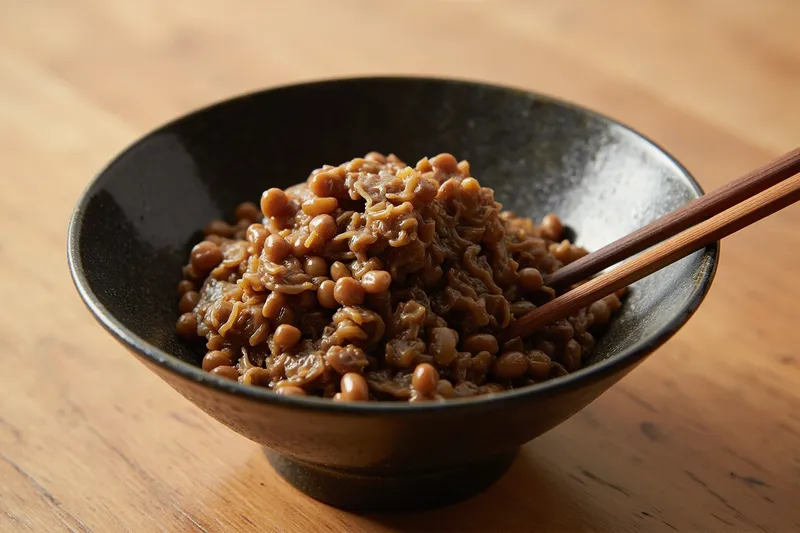
Natto over rice is the standard plate. Pour the tare around the edge of the rice rather than over the beans, so the salt arrives in bites with the rice. If the texture is the problem, the topping ladder helps: grated daikon first, bonito flakes next, then a soft egg, extra spring onion, karashi mustard, chopped shiso.
Three rookie mistakes: expecting bean-like flavour and a clean bite, skimming the liquid off and serving the beans dry, and doubling the shoyu on top of a tare that is already salty. On temperature, natto is eaten raw or gently warmed, never boiled. Open a pack and eat it the same day, and if it has to wait, refrigerate it and follow the instruction on the pack.
At a restaurant, ask for natto with shoyu, wasabi and green onion on the side, and mix it yourself at the table.
Buying natto: packs, powders and where to find it
On a US shelf you will find single-serve plastic cups of roughly 100 g, multi-pack trays, larger tubs for regulars, and freeze-dried or rehydratable natto for buyers who will not commit to a fresh pack. Miso pastes sit in the international aisle; natto is usually in the refrigerated section next to tofu, eggs and fresh noodles, because it is a fresh fermented food rather than a shelf-stable jar.
Check six things on the pack: the best-before date, whether it is raw or pasteurised, single serve or bulk, whether salt has been added, the allergen line, and the sodium and protein per pack. The sodium number goes straight into the arithmetic above.
Grocery delivery apps list natto under Japanese fermented soybeans, and each store sets its own price, so a number you saw on one app is not a number you can rely on next week. Compare the price per gram rather than per pack, since the same brand comes in both a single cup and a tray of four.
Fermented Foods in the Japanese Diet: Miso, Natto, Tempeh, Doenjang
Miso, natto, tempeh, doenjang: four ferments, four jobs
Fermented soy is one idea with several executions. Miso and shio koji rely on the mould Aspergillus oryzae working with yeasts and lactic cultures on cooked soybeans and salt. Natto relies on a bacterium and works on whole beans. Tempeh uses Rhizopus moulds on cracked beans, and doenjang from Korea runs a different mould-and-salt process again.
The fact worth carrying to the shop: nattokinase appears only in natto, so miso and tempeh never carry it. Miso and natto both supply vitamin K2, and the amounts are not close.
Salt in miso and doenjang is a preservation tool as much as a seasoning, which is why both are salty by design. Flavour intensity tracks fermentation length and salt percentage together, and how much a paste delivers depends on the brand. I would not buy a paste for probiotics unless the tub states a live count.
| Ferment | Culture and substrate | What it gives | What it does not give | Where the sodium sits |
|---|---|---|---|---|
| Miso | Aspergillus oryzae, yeasts and lactic cultures on cooked soy and salt | Umami, fermented soy protein, vitamin K2 | Nattokinase | Added salt in the paste |
| Natto | Bacillus subtilis var. natto on whole soybeans | Nattokinase, high vitamin K2, protein and fibre | Low sodium on its own | Added sauce, or none if you skip it |
| Tempeh | Rhizopus moulds on cracked soybeans | Protein and fibre | Nattokinase | Usually little added |
| Doenjang, shio koji | Mould and salt on soybeans | Deep umami, fermented soy | Nattokinase | Heavy salt |
Cooking with fermented soy: the ten-minute bowl, packets and leftovers
The ten-minute weekday bowl: strained dashi, rehydrated wakame, sliced tofu, and the paste stirred in off the heat. The four steps are in the dashi section above, and the homemade miso soup guide goes into the detail.
Instant miso packets are the quick version, so read the Nutrition Facts panel on the packet in your hand for the milligrams per packet. Packaged soups are where most of the soup sodium in the American diet comes from, and instant miso sits in that group, which makes the packet number the one that counts for you.
Low-sodium miso is the compromise. Compare the sodium per tablespoon on two tubs and you will see how wide the spread between brands runs; the reduction on the label is not the same as the flavour you give up, so try half your usual spoonful with more toppings.
The paste does more than soup: a miso-lemon dressing for cucumber and tofu, a marinade for fish and chicken, a seasoning for soba broth, a punch for edamame and seaweed salads. Leftover miso soup becomes noodle broth the next day.
Which Fermented Soy to Buy, and How Often
Who should eat miso, who should eat natto, who should eat neither
Three lines to start. Buy miso for everyday umami on a controlled salt budget. Treat natto as a high-value single-serve breakfast with one hard drug rule attached. Skip both if soy is an allergy.
Miso is the flexible one: the paste sets the sodium, the toppings set the volume, and the daily budget is the constraint. Natto is the concentrated one, with more vitamin K2, more protein per pack and a texture barrier that keeps people off it for years. For gout, I am not giving you a purine figure, and the guideline point plus a conversation with your clinician stand in its place.
Nothing here replaces medical care, and anything on a prescription list goes to your prescriber before you change it. The Mediterranean diet gets compared with the Japanese one all the time, and the overlap is real: vegetables, fish, small amounts of meat, and salt kept low. What differs is the fat, which in the Mediterranean pattern is mostly olive oil.
| Your situation | What to do | The swap |
|---|---|---|
| Average cook | Miso most mornings, natto a few mornings a week | Measure the paste, do not eyeball it |
| Cutting sodium | One tablespoon, unsalted dashi, more toppings | Compare per-tablespoon lines on two tubs |
| High blood pressure | Small bowl, steady K2 intake, tell your doctor | Never stop a prescribed medicine for a food |
| Warfarin | No natto without the prescriber's agreement | Miso carries K2 too, so the total matters |
| Gout | Ask about pattern and frequency | Plant-source purines are not the target |
| Soy allergy | Neither miso nor natto | Check the sesame, fish and wheat lines too |
| Protein target | A natto pack with tofu, eggs or yoghurt | Read the protein per pack |
| Vegetarian | Both work | Kombu-only dashi instead of bonito |
| Tight budget | Tofu, edamame and plain miso | Compare price per gram, not per pack |
| Pregnancy | Use the target your clinician gives you | Ask for the number, do not guess it |
Quick questions, a shelf checklist and what to check with your doctor
Is natto worth eating as a breakfast food? One pack gives protein, fibre and vitamin K2, and it turns a bowl of rice into breakfast in the time it takes to boil the kettle. If the smell is the blocker, serve it cold over rice with grated daikon and bonito flakes, and mix it at the table rather than before.
Which miso is the lowest in sodium? The label decides, not the colour and not the age of the paste. Compare the sodium per tablespoon across a few tubs and take the lowest number that still tastes like miso to you. An aged red aka can easily be saltier per spoonful than a fresh white shiro.
Can I eat miso with high blood pressure or on blood-pressure medication? Usually yes, with the bowl sized and the paste measured. A tablespoon costing half the daily sodium limit spends half the day before dinner, so split the paste, keep the dashi unsalted and lean on the toppings.
Is miso a probiotic, and how long does it keep? Only if the tub states a live count; silence on the label means it is not a probiotic product in any useful sense. After opening it goes in the fridge, and the best-before date on the lid is the deadline that matters.
Five things worth a word with your doctor or pharmacist before you change what you eat:
- If you take warfarin or another anticoagulant, agree the natto question with your prescriber before you change a single meal.
- If you take levothyroxine, keep the pill and the soy food apart and let your prescriber set the gap.
- If you have kidney disease, heart failure or you are pregnant, use the sodium target your clinician gives you instead of the general one.
- If you have surgery booked or take antiplatelet drugs, raise any nattokinase supplement with a clinician first.
- If you have gout, take your eating pattern and frequency to your doctor instead of a per-pack purine figure.
- Sodium per tablespoon on the tub, read against the 2,300 mg day
- Added sugar in the ingredient list
- The koji grain: rice or barley
- The allergen line: soy, sesame, fish, wheat
- Any wording about live cultures, and the best-before date