
Japanese diet vs low carb: in the biggest randomised trial of the two, one group lost 5.3 kg in a year and the other 6.0 kg, a gap of under a kilo. The choice turns on how much carbohydrate you can keep eating, how much fibre comes with it, how much salt, and any medication you take.
This is written for adults with a BMI of 25 or over who are not on glucose-lowering drugs. Three documents shape what follows: the Dietary Guidelines for Americans 2025–2030 (January 2026), the ADA Standards of Care in Diabetes 2026 (December 2025) and Japan’s 2025 Dietary Reference Intakes, in force through FY2029.
Japanese Diet vs Low-Carb Diet: What Each One Looks Like on the Plate
A weekday Japanese breakfast, one soup and three dishes
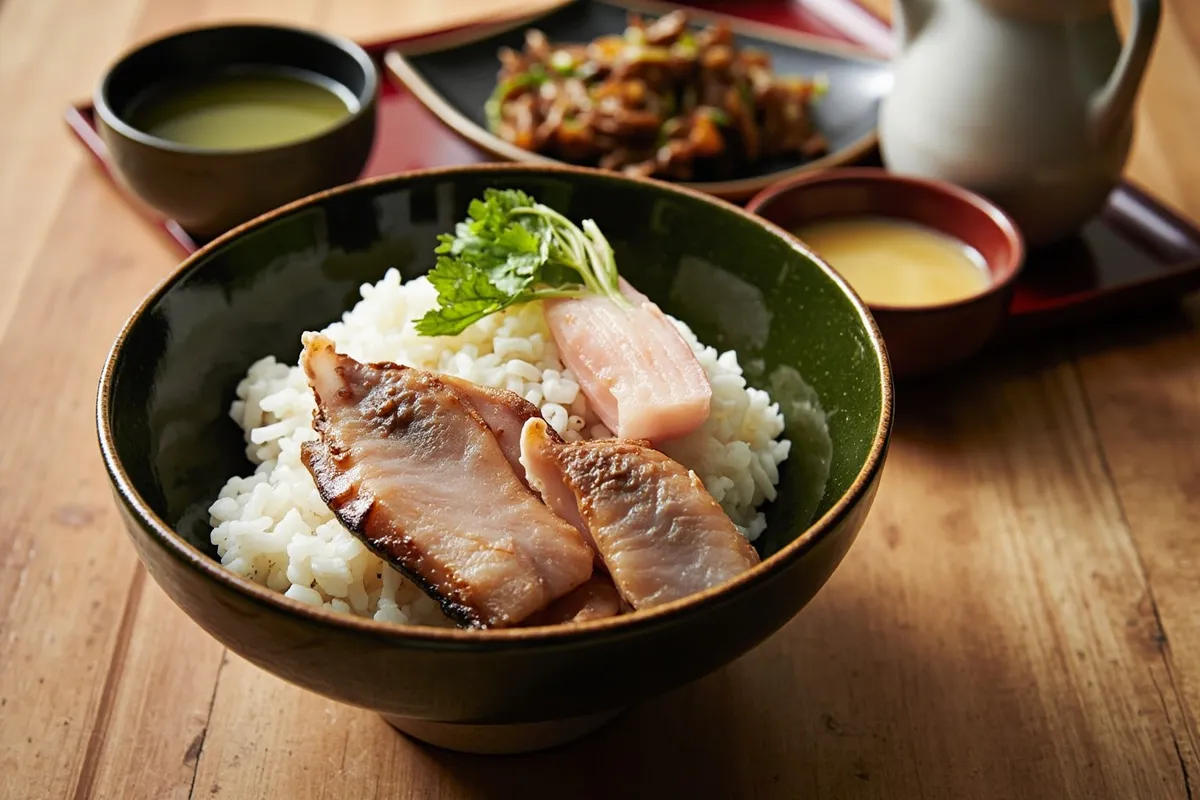
Breakfast in my family in Yokohama took ten minutes: rice, a bowl of soup, something from the fridge, tea, all shared from the middle of the table. I cook it the same way in Manchester with supermarket ingredients, and the logic holds: one soup and three dishes (ichiju-sansai), with rice as the carbohydrate anchor rather than the whole meal. The washoku frame is simple enough to copy without a Japanese kitchen.
Numbers for that plate, from Japan’s Ministry of Education food composition tables (2020 edition, eighth revision): cooked white rice runs about 25–26 g of carbohydrate per 100 g, natto about 12–13 g per 100 g, brewed green tea next to nothing. A packaged red miso label gives 26.7 g of carbohydrate per 100 g, which is roughly 4 g in a 15 g tablespoon.
- Rice, cooked, about 150 g: the carbohydrate anchor
- One soup, miso or clear kombu broth
- One small protein dish: fish, tofu, natto, an egg
- Two small vegetable dishes, pickles counted
- Green tea or matcha to finish
This describes a pattern. Portions and appetite vary, and plenty of Japanese adults skip breakfast. What transfers to a British shop is the structure: carbohydrate in one predictable place, protein in small portions, vegetables in quantity.
What low carb covers, from 130 g down to keto
The label covers a range of intakes. Know Diabetes, the NHS-affiliated programme, defines a low-carbohydrate diet as 50–130 g of carbohydrate a day; an NHS Somerset position statement calls anything under 50 g a day a very low-carbohydrate ketogenic diet. In energy terms 130 g is about 26% of a 2,000 kcal day, my arithmetic rather than a published figure.
The randomised evidence for that band is not new. The Cochrane review of low-carbohydrate against balanced-carbohydrate diets pulled in 61 trials and 6,925 adults, and its search was current to June 2021, so treat it as the most recent synthesis unless a newer one has appeared.
Net carbs is the number people quote, but most packs never print it. Take total carbohydrate and subtract the fibre line. In Europe, polyols such as maltitol sit inside the carbohydrate line and outside the sugars line, so read both.
One more term to keep straight: carbohydrate energy ratio is carbohydrate grams turned into a share of calories. It is the cleanest way to line up a Japanese plate with a low-carbohydrate one.
Japanese diet carb content against keto thresholds
Here is the carbohydrate in ordinary items, as you eat them, with the units matched to the portion in the first column.
| As eaten | Carbohydrate | Fibre | Note |
|---|---|---|---|
| Cooked white rice, 150 g | 38–39 g | about 1 g | your biggest carb item |
| Red miso paste, 1 tbsp, 15 g | about 4 g | about 1 g | also 1.65 g sodium |
| Nori sheet, 5 g | about 1.5 g | about 1 g | mostly fibre |
| Firm tofu, half a block, 113 g | about 3 g | about 0.5 g | protein, not carbs |
| Green tea, brewed, 240 ml | 0 g | 0 g | matcha carries more caffeine |
Four things make a Japanese day read as moderate-carbohydrate rather than low-carbohydrate: the volume of rice, miso and soy sauce adding up, portion discipline, and fermented staples carrying carbohydrate in a spoonful. The reference band is a share of energy, 50–65% for women aged 30 to 49, so grams depend on your size and your calories.
Two caveats. No trial has tested the Japanese pattern; the closest thing is the balanced-carbohydrate comparator in the Cochrane review, and the reference band is a nutrition target rather than a weight-loss plan. The table describes home cooking. Ramen, curry or a convenience-store bento changes the numbers in one sitting.
Sushi is the case readers ask about most: six pieces of nigiri carry roughly 30 g of carbohydrate, nearly all of it in the rice.
Low-Carb vs Japanese Eating: Which Diet Loses More Weight
What randomised trials actually show
The short version: low-carbohydrate and balanced-carbohydrate diets differ by about a kilogram. The Cochrane review of 61 trials and 6,925 adults found differences of roughly 1 kg in trials lasting three to eight and a half months and under 1 kg in trials running one to two years. For HbA1c, LDL cholesterol and diastolic blood pressure up to two years, it found probably little or no difference. The Cochrane review CD013334 is readable in an hour.
The comparator there is balanced-carbohydrate diets. The Japanese diet has never been tested head to head against a low-carbohydrate diet, so the fair comparison is energy shares: the Japanese reference band sits at 50–65% of calories, DIETFITS’ low-carbohydrate arm finished at 30%, and the NHS band of 50–130 g lands near 26% of 2,000 kcal.
Two diets differ in more than carbohydrate: fibre, protein and coaching moved too. When two arms land within a kilo of each other, the deciding factor is which one you still want in week nine.
DIETFITS: what 609 people ate and what happened
DIETFITS is the trial most people mean: 609 overweight adults without diabetes, randomised to a healthy low-fat diet and a healthy low-carbohydrate diet, free-living and coached rather than fed meal plans.
| At 12 months | Healthy low-fat | Healthy low-carbohydrate |
|---|---|---|
| Mean weight change | −5.3 kg | −6.0 kg |
| Carbohydrate a day | 213 g, 48% of calories | 132 g, 30% of calories |
| Fibre a day | 23.0 g | 18.6 g |
| LDL change | −2.12 mg/dL | +3.62 mg/dL |
Four design details explain the narrow gap: people lived at home, advice was coaching rather than menus, the low-carbohydrate arm was defined by grams and not by ketosis, and both arms were built on decent food.
There is no loser here. The ADA’s 2026 Standards of Care use a 5–7% loss of starting weight as the benchmark that improves glycaemia and other cardiovascular risk factors, and both arms cleared it. The between-group difference was 0.70 kg, with a confidence interval from −0.21 to 1.60 kg, which does not reach statistical significance.
A day in each arm can only be reconstructed from the published guidance: eggs, salad and olive oil on the low-fat side; yoghurt, nuts and eggs with vegetables and dairy on the low-carbohydrate side. Nobody’s plate was measured, so read this as the instructions, not as a record of what 609 people ate.
The 5–7% benchmark and where the Japanese pattern stands
Losing 5–7% of your body weight is the target worth aiming at, because that is the loss the ADA’s 2026 Standards link to better blood sugar and fewer cardiovascular risk factors.
| Your weight | 5% | 7% |
|---|---|---|
| 75 kg | 3.75 kg | 5.25 kg |
| 95 kg | 4.75 kg | 6.65 kg |
Four levers sit outside the plate, and each has its own target rather than feeding one big number:
- Steps and energy expenditure. Japanese adults average 6,628 steps a day for men and 5,659 for women. At a moderate 100–110 steps a minute, that is roughly an hour of walking, my estimate rather than a measured figure.
- Sodium and blood pressure. Salt intake here runs above target, and sodium moves blood pressure, not weight.
- Fibre and glycaemia. This is the one that changes fullness and how glucose behaves after a bowl of rice.
- Coaching and environment. The ADA’s 2026 Standards put the emphasis on eating patterns with the strongest evidence base, naming Mediterranean and low-carbohydrate patterns.
For the Japanese pattern, the closest trial proxy is DIETFITS’ healthy low-fat arm at −5.3 kg: moderate carbohydrate, plenty of vegetables, little salt. Nobody has run a trial of the Japanese pattern itself. And a BMI of 25 or over is the obesity threshold Japan’s own nutrition survey uses, which is where the figure of 31.5% of men aged 20 and over comes from.
The Japanese Diet Scoreboard: How the Pattern Is Measured and What It Predicts
How the Japanese Diet Index is built and what it predicts
The pattern gets measured with the Japanese Diet Index, a score built from the foods that keep showing up in Japanese eating. A review of 39 epidemiological studies found the most common components are soy and soy products, seafood and vegetables, with rice and miso soup behind them.
| Component | Direction | What to watch |
|---|---|---|
| Vegetables | more is better | intake is falling |
| Soy and soy products | more is better | tofu, natto, edamame |
| Seafood | more is better | fish, a little shellfish |
| Fruit | more is better | easiest place to add |
| Rice and grains | amount, not quality | portion does the work |
| Green tea | more is better | unsweetened |
| Miso and seasonings | more is better | sodium climbs with the score |
The outcome evidence comes from a prospective cohort of 92,969 adults aged 45 to 74, followed for a median of 18.9 years. People in the highest score group had lower all-cause mortality than the lowest group, a hazard ratio of 0.86, and lower cardiovascular mortality at 0.89. Green tea at or above the median came with lower all-cause mortality too, at 0.89. Rice at or above the median did not: 1.02, no meaningful association.
Two caveats. This is a cohort, not a trial, so the score is associated with lower mortality rather than proved to cause it. And the pattern’s weakest link is vegetables: the 2023 National Health and Nutrition Survey put average intake for adults 20 and over at 256 g a day, with significant declines over ten years for men and since 2015 for women. Copying the pattern means fixing that gap.
Gohan portions, hara hachi bu, green tea and matcha
Rice is where the arithmetic shows. Average daily rice intake in the NILS-LSA study was 278 g for people with the best nutrient density against 310–323 g for the population overall, and those are dry weights. Cooked rice weighs about two and a half times more, so 278 g raw is a good deal beyond one bowl. The portion question does more work than any ingredient swap.
The habit worth borrowing is not a rule about fullness. Hara hachi bu is a custom of stopping before you are completely full, useful as a nudge rather than a measured capacity. The practical version: one bowl, no refills, vegetables on the table.
- A smaller bowl, which does more work than willpower
- One serving, served once
- Kombu or kombu-shiitake broth instead of noodles some lunches
- Rice alongside vegetables rather than instead of them
Green tea is the default, matcha the occasional stronger one, and matcha is powdered leaf, so a tin usually carries more caffeine than a cup of steeped sencha. One part of the pattern is a weakness: konbini desserts, wagashi and takeaway sauces. The Dietary Guidelines for Americans 2025–2030 set added sugars at no more than 10 g per meal, which is the number to read against a dessert label. Green tea and matcha deserve more detail than this.
Okinawa’s legacy and the salt that comes with it
The Okinawa diet is the usual example, and the popular version is low-salt. The data says otherwise. In the cohort, the highest Japanese Diet Index group ate 6,466 mg of sodium a day against 3,173 mg in the lowest, and every version of the index correlated positively with sodium, at energy-adjusted correlations of 0.26 to 0.38. Potassium rises alongside it, and so does the salt.
Japan’s 2024 National Health and Nutrition Survey, the expanded round published in December 2025 and the baseline for Health Japan 21’s third term, put average salt intake at 9.6 g a day, the lowest in twelve years and still above both the 7 g Health Japan 21 target and the 6.5 g salt-equivalent reference in the 2025 Dietary Reference Intakes. The Ministry of Health survey release has the figures.
- Miso sold as a concentrate: use a quarter of the label amount, or make your own from paste
- Instant noodle packets: use the seasoning for less than half the noodles, then add vegetables
- Preserved and salted items: salt fish and tsukemono are traditional and still sodium
- Table salt: leave the shaker in the drawer
Doing the arithmetic helps. Japanese food composition tables convert sodium to salt equivalent by multiplying by 2.5. A 15 g tablespoon of red miso paste carries about 1.65 g of sodium, roughly 4.1 g of salt, a quarter of a day’s target in one spoonful. Keep the potassium-to-sodium ratio as a personal marker rather than a health score. With high blood pressure or chronic kidney disease, your clinician’s sodium and potassium advice comes first.
What Low-Carb Does to Cholesterol, Fibre and Ketoacidosis Risk
The lipid and fibre trade-off in trial data
Cutting carbohydrate does not leave everything else untouched. The same DIETFITS trial measured bloods at 12 months, and the two arms moved in opposite directions on some markers.

| Change at 12 months | Healthy low-fat | Healthy low-carbohydrate |
|---|---|---|
| LDL cholesterol | −2.12 mg/dL | +3.62 mg/dL |
| Triglycerides | −9.95 mg/dL | −28.20 mg/dL |
| Saturated fat, share of calories | 9.0% | 14.5% |
| Fibre a day | 23.0 g | 18.6 g |
Triglycerides like the low-carbohydrate arm. LDL cholesterol does not: it fell slightly on the low-fat side and rose on the other, and saturated fat supplied 14.5% of calories against 9.0%, which is the most likely reason. If your LDL is high or you have been told to watch it, that is the row to read twice.
Fibre is the trade most people miss. The reference target is at least 18 g a day for women aged 30 to 49, and the low-carbohydrate arm averaged 18.6 g, so it barely cleared the line while the low-fat arm reached 23 g. Four ways to close the gap:
- Legumes: beans, chickpeas, lentils
- Non-starchy vegetables, more than you expect
- Whole grains or bran, in small portions
- Ground psyllium or another fibre supplement, if food alone will not do it
Restricting carbohydrate for months also crowds out some micronutrients along with the fibre. If that is your plan, have your fibre intake and blood markers reviewed with a clinician rather than trusting a shopping list.
Ketoacidosis risk, SGLT2 inhibitors and when to call a doctor
If you take an SGLT2 inhibitor such as empagliflozin, cutting carbohydrate sharply can precipitate ketoacidosis. The approved Jardiance (empagliflozin) prescribing information has a dedicated ketoacidosis section that names a ketogenic diet among the conditions that can trigger it, and it warns that ketoacidosis can occur at glucose levels below 250 mg/dL. The label lists nausea, vomiting, abdominal pain, malaise and rapid breathing as symptoms. Tell your prescriber before you change how you eat.
The warning belongs to the drug. Plenty of people on these drugs eat a moderate-carbohydrate diet safely. What the label is really flagging is euglycemic ketoacidosis, the version where blood glucose looks deceptively normal while ketones climb, so a normal reading does not rule it out.
Two more situations need a doctor in the room. If you use insulin, the carbohydrate you eat is part of your dosing, so any sharp cut has to be recalculated by your prescriber rather than guessed at. And if you are pregnant or have a history of disordered eating, a very low-carbohydrate cut is the wrong place to experiment. Symptoms that need same-day medical advice: vomiting that will not stop, deep or rapid breathing, and confusion.
Where the guidelines land, and the two alternatives that also work
Guidelines treat these as eating patterns inside an overall calorie framework rather than as ranked diets, and both were refreshed recently.
| What the guideline says | Source | What it means here |
|---|---|---|
| 2–4 servings of whole grains a day | Dietary Guidelines for Americans 2025–2030, January 2026 | room for brown rice, oats, buckwheat |
| 1.2–1.6 g protein per kg of body weight | same | tofu, fish, soy, eggs |
| Saturated fat below 10% of calories | same | the low-fat arm sat at 9.0% |
| Sodium under 2,300 mg a day from age 14 | same | a miso-heavy day reaches it easily |
| Added sugars no more than 10 g per meal | same | the dessert gap in this pattern |
| Mediterranean and low-carbohydrate patterns named for preventing type 2 diabetes | ADA Standards of Care in Diabetes 2026, December 2025 | the Japanese pattern is not on that list yet |
The Mediterranean structure and Japanese-style cooking overlap more than the labels suggest: olive oil, fish instead of red meat, leafy greens, soy in place of some meat and dairy. If you already cook Mediterranean, switching to a Japanese pattern is a set of swaps rather than a new discipline.
On meal-skipping schedules, keep your expectations modest. The ADA names eating patterns rather than timing schedules, and the Cochrane comparison tested carbohydrate amounts, not meal timing, against a Japanese-style pattern. Intermittent fasting can sit on top of either, and it helps when the schedule fits the week you actually have.
Shopping a Japanese Diet: Tofu, Miso, Natto, Nori, Dashi and Green Tea
Reading supermarket labels for carbs, salt and fibre
The nutrition label tells you three of the four things that matter. Carbohydrate and sugars sit together, fibre sits on the same panel, and salt appears either as salt or as sodium depending on the country you are shopping in.
| On the pack | Compare against | Usual trap |
|---|---|---|
| Total carbohydrate | your share of calories, not a fixed gram number | fruit-flavoured protein bars carrying 20 g of carbs |
| Fibre | at least 18 g a day (DRI reference) | low-fat dressings with sugar for bulk |
| Salt or sodium | 6.5 g salt equivalent a day | sugar-free miso blends full of maltitol |
| Sugars | no more than 10 g added per meal | low-carb granola with dried fruit |
For anything unpackaged, the Ministry of Education’s Food Composition Database is free to search, covers 2,478 foods in its 2020 edition (eighth revision, with the 2023 supplement), and gives carbohydrate and salt equivalent per 100 g. That is where you check raw kombu or shelled edamame rather than guessing.
Salt maths: Japanese tables convert sodium to salt equivalent by multiplying by 2.5, so 1,000 mg of sodium on a North American label is about 2.5 g of salt. In Britain and Europe the label already prints salt, so nothing to convert. One more trap worth naming: reduced-fat peanut butter often gets its texture from added sugar, so the fat goes down and the carbohydrate goes up.
What each staple contributes
| Staple | Typical portion | Carbohydrate and protein | Sodium note |
|---|---|---|---|
| Firm tofu | 113 g, half a block | about 3 g carbs, 13 g protein | low, usually under 100 mg per 100 g |
| Natto | 100 g pack | about 12 g carbs, 8 g protein | modest, around 60–90 mg per 100 g |
| Red miso paste | 15 g, 1 tbsp | about 4 g carbs, 1.5 g protein | 1.65 g sodium, about 4.1 g salt |
| Soy sauce | 15 ml, 1 tbsp | about 1–2 g carbs | around 900 mg sodium |
| Dried kombu | 5 g strip | negligible carbs | roughly 300 mg sodium |
| Green tea or matcha | 240 ml | no carbs, no protein | none worth counting |
Four ways these build a meal rather than a museum piece:
- Breakfast: rice, natto or tofu, a small fish or a boiled egg, green tea
- Lunch box: rice, one dressed vegetable, a slice of omelette or tofu
- Dinner: one soup and three dishes, with a fillet of fish or a block of tofu
- Snack: edamame, roasted soy nuts, or a cup of hojicha
Two side notes. Miso, soy sauce, natto and preserved items are all sodium sources, and the grams above are the reason to watch them rather than a footnote. On caffeine, matcha is powdered leaf and usually carries more per serving than steeped sencha, so check the pack if you are sensitive. On dashi, kombu gives glutamate and bonito flakes give inosine; kombu alone tastes cleaner and more mineral, bonito alone rounder and smokier, and the two mix well.
Price and shelf check for US, UK, Australian and Canadian shoppers
Shelf prices move, so treat these as 2026 supermarket ranges rather than fixed quotes, and read the label before filling a basket.
| Market | Tofu | Miso paste | Nori |
|---|---|---|---|
| United States | $2.47 per 454 g; $2.97 per 397 g | $4.98 per 300 g | $3.64 per 28 g |
| United Kingdom | £1.42–£2.30 per 280–300 g | £1.25 per 100 g; £2.25 per 150 g | not tracked |
| Australia | not tracked | A$7.95 per 200 g, seen as low as A$5.95 | not tracked |
| Canada | C$4.99 per 400 g | not tracked | not tracked |
The Canadian data covers tofu only, so read the other cells there as unknown rather than as cheap. In Australia a 200 g tub of white miso at A$7.95 works out near A$40 a kilo, which is the figure to compare against a store-brand jar on your own shelf.
Four swaps that cut the bill without breaking the pattern:
- Buy tofu in the big block and cut it yourself
- Store-brand miso instead of the named Japanese jar
- Dried kombu instead of boxed soup-base sets
- Loose dried bonito by weight instead of sachets
Dried kombu and loose bonito normally cost less per serving than a boxed set, but compare the shelf price per serving in your own shop rather than taking my word for it.
The Verdict: Which Diet to Follow and How to Start
Pick by goal, budget and health status
No trial arm made one side the winner, so the choice is about what you can sustain and what your body is doing. Here is how I would sort it.
| If you are | Start with | Because | What changes it |
|---|---|---|---|
| Overweight, no medication | Japanese-style, 50–65% of calories | most people hold it | step down to 50–130 g a day if it sticks for weeks |
| Type 2 diabetes on medication | the pattern your prescriber supports | drug and food interact | talk to your doctor first |
| High LDL cholesterol | the lower-fat version | the low-carb arm raised LDL | keep saturated fat under 10% |
| Low fibre intake | Japanese-style with legumes | easy to fall short | add beans and whole grains |
| Short on time | one soup, three dishes | it assembles fast | batch-cook the soup |
My default for an adult with a BMI of 25 or over who takes no glucose-lowering drugs: the Japanese-style pattern at the reference band of 50–65% of calories, because that is the version most people keep for months. Stepping down to the clinical low-carbohydrate band of 50–130 g a day is a reasonable next move if it holds up over weeks. Four groups should not start a ketogenic-style cut without a clinician: people on SGLT2 inhibitors, people on insulin, anyone who is pregnant, and anyone with a history of disordered eating.
This article sets no calorie target, because your numbers depend on your body. The NutriMap calculator returns personal energy, carbohydrate, fat, fibre and salt targets against the 2025 Japanese reference values, which is a decent first number to work from.
A two-week start, if you want one: shop for tofu, natto, a jar of miso, dried kombu, a bag of rice, frozen edamame, spring onions, ginger and a piece of mackerel. Cook rice once, make a kombu broth in the evening and dress it in the morning, and put fish or tofu on the plate three times that week. Nothing here needs a recipe book or a new pan.
A moderate-carb week that borrows from both patterns
Here is a week built from the Japanese structure with the carbohydrate pulled in a little. The gram column is illustrative: at roughly 1,800 kcal a day, 50–65% of calories lands around 225–293 g of carbohydrate, and the DIETFITS low-carbohydrate arm finished at 132 g.
| Day | Meals | Main carbohydrate source | Carbohydrate |
|---|---|---|---|
| Mon | Rice, miso soup, grilled mackerel, spinach | one bowl of rice | about 250 g |
| Tue | Tofu scramble, miso soup, cucumber, green tea | noodles, small portion | about 225 g |
| Wed | Natto, rice, greens, miso soup | one bowl of rice | about 260 g |
| Thu | Omelette, kombu broth, a bowl of rice | rice, smaller bowl | about 235 g |
| Fri | Yoghurt and nuts, fish, vegetables, rice | one bowl of rice | about 245 g |
| Sat | Chicken and vegetable curry, rice | rice, smaller bowl | about 290 g |
| Sun | Soba, greens, tofu, miso soup | soba, small portion | about 230 g |
Four rules that keep the week coherent:
- Keep the soup-and-three-dishes frame; it does the portioning for you
- One bowl of rice, served once, no refills
- Count miso and soy sauce twice, once as carbohydrate and once as salt
- Keep legumes in, so fibre does not collapse
Week checklist: rice measured, soup made twice, fish or tofu on the plate five times, green tea in the house, miso used in half the spoons you planned, and the salt shaker left in the drawer.
No trial arm came out ahead, so the practical answer is whichever version you are still eating in month two. If that is the Japanese-style plate with the rice bowl measured and the soup made at home, that is a good enough plan.
Frequently Asked Questions
How many carbs does the Japanese diet contain per day?
The national reference band is a share of energy: 50–65% of calories for women aged 30 to 49 in the 2025 Dietary Reference Intakes. At roughly 1,800 kcal that works out to about 225–293 g of carbohydrate a day, which is arithmetic on my part. Daily rice intake in Japanese studies runs at 278–323 g of dry weight, several bowls of cooked rice once you multiply it, and miso adds a few grams on top. The exact number depends on your size and your calories.
Is the Japanese diet lower-carb than keto?
No, it sits well above it. A ketogenic band is under 50 g a day, the clinical low-carbohydrate band is 50–130 g, and a Japanese-style day lands around 225–293 g at 1,800 kcal. Rice is the bulk of it, miso is a daily carbohydrate source, and the reference band sets carbohydrates at 50–65% of energy. Sushi shows it most clearly: six pieces of nigiri carry roughly 30 g of carbohydrate, nearly all of it in the rice.
Which of the two works with type 2 diabetes, and what about SGLT2 inhibitors?
The Cochrane synthesis found probably little or no difference in HbA1c between the diet arms up to two years, and the ADA’s 2026 Standards of Care name Mediterranean and low-carbohydrate patterns among the eating patterns with the strongest evidence for preventing type 2 diabetes. If you take an SGLT2 inhibitor, the empagliflozin label names a ketogenic diet among the conditions that can precipitate ketoacidosis, so tell your prescriber before cutting carbohydrate sharply. For context, Japan’s 2024 nutrition survey put the number of people with strongly suspected diabetes at about 11 million.
Can I follow a Japanese-style pattern with high blood pressure or kidney disease?
With your clinician’s numbers rather than the general ones. The pattern’s benefits travel with its sodium load: the highest-score group in the cohort ate 6,466 mg of sodium a day against 3,173 mg in the lowest, and average intake here is 9.6 g of salt a day against a 7 g target. Fewer salty presets, more kombu and vegetable broth, and potassium from fruit and vegetables are the practical moves, but with high blood pressure or chronic kidney disease the sodium and potassium advice has to come from your own doctor.