
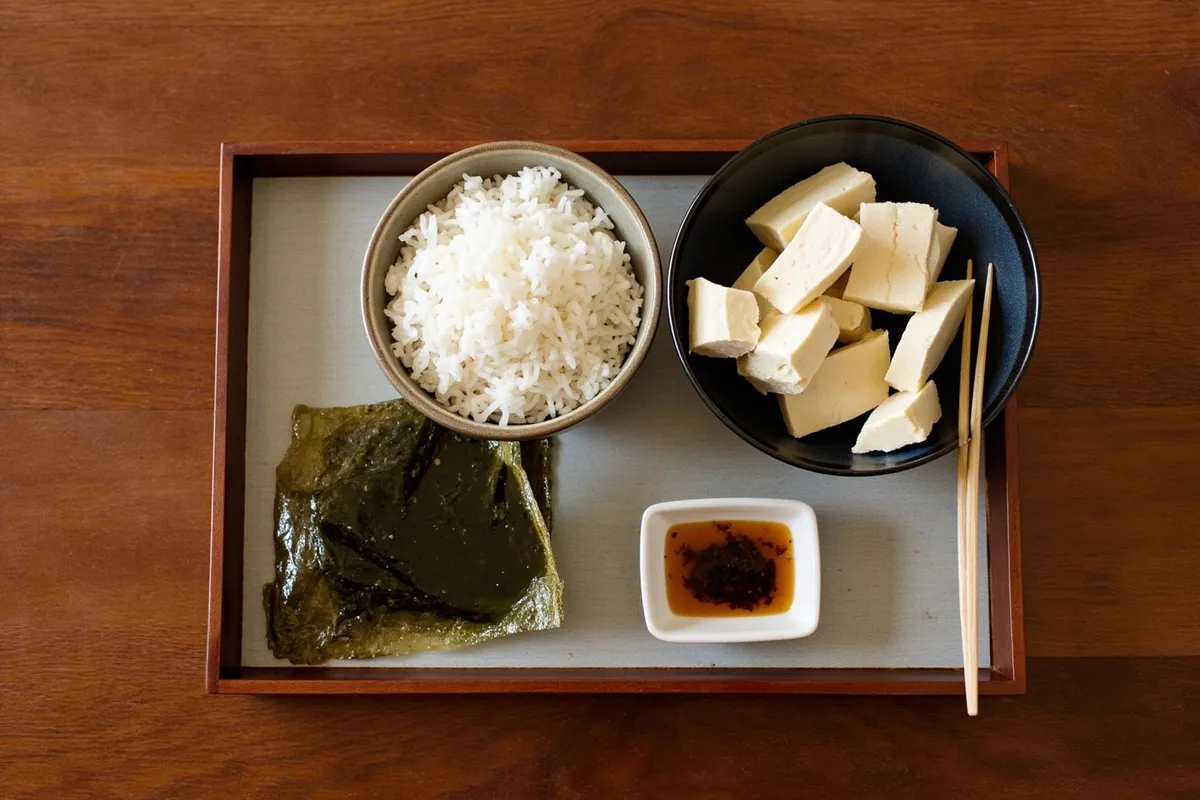
The Japanese diet for weight loss is usually sold as packaging: a name, a rule set, a before-and-after photo. The real thing is plainer. A bowl of rice, a piece of fish or tofu, two or three small vegetable dishes, and one rule at the table: stop when you are satisfied, not stuffed. Add regular walking and that is the plan.
I cook this way in Manchester, out of British supermarkets, and I keep a food journal while I test it. The research on the 80% stop on its own is thin, so I am not going to promise you a number of kilos. What I can give you is the plate, the shopping list, the price per 100 grams, and the places where the plan breaks.
What the Japanese diet for weight loss actually is
Hara hachi bu: the 80% stop in practice
Hara hachi bu means eating until about 80% full. The teaching behind it is Japanese and Confucian, and the feeling it describes is comfortably satisfied rather than stuffed. That feeling has a name, manzuku-kan, and it arrives before you are stuffed. You leave a little room, at every meal.
It is a framework on its own, not a fasting protocol, and it stands on the same ground as mindful and intuitive eating: notice the fullness cues, eat slowly enough for them to register, and stop when they arrive. It sits much closer to awareness than to caloric restriction.
Here is the arithmetic, with the same food on the same day.
| Meal | Big plate version | Stopped at 80% |
|---|---|---|
| Breakfast | 800 kcal | 640 kcal |
| Lunch | 900 kcal | 720 kcal |
| Dinner | 800 kcal | 640 kcal |
| Day total | 2,500 kcal | 2,000 kcal |
A 2,500-calorie day becomes about 2,000. That gap comes from awareness rather than from a stricter food list, and the table is illustration rather than measurement: nobody has published a kilogram figure for the 80% rule on its own.
- Serve from the counter, never from the pot on the table.
- Hold the second helping back for later. A small plate saved is worth about 200 calories.
- Slow down the first five bites. Once you are past them, fullness usually follows.
- Stop at satisfied. Not stuffed, not clearing the plate.
- Still hungry after ten minutes? Add vegetables and protein, wait again, then take a small second plate. Not biscuits.
The rule does not suit everyone. Athletes, children, older people and anyone recovering from illness have different needs, and concentrating only on eating less can set off a cycle of restriction and overeating. If that describes you, a clinician comes before another plan.
The ichiju-sansai plate: what goes on it
Ichiju-sansai is the name for the arrangement I grew up with: rice, a soup and three small dishes sharing the middle of the table. The plate version is easier to keep, with about a third staple, a third protein and a third vegetables. No source pins down an official ratio, so treat the thirds as a guide rather than a rule.
This is the plate method of portion control. The staple is gohan, usually short-grain rice. Protein is fish, tofu, egg or chicken. Vegetables take the rest, and they do the heavy lifting for satiety and fibre. WHO's healthy diet guidance puts the floor at 400 grams of fruit and vegetables a day and 25 grams of fibre, which works out at two handfuls of vegetables at every meal.
| Staple | Protein | Vegetables | |
|---|---|---|---|
| What belongs here | Rice, noodles, bread, potatoes | Fish, firm tofu, egg, chicken, beans | Anything that comes in a handful: cabbage, carrot, daikon, shiitake, greens |
| Amount to start with | 150 to 200 g cooked short-grain rice | 100 to 120 g | Two fists, roughly 300 to 350 g |
| The trap | Rice on rice. The bowl grows before you notice | Skipping it, then snacking at nine | Leaving the salt on the table: miso, shoyu, pickles |
Cooking for one changes the arithmetic, so I keep four ways of building the plate:
- Cook a batch of rice and one tray of vegetables, then assemble through the week.
- Buy ready-cooked rice and one protein at the counter on the way home.
- Build around what is already in the fridge. Rice, greens and an egg beats an empty evening.
- Buy one vegetable that is cheap this week and let it fill the bowl.
Two traps sit under that table. A rice-heavy plate can leave the protein slot empty, and the plant-forward bowl turns high-salt through miso, shoyu and pickles without changing shape at all. Both get their own section below.
How this differs from 16:8, a 20% deficit and fad diets
Most diets that work share one mechanism: fewer calories, kept up for months. What differs between them is what they ask of you and what they depend on. I compared the Mediterranean plate in Japanese Diet vs Mediterranean Diet, and the same applies to the other two.
| This plan | Intermittent fasting 16:8 | A manual 20% calorie deficit | Mediterranean-style plate | |
|---|---|---|---|---|
| What it asks of you | Stop at 80% at every meal | No eating for a 16-hour window | Count and log everything you eat | Build meals around olive oil, vegetables and fish |
| What the result depends on | Portion awareness and salt | Sleeping through the fasting hours | Honest logging | Consistency with the pattern, not one meal |
| What breaks it for most people | Evenings, takeaways, big bowls of rice | Evening hunger, then a binge | Week one of logging, then fatigue | Fewer visible rules, so it needs more planning |
And a short list of what this plan is not, so the expectations are clear:
- No 3-3-3 rule
- No fasting window
- No banned food
- No detox tea, no supplement, no burn-fat product
- No tea ceremony dressed up as a fat-loss method
A normal day of washoku: set meals, breakfast and the protein slot
Teishoku and the gohan portion
A teishoku is a set meal: rice, a bowl of soup, a main dish and small sides. An ichiju is the single-bowl version, and it is what most people make at home. Either way the rice is the staple rather than the meal, and the gohan rice portion decides how the day goes.
Short-grain white rice at 150 to 200 grams cooked lands at roughly 195 to 260 calories. Genmai brown rice brings more fibre, and I mix a little into short-grain so it stays edible instead of chewy. How a smaller bowl of rice supports weight loss has the portion maths.
| Bowl | Protein source | Vegetable volume | Rice portion |
|---|---|---|---|
| Chicken and rice | 100 to 120 g grilled chicken breast | Two handfuls of cabbage and carrot | 150 g cooked |
| Sardine and vegetable | One tin of sardines in oil, drained | Grated daikon and a handful of spinach | 150 g cooked |
| Tofu and egg | 120 g firm tofu and one egg | Stir-fried greens with a spoon of sesame oil | 180 g cooked |
- The no-time version: ready-cooked rice, a tin of fish and frozen vegetables, five minutes in a hot pan.
- Cook a double batch of rice and freeze half in portions. It reheats in a couple of minutes.
- The weekday lunch that survives a long gap: rice, one protein, two vegetable sides, decided the night before.
- Eat from a bowl rather than a plate you keep topping up. Bigger plates mean more rice served without thinking.
A Japanese breakfast bowl
Breakfast is where a lot of people quietly skip protein and then wonder why they are peckish by eleven. A Japanese breakfast bowl fixes that with very little work: rice, a protein, something fermented, a little seaweed.
A useful target is 1.2 to 1.6 grams of protein per kg of bodyweight, which for a 70 kg adult is 85 to 110 grams across the day. Breakfast is the easiest place to add a chunk of it.
| Component | Typical serving | Protein per 100 g | What it adds |
|---|---|---|---|
| Natto | 100 g | ≈8 g | Fermented soy, the classic opener |
| Egg | 1 large (about 50 g) | ≈13 g | The cheapest protein on the table |
| Cooked short-grain rice | 150 g | ≈2.5 g | The staple under everything |
| Dried nori seaweed | 3 g, a sheet or two | ≈21 g | Iodine and a salty edge |
| Wakame side | 30 g drained | Trace | Fibre and a sour note, not protein |
- Natto, egg, rice and nori: stir the natto into the rice, heat it, done.
- Tofu scramble with a spoon of shoyu and a bowl of rice.
- Leftover grilled fish from the night before, with rice and a wakame side.
- Instant oats instead of rice, with the same protein on top.
Three practical warnings. Soy allergy rules out the natto and the tofu. Kombu and wakame bring iodine, so do not stack kombu, wakame and iodised salt in the same meal. And a soft or raw egg needs cooking through unless you are certain about the source.
Filling the protein slot: fish, firm tofu, tempeh
Fish, tofu and eggs do the same job in that bowl: they make it filling without adding a pile of rice. Which one you pick matters less than picking one and sticking with it.
| Protein | Protein per 100 g | Calories per 100 g | Note |
|---|---|---|---|
| Canned mackerel in water | 15 to 25 g | 150 to 200 kcal | Omega-3 without a pan. Watch the salt |
| Sardines in oil | 15 to 25 g | 180 to 210 kcal | Small fish, soft bones, the cheap version |
| Firm tofu | ≈8 g | ≈75 kcal | No fish, still a solid slot |
| Tempeh | ≈19 g | ≈190 kcal | Firm, savoury, keeps a week in the fridge |
| Chicken breast, raw | ≈23 g | ≈120 kcal | The swap I use when I want no smell at work |
- Canned mackerel over rice with grated daikon and a spoon of shoyu, no cooking at all.
- Sardines simmered in a little water with ginger and soy.
- A fillet seared both sides, shioyaki style, with a slice of lemon.
- No fish in the house: firm tofu, tempeh, chicken or egg hold the same slot.
Vegetarian and vegan lines work the same way. Firm tofu, tempeh, frozen edamame and lentils take the protein slot, and the fish slot is simply left empty.
Vary the fish rather than eating the same species daily, and check the FDA and EPA advice on eating fish before making fish a daily habit, especially with pregnancy or children in the house. Mackerel and sardines are the affordable omega-3 slot, and the small oily ones are the safest of that group.
What the evidence actually shows
Where the practice comes from, and the Okinawan plate
Hara hachi bu comes from a Japanese Confucian teaching, and it was described in the context of Okinawan eating. The traditional Okinawan plate is heavy on sweet potato, soy, sea vegetables and bitter melon, with fish most days and pork rarely. The Okinawa diet is worth a read on its own.
Japanese weight figures need a label, because Japan's own survey counts a BMI of 25 and above as obesity, which is stricter than the international line of 30. The numbers come from the Ministry of Health, Labour and Welfare's National Health and Nutrition Survey rather than from a private poll: the MHLW survey and the World Obesity Federation's Japan profile are where I check them.
| Staple | Role in the pattern | Supermarket stand-in |
|---|---|---|
| Sweet potato | The main carbohydrate, taking over part of the rice | A medium sweet potato, baked |
| Soy and beans | Daily protein, fermented and otherwise | Tofu, tempeh, edamame |
| Sea vegetables | Seasoning, fibre and iodine | Nori, wakame, kombu |
| Bitter melon | A vegetable with little to hide behind | Rare on shelves here, so cabbage is the stand-in |
| Fish | Small oily fish, several times a week | Canned sardines and mackerel |
| Pork | Rare, and in small amounts | A small strip in a stir-fry |
- Steamed sweet potato, roughly the size of your fist.
- Stir-fried bitter melon if you can find it, cabbage if you cannot.
- Simmered tofu with a spoon of shoyu.
- A small bowl of rice, not a large one.
What the studies can say, and what they cannot
Read the hara hachi bu research and you notice what it holds and what it does not. Earlier studies looked at the whole dietary pattern of people living where the practice is common, not the 80% rule on its own. In those groups people ate fewer calories overall, gained less weight across the years and showed a lower average BMI, with men choosing more vegetables and fewer grains. The rule has also had a proper hearing in the science press, where a dietetics lecturer at Cardiff Metropolitan University set out what the evidence does and does not show.
That is a real signal, and it is worth acting on. It is not a licence to promise a number on the scale, because nobody has tested this rule and published a kilogram figure. Anyone who sells you one is guessing from the same arithmetic I have shown you.
| What the evidence can say | What it cannot say |
|---|---|
| Total daily calorie intake goes down in the groups studied | That the 80% rule alone produces a set weight loss |
| Lower long-term weight gain and lower average BMI in those groups | That the 80% stop is what caused it, separated from the rest of the diet |
| It fits comfortably with mindful and intuitive eating | That it is a restricted or fasting-style protocol |
| The patterns behind it, not the individual foods | Which Japanese food is the important one |
For scale: in 2024, 45% of adults aged 18 and over were overweight, which is 2.6 billion people, and 940 million of those adults were living with obesity. If you are under 60 and your weight is already where you want it, these numbers change what goes into the shopping trolley, not how you build the plate.
The all-ages picture is starker: 1 in 7 people on the planet, 1.1 billion, were living with obesity, and the share of adults who are overweight has gone from 25% in 1990 to 45% in 2024. Higher-than-optimal BMI was linked to about 3.7 million deaths in 2023, and the global cost of excess weight is projected to reach US$3 trillion a year by 2030. WHO's obesity and overweight fact sheet has the details.
Buying for it: salt, vegetables and tea
Shoyu, miso and the sodium per serving
This is the part of the Japanese plate that sneaks up on you. Miso paste, shoyu soy sauce and pickles are not the vegetables. They are the salt, and they turn a plant-forward bowl into a high-sodium meal without the bowl changing shape at all. So read the sodium per serving on the label rather than the front of the packet.
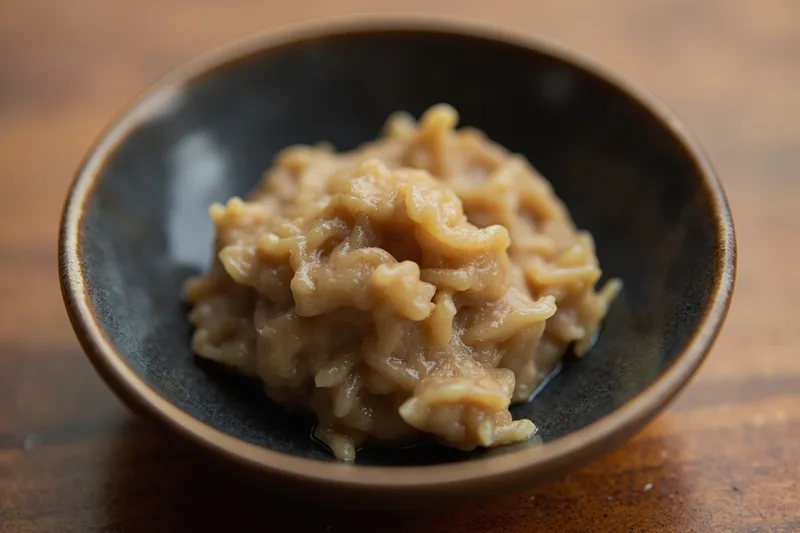
WHO advises keeping salt under 5 grams a day, which is 2 grams of sodium, and names soy sauce, fish sauce and bouillon as the main sources of added salt. Their advice is practical: keep high-sodium condiments off the table and choose lower-sodium versions when the shop has them.
| Item | One serving to check | Why it matters |
|---|---|---|
| Miso paste | 1 tbsp | A couple of spoonfuls can use up much of the 2 g daily sodium limit |
| Shoyu soy sauce | 1 tbsp | Poured by habit, measured by accident |
| Pickled daikon and carrot | 100 g | Salty twice over: the brine and the shoyu you add |
| Canned mackerel | 1 tin, drained | The protein slot and the salt arrive together |
| Instant dashi | 1 sachet | Tastes light, often salty. Check the sachet |
- Measure the shoyu with a teaspoon instead of pouring from the bottle.
- Dilute the miso with dashi or hot water before deciding it needs more salt.
- Rinse canned fish and drained pickles under the tap.
- Use unsalted dashi or a strip of kombu instead of a salty stock cube.
- Take the salt off the table. Nobody misses it after a week.
- Switch to lower-sodium soy sauce and a milder miso.
When you do not cook, the salt is in the miso soup, the dipping sauce and the rice refills, not in the fish. Ask for sauces on the side. And do not be alarmed when a salty day moves the scale a kilo the next morning. That is water, not fat.
Budget vegetables, the freezer shelf and fibre
Fibre is the quiet reason the Japanese plate works. It comes from the vegetables, the seaweed and the beans, and it fills a bowl without adding calories. WHO puts the target at 25 grams of fibre a day, alongside 400 grams of fruit and vegetables.
| Vegetable | Calories per 100 g | Fibre per 100 g | What it is for |
|---|---|---|---|
| Shredded cabbage | ≈25 kcal | ≈2 g | The base of half the dinners, cheap and forgiving |
| Carrot | ≈40 kcal | ≈3 g | Sweetness that stops a plain bowl tasting dull |
| Daikon | ≈15 kcal | ≈2 g | Grated raw or pickled, it adds bulk |
| Shiitake, fresh | ≈35 kcal | ≈2.5 g | Umami, so the bowl tastes finished |
| Soybean sprouts | ≈30 kcal | ≈2 g | Cheap bulk for stir-fries |
- Shredded cabbage and carrot in the fridge. They last a week or two.
- Frozen edamame and frozen spinach for the protein and fibre slots.
- Wakame packets and kombu strips in the cupboard for seasoning.
- Tofu, and a bag of short-grain rice in whatever size fits your week.
- One seasonal vegetable that is cheap right now, filling half the plate.
Sea vegetables are seasoning and fibre, not a protein source, and I would not build a meal around them. For cabbage, carrot, onion and edamame, read the unit price on the shelf rather than trusting any list, including mine.
Green tea, matcha and the caffeine cutoff
Green tea fits this plan because it replaces something else, not because it burns anything. The green tea catechins and EGCG get all the attention, including in what to do with green tea and matcha, but the plain reason to drink it is that it takes the place of a sweetened drink. Free sugars should stay under 10% of your energy, and a sweet bottle eats a serious chunk of that.
| Drink | Caffeine per serving | Sugar | What it costs you |
|---|---|---|---|
| Brewed green tea | 30 to 50 mg | None | The cheapest option in the house |
| Matcha | 60 to 80 mg | None | Price per gram varies more than the flavour does |
| Bottled green tea | 25 to 40 mg | Often 20 to 30 g per bottle | Check the label before the bottle |
- Divide the price by the grams. A large tin is not automatically a better deal.
- Culinary grade for baking, ceremonial grade for drinking. If the tin does not say, assume culinary.
- Buy a small tin first. Matcha fades, and stale matcha tastes like grass.
- Keep it sealed and cool. The fridge is kinder to it than the cupboard.
- If the per-ounce price looks extreme, put it back.
Matcha is a caffeinated drink, not a fat-burning product, so keep the last cup well before bed and cut the caffeine before you cut the food if sleep suffers. My own caffeine cutoff is mid-afternoon. This plan needs no supplements: ask your doctor about iodine or vitamin D status rather than guessing with kelp tablets. Alcohol fits nowhere in the plate. It brings calories with none of the fibre or protein that fill you up, and its own health risks on top.
Calories, walking and plateaus
Maintenance calories and the 20% gap
The 80% stop and a manual deficit are the same arithmetic in different clothes. If your maintenance is around 2,500 calories a day, a 20% calorie deficit takes you to 2,000, which is the number the first table produced without you counting anything.
Find your own maintenance first. I start from a published equation, add back the average change over the last few weeks, and adjust from there. For a woman of 70 kg and 175 cm, the usual estimate lands around 1,850 to 2,050 calories a day, and a 20% cut puts that at roughly 1,500 to 1,650.
| Line | Amount | Notes |
|---|---|---|
| Cooked short-grain rice | 200 g | ≈260 kcal |
| Protein | 120 g | Fish, tofu or chicken |
| Vegetables | 350 g | Mostly cabbage, carrot, daikon, greens |
| Cooking oil | 1 tbsp | Sesame oil adds up faster than you think |
| Shoyu and miso, measured | 1 to 2 tbsp | Salt, and sugar in commercial miso |
| The 80% stop on the last plate | – | A smaller portion, no extra calories |
- Take your weight, pick a maintenance equation and write down the number with the activity level you used.
- Compare that number with what the scale has actually done over the last three weeks.
- Adjust from there and keep the change small.
- Add your daily walking to the estimate. Total daily energy expenditure is not the same thing as intake.
Two warnings. In many households the 80% stop produces this gap on its own, so stacking the two methods is how people end up under-eating. And sustained intake below about 1,200 calories needs clinical supervision rather than willpower.
Walking: the most accessible lever
Walking is the cheapest part of this plan and the first thing people drop. I use 8,000 to 10,000 walking steps per day as a practical target rather than a magic number, and a short walk after a meal does more for the shape of the day than anything I have changed on the plate. What 10,000 steps can and cannot do is the longer version.
- Park two streets away and walk the last stretch.
- Ten to fifteen minutes after dinner, before you sit down again.
- Stairs instead of the lift.
- Walk the shopping trip instead of driving to the door.
- A short walk after lunch on long workdays.
Plateaus, the tracker and keeping the weight off
Weight loss runs in a curve, not a line. Two or three weeks without a change in the weekly average is a weight loss plateau, and it usually points at something specific rather than at a failed plan. Read your last two weeks of notes before you change anything.
| Week | Weight | Waist | Avg kcal | Steps | Hunger 1-5 | Sleep |
|---|---|---|---|---|---|---|
| 1 | 71.8 kg | 82.0 cm | 2,050 | 6,200 | 2 | 7 h |
| 2 | 71.3 kg | 81.5 cm | 2,000 | 8,400 | 3 | 6.5 h |
| 3 | 71.0 kg | 81.2 cm | 2,050 | 9,100 | 2 | 7 h |
- Portion creep at dinner, where the 80% stop quietly became 100%.
- Bottled drinks and weekend grazing.
- Salt and water retention. A salty day holds on to a kilo of water.
- Short sleep.
- An empty protein slot at breakfast.
Change one thing at a time. Cutting calories, raising steps and cutting salt together means you will never know which one moved the number. Meal timing matters less than you think: regular protein at breakfast does more than shifting lunch by an hour.
On timing, a daily gap of 500 calories works out at roughly 0.45 kg a week, using the usual 7,700 calories per kilo of body fat. That is arithmetic, not a promise, so judge it on the four-week trend of weight and waist, plus how hungry you feel, rather than on a single reading after a salty dinner.
Keeping the weight off comes down to three habits: the rice portion, protein at breakfast and the after-dinner walk. When the weight settles, go back to maintenance calories rather than continuing to cut. If the scale is stuck and your BMI is high, or you take blood pressure or diabetes medication, see a clinician before trying anything harder. Who should ask a doctor first lists the signs.
What it costs
Modelled 2026 unit prices for the staples
The prices below are modelled 2026 estimates per 100 g or 100 ml, not surveyed shelf prices. I use the range across the three chains because it is a range rather than a ranking: each chain price is one base price multiplied by a fixed factor, so the columns do not tell you which shop is cheaper. For your own basket, read the unit price on the shelf.
| Item | Modelled range per 100 g or 100 ml | Where it sits in the plan |
|---|---|---|
| Tofu | $0.30 to $0.50 | The protein slot when there is no fish |
| Short-grain rice | $0.25 to $0.50 | The staple |
| Soy sauce | $0.40 to $0.80 | Seasoning, and the main salt source |
| Sesame oil | $1.50 to $2.50 | A spoon per batch, not per bowl |
| Aged kimchi (store-bought stand-in) | $1.20 to $1.80 | Ferment for the fridge, in place of Japanese pickles |
| Pickled daikon and carrot | $0.55 to $1.00 | The tsukemono stand-in |
| Soybean sprouts | $0.40 to $0.65 | Bulk for stir-fries |
| Chicken breast | $0.55 to $0.95 | The no-fish swap |
| Doubanjiang (store-bought stand-in) | $0.85 to $1.40 | Chilli bean paste for the stir-fry sauces |
| Gochujang (store-bought stand-in) | $0.70 to $1.20 | Sweet chilli paste, useful in marinades |
| Fish sauce (store-bought stand-in) | $0.55 to $1.10 | Sharper than shoyu, and saltier. Use less |
| Fresh ramen noodles | $0.45 to $0.85 | A fast staple for a bowl |
| Cabbage, carrot, onion, edamame, dashi | Read the shelf price | The bulk of the plate. Unit price per 100 g decides |
The same table is published for the UK, Canada and Australia, and for South Korea, Spain, Mexico and Thailand, so use the one for your country before you budget. For average retail unit prices by food group and area, the USDA ERS food-at-home price series is the longer reference.
A starter shopping list and how to shop by unit price
One person, one week, built from the items priced above. The quantities are deliberately round, because the point is the habit rather than the exact amount.
| Item | Quantity | Modelled unit price | Role in the plan |
|---|---|---|---|
| Short-grain rice | 1 kg dry | $0.25 to $0.50 per 100 g | About twelve bowls of 200 g |
| Firm tofu | 700 g | $0.30 to $0.50 per 100 g | Two protein slots |
| Soy sauce | 250 ml bottle | $0.40 to $0.80 per 100 ml | Seasoning, and the salt budget |
| Sesame oil | 100 ml | $1.50 to $2.50 per 100 ml | One batch of stir-fries |
| Chicken breast | 500 g | $0.55 to $0.95 per 100 g | Two no-fish meals |
| Soybean sprouts | 300 g | $0.40 to $0.65 per 100 g | Vegetable bulk |
| Pickled daikon and carrot | 200 g | $0.55 to $1.00 per 100 g | A tsukemono stand-in |
| Aged kimchi | 200 g | $1.20 to $1.80 per 100 g | Store-bought stand-in for the fridge ferment |
| Miso paste | 300 g | Read the shelf price | One pot of soup, and the salt in it |
| Canned mackerel | 2 tins | Read the shelf price | Two fish meals |
| Nori and eggs | 2 packs, 6 eggs | Read the shelf price | Breakfast for the week |
Adding up only the items priced here, the basket lands somewhere around $40 to $55 a week. That is modelled arithmetic rather than a quote, and it leaves out produce, eggs, fish and dashi, so treat it as a starting figure and add your own prices to it.
- Read the price per 100 g or 100 ml rather than the sticker.
- Compare two shelves before anything goes into the basket.
- Take the bigger pack only when its unit price is lower.
- Freeze extra tofu and blanched vegetables when you cook a batch.
- Let the cheapest seasonal vegetable fill half the plate.
Is this for you, and what the first week looks like
Who it suits, and who should skip it
The plan is generous, a plate, a stop rule and walking, but it is not neutral. It suits people who eat from big platters, skip breakfast, want structure rather than a new macro system, and are happy to keep rice in the rotation.
| This suits you if | Skip it, or get advice first, if |
|---|---|
| You eat from big platters and stop when told to | You are underweight |
| You skip breakfast and think about food by eleven | You are pregnant or breastfeeding |
| You want structure, not a new macro system | You are training for a sport or building mass |
| You already buy vegetables most weeks | You are managing diabetes or blood pressure |
| You are happy with rice in the rotation | You have a history of disordered eating |
If the rice plate does not fit you, keep the same thirds and build them Mediterranean-style with olive oil, vegetables and fish. Plant protein can take the place of fish, and structured 16:8 works on the same portions if your schedule suits it. For anything in the right-hand column, a clinician comes before another plan.
Your next seven days
One change a day, so that when something works you know what it was. Running all seven at once is how people end up with a bad week and no idea why.
- Day one: set the plate at dinner. Rice, protein, two vegetables.
- Day two: cut roughly 200 calories at lunch.
- Day three: put protein at breakfast.
- Day four: a ten-minute walk after dinner.
- Day five: one salt swap. Measured shoyu, or diluted miso.
- Day six: weigh in and measure your waist. That is your first tracker entry.
- Day seven: what changed, what was hard, what you keep.
Weight once a week, waist once a week, hunger from 1 to 5 after dinner, and steps. Stop and reassess if nothing has moved for two or three weeks, if you are permanently hungry or flat on energy, or if you are managing a medical condition.
If I kept only three things from all of this, it would be the rice portion, protein at breakfast and the walk after dinner. Everything else is detail, and detail is what falls off first.