
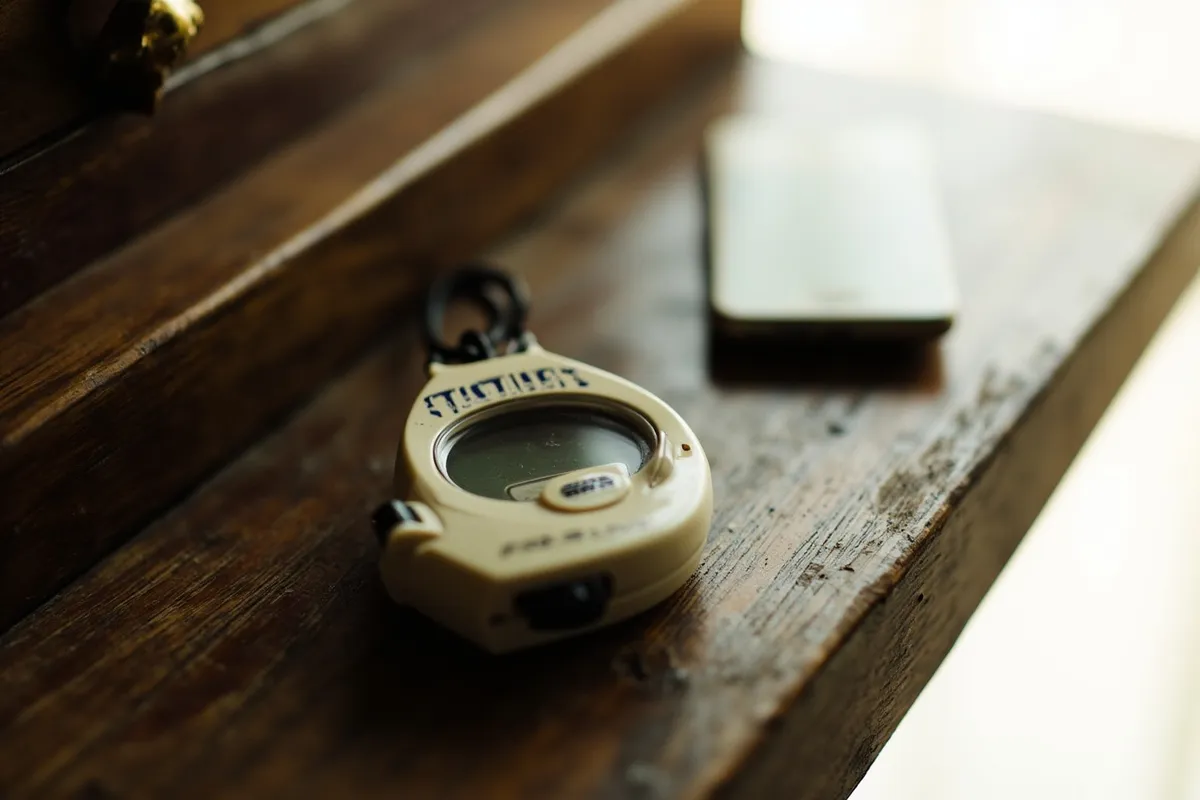
Ten thousand steps a day is the most widely repeated number in fitness, and almost nobody who says it can tell you where it came from. I have kept a food journal for years and counted steps alongside it, and my own summary is short: walking for weight loss works, the number was invented by a pedometer company rather than by any health body, and the figure on your wrist is an estimate rather than a measurement.
The surprising part is the shape of the benefit. It is steep at the bottom and flattens early, a good share of the calories you burn get quietly eaten back, and a decent weekly average beats a heroic weekend. That is a smaller promise than the posters make and a more useful one.
Where 10,000 steps came from, and what the research actually supports
A 1965 pedometer slogan with no guideline behind it
The number started life as advertising. YAMAX was founded in 1942 to build aircraft instruments, moved into clock movements, and in 1965 launched a small pedometer called the Manpo-kei, which means a ten-thousand-step meter. The promise on the box was that the device gave you healthcare. The YAMAX company history still tells the story, trademark registrations included.
For most of the next fifty years the slogan had no evidence attached to it at all. The first serious tests of the figure arrived in 2019. WHO, the body people assume would set a step target, writes its guidance in minutes per week instead: 150 to 300 minutes of moderate-intensity physical activity for adults, plus muscle-strengthening work on two or more days. The WHO physical activity fact sheet contains no step number, and no guideline body has ever published one.
Where the number came from
- 1965: the Manpo-kei pedometer and a healthcare slogan.
- 2019: the first large cohort tests of 10,000 steps.
- 2022: a 15-cohort meta-analysis locates the plateau.
- 2025: a dose-response review across 57 studies.
What the 2025 dose-response review actually measured
The 2025 dose-response review in The Lancet Public Health is the most useful recent work on the question. It pooled 57 studies from 35 cohorts, plus a meta-analysis of 31 studies from 34 cohorts, and asked what happens to health as daily steps rise. The outcome list is long: cardiovascular disease incidence and death, all-cause mortality, dementia, falls, cancer incidence and death, type 2 diabetes, depressive symptoms. Physical function is not on it, which tells you something about the limits of what we actually know.
The numbers people quote usually skip the baseline. At 7,000 steps a day against 2,000 steps a day, the review found 47% lower all-cause mortality, 25% lower cardiovascular disease incidence and 47% lower cardiovascular disease death. The comparison is with somebody already walking 2,000 steps, not with somebody sitting still all day, so read these as a dose gradient rather than a prize. These are observational cohorts with device-measured steps, so they show a link and not a proven cause. The ACC summary of the review sets out the comparisons.
The curve also flattens at different points depending on the outcome. For cardiovascular disease incidence the extra gain levels off near 7,802 steps a day, and near 5,400 for older adults. For cardiovascular disease death it flattens around 5,500 steps. Those are the points after which extra steps buy less, not thresholds to reach. If you start from 3,000, most of the benefit is still ahead of you.
| Outcome | Where the gain flattens | 7,000 steps against 2,000 |
|---|---|---|
| All-cause mortality | around 7,000 steps | 47% lower risk |
| Cardiovascular disease incidence | 7,802 steps, older adults 5,400 | 25% lower risk |
| Cardiovascular disease death | around 5,500 steps | 47% lower risk |
All comparisons in cohort studies, against a 2,000-step baseline rather than against inactivity.
The plateau, and the one pace signal that survives adjustment
A 2022 meta-analysis in the same journal pooled 15 international cohorts: 47,471 adults, 3,013 deaths, median follow-up of 7.1 years. Mortality risk fell steadily with step count until a plateau that depends on age, roughly 6,000 to 8,000 steps for people over 60 and 8,000 to 10,000 for younger adults. Against the lowest quartile, the three higher quartiles carried hazard ratios of 0.60, 0.55 and 0.47, and the lowest risk sat at about 7,000 to 9,000 steps a day. The 15-cohort step-count meta-analysis is readable, if you enjoy that kind of evening.
Pace gave the researchers one more thread. The fastest half-hour of the day, in steps per minute, was linked to lower mortality even after the daily total was taken into account, with a hazard ratio of 0.67 and a confidence interval of 0.56 to 0.83. But the total time spent at 40 steps a minute, or at 100, showed no association once volume was accounted for, and the authors described the evidence on intensity beyond step volume as inconsistent. In those same cohorts the median peak half-hour was 64 steps a minute, people logged a median of 51 minutes a day at 40 steps a minute or faster, and only about 5 minutes a day at 100 steps a minute or faster. Fast bursts are worth having. They do not replace the volume.
Two caveats sit under all of this. The 15 cohorts skew older, so the numbers describe people in their sixties more closely than people in their thirties. And cohort data cannot tell you whether the steps were taken deliberately or on the way to the bus, which matters for how you use your own day.
Walking for weight loss: the calorie math
How many calories does walking burn over 10,000 steps?
Ten thousand steps is roughly 7 to 8 km for an average adult, and takes about 100 to 160 minutes depending on pace. At the median peak rate of 64 steps a minute it eats about 2.5 hours; at a brisk 100 steps a minute it takes closer to 100 minutes. The figure that matters for weight is the burn above rest, not the number on the watch.
Using 3.5 to 4.0 MET for moderate-intensity walking, the arithmetic lands around 300 to 500 kcal a day for most adults and near 375 kcal for somebody of 75 kg. Heavier adults spend more on the same steps, since the same 10,000 take longer, and pace moves the number less than people expect: distance and stride length decide the spend, not how briskly you look while doing it. Flat, easy ground gives a little back compared with a hill.
The calories your phone reports are a separate animal. Wrist and hand sensors estimate energy cost from steps, and those estimates have never been validated against a laboratory measurement in any way I would trust. Treat the number as a rough measure of the size of the effort, not as an entry in a food budget.
| Body weight | Steady pace, about 3.5 MET | Brisk pace, about 4.0 MET |
|---|---|---|
| 60 kg | about 355 kcal | about 300 kcal |
| 75 kg | about 445 kcal | about 375 kcal |
| 90 kg | about 535 kcal | about 450 kcal |
My own estimate, counted above resting metabolism, taking 10,000 steps as about 8 km. Steady means roughly 70 steps a minute and takes a little over two hours; brisk means about 100 steps a minute and takes about 1 hour 40 minutes. A 90 kg adult at a steady pace is the case that pushes past 500 kcal.
What that equals in fat, and what walking alone cannot fix
Ten thousand steps a day with no change on your plate adds roughly 2,100 to 3,500 kcal a week, which works out at about 0.3 to 0.5 kg of fat a week at the usual 7,700 kcal per kilo of fat. It is a real effect and it is slow. Nobody has ever described a quarter of a kilo a week as dramatic, which is one reason the walking-only route gives up so easily.
Add a diet deficit and the numbers get better, but only once you name your assumptions. Take 300 to 500 kcal a day of deficit on top of 300 to 500 kcal of walking: that is 600 to 1,000 kcal a day, 4,200 to 7,000 kcal a week, roughly 0.55 to 0.91 kg of fat a week. That is arithmetic rather than a promise, and it assumes you do not eat the difference back. I would write those assumptions down before starting, because the eat-back is where plans quietly die.
| Daily deficit | Walking burn | Weekly gap | Approximate fat |
|---|---|---|---|
| 300 kcal | 375 kcal | 4,725 kcal | 0.6 kg a week |
| 500 kcal | 450 kcal | 6,650 kcal | 0.86 kg a week |
Both rows assume nothing is eaten back, and both are my own arithmetic on the ranges above.
Trials on this question exist. One 24-week randomised study in first-year university women assigned people to 10,000, 12,500 or 15,000 steps a day, and the per-arm results differ enough between write-ups that I will not quote them from memory. The shape of the study is the part worth keeping: three step targets, one of them matching the slogan, and 24 weeks of supervision. That is how much structure this kind of work needs before a difference appears.
Deficit math
- Input: your body weight.
- Input: your daily steps and the burn they produce.
- Input: the daily calorie deficit you chose.
- Output: weekly energy gap and the fat it covers.
- Output: the one habit, eating less, that has to hold.
Appetite compensation and the lean mass you keep
Two things soften that arithmetic. First, non-exercise activity thermogenesis, the calories you burn just being alive and fidgeting, differs enormously between people. Two people can sit at the same desk and burn noticeably different amounts, and adding walking often gets partly compensated by eating more, usually without noticing. I do not have a solid figure for how much, and I would rather say that than invent one.
Second, what you lose during a deficit matters. Keeping some muscle means you can walk more, burn more, and look less deflated. Roughly 1.2 to 1.6 g of protein per kg of body weight, around 90 to 120 g a day for somebody of 75 kg, is the range I would aim for while cutting, and it pairs naturally with a smaller bowl of rice and controlled side dishes.
Watch how the tracker changes your eating. For some people a step number becomes a licence to eat; for others it becomes a rule to fast in order to earn steps. Both turn a useful habit into a strange one, and both show up in a food journal faster than you would expect.
Where the step count stops: intensity, strength and sitting
Minutes are covered; intensity and strength are not
Walk 10,000 steps a day for a week and you have almost certainly cleared the 150 to 300 minutes of moderate activity WHO recommends for adults aged 18 to 64. What you have not cleared is the condition attached to it: moderate intensity, and muscle-strengthening work on two or more days a week. Both of those need a decision that a step counter never makes for you.
My own weekly plan looks like this: two 20 to 30 minute strength sessions, a couple of days where the walking pace is deliberately faster than my normal amble, and ten minutes of balance work, which matters more the older you get. Anyone past sixty gets more out of that balance work, and slow tai chi style practice counts as time well spent.
Order matters too. Strength work first, then the walk. It feels harder, and it protects the knees you are about to use for the next 8,000 steps.
Sitting time, visceral fat and blood pressure
Your step count says nothing about the hours in a chair. Standing every 30 to 60 minutes and moving for two or three minutes helps the body handle a meal better, and that effect is not only about calories. Walking trims visceral fat a little, and the change shows up in the waist measurement before it shows up on the scale.
Regular weekly volume also pulls blood pressure down a shade and lowers the risk of type 2 diabetes, which is a quieter reason to keep walking than the bathroom scale. If blood pressure or blood sugar is part of why you started, the weekly volume matters more than the daily count. The useful step range sits near 7,000, and for anyone over 60 the plateau comes sooner.
Four office swaps cost you almost nothing: stand for two or three minutes every hour, take phone calls while walking, put the printer across the floor so the walk to it is not optional, and walk for your coffee instead of queueing for it.
Faster and slower: what interval walking can and cannot claim
Interval walking training means alternating harder and easier blocks instead of holding one pace for the whole session, and the Japanese work on this, sometimes labelled Nihon Walking, is where most people meet it. One controlled 2019 study, published with the memorable name erclats, reported better results than continuous moderate walking on weight, blood pressure, leg strength and fitness. The published effect sizes are not something I can quote from memory, so I will not pretend otherwise. What I can say is that the study was controlled, and that it was about intervals rather than step counts.
Here is the gap worth knowing: nobody has run a trial comparing intervals plus a step target against either one alone. The combination sounds logical and stays untested. I would treat any article promising both as marketing rather than evidence.
My own version is simple, and it is a starting point rather than a published protocol: three minutes of easy walking, three minutes of faster walking, ten times through, three days a week. The faster part should feel slightly uncomfortable, like you can hold a conversation but not comfortably sing.
| Block | Length | Pace |
|---|---|---|
| Easy | 3 minutes | conversational, can sing |
| Faster | 3 minutes | can talk, cannot sing |
| Rounds | 10 | about one hour in total |
| Frequency | 3 days a week | add a walk on the other days |
My template for a healthy adult, not a study protocol. Heart or joint problems and a clinician's advice come first.
Step counters and wearables: how to read your numbers
Phone apps, dedicated trackers and smartwatches
Research-grade accelerometers worn at the waist are the reference point. Consumer devices sit a fair way off that reference, by 20% or more in some comparisons, and a tracker on your wrist will not give the same number as one clipped to your hip. Every step count on a screen is an estimate, and estimating twice a day in two places does not make it more precise.
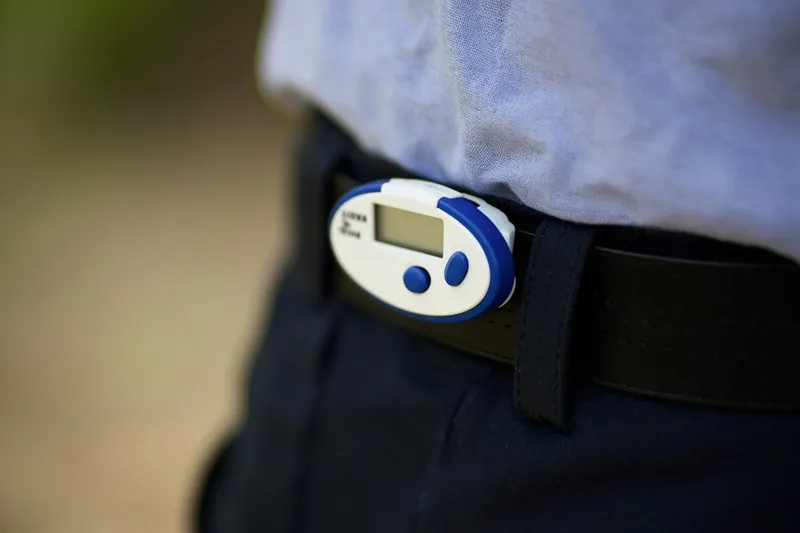
Your phone is not a compromise. Google Fit, Apple Health and Samsung Health all keep a step count on the handset in your pocket, so the walk you forgot about still gets counted, along with the queue at the shop. A dedicated tracker such as the Fitbit Inspire 3, or the screenless Fitbit Air, is steadier in practice because you tend to wear it on purpose, though wrist and hip placements still disagree with each other. A smartwatch sits in between, and its screen gives you a reason to look at the number. None of them wins in the abstract: they suit a distracted person, a forgetful person and a person who likes numbers.
Calorie figures on those screens deserve even more suspicion. Reviews of wearable accuracy, including a systematic one in JMIR mHealth uHealth, find energy estimates drifting well away from laboratory measurement. Steps are estimates too, but the gap is smaller. Use the step count for what it is good at, and ignore the calorie number unless the maker explains the calculation.
Free tier versus Google Health Premium
Until 2026 the app on most wrists was called Fitbit, and the paid plan was Fitbit Premium. Google renamed the app Google Health and the plan Google Health Premium. For accounts in the United States the plan costs $9.99 a month or $99.99 a year, and the annual price went up from $79.99.
Which metrics stay free after the rename is the thing worth checking before you subscribe, and Google's own Google Health support pages are where the split is described. Oura and Apple Fitness+ set their own prices, and both change often, so the provider's own pricing page beats any figure you find in an article.
My own view: if you already carry a phone with a step counter, the free tier is enough for everything in this piece. A subscription earns its keep only if you want coaching on training load or sleep, which is a different job from counting steps. I would not pay $9.99 a month to be told to walk more.
Before you pay
- Check which metrics your free tier still shows in Google's Health support pages.
- Look for the training-load or sleep coaching you would actually use.
- Check whether your country is billed in local currency with local tax.
- Compare the price at checkout, not the price in an advert.
What it costs in your own market
The one hardware price I can put a number on is the screenless Fitbit Air, at about $99 for US accounts, which arrived with the rename. Anything else you consider should be priced on the brand's own store page and on your country's Google Play or Google One page, because the same subscription is billed in local currency and tax treatment differs from market to market.
Walking shoes get the same treatment. Brand pages and retailer listings in your own market are the only place a range means anything, since the price bands that float around the internet are usually somebody else's currency and a year out of date.
| Item | Where to look | Note |
|---|---|---|
| Tracker hardware | brand store page | Fitbit Air about $99, US accounts |
| Subscription | Google Play or Google One in your country | billed in local currency and tax |
| Walking shoes | brand and retailer listings in your market | fit first, price second |
Prices move without announcement, so read the live page on the day you buy rather than the number you remember.
Building the habit: baseline, logistics and local habits
Read a baseline week before you change anything
Start by averaging seven days rather than reading one good day. One long Saturday can look like a fine week and mean nothing. While you are looking, note the pace as well as the count: 10,000 steps at 55 steps a minute cover a good deal more time than 10,000 at 90, and the minutes are what a weekly activity guideline actually counts.
Then set the first goal as your average plus 1,000 to 2,000 steps and go from there. You will hear the plus 10% a week rule in running circles, and it is worth being precise about it: the number comes from running, where it was never properly tested either, and no sports-medicine guideline supports it. I would treat it as folklore, add steps gradually, and keep an eye on how your shins and heels respond.
Seven-day baseline
- Daily steps for seven days, then the average.
- Typical steps per minute on an ordinary day.
- First goal: average plus 1,000 to 2,000 steps.
- The weakest part of your day, and what fills it.
Where the extra 3,000 steps fit in a working day
The extra 3,000 steps do not need a special walk. They arrive in pieces: a flight of stairs is around 10 to 15 steps, parking two blocks away adds roughly 300 to 400, and a 20-minute walking meeting is about 2,000 steps. Add them across a week and your total shifts without anything resembling a workout.
A plain working day can carry most of it. Ten minutes after breakfast, where a quick Japanese-style breakfast does not fill you enough to skip; the last part of the commute on foot; a couple of minutes standing between meetings; a 20-minute walk at lunch; and an evening walk to make up the rest. None of that needs a change of clothes, which is why it survives a rainy week.
Weekends can be quiet without breaking anything. The weekly average is what the research leans on, so two slow rest days cost you less than two days of heroics followed by three days of nothing.
The Japanese walking habit: what to take and what to leave
The Japanese walking habit is not really a walking programme. It is a set of food customs and a daily-life pattern, and it travels badly when you keep the slogans and drop the meals. Washoku and the ichiju-sansai format of one main dish with three small sides are about portion control, not about covering the plate. Hara hachi bu, eating to around 80% full, is the practice I find genuinely useful, and I would call it a portion habit rather than a weight-loss method.
Okinawa adds the part people notice: older people there walk a lot, eat from small plates, and live long. The Okinawa diet covers the food side. The walking is ordinary daily life rather than training, and the link with longevity is an association between several habits, not proof that any one of them carries the effect. I would take the small plates and the daily wandering, and leave the idea that a lifestyle can be prescribed.
The part worth borrowing is dull: eat a little less than you want, walk every day without treating it as exercise, and keep both going for years. What the longevity research does and does not say makes the same case for the pattern as a whole.
Meals, maintenance and staying uninjured
Walking after meals and postprandial glucose
One trial in adults with type 2 diabetes compared walking after each meal with a single longer daily walk. The interesting part is the design: short walks spread through the day against one block of movement in the evening. Spreading movement across meals suits postprandial glucose handling better than saving it all for the evening, at least in principle.
The practical version is easy: 10 to 15 minutes at an easy pace after eating, three times a day. It fits after a work lunch, and it is short enough that you will still do it on a bad evening. If you get hungrier later in the day, a walk after dinner also takes the edge off the evening appetite for me.
Walking after meals on diabetes medication
Post-meal walking combined with insulin or sulfonylureas can push blood glucose lower than intended. Ask your prescriber before you build the habit, not after the first shaky morning.
Weekly averages, when results show, and holding the weight off
Expect slow and noisy. The arithmetic gives roughly 0.3 to 0.5 kg a week from 10,000 steps with no change in eating, and a daily scale reading moves by half a kilo to a kilo in either direction because of water, salt and the last meal. Judge the weekly average rather than the Tuesday reading, and give it four to eight weeks before you decide nothing is happening.
Your energy needs fall as you get lighter, roughly 10 kcal for every kilo lost, which is why the second month slows down even if you have changed nothing. A steady weekly average somewhere in the 7,000 to 10,000 range is worth more than 15,000 steps on three days and 2,000 on the other four, because past the plateau the extra steps do very little.
Re-baseline every four to six weeks, and when the weight goes, raise the food a little instead of adding hours of walking. A maintenance plan built mostly on walking is a plan you will not keep for years.
Shin splints, plantar fasciitis and shoes for daily use
The most common walking injury is not dramatic, it is simply persistent: shin splints, which is pain along the bone, or plantar fasciitis, where the heel is worst with the first steps of the morning. When either appears, lower the load for a few days, stretch the calf and the sole of the foot, and swap walking for cycling or swimming until it settles. Adding steps straight through shin pain is how a two-week nuisance becomes a six-week one.
On shoes, the criteria matter more than the price. You want room in the toe box, a heel that holds, and cushioning matched to the surface you walk on. Running shoes are built for running, and for a 10,000-step day on pavement I would use walking shoes for daily use instead. Running shoes generally come out of service somewhere around 500 to 800 km, which arrives sooner than most people expect.
See someone if the pain lasts beyond a week, if there is swelling, if it wakes you at night, or if you feel numbness. Those four signs are the ones I would not wait out, and they are also the ones where better shoes will not help.
The verdict: who should chase 10,000 steps and who should not
Who gets the most from the target
If you sit at a desk and currently walk 3,000 to 5,000 steps, you have the most to gain. The curve is steepest at the bottom, and the cardiovascular death curve flattens near 5,500 steps, so every extra thousand in the early weeks does more work than the tenth thousand later on.
Past 60, the step-count plateau sits around 6,000 to 8,000, so pushing to 10,000 runs into diminishing returns. If you are already above 12,000 steps, spare effort goes further on pace and strength work than on more steps. If your reason for walking is blood pressure or insulin resistance, weekly volume and post-meal walks are the parts that pay. If your knees or ankles object, ground surface and impact matter more than the number, and cycling buys you the same minutes without the pounding.
And if 5,000 is all you can manage? Do that. The evidence points the same way below the plateau, and 5,000 kept for a year beats 10,000 kept for a month.
The three numbers to track, and what to do when they stall
Three numbers, one of them from the scale and two from a tape measure and a diary. When they stop moving for three weeks, change one thing at a time: cut 100 to 200 kcal a day, or add roughly 2,000 steps to your weekly average. If the knees start complaining, take the volume down and change the surface before you change the intensity.
- Weekly average steps, averaged over seven days.
- Waist circumference, measured monthly at the same point.
- Strength sessions completed per week, two as the target.
- After three flat weeks: cut 100 to 200 kcal a day, or add about 2,000 steps.
Who should talk to a clinician first
Some situations are not a place to start alone:
- Recent surgery or a joint replacement.
- Pregnancy and the first months after childbirth.
- Heart disease, or chest pain when you exert yourself.
- Diabetes treated with medication.
- A history of disordered eating.
- Shin or heel pain that keeps coming back.
None of this means no walking. It means a conversation first, so the plan fits the treatment instead of fighting it. The useful thing is to say the number of steps and the pace you plan to keep, because that is what the answer will be about.
Sources and limits. The figures come from the 2025 dose-response review in The Lancet Public Health, the 15-cohort step-count meta-analysis in the same journal, the WHO physical activity fact sheet, and YAMAX's company history for the 1965 pedometer. The step evidence is observational, so a link between step counts and outcomes is not proof of cause. Wearable calorie figures are not validated against laboratory measurement. Prices shown are for US accounts and change without notice; other markets are billed in local currency. The names Google Health and Google Health Premium date from the 2026 rename.