
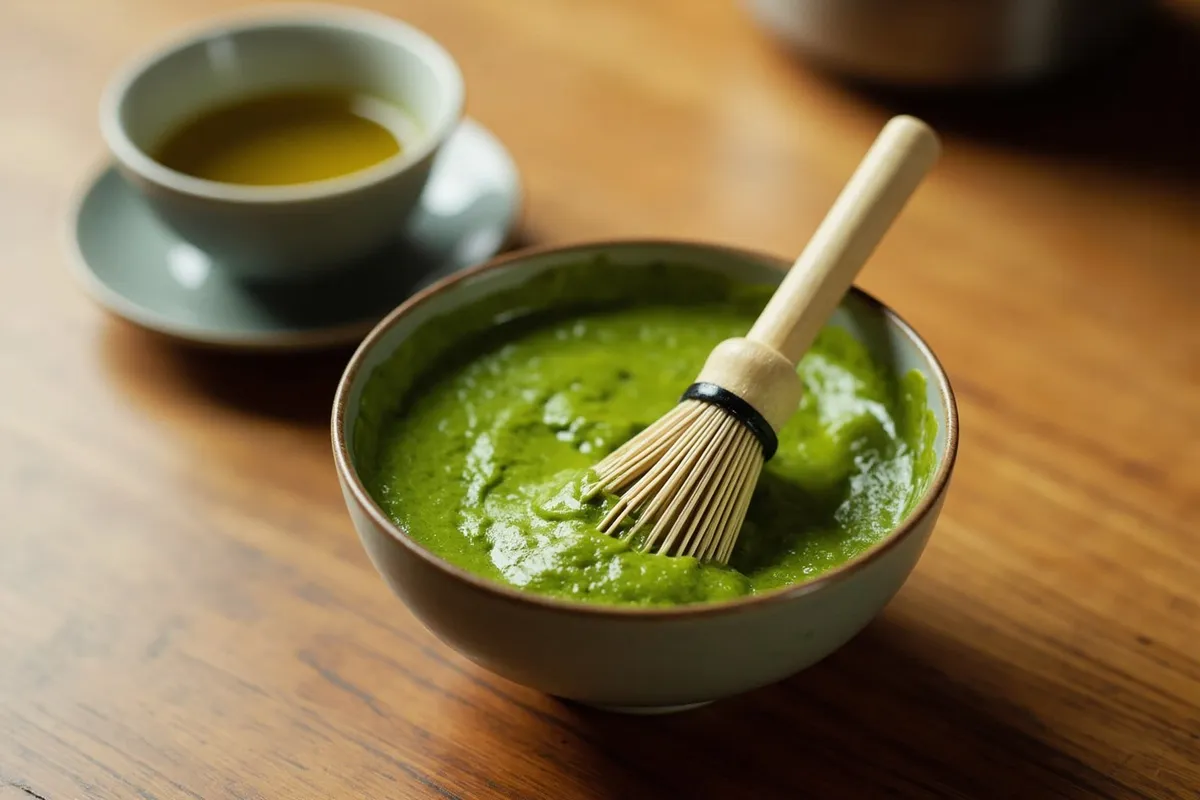
Two grams of matcha gives you roughly two to three times the catechins of a cup of brewed green tea and one to three times the caffeine. That is most of what the green tea and matcha health benefits argument comes down to, and it is a good deal smaller than the tins promise.
I am a home cook, not a dietitian, and I treat nobody. This is what I found in my own kitchen and in the studies: which format for which goal, how much caffeine, what it costs, where tea can interfere with a medical plan. The benefits are real but modest, matcha is a delivery format rather than a different plant, and the record 2026 Uji season and export numbers are why prices are moving while shelf prices are not falling. Where the evidence is thin I say so, and none of this is medical advice.
Green Tea and Matcha Benefits: What the Studies Actually Show
Catechins and EGCG: what a cup and a bowl actually contain
Green tea leaf is 30-42 % catechins by dry weight, and 60-65 % of those catechins are EGCG. A 250 ml cup of brewed tea carries 240-320 mg of them. Run the same percentage over 2 g of matcha powder and a bowl comes out at roughly 600-840 mg of catechins, of which about 360-546 mg is EGCG.
Those bowl numbers are my arithmetic, not a measurement: the compounds were counted in brewed tea and the leaf percentage applied to the powder. Treat them as an estimate. The cup figure is the one with a spoon next to it.
| Compound | 250 ml brewed cup | 2 g matcha bowl | Where the number comes from |
|---|---|---|---|
| Total catechins | 240-320 mg | about 600-840 mg (derived) | 30-42 % of dry leaf weight applied to the powder |
| Share that is EGCG | 60-65 % | 60-65 % (derived) | Same share of the bowl total |
| EGCG per serving | about 145-210 mg (derived) | about 360-546 mg (derived) | Multiplied through; matcha itself was not measured |
Three advertising lines, and what the numbers behind them support:
- "Matcha is packed with antioxidants" – per serving, roughly two to three times a cup's catechins, while brewed tea hands you most of the same compounds for a fraction of the price.
- "Green tea extract gives you the full benefit" – the extract is the form that was looked at hardest. EFSA, the European Food Safety Authority, found infusions generally safe, with average daily EGCG from traditional infusions at 90-300 mg and up to 866 mg at the high end, while supplement doses of 800 mg a day or more produced a statistically significant rise in liver enzymes.
- "A bowl of matcha equals a cup of green tea" – no. Two to three times the catechins, and one to three times the caffeine.
One number worth keeping: two bowls of matcha reach roughly 720-1,090 mg of EGCG on the same estimate, which is the range where the supplement signal appears. My arithmetic, not a measurement, and EFSA assessed supplements rather than infusions, but if you drink two bowls a day and also take an EGCG supplement, that combination deserves a question to your doctor.
Green tea for weight loss: what the trials and meta-analyses show
The best summary I could find is a 2024 network meta-analysis in the British Journal of Nutrition: 22 randomised trials, 1,710 adults, an average of ten weeks. Green tea drinkers weighed about 1.23 kg less than placebo (95 % CrI −2.45 to −0.02) and 1.61 kg less than people drinking water (−2.90 to −0.35).
Those are real numbers, and they are small in three ways. The review rated the certainty of the evidence as low against placebo and very low against water. Every comparison sat below the 4.5 kg the authors used as the smallest difference worth noticing to a patient. And when they narrowed the analysis to adults who were overweight or obese, no beverage, tea or coffee, came out ahead. A separate 2024 meta-analysis of ten trials in people who were training found a small extra effect from adding green tea: weight SMD −0.30, BMI −0.33, fat mass −0.29, and its own authors called it "quite minimal".
Advertisements will tell you green tea switches on AMPK and turns up thermogenesis. That is the marketing talking, not a finding in people; the human evidence here is short, small and inconsistent. In Great Britain no caffeine claim is approved in the Nutrition and Health Claims Register, so green tea or matcha sold here cannot carry a weight-loss promise either.
Cholesterol, cardiovascular mortality and the longevity signal
The dataset here is much larger and the claims much softer. A 2024 meta-analysis of 38 prospective cohort data sets from 27 papers, covering 1,956,549 people, found the highest tea drinkers had about 10 % lower all-cause mortality (RR 0.90, 95 % CI 0.86-0.95) and 14 % lower cardiovascular mortality (RR 0.86, 0.79-0.94) than the lowest. The best all-cause figure sat at two cups a day (ES 0.91, 0.88-0.94).
Read that as a pattern, not a prescription. Cohort data can pick up the person who drinks tea because they are already doing the other things worth doing. Two cups a day is where the model puts the curve, not a target a doctor would hand you. For blood lipids and blood pressure, EFSA's 2018 review of the human evidence stopped short of a causal claim, which tells you where the honest floor is.
Matcha Nutrition Facts: Caffeine per Serving, Vitamin K and Iron
Caffeine per serving: matcha, brewed green tea and coffee
Start from the cup, because that is the unit people think in. USDA FoodData Central lists brewed green tea at about 28 mg of caffeine per 237 ml cup. Matcha powder runs 18.9-44.4 mg a gram, so a standard 2 g bowl lands at 38-88 mg, one to three times the cup.
| Serving | Caffeine |
|---|---|
| Brewed green tea, 237 ml | about 28 mg |
| Matcha, per gram | 18.9-44.4 mg |
| Matcha bowl, 2 g | 38-88 mg |
| One branded 2 g matcha entry | 64 mg |
| Coffee, 12 fl oz cup | roughly 130-200 mg (derived from the FDA's two-to-three-cups framing of 400 mg) |
Read that table backwards and you get the number most people actually want: it takes 4-10 bowls of matcha, about eight cups of black tea (6-10 depending on strength) or 14 cups of green tea to reach 400 mg of caffeine.
The limits come from EFSA's guidance on caffeine: 200 mg in a single sitting and 400 mg a day for a healthy adult, 200 mg a day in pregnancy, and 3 mg per kg of body weight as a habitual limit for children and adolescents. Run the bowl through those and it becomes usable: two to five bowls reach the pregnancy limit, and for a 30 kg child 3 mg per kg is 90 mg, about one small bowl and possibly more than a full 2 g one.
Two notes from my own kitchen. A bowl is one sitting of caffeine rather than a cup you sip over an hour, so if it sets your teeth on edge, split the powder into two smaller bowls. And all of this arithmetic runs on 2 g, because a ceremonial scoop holds about 1.2 g, so a heaped-scoop bowl lands near the bottom of the range and a bag-filled one near the top. If you are counting milligrams, weigh the powder. Scoops are guesswork dressed as precision.
Vitamin K, iron and magnesium: why the powder looks different on paper
One branded 2 g matcha entry makes a busy label: 5 calories, no fat, 1 g carbohydrate, 1 g fibre, 1 g protein, 58 micrograms of vitamin K (48 % of the daily value), 0.36 mg of iron, 4.6 mg of magnesium and 64 mg of caffeine. That is one product on a shelf, not the matcha category, so I would not treat it as an average.
| Per 2 g of matcha (one branded entry) | Amount |
|---|---|
| Calories | 5 |
| Fat | 0 g |
| Carbohydrate | 1 g |
| Fibre | 1 g |
| Protein | 1 g |
| Vitamin K | 58 mcg (48 % of daily value) |
| Iron | 0.36 mg |
| Magnesium | 4.6 mg |
| Caffeine | 64 mg |
Only caffeine has a clean comparison across formats: a 237 ml cup of brewed green tea holds about 28 mg. Everything else in that table depends on the leaf, the steep and the brew, so a brewed cup has no single figure worth setting against a powder. The powder is different by design, and the difference matters in two places.
The first is iron. 0.36 mg in a bowl is not a meaningful dose, so the question is not how much you swallow but how much you absorb. In a controlled trial in healthy UK women, drinking tea with an iron-rich porridge meal cut non-haem iron absorption by 37.2 %, and waiting an hour between the meal and the tea cut that inhibition to 18.1 %. Tannins do the blocking; they are also what gives green tea its grip on the mouth.
The second is vitamin K, at 48 % of the daily value in two grams of powder, and it interacts with warfarin, which is the next section. If you have iron-deficiency anaemia, keep tea an hour away from iron-rich meals and from iron tablets, and never swallow a tablet with a bowl of matcha.
Warfarin, extracts and other medicines
The best-documented interaction is with warfarin. A 1999 case report recorded a patient's INR falling from 3.79 to 1.37 about a week after they started drinking green tea, then climbing back to 2.55 once they stopped, which means green tea can blunt the anticoagulant effect. If warfarin or another anticoagulant is on your list, keep the amount steady rather than erratic and tell your prescriber how many cups or bowls you actually drink.
The liver warning travels with extracts, not leaves. EFSA tied a statistically significant rise in serum transaminases to supplement doses of 800 mg of EGCG a day or more, while infusions stayed generally safe, so two bowls of matcha belong in a different category from an EGCG tablet. High-dose supplements and a bowl of tea are not the same exposure, and stacking one on the other is where I would start worrying.
- Warfarin and other anticoagulants: keep the amount steady and tell your prescriber.
- Iron supplements and iron-rich meals: leave an hour between them and the tea.
- Beta-blockers such as nadolol: green tea may affect how some of these are taken up, so ask your prescriber before you change your routine.
- Decongestants and other stimulants: caffeine adds up faster than people expect.
- Pregnancy and children: run the numbers first, the limits are in the caffeine section above.
- Existing liver conditions: mention your tea and any supplements in the same breath.
On contaminants I keep it simple: I buy from sellers who publish batch tests and state where the leaf came from. A higher price tells you nothing about what a lab found in it.
Matcha vs Green Tea: The Differences That Change Your Decision
Shade-grown tea (kabuse) and why the whole leaf matters
Matcha starts as tencha: tea leaves that have been shaded, traditionally under straw or reed screens, for about three weeks before picking. The plants are kept out of the light, which pulls back the bitterness plain sencha carries and pushes the leaf towards the savoury, marine notes that make matcha taste like food rather than tea.
Then the leaf is stone-milled into a fine powder. Here is the part that matters for your decision: when you brew green tea, the leaf goes into the pot and then into the bin and you drink the water. With matcha you swallow the leaf. A gram of matcha therefore carries more of the plant than a gram of brewed tea does, because none of it is left behind.
- Tencha: the raw material, the shaded leaves that get ground.
- Sencha: everyday steamed leaf tea, brewed.
- Gyokuro: shaded leaf brewed rather than ground, and dearer.
- Hojicha: roasted leaf tea, low in astringency.
- Genmaicha: green tea blended with roasted rice.
- Matcha: tencha ground to powder.
One word of care. Matcha is a way of processing tencha, not a separate species of tea, so if a shop sells "matcha" at the price of sencha, something has been cut or renamed. The ingredient list settles it, and the shopping section comes back to that.
Usucha vs koicha: ritual, strength and what you are buying
Usucha, thin tea, is the bowl most people picture: about 2 g of powder whisked with 70-80 ml of water. Koicha, thick tea, is roughly double, about 4 g, whisked into something close to a cream. Koicha is what tea ceremony at its most formal looks like, and it costs four times the powder of a thin bowl for exactly that reason.
At about £1 a gram that gap becomes real money: around £2 a usucha bowl and £4 a koicha bowl before delivery. The chasen, the bamboo whisk, and the chashaku, the bamboo scoop, are the two tools, and the whisk is the part people rush. Whisk in a W shape from the bottom up, briskly, without letting the tines scrape the bowl wall.
| Bowl | Powder | Water | Strength | Cost per bowl at £1 a gram |
|---|---|---|---|---|
| Usucha, ceremonial scoop | about 1.2 g | 70-80 ml | light | £1.20 |
| Usucha, typical commercial serving | 2 g | 70-80 ml | medium | £2.00 |
| Koicha | about 4 g | less water, thicker bowl | strong | £4.00 |
My rule of thumb: usucha every day, koicha when you have ten quiet minutes and a reason to use them. I do not think most people need thick tea, and the powder price is only the cheapest of what the ritual asks of you.
Ceremonial vs culinary grade: what the label actually tells you
"Ceremonial grade" is a marketing word with no regulator behind it. In a 2026 survey of 12 brands and 2,386 US listings, the word appeared on tins from $0.77 to $2.23 a gram, and none of the five most expensive tins carried it. The spread inside a single brand was even wider: Ippodo Wakaki costs $11 for 20 g, or $0.55 a gram, and Ippodo Kanza costs $104 for the same 20 g, or $5.20 a gram.
Both are ground leaf and both are safe to drink. The grade tells you the intended use, drinking or baking and blending, not the quality, not the strength, not the safety. There is a second trap: about one in five US listings priced under $0.40 a gram is not matcha at all. Most of those are sweetened latte mixes with sugar as the first ingredient, and the rest are bulk culinary powder.
So price is a better first filter than the word on the lid. Six things worth checking on any tin:
- Ingredients: powdered green tea leaf and nothing else.
- Pure powder rather than a mix, which the ingredient list settles.
- Origin of the leaf.
- Harvest or batch.
- Best-before date.
- A published batch or lot test, if the seller has one.
How to Prepare Green Tea and Matcha at Home
How to prepare matcha: usucha step by step
- Sift the powder. Two chashaku scoops is a ceremonial bowl, about 1.2 g, and 2 g is the commercial serving that every caffeine number in this article is based on.
- Boil the water, then let it cool to about 90 °C. This bowl is whisked, not steeped, so the water is hotter than you would use for leaf tea.
- Pour in about 70-80 ml, then add a little extra water to the powder and work it into a smooth paste with the chashaku. No lumps, no floating dust.
- Add the rest of the water and whisk with the chasen in a W motion, briskly and close to the surface, until a fine foam appears.
- Drink it while it is still warm. I take the first sip standing up in the kitchen, and that is the honest reason I keep making it.
What you need: a wide bowl, a bamboo chasen, a bamboo chashaku and a small sieve. Add a thermometer if you want the water right the first time, because the ten seconds between a boiling kettle and the bowl is where good bowls get ruined.
Troubleshooting from my own kitchen rather than a manual. Bitter means the powder was heaped, the water too hot or the whisk too slow. Thin foam means too much water or a cup that went cold. Clumps mean the powder was not sifted. None of these need new equipment, only attention.
Koicha, and brewing sencha or gyokuro properly
Koicha uses the same tools and a different temperament: about 4 g of powder, less water, and a whisk moved more slowly with more pressure at the bottom of the bowl. It should sit on the bamboo a moment longer than thin tea does. The strength lands closer to a double espresso than to a cup of tea, and the powder price is the visible part of that.
Sencha and gyokuro are brewed rather than whisked, and the difference is mostly heat and time rather than leaf. My working numbers, which you should treat as a starting point and adjust to your own kettle and leaf: sencha at 70-80 °C for one to two minutes, gyokuro a little cooler and much shorter, around half a minute. Green tea is unforgiving about heat, and water that is too hot pulls tannin rather than tea.
Latte mixes, storage and the opened tin
A matcha latte mix is a milk-and-sugar product that happens to contain tea powder, with sugar usually listed first. The shopping section explains how to tell one apart from real matcha; the short version is that the ingredient list gives it away in one line.
The storage logic is short. Matcha oxidises once the tin is open, and oxidised powder loses both its colour and its smell: dull green instead of bright, flat instead of grassy. Keep the tin closed, cool and dry, away from light, and buy a size you will finish within a month or two. A 30 g tin is fifteen two-gram bowls, which is about two weeks at one bowl a day.
Frothed milk or whisked foam is a texture preference and nothing more. If you use a milk frother, it is still matcha; you are just getting the air in a different way.
Cost per Gram: Matcha Against Green Tea
US and UK prices: per-gram and per-bowl maths
US prices, collected on 24 and 25 August 2026, excluding shipping and tax:
| Product | Per gram | Per 2 g bowl |
|---|---|---|
| Value tins | $0.44 | $0.88 |
| Mid-market tins | $1.11 | $2.22 |
| Premium tins | $1.83 | $3.66 |
| Costco Sencha Naturals Everyday, 1,021 g for $54.99 | $0.05 | $0.10 |
| Target Jade Leaf Barista Ceremonial, 454 g for $119.99 | $0.26 | $0.52 |
| Café matcha latte | not sold by weight | $6.00-9.00 |
| Twinings Pure Green Tea, $14.97 for 100 bags | reference row | about $0.15 a cup |
UK prices, from a buying guide updated 25 July 2026:
| Product | Per gram | Per 2 g bowl |
|---|---|---|
| Tesco own-label, £4-5 per 30 g | £0.13-0.17 | £0.27-0.33 |
| Sainsbury's Teapigs, £7-8 per 30 g | £0.23-0.27 | £0.47-0.53 |
| Waitrose Clearspring, £8-10 per 40 g | £0.20-0.25 | £0.40-0.50 |
| PerfectTed, £9.50-11.99 per 40 g | £0.24-0.30 | £0.48-0.60 |
| Holland & Barrett OMGTea ceremonial, £24.99 per 30 g | £0.83 | £1.67 |
| Specialist online shops, £25-35 per 20-40 g | £0.63-1.75 | £1.25-3.50 |
Two cautions. The roughly $1.00 a gram "fair everyday price" is the survey's own benchmark rather than my verdict, and the café range is a snapshot of listed prices, not an average worth planning a year around; the annual figure of $2,190-3,285 assumes one latte every single day.
Price any tin in twenty seconds. Divide the tin price by the grams, then by 2, for the cost of a bowl; divide the grams by 2 for the number of bowls, then by 7 for the weeks at one bowl a day. And if you want the number that actually matters, cost per milligram of caffeine: about $0.005 for a $0.15 bag of brewed green tea, against $0.017-0.040 for a matcha bestseller at $1.53 a 2 g bowl. Bagged tea is roughly three to seven times cheaper per milligram, which is the honest version of "green tea is cheaper".
I still buy the cheapest sensible tin and spend the money on decent sencha instead. The ritual matters in the bowl, not on the lid.
Japan: auction prices, crops and export records
| Figure | Market year | Number |
|---|---|---|
| Machine-picked tencha, Kyoto first market | 2026 | ¥13,972/kg, about 1.7× the ¥8,235/kg record set in 2025 |
| Uji season, total transactions | 2026 | ¥12.94 bn across 950 t at ¥13,614/kg, against ¥9.629 bn and ¥10,251/kg in 2025 |
| Machine-harvested first-flush tencha | 2026 | ¥10.1 bn, 50 % more in value, at ¥17,250/kg |
| Farm-gate tencha | 2024 crop ¥3,278/kg, 2025 crop ¥8,562/kg | the biggest jump in the table |
| Farm-gate sencha | 2024 crop ¥1,197/kg, 2025 crop ¥1,746/kg | up, but nothing like tencha |
| First-flush leaf | 2026 | about twice the previous year in Kagoshima, about 1.7 times in Shizuoka |
| Japanese green tea exports | calendar 2025 | a record 12,612 t; powdered tea 8,718 t, 69 % of volume and 84 % of value, with the United States taking 4,431 t |
| Export value | January-August 2026 | ¥67.4 bn, 77.3 % up on the same months of 2025, the largest rise among Japan's food exports |
The figures above are the market's; the conclusion is mine. A tight crop and heavy export demand are why matcha prices abroad are firm, and neither of those things reverses itself in a fortnight. If you are planning to drink matcha daily, buying the size you will finish in a month or two is a better bet than waiting for a cheaper tin.
Counterfeits, "Uji" labels and the GI register
Counterfeiting has become a named problem. Matcha made in China and sold under "Uji Matcha" labels has produced legal disputes, and in 2026 the Japan Tea Central Public Interest Incorporated Association applied to register Japanese tea as a geographical indication on a national register that holds 167 products. The application is pending, so this is a direction of travel rather than a seal you can check on a tin today.
What geographical indication status would do for a buyer is protect the name of the region and the method, not certify every tin you buy. Your filters stay practical for now: a pure-leaf ingredient list, a bright green colour rather than a grey-yellow one, a grassy aroma rather than a dusty one, and a price inside the ranges above. A tin well below the floor is telling you something, and it is not telling you that you got a bargain.
Colour and aroma judgements are mine, not lab results. If you want certainty, buy from a seller who publishes the harvest, the lot and a batch test.
Japanese Tea Culture and the Nuances That Change Your Order
Hara hachi bu, ichiju-sansai and the Okinawan diet
Hara hachi bu, eat until about 80 % full, is the rule my grandmother followed without ever using the phrase. Ichiju-sansai is the plate it comes with: one soup, three small dishes and a bowl of rice, served in the middle of the table and shared. Washoku is the whole table setting around it.
The Okinawan numbers are striking: elders there have been reported at roughly 1,800-1,900 kcal a day with a BMI of 18-22, against 26-27 for US adults over 60. The honest limit matters here. Direct experimental tests of the 80 % rule itself are scarce, and the classic studies looked at the overall dietary pattern of populations where the practice is common rather than the rule in isolation.
Tea fits that table as a habit rather than a supplement. Nobody at my grandmother's table was drinking matcha to lower their blood pressure; it was there because the water was hot and the leaves were good.
What transfers: smaller portions, a plant-heavy plate, tea drunk with the meal instead of between meals, and less salt and sugar than a typical dinner. What does not transfer: copying an 1,800 kcal target, or eating to 80 % full if weight is something you are managing with professional advice.
Where the tea is actually drunk: consumption and a shrinking base
| Measure | Figure |
|---|---|
| Green tea purchased per household, Shizuoka | 1,415 g |
| Green tea purchased per household, Okinawa | 336 g, a 4.2× spread |
| National green tea purchase, per person | 233 g in 2024, against a 1999 peak of 567 g |
| National green tea purchase, per household | 671 g in 2024 |
| Domestic tea consumption, fiscal 2024 | 91,125 t in total: green 68,134 t, black 15,039 t, oolong 7,951 t |
| Domestic tea consumption, fiscal 1996 peak | 156,025 t |
Cultivated land shrank from 49,000 ha in 2005 to 33,000 ha in 2025, and output from 100,000 t to 75,000 t. The number of farmers in Kagoshima and Shizuoka is now less than a quarter of what it was in 2000.
What that means for someone buying outside Japan is simple: less leaf coming to market, more of it going to export, and prices that do not wait for demand to soften. Shizuoka households still drink four times what Okinawan households drink, and Okinawa, the island behind the diet everyone quotes, drinks comparatively little tea.
Ordering from outside Japan: duties, shipping and freshness
Ordering from Japan adds three things: duty and VAT handling, shipping time, and a tin that spends weeks in transit. Duty and VAT depend on your country's rules and on the seller's terms, with DDP meaning the seller handles it and you pay the listed price while DAP means you pay on arrival, so read the shipping line rather than assuming.
Heat and time do the actual damage. A tin that sits in a warm van for a fortnight arrives duller and flatter than one opened in a cool kitchen, and good packaging does not reverse that. My rule: buy smaller tins from a seller who states the harvest and the lot, and open them within a couple of months rather than saving them for a special occasion.
The shift in demand towards North America and Europe is visible in the export figures above. Which means the good lots are not sitting around waiting for you either.
Green Tea, Matcha or Both: The Verdict
The verdict: which format, for what, at what cost
Green tea has the strongest and cheapest evidence base. Matcha wins on convenience, on how much of the leaf you get in one sitting and on the ritual; it does not win on proven health superiority, because most of the trials were run on brewed tea. The weight case is real and small, with low to very low certainty behind it. The decision points that actually matter are the safety ones: warfarin and vitamin K, iron and tannins, supplement doses against leaves, pregnancy and children.
Three readers, three answers:
- You drink coffee all day and want a ritual without the jolt: bagged green tea. About 28 mg of caffeine a cup against roughly 130-200 mg in a 12 fl oz coffee, at about $0.15 a cup.
- You are managing your weight and want a ritual with a dose you can measure: a 2 g matcha bowl, weighed, with the caffeine written down.
- You have iron-deficiency anaemia or you take warfarin: brewed tea, timed an hour away from meals and iron, and a word with your prescriber before you change how much you drink.
With no specific risk factor, the default is good bagged green tea: about $0.15 a cup and roughly three to seven times cheaper per milligram of caffeine than a 2 g matcha bowl. Matcha is a legitimate upgrade for convenience and ritual, not for a proven health edge. That is my verdict, and I can hold it with a straight face.
Decision table and where to start
| Format | Caffeine per serving | Best-supported benefit | Realistic cost per serving | Who should skip it |
|---|---|---|---|---|
| Brewed green tea bag | 28 mg per 237 ml | The strongest evidence base, and the cheapest way to get the same catechins | about $0.15 a cup | Nobody in particular, but keep it steady if you take warfarin |
| Brewed sencha or gyokuro | about 28 mg a cup | Same compounds, more leaf flavour, more ritual than a bag | less than a matcha bowl | Same rules as above |
| Matcha bowl, 2 g | 38-88 mg | The whole leaf, so about two to three times a cup's catechins (derived) | $0.88-3.66 for value to premium tins | Anyone counting caffeine in a tight budget |
| Matcha latte mix | Depends on the mix | A drinkable matcha with milk and sugar, often mostly sugar | Cheaper than pure matcha | Anyone watching added sugar |
| Green tea or EGCG extract | Dose on the label | The form carrying the liver signal at 800 mg EGCG a day | Varies, and not cheap | People with liver conditions, and anyone already drinking matcha daily |
| High-priced "ceremonial" tins | 38-88 mg | The same powder in a fancier tin | $1.83-5.20 a gram | Nobody medically. Your wallet, mostly |
A thirty-day starting plan, in three steps:
- Pick one format and stay with it for a month: a bag a day, or one weighed 2 g bowl.
- Write down the caffeine it delivers, 28 mg for a cup and 38-88 mg for a 2 g bowl, and compare it with the coffee you were drinking instead.
- Buy the smallest tin you will finish within a month or two, and store it closed, cool and dry.
Four questions I get asked most, answered short:
- How much matcha a day is too much? Two to five 2 g bowls is the pregnancy limit of 200 mg; most healthy adults have room to 400 mg a day, which is four to ten bowls.
- Is matcha stronger than coffee? On caffeine, no: 38-88 mg a bowl against roughly 130-200 mg a cup. On catechins, yes, about two to three times a cup of brewed green tea.
- Can I drink it with iron tablets or on warfarin? Keep tea and iron an hour apart, and on warfarin keep your intake steady and tell your prescriber.
- How do I know a tin is any good? A pure-leaf ingredient list, a stated harvest and origin, and a price inside the ranges above.
Before you buy or change your routine
- If you take warfarin or another anticoagulant, tell your prescriber how many cups or bowls you drink and keep the amount steady.
- If you take iron supplements or have iron-deficiency anaemia, leave an hour between tea and iron, and keep iron tablets away from matcha.
- If you are pregnant, count a 2 g bowl as 38-88 mg of caffeine against the 200 mg a day limit, and let your prescriber have the final word.
- If you order from outside the UK, read the shipping line for duty and VAT terms before you pay, and check who handles what on arrival.
- Buy tins with a pure-leaf ingredient list, a stated harvest and origin, and published batch tests; a price far below the range above is a warning, not a bargain.
The weight evidence is low to very low certainty, the lipid claims are not established in people, and the 80 % rule has been studied mostly through whole dietary patterns rather than in isolation. Where the research is thin, I have said so rather than rounding it up.