
Around 1950, Okinawans ate about 1,785 kcal a day while the rest of Japan was at 2,068. That gap is most of what people mean by the Japanese diet: less food, mostly vegetables, sweet potato where you would expect rice, and a broth doing the work a sauce does elsewhere. I cook this food at home most weeks, and this is my working set of what goes on the plate, what it costs in a British supermarket, and where the longevity story gets thin.
Two caveats up front. A November 2024 feature in Science argued that the blue zone idea rests on an absence of evidence linking community lifestyle to longevity, and a 2021 review in Science-Based Medicine found no controlled studies of elderly people in blue zones at all. That review also found Okinawans born after 1945 have no longevity advantage over elderly people in most other Japanese regions. Read this as a cooking method with a decent evidence base, not as a longevity formula.
- What the 1949 Okinawan plate looked like, in grams and calories
- Which blue zone claims survive the 2024 critique, and which do not
- What a week of this shopping costs at British prices
- Where hara hachi bu and fasting collide with the evidence
Japanese Diet in Numbers: The Okinawan Plate Before Westernisation
What 85% carbohydrate and 6% fat looked like on the table
The macronutrient split in the traditional Okinawan diet of 1949 was 85% carbohydrate, 9% protein and 6% fat, with saturated fat at 2% of calories. A review of the traditional Okinawan diet sets out those numbers, and they explain the plate better than any single ingredient.
Each column below carries its own year, because the figures come from different collections.
| Measure | Okinawa, 1949 | Japan, around 1950 |
|---|---|---|
| Calories a day | about 1,785 | 2,068 |
| Calories from grains | 33% | 75% |
| Calories from vegetables | 58% | 8% |
| Vegetables eaten a day | 965 g | 301 g |
The categories overlap: sweet potato is counted among vegetables in the 1949 figures and among grains in the comparison, so the two percentages cannot be added on top of the 85% carbohydrate share.
The washoku plate has four parts: rice, soup, side dishes and pickles. On Okinawa the rice slot often held sweet potato instead, and the soup was a thin miso or kombu broth rather than anything heavy.
Sweet potato, bitter melon and a 1,262-gram day
A whole day of food came to about 1,262 g, and 849 g of that was sweet potato. Two thirds of everything by weight, which is the single most useful thing to know about this diet: the staple was coloured, high in fibre and slow to raise blood sugar, not white and refined.
I would not read the 849 g as 69% of calories, because the same diet puts grains at 33% of calories, and both cannot be true at once. Weight share and calorie share are different measurements, and the weight share is the one that survives.
| Sweet potato, baked, 200 g | Amount |
|---|---|
| Calories | about 180 |
| Carbohydrate | about 41 g |
| Fibre | about 6 g |
| Vitamin A | about 1,100 µg retinol equivalents |
| Glycaemic index | about 54 (boiled) |
| Glycaemic load | about 22 per 200 g |
Those figures come from standard nutrient tables for sweet potato, cooked, and from glycaemic index tables that list boiled sweet potato at roughly 54. The old Okinawa record of 849 g a day was a wartime and post-war scarcity pattern, not a target: at 200 g a day you get the fibre and the colour without 180 kcal of starch at every sitting.
Five Okinawan dishes worth copying at home, with the proportions that make them work:
- Goya chanpuru (苦瓜チャンプルー): half a goya, the spiky bitter melon, hollowed and sliced thin; 150 g firm tofu pressed and cubed; one tablespoon shoyu; a teaspoon of salt; a little lard or oil. Simmer the melon and tofu together until the melon softens, roughly 15 minutes. The bitterness is the point and it does not cook out entirely, so start with half a melon.
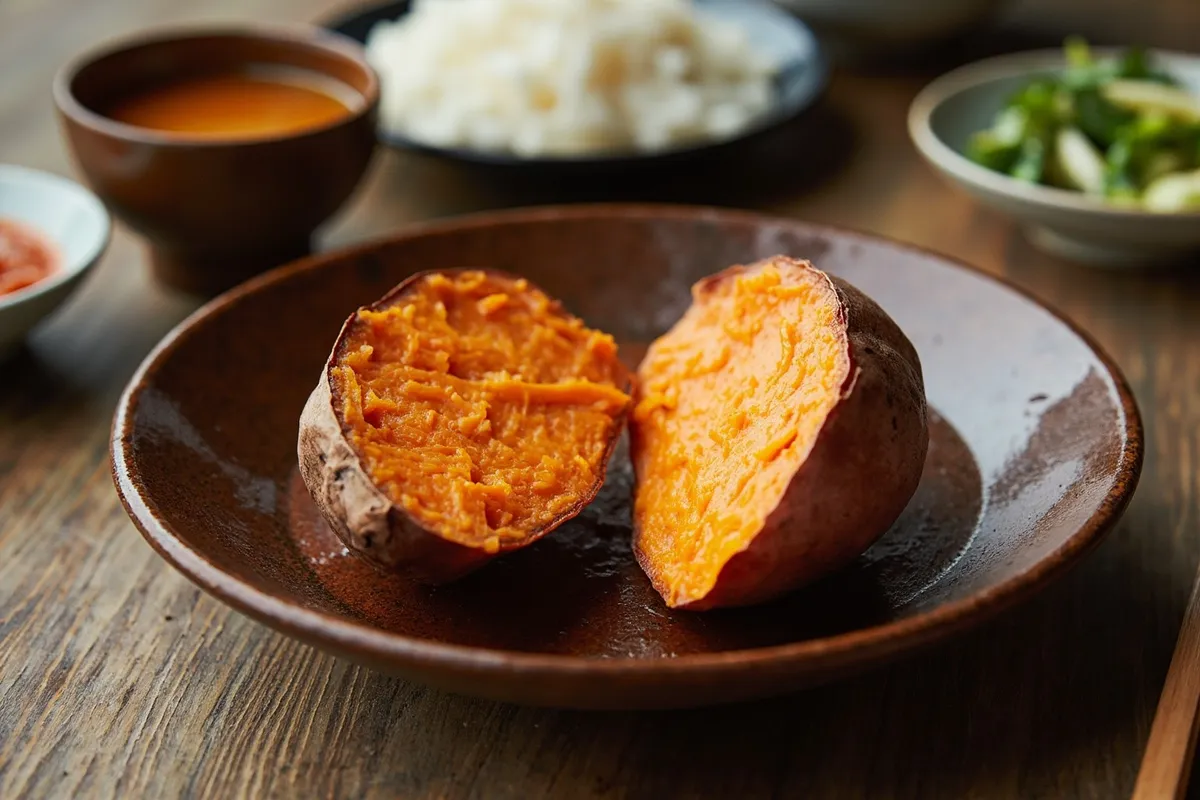
- Sweet potato with miso (焼きいも): a 200 g sweet potato, baked whole at 200°C for about 40 minutes until a knife goes through without resistance; 1 tablespoon white or yellow miso loosened with 1 tablespoon hot water; a few sesame seeds. The miso goes on after baking, not before, or it burns.
- Nibushi (煮干し): 20 g dried anchovy or sardine, rinsed off the salt quickly and soaked in200 ml cold water for 20 to 30 minutes; 100 g daikon and a pinch of ginger simmered in the same liquid for 15 minutes; the fish added for the last 5 minutes. The soaking water is discarded, which takes most of the salt with it.
- Itashi (押し菜): 200 g spinach, komatsuna or another leafy green, blanched for 30 seconds and squeezed dry; 1 tablespoon shoyu and a teaspoon of sesame oil tossed through while hot. Itashi literally means pressed greens.
- Kandaba (かんば): 100 g sweet potato leaves, chopped; 100 g firm tofu; a teaspoon of grated ginger and a teaspoon of shoyu; stir-fried over high heat for 2 minutes until the leaves wilt. This is the dish to skip if you cannot find the leaves, since the stems stay tough.
Swaps for a British kitchen: Satsuma imo becomes any sweet potato or orange-fleshed squash, goya becomes a courgette blistered in a dry pan, daikon becomes a large radish, shiso becomes mint or nothing at all. I keep the miso and the kombu and change everything else.
What westernisation changed and what it cost
From the 1960s the Okinawan plate was rebuilt, and four shifts did most of the damage.
- Sweet potato gave way to rice and bread, so the starch became refined
- Fat rose from about 6% of calories to 27%
- Fried and Western dishes replaced boiled fish and simmered vegetables
- Portions grew
Life expectancy in Okinawa Prefecture moved too, but the direction of that slide is less tidy than the cooking advice, so it sits in the next section.
Blue Zones and Longevity: Where the Evidence Stands
Where the blue zones are and how the label was made
The name comes from the original survey, where researchers used a blue pen on a map to mark villages with a long-lived population. Four zones have held up since, one is emerging and one is on the way in.
| Zone | Country | Status | What the claim rests on |
|---|---|---|---|
| Okinawa, Ryukyu Islands | Japan | validated | original survey |
| Nuoro province | Italy, Sardinia | validated | original survey |
| Bolotana | Italy, Sardinia | candidate, preliminary | validated civil and parish records of people born 1900 to 1925, not self-reported ages; the authors ask for longer observation |
| Nicoya peninsula | Costa Rica | validated | original survey |
| Ikaria | Greece | validated | original survey |
| Martinique | France | emerging fifth zone | proposed in a 2025 review |
Bolotana starts from birth records rather than from what people say about their own ages, which is a stronger footing than most longevity claims get. Its own authors ask for longer observation and continued demographic validation before it counts as an established zone, so I would call it a candidate and leave it there.
The 2024 Science critique and the parts that survive it
The concept has taken real fire. In November 2024, Ignacio Amigo wrote in Science that the blue zone idea rests on an absence of evidence linking community lifestyle to longevity. The 2021 review in Science-Based Medicine went further, finding no controlled studies of elderly people in blue zones and calling blue-zone diets speculation.
| Claim | Where it stands | Basis |
|---|---|---|
| A blue-zone diet prolongs life | Not established | the 2024 Science feature and the 2021 Science-Based Medicine review |
| Okinawans born after 1945 live longer | No advantage over elderly people in most other Japanese regions | Science-Based Medicine, 2021 |
| A blue zone can be tested | Yes | a 2025 review proposes strict age validation, demographic indicators, and longevity at least 50% above the national average |
When someone brings up the blue-zone list at dinner, the honest one-liner is: these places have produced a lot of centenarians on a simple diet, and nobody has shown the diet is the reason.
Centenarian numbers: Okinawa's thirty-year lead and its slide
Between 1949 and 1998 people in the Ryukyu Islands averaged 83.8 years of life against 78.9 in the United States. That is a fifty-year average, not today's number, and Okinawa's standing slipped: it had the highest life expectancy of all 47 prefectures for almost thirty years and sat 26th for men in 2000. Much of the centenarian data comes from the Okinawa Centenarian Study, a long-running survey of the island's oldest residents.
| Measure | Figure |
|---|---|
| Average life expectancy, Ryukyu Islands, 1949 to 1998 | 83.8 years |
| Average life expectancy, United States, same period | 78.9 years |
| Okinawa among Japan's 47 prefectures | highest for men for almost 30 years, 26th in 2000 |
| Bolotana, remaining life expectancy at 70, 2021 to 2025 | 16.02 years for men, 20.85 for women |
| Bolotana women who reached 70 and lived to 100 | 13.83% |
| Bolotana women compared internationally | second only to Hong Kong, on the authors' own reckoning |
The last three rows are the Bolotana researchers' own findings, and they say in the same breath that longer observation and demographic validation are needed before their village joins the list properly.
The Okinawa Diet: Hara Hachi Bun Me and the Everyday Plate
Hara hachi bun me: stopping at eight parts out of ten
Hara hachi bun me means eating until eight parts out of ten full. Okinawans who follow it eat about 1,800 to 1,900 kcal a day, and their elders' BMI sits at roughly 18 to 22, against 26 to 27 for US adults over 60. The mechanism there is a smaller plate rather than a different metabolism. My notes on what eating to 80% full actually does cover the practical side.
- Serve yourself less than looks right. I take half the rice I would normally bowl
- Stop at eight and push the plate away, even when the meal is good
- Weigh once a week rather than daily, or it turns into a chore
This is a household rule, not a clinical guideline. Anyone pregnant, under 18, training hard, or with a history of disordered eating should leave the restriction alone and ask a doctor first.
Thirty foods a day, one staple: the ichiju-sansai template
Japan's Ministry of Health, Labour and Welfare advises eating 30 different foods a day to cover a wide range of nutrients. The washoku template then organises them into a bowl of rice, a bowl of soup and three small side dishes, with pickles alongside.
| Japanese food guide spinning top | On a British plate |
|---|---|
| Soup | miso or kombu dashi, with wakame and a little tofu |
| Three small side dishes | one vegetable, one fish or bean, one mushroom or seaweed |
| Rice | a small bowl, or sweet potato when that is the day |
| Pickles | a forkful, tsukemono style |
Gomi (五味), the five tastes, gives you a way to build meals that do not repeat: umeboshi for sour, Satsuma imo for sweet, miso for salty, goya for bitter, kombu dashi for savoury. A meal only has to hit two or three of them to feel complete.
The vegetable figure from the table above, nearly a kilo a day, is the part people ask about. My own split without a scale: roughly 200 g at breakfast, 300 g at lunch, 350 g at dinner, plus pickles and seaweed on the side. The 30-food habit does the rest of the work on variety.
Salt, dashi and the 9.6 g a day reality
Japan's own salt numbers have come down and are still above target. The 2024 National Health and Nutrition Survey put average salt intake at the lowest level in 12 years, and above the goal set by Healthy Japan 21.
| Salt picture | Figure |
|---|---|
| Japan, average salt a day, 2024 National Health and Nutrition Survey | 9.6 g |
| Healthy Japan 21 goal | under 7.5 g a day for men, under 6.5 g a day for women |
| Salt in a 15 g spoonful of a 34% soya, 11.9% salt miso | about 1.8 g |
| Food-based sodium, 1949 Okinawan diet | 1,113 mg a day |
| Food-based sodium, today's Okinawan elders | 3,100 mg a day |
| Food-based sodium, modern Okinawan diet | 3,256 mg a day |
The UK benchmark is tighter than the Japanese one: the NHS advises adults to eat no more than 6 g of salt a day, about one level teaspoon, and notes that around three quarters of dietary salt comes from packaged and everyday foods, takeaways and restaurant meals. Miso and shoyu count inside that same budget, so measuring them matters more than the salt cellar does.
The last three rows count sodium from food only, without table salt and without processed food, so neither diet is fully described. Converting 1,113 mg of sodium into grams of salt is my own arithmetic rather than a published figure.
Five swaps that cut sodium without cutting umami:
- Measure the miso, because a level tablespoon is where the salt hides
- Cook dashi from kombu only and skip the bonito step
- Stop adding salt at the table, the broth already carries it
- Use miso as a seasoning beside the bowl rather than as a broth base
- Keep pickled vegetables to a forkful rather than a bowl
Both belong on that list. The NHS names soy sauce among the foods especially high in salt, alongside cured and smoked meat, cheese, stock cubes and savoury snacks, and notes that many people go over their daily limit from these foods alone. That is the argument for measuring the miso and for seasoning the kombu broth rather than adding salt at the table.
1949 Okinawa is a description of how people ate, not a diet to copy. The cautions at the end explain why.
The Japanese Diet for Weight Loss: What Actually Moves the Scale
Portion control versus fasting windows
The 2025 BMJ network meta-analysis pooled 99 randomised trials and 6,582 adults, and it gives the clearest answer to the fasting question. The full analysis reports weight change against unrestricted eating as follows.
| Strategy | Weight change against unrestricted eating |
|---|---|
| Alternate day fasting | minus 3.40 kg |
| Whole day fasting | minus 2.36 kg |
| Continuous energy restriction | minus 2.11 kg |
| Time-restricted eating | minus 1.72 kg |
Against continuous calorie restriction directly, alternate day fasting was ahead by 1.29 kg (95% CI minus 1.99 to minus 0.59) on a threshold of 2.0 kg for clinical importance. In trials running 24 weeks or longer there was no difference between any intermittent strategy and continuous restriction at all.
So a fasting timetable adds very little over simply eating less. The Okinawan mechanism was a smaller plate and a low glycaemic-load starch, and those numbers are in the sweet potato table above.
The evidence for eating less is stronger than the evidence for any named blue-zone food. CALERIE 2 randomised healthy non-obese adults aged 21 to 50 to 25% calorie restriction or unrestricted eating for two years, and two years of restriction slowed DunedinPACE, a DNA methylation measure of the pace of biological ageing. It measured biomarkers rather than lifespan, and its participants were young, so Nature Medicine supports the smaller plate as a mechanism, not as a longevity formula.
Matcha, sencha and the catechins question
Green tea's fat-burning reputation rests on catechins, EGCG among them, and on caffeine. The best evidence does not support it. A 2021 Cochrane review pooled 15 weight-loss studies and three weight-maintenance studies with 1,945 participants and found no statistically significant loss, nothing likely to be clinically important, and no benefit for keeping weight off.
One caveat matters: Cochrane pooled preparations, including extracts, which is not the same as a cup of matcha. The review does not show that green tea burns fat, and it does not show that a cup of green tea does nothing. It shows the fat-burning claim has not been demonstrated.
| Matcha | Sencha | |
|---|---|---|
| Form | finely milled whole leaf | whole leaf, steeped |
| How you drink it | whisked, leaf and all | infusion, leaf stays in the pot |
| Caffeine | tends to be stronger, you drink the leaf itself | lighter |
| On the pack | one ingredient, short date | sealed bag keeps the leaves fresh |
I keep matcha for a weekend morning and sencha for the weekdays. Brewing details are in my green tea and matcha guide, and the price table for both sits below.
Soy protein, tofu and the benchmark to beat
Tofu's evidence is modest and specific. The meta-analysis behind the FDA's soy protein heart-health claim covered controlled trials, and this is what it found.
| Measure | Change against a non-soy protein control diet |
|---|---|
| LDL cholesterol | minus 4.76 mg/dL |
| Total cholesterol | minus 6.41 mg/dL |
| Soy protein a day | median 25 g |
| Duration | median six weeks |
That covers lipids over about six weeks. It says nothing about cancer, thyroid or hormones, and tofu is not a substitute for prescribed statins. The soy isoflavones genistein and daidzein are the compounds behind most of the interest, and on the shelf I go for firm or calcium-set tofu, which is set with calcium sulfate and keeps its shape in a hot pan.
Blood pressure separates the fermented items from the plain one. In an analysis of Japanese dietary data, intake of miso and natto, but not tofu, was negatively associated with the risk of hypertension, defined as systolic blood pressure of 130 mmHg or more or diastolic of 85 mmHg or more. Fermented soy, not soy as such, is where the signal sits, as recorded in PubMed Central.
The 2025 to 2030 Dietary Guidelines for Americans, released on 7 January 2026, put adult protein at 1.2 to 1.6 g per kg of body weight a day and cap saturated fat at 10% of calories. Added sugars are capped as well.
On obesity, the two countries' numbers are not comparable, and I would not put them side by side without saying so. US adult obesity was 40.3% age-adjusted in the August 2021 to August 2023 NHANES cycle, including 9.7% severe obesity. Japan defines obesity as BMI above 25 rather than 30, and in the 2019 National Health and Nutrition Survey 39.7% of men aged 40 to 49 and 16.6% of women aged 40 to 49 were above that threshold. Different age bands, different cut-offs, no ranking.
How to Eat Like Japanese: The Rules That Carry the Habit
Ichiju-sansai and gomi: the shape of a meal
The most portable idea in the japanese diet is the plate shape rather than any single food: one bowl of soup, three small dishes, a small portion of rice, eaten in that order.
- Soup first, while the stomach is empty, because it fills without much food
- Then the small dishes, one at a time, so you taste each of them
- Rice last, when you are already partly full and eat less of it
The order matters more than the ingredients. Put the rice bowl in front of someone at the start of a meal and the rest of the dish gets eaten faster and in larger amounts.
My rebuild of a British dinner: leftover roast chicken becomes a small bowl of salad with the pan juices loosened with hot water and a spoon of miso; the boiled potatoes become a small dish of sweet potato mash; frozen peas go into the soup. Three small bowls, one small plate of starch, and the rest of the evening's cooking disappears.
Dashi: the technique that makes low-fat cooking taste like something
Most Japanese home cooking starts with a bowl of dashi, a simple stock, and the whole reason a low-fat plate tastes like something is that the flavour arrives in the liquid instead of the fat. My quick version for a weeknight:
- Wipe 10 g of kombu with a dry cloth and put it in 400 ml of cold water
- Leave it off the heat for 10 minutes, then lift the kombu out
- Never boil it, because boiling makes the stock cloudy and bitter
- Season at the table with a splash of shoyu or a spoonful of miso
Timings and quantities here are mine, tuned in my own kitchen. The classics run longer and hotter.
| Ingredient | How I use it | Flavour |
|---|---|---|
| Kombu | cold infusion for dashi | deep savoury base |
| Wakame | added at the last moment | sea-green, softens fast |
| Nori | shredded over rice or soup | light marine salt |
| Hijiki | braised with beans | strongest of the four, and the one to skip |
| Miso | stirred into hot broth off the heat | salt and depth |
Three words to know: dashi is the stock, miso is a fermented soybean paste, shoyu is soy sauce.
Hijiki is the seaweed to skip. It can carry high levels of inorganic arsenic, and health bodies in the UK and Australia advise avoiding it, while wakame, kombu and nori are the low-arsenic types. The practical handling is in the cautions at the end.
Natto, miso and the fermented staples
Natto is the strongest fermented item here, and its headline compound is menaquinone-7, a form of vitamin K2.
| Natto and vitamin K2 | Figure |
|---|---|
| MK-7 in a 50 g serving of natto | about 380 µg |
| Daily dose described as enough to keep circulating levels stable | 100 to 200 µg |
| Habitual natto intake and serum MK-7, 2025 meta-analysis of six Japanese studies with 2,327 participants | d = 2.10 (95% CI 1.55 to 2.66), after one outlier cohort was excluded |
| Habitual natto intake and bone mineral density | d = 0.65, falling to 0.35 without the outlier study |
| Certainty of that evidence | moderate for MK-7, low to very low for bone density |
Natto carries a second compound the table above does not cover: nattokinase, a potent fibrinolytic enzyme that breaks down fibrin. A Japanese cohort study examined whether natto intake, alongside soy protein and soy isoflavones, tracks with cardiovascular disease mortality, and the American Journal of Clinical Nutrition sets out the design. It is the same natto that needs a doctor's advice when anticoagulants are involved.
One 50 g serving already carries more MK-7 than the range described as sufficient, so a supplement on top of daily natto is usually money spent for nothing, and it sharpens the anticoagulant question. Natto is fermented with Bacillus subtilis var. natto, and vitamin K interacts with drugs such as warfarin, so anyone on blood thinners should ask a doctor before increasing natto or taking MK-7 in any form. The 2025 review of natto and menaquinone-7 sets out the dose data.
The strongest cohort evidence in this food set points at fermented soy. In a large prospective cohort of Japanese adults, higher intake of fermented soy products such as natto and miso was associated with a lower risk of high blood pressure, and natto intake with lower cardiovascular disease mortality. The association ran with fermented soy rather than with total soy intake, which is the part worth remembering at the shelf. The cohort analysis is published in BMJ.
Fresh natto is a slimy, deliberately ugly thing that does not wait for you, so I buy the frozen packs, which travel better and keep longer.
A Japanese Week of Eating: The Shopping List and a Ten-Minute Breakfast
Breakfast in ten minutes, lunch with no cooking
The week below is built around the 30-foods-a-day habit and the vegetable split given in the ichiju-sansai section. No calorie counts per meal, since those depend on your own portions.
| Day | Ten-minute breakfast | Lunch, no cooking | Dinner |
|---|---|---|---|
| Mon | Miso soup, rice, pickles | Rice with miso dressing | Goya chanpuru |
| Tue | Natto over rice | Tofu and wakame salad | Sweet potato with miso |
| Wed | Onigiri with nori | Natto and cucumber onigiri | Nibushi fish with daikon |
| Thu | Yogurt with sweet potato | Soup, rice, salad | Itashi braised greens |
| Fri | Wakame salad, rice | Nori and tuna rolls | Kandaba with tofu |
| Sat | Miso soup, rice, pickles | Leftover soup and rice | Goya chanpuru |
| Sun | Natto over rice | Tofu and wakame salad | Sweet potato with miso |
The ten-minute breakfast formula, five options: miso soup with rice and pickles; natto over rice; an onigiri wrapped in nori; yogurt with sweet potato; wakame salad with rice. Learn the onigiri first: a handful of rice, a pinch of salt, a sheet of nori, three minutes.
The savoury morning options get more detail in my Japanese breakfast notes.
What it costs: the Japanese pantry at British prices
All prices below are UK shelf prices in 2026, converted to a price per 100 g so the columns can be compared. The fish and the seaweed are the expensive part; the fermented staples work out cheaper per 100 g than most people expect, once a 300 g pack is compared fairly with a 100 g pot.
| Item | Shelf price | Price per 100 g |
|---|---|---|
| Miso, supermarket own-brand | £1.80 to £1.90 per 100 g | £1.80 to £1.90 |
| Miso, Yutaka organic | £3.30 for 300 g | £1.10 |
| Miso, Hikari Maru-Yu koji | £5.49 for 375 g | £1.46 |
| Firm tofu, Sainsbury's SO Organic Super Firm | £1.42 for 300 g, usually £1.34 | £0.47 (£0.45 on offer) |
| Firm tofu, Tesco Plant Chef Organic Firm | £1.95 for 399 g | £0.49 |
| Natto, frozen packs | about £2.50 for 4 x 50 g | about £1.25 |
| Nori, plain sheet | about £2.50 for 5 x 10 g | about £5.00 |
| Dried kombu, 10 g pack | about £1.60 | about £16.00 |
| Dried wakame, 30 g pack | about £2.50 | about £8.30 |
| Short-grain rice, 1 kg | about £2.20 | about £2.20 |
| White fish fillet, frozen or fresh | about £6.00 per 300 g | about £2.00 |
| Matcha, 30 g tin | about £9.00 | about £30.00 |
| Sencha, 100 g bag | about £5.00 | about £5.00 |
Prices move with promotions and stockists, so read the ticket on the shelf rather than trusting an old number. Two rows deserve a second look. Kombu and wakame look expensive per 100 g because the dry weight is tiny: 10 g of kombu makes roughly a litre of dashi, so a £1.60 pack is a month of broth for one person. Nori is the reverse, five sheets and the bag is finished in a month or two. Matcha at £30 per 100 g is a luxury next to sencha, and the evidence does not give you a reason to pay it.
What a week actually costs
One person, seven days, using the prices above and nothing fancy:
| Line | Weekly cost |
|---|---|
| Miso, 100 g at Yutaka price per 100 g | £1.10 |
| Firm tofu, one300 g pack | £1.42 |
| Natto, one 4 x 50 g pack of frozen | £2.50 |
| Nori, one 5 x 10 g pack | £2.50 |
| Kombu, a fifth of a 10 g pack | £0.32 |
| Short-grain rice, 500 g | £1.10 |
| Sweet potato, 1.4 kg | £1.40 |
| Fish, one 300 g fillet across three dinners | £6.00 |
| Vegetables, beans, eggs and fruit for the week | £14.00 |
| Green tea, sencha or a combination | £2.50 |
That is about £32 for one person for seven days, and roughly £11 of it is vegetables, beans, eggs and fruit. The Japanese-specific lines – miso, tofu, natto, nori, kombu, green tea – come to about £10. The fish is the single biggest item, and buying frozen white fillets rather than anything line-caught is where I save.
Where to buy the Japanese pantry in the UK
- Specialist shops: Yutaka and the Japan Centre carry the wider range, including koji miso and fresh natto
- Supermarket own-brand lines: Sainsbury's and Tesco both sell a decent miso at £1.80 to £1.90 per 100 g
- The mainstream aisle: organic firm tofu at £1.42 in Sainsbury's and £1.95 for 399 g of Tesco Plant Chef
- Online: the same brands ship, with delivery on a subscription or a large order
Four things worth reading on the label. Salt per 100 g, since the Yutaka miso carries 11.9% salt and a 15 g spoonful of it is about 1.8 g of salt. Whether wheat is in there: Yutaka's is soya beans, rice and salt, while many shoyu and some miso are built on wheat. Whether the label lists additives at all: the koji miso above lists none. And the date, though nori loses its aroma long before its printed date, so buy a smaller bag rather than one you will not finish.
Two things I would skip: seaweed chips, because of the iodine load, and hijiki, because of arsenic. The figures are in the cautions below.
Storage, briefly. Fresh natto keeps only a few days and smells like a school dining hall; the frozen packs keep much longer. Miso in the fridge stays usable for months, and nori keeps its smell for a few months in a sealed bag before going flat.
What to Copy, What to Skip and Where to Start
What the evidence supports, and what it doesn't
The cookable part of this plate is in good shape. The longevity story around it is a hypothesis, and the weight-loss shortcuts do not hold up.
| What you might be told | What I would say | Where it stands |
|---|---|---|
| Eat to 80% full and you will lose weight | Worth trying | A portion rule with a mechanism, not a metabolism switch. The mechanics are in the section on hara hachi bun me |
| Green tea melts fat | Skip it | No significant loss in any pooled trial, Cochrane 2021 |
| Blue zones prove the diet makes you live longer | Overreach | An interesting correlation with no demonstrated cause, and the 2025 review shows how a zone should be tested |
| Tofu protects your heart | Half true | A small LDL drop over about six weeks and nothing else. The numbers are in the section on soy protein and tofu |
| Copy the 1949 Okinawan diet exactly | Not a target | It was a very low-fat diet for a very active population. The cautions section covers why |
Risks, cautions and who should not copy this
A few practical warnings, and then the people who should talk to a doctor first.
- Warfarin and other anticoagulants: vitamin K interacts with them, so do not increase natto or take MK-7 supplements without asking
- Nori and iodine: a 10 g serving of dried nori supplies 232 µg of iodine, 155% of the 150 µg allowance, against a 1,100 µg tolerable upper limit, and 5 g of seaweed chips is roughly 80 µg. The Harvard Nutrition Source on seaweed sets out the figures
- Hijiki and arsenic: it can carry high levels of inorganic arsenic, and health bodies in the UK and Australia advise avoiding it, while wakame, kombu and nori are the low-arsenic types
- Miso and salt: about 1.8 g of salt per 15 g spoonful of a 34% soya, 11.9% salt miso
- 1949 as a target: 6% of calories from fat at about 1,785 kcal a day works out to roughly 12 g of fat a day, my arithmetic on those figures. That describes how one population ate, and current guidance caps saturated fat at 10% of calories without setting any floor for total fat
Talk to a doctor before you start if any of this applies to you: you take anticoagulants; you have hypertension, kidney disease, or follow a sodium-restricted diet; you are pregnant or breastfeeding; you are under 18; you train hard enough that cutting food affects performance; you have a history of disordered eating or restrictive dieting.
A four-week starting plan
One change a week, each with a checkpoint you can actually check.
- Week 1, portion control: weigh your rice for a fortnight and stop at eight parts out of ten. Checkpoint: your evening bowl is smaller on day 14 than on day 1
- Week 2, variety and stock: run the 30-food tally and keep a ten-minute pot of kombu dashi in the fridge. Checkpoint: 30 different foods in one day
- Week 3, breakfast and salt: switch the weekday breakfast to one of the five options and measure the miso. Checkpoint: five mornings on the new breakfast, one spoonful of miso a day
- Week 4, review: weigh once, note your blood pressure if you track it, and write down how you slept. Checkpoint: weight, blood pressure and sleep recorded against the 2025 to 2030 Dietary Guidelines for Americans targets and the Healthy Japan 21 salt goal of under 7.5 g a day for men and under 6.5 g a day for women