
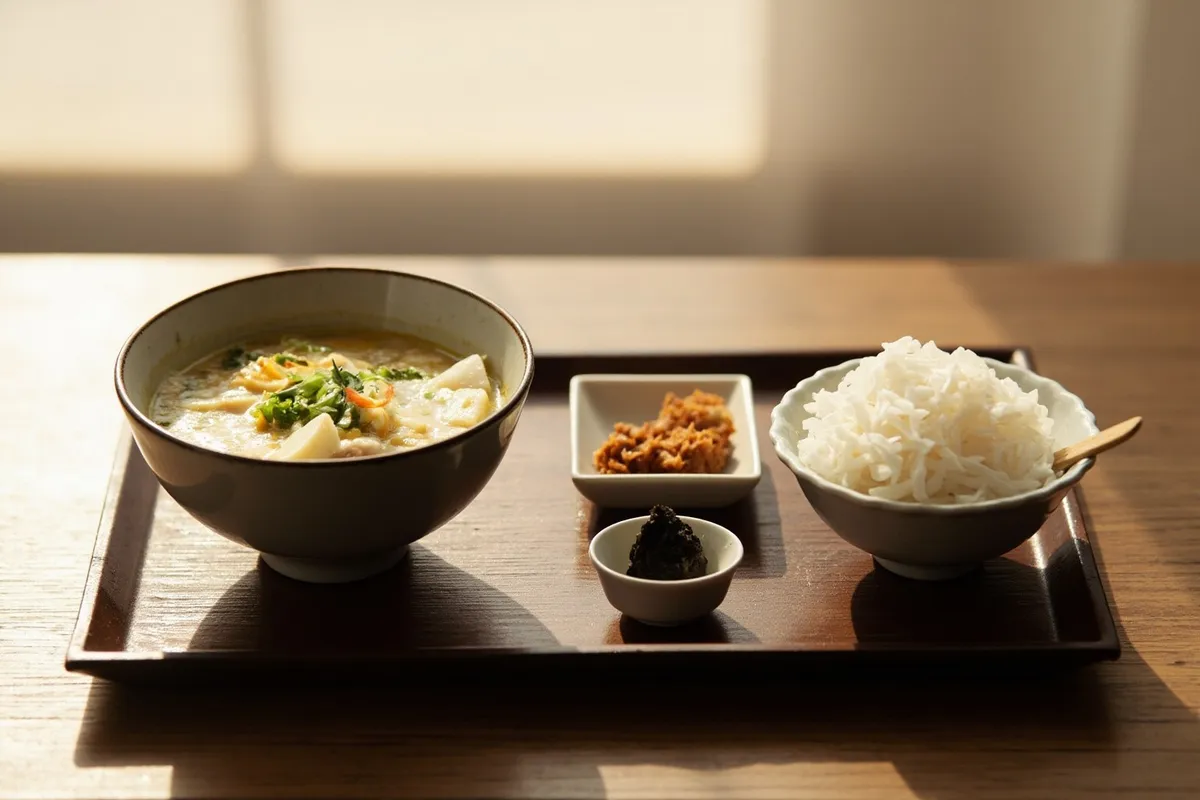
A Japanese breakfast is a structure, not a list of superfoods: rice, one soup, one protein dish and two small vegetable sides, put in the middle of the table and shared. That template is the honest answer to "does a Japanese breakfast help you lose weight" – it helps because it makes a calorie deficit easier to keep, not because one ingredient in it burns fat on its own.
Portion control and protein, not a magic food – and the trade-off is sodium, not calories.
I grew up with the pattern at my grandmother's table in Yokohama, and rebuilding it in Manchester took me years of cooking and food journals. What I could never find in English was a version that separates what the studies show from what is only tradition, so that is what this piece does.
- Traditional Japanese breakfast foods follow ichijū sansai – one soup and three dishes – with rice served beside them, not counted among them.
- One assembled plate costs about 430 kcal and about 26 g of protein.
- The 80% rule has never been tested on its own; the evidence comes from whole Okinawan and Japanese diets and is observational.
- Intermittent fasting loses roughly the same weight as plain calorie-cutting, so the breakfast itself is not the lever.
- Sodium is the price of the format: about 475 mg in that plate, 467 mg of it from the soup.
So: yes, a Japanese breakfast can support weight loss, mostly through portion control and protein. The scorecard near the end tells you which claims hold up and which I would skip.
What a Japanese Breakfast Is: Ichijū Sansai, Washoku and Teishoku
Ichijū Sansai: One Soup, Three Dishes
When people ask what a traditional Japanese breakfast actually includes, the answer starts with ichijū sansai – "one soup, three dishes". The rice is not one of the three. It sits next to them in its own bowl.
- Rice (gohan) as the staple, served alongside and not counted among the three.
- One soup, usually miso or a dashi-based broth.
- One main dish: fish, egg, tofu or other protein.
- Two small vegetable sides: pickles (tsukemono), greens, a tofu or an egg dish.
So a full plate is four plated items plus rice. Plenty of people meet the phrase in English, count three things total, and end up wondering why their Japanese breakfast looks like rice and soup.
Glossary, because these words come up everywhere:
- Teishoku – a set meal, several dishes served together.
- Asagohan – the breakfast form of a set meal.
- Gohan – cooked rice, and by extension a rice meal.
- Tsukemono – pickled vegetables, the small bowls on the side.
The format survives at home breakfasts and in ryokan dining rooms: same logic, rice and soup and sides. What changes is how much of it goes into the bowl.
Teishoku and Asagohan: What a Japanese Breakfast Looks Like Now
Teishoku is a set meal: several dishes served together, the way I ate them at home. Asagohan is the breakfast form of that set meal, not a different system – same structure, fewer components on a working morning, and often one dish doing the work of two.
| Weekday teishoku set | Weekday asagohan |
|---|---|
| Rice, miso soup, a fish dish, two vegetable sides | Rice, soup, one protein dish (tamagoyaki or natto), one side |
The one-bowl shortcuts are modern, and they work because the protein anchor stays: tamago kake gohan is rice with a raw egg stirred through, natto gohan is rice topped with fermented soybeans. I keep natto for that reason as much as for the taste – it is the fastest plate I can put together and it carries real protein.
Washoku and the UNESCO Listing: What It Means for Your Plate
Washoku is the broader cooking system behind that plate, and UNESCO lists it as intangible cultural heritage. What the listing protects is a way of cooking and eating – seasonality, balance, small dishes – and it says nothing about calories or weight.
That matters because heritage status gets used as a wellness claim. It is not one. A traditional plate can be light or heavy depending on the rice portion, the oil in the soup and the fish you picked.
How to check any number in this piece yourself, without taking my word for it:
- USDA FoodData Central – free, in English, and the source of every calorie and protein figure below. A free API key lifts the rate limits.
- Standard Tables of Food Composition in Japan, 2015 (Seventh Revised Version) – the Japanese reference for what is in a food, including the vitamin K2 and iodine figures used later.
- The FAO country page on the Japanese Dietary Guidelines (Shokujikun, launched 2000; spinning-top food guide 2005, revised 2010).
- The Ministry of Health, Labour and Welfare's National Health and Nutrition Survey, fielded each October–November. The 2024 round covered 25,816 eligible and 10,414 participating households, with 15,269 people measured and 18,457 completing the dietary survey, and was published on 2 December 2025.
Hara Hachi Bu, the 80% Rule and the Okinawan Evidence
What Hara Hachi Bu Means and Where It Comes From
Hara hachi bu comes from a Japanese Confucian teaching: eat until you are about 80% full. It came up again and again while I was reading about the Okinawa diet, and I wrote about it separately in Hara Hachi Bu: What Eating to 80% Full Actually Does.
What the research links it to:
- lower total daily calorie intake
- lower long-term weight gain
- a lower average BMI
- in men, more vegetables and fewer grains at meals
And what it is not: no study has tested the 80% rule in isolation, because the work so far has examined the overall diets of Okinawan and Japanese populations. Read it as a habit that travels with a pattern of eating, not as a tested intervention.
The Okinawa Diet and Blue Zone Claims
The Okinawa diet is a whole way of eating: plenty of vegetables, little processed food, modest portions, fish and soy as protein, sweet things as an occasional treat. Blue Zone is a label for places where researchers look for long lives, and it describes a set of observational data rather than a controlled test of any single rule.
The more useful comparison is Japan's position now. In the 2024 National Health and Nutrition Survey, 25.3% of adults over 20 were at BMI 25 or above – Japan's own obesity threshold, at 32.4% for men and 19.3% for women – while the WHO figure for adults at BMI 30 or above in Japan in 2024 was 5.9%.
Two numbers, two thresholds. Japan's BMI 25 cut-off is lower than the WHO's 30, so a country can look obese by its own standard and modest by the global one. Pick the standard you are measuring against before comparing Japan with anywhere else.
Japanese Dietary Guidelines, Health Japan 21 and the 2024 Survey
The Japanese Dietary Guidelines have run since 2000, and their food guide is the spinning top from 2005, revised in 2010 – staple, side dishes, main dish and soup, arranged in a balance. Health Japan 21 (third term, 2024–2035) turns that into measurable targets, and the annual national survey shows whether people hit them.
| Indicator | Official target | 2024 survey result |
|---|---|---|
| Salt intake | 7 g a day by fiscal year 2032; dietary reference values set under 7.5 g for men and 6.5 g for women | 9.6 g a day for adults 20+, men 10.5 g, women 8.9 g |
| Balanced meals | 50% of adults eating a staple, main dish and side dish together at least twice a day | 52.8% on almost every day of the week |
| Daily steps | 7,100 | 7,071 on average for adults 20+; men 8,564 and women 7,287 for 20–64-year-olds |
Read that as a scoreboard, not a diagnosis. The salt line is the one I keep coming back to, because the Japanese plate people want for weight loss is also the plate that runs over on salt. The full survey data is in the National Health and Nutrition Survey.
What to Eat for a Japanese Breakfast: Core Components and Protein Anchors
The Core Components: Rice, Soup, Protein and Two Sides
Build it slot by slot. Two or three options per slot is enough, and every slot has a job.
- Rice – plain steamed short-grain, and the portion is the main decision you make.
- Soup – miso with kombu and bonito flakes, or a lighter dashi. Tofu and wakame in the bowl add body.
- Protein – grilled fish, tamagoyaki, natto, firm tofu, edamame.
- Pickled side – tsukemono: cucumber, radish, ume.
- Second vegetable – greens, mushrooms, hijiki or wakame salad.
- Drinks – green tea or roasted hojicha, water with a slice of yuzu, and nothing sweetened. Sake or a splash of ozakura adds alcohol on top. More on tea in Green Tea and Matcha: Benefits, Research and How to Use Them.
Yuzu, kombu and bonito flakes are worth getting right because they do the work of salt without the salt. Hot water with a slice of yuzu tastes like a season; plain water tastes like nothing.
One accuracy note on the soup: the USDA figure I use is labelled "Soup, miso or tofu", a mixed dish category calculated from component recipes rather than measured in a lab, so treat it as a typical bowl of miso or tofu soup. Its 467 mg of sodium works out at roughly 1.2 g of salt, and that conversion is arithmetic, not a label reading.
Protein Anchors: Natto, Tamagoyaki, Tamago Kake Gohan and Fish
Protein is what lets a small breakfast hold you until lunch. Four anchors earn their slot:
- Natto – fermented soybeans, the strongest protein per serving here and the fastest plate to assemble.
- Tamagoyaki – rolled omelette, sweetened or savoury, cheap and portable.
- Tamago kake gohan and natto gohan – rice plus a protein you stir in, which turns the bowl into a full meal.
- Fish – grilled salmon or mackerel, the most filling anchor per calorie, and the one to cook when you want the plate to feel generous.
| Per 100 g | Protein | Fat | Fibre | Calories | Also |
|---|---|---|---|---|---|
| Natto | 19.4 g | 11 g | 5.4 g | 211 kcal | 729 mg potassium, 7 mg sodium |
| Tofu, firm | 17.3 g | 8.7 g | 2.3 g | 144 kcal | 683 mg calcium |
| Salmon, farmed Atlantic, cooked | 22.1 g | – | – | 206 kcal | 0.69 g EPA + 1.46 g DHA, 526 IU vitamin D |
Two cooking notes. Natto goes into the bowl and gets stirred straight away – the smell and the texture both change if it stands, so I never make it in advance. And tofu is set with nigari, magnesium chloride, which is why firm tofu tastes different from the silky kind.
Natto and blood-thinning medication need their own paragraph, further down, so read that before you make it a daily habit.
Buying It: Where Natto, Miso and Rice Are Sold
Prices move, so treat this as a shape rather than a promise – checked in October 2026 at the shops named.
| Item | United States | United Kingdom | Australia |
|---|---|---|---|
| Natto | 3 × 133 g for $2.99 at H Mart (about $0.75 per 100 g) | Frozen 3 × 50.4 g for £2.35 at Oriental Mart; £1.40–£4.00 at Yutaka; live natto £5.29 a pack | Azuma frozen mini 3 × 135 g for A$3.59 and 4 × 160 g for A$4.09 at Umall; 3-pack for A$6.40 at Asia Grocery Town |
| Short-grain rice | Koshihikari 2 kg for $10.99 at H Mart, $17.99 with same-day delivery (about $0.55 per 100 g) | – | – |
| Miso | – | 21 g × 5 at Sainsbury's for £1.50, 200 g tub at Ocado for £3.30 (about £1.43–1.65 per 100 g) | – |
| Nori | – | 7 sheets at Ocado for £3.25 (about £0.46 a sheet) | – |
Two practical notes. In the UK, natto is still a specialist-shop buy rather than a mainstream supermarket item, and Canadian prices vary by store, so I would not quote you a figure. The cheapest plate on the table is rice plus natto plus an egg.
Labels beat names. Check sodium per serving first, keep added sugars at or under 10 g a meal and saturated fat under 10% of calories, and on convenience products read the dashi line – kombu or bonito flakes in the ingredients is a good sign.
- No time? Frozen natto packs and microwave rice get a bowl on the table in minutes; a second protein from the fridge does the rest.
- No Japanese shop? Tofu, edamame and eggs stand in for natto, and nobody in my kitchen complained.
The Numbers: Calories, Protein, Carbs and Portions
A Worked Example: 430 kcal and 26 g of Protein
| On the plate | Calories | Protein | Other |
|---|---|---|---|
| 150 g cooked white rice | 195 kcal | 4.0 g | 42.3 g carbohydrate, about 1 mg sodium |
| 245 g cup of "Soup, miso or tofu" | 24 kcal | 2.2 g | 467 mg sodium |
| 100 g natto | 211 kcal | 19.4 g | 11 g fat, 5.4 g fibre, 7 mg sodium |
| Total | 430 kcal | 26 g | about 475 mg sodium, 467 mg of it from the soup |
That is one assembled plate, not a national average, and the figures are recomputed from USDA values rather than weighed in a kitchen. Change the rice portion, the protein anchor or the soup and the whole row moves.
The PFC balance is worth noticing: about 42 g of the carbohydrate comes from the rice, while nearly all the fat comes from the natto. That is a different shape from a Western breakfast where fat and sugar often supply half the calories, and it is why the plate can look small and still hold.
Protein Math: Can One Breakfast Reach 1.2–1.6 g/kg?
The US Dietary Guidelines for 2025–2030, published on 7 January 2026, suggest adults eat 1.2 to 1.6 g of protein per kg of body weight a day – 50 to 100% more than the previous minimum. That is one country's guidance, not a global consensus, and the Japanese dietary reference values set no protein target at all. Still, it is a useful yardstick for the plate.
| Body weight | Daily target at 1.2–1.6 g/kg | This 26 g breakfast covers |
|---|---|---|
| 60 kg | 72–96 g | about 27–36% |
| 80 kg | 96–128 g | about 20–27% |
| 100 kg | 120–160 g | about 16–22% |
That table is arithmetic from the cited figures, not a published finding – but the gap is the useful part. One bowl covers roughly a quarter to a third of the day's target, so the healthy breakfast ideas that add protein all start the same way: keep a second anchor.
- Add a second anchor: more fish, a boiled egg, more tofu or edamame.
- Turn the bowl into natto gohan or tamago kake gohan so rice and protein sit together.
- Keep the soup: 24 kcal and very little else, and it adds the volume that stops you hungry at 11 a.m.
White Rice, Glycaemic Index and Why the Gohan Portion Matters
Rice is measured in go, a Japanese portion unit, and the go size follows the bowl rather than the gram. So I use grams here, with a 150 g bowl as the reference plate.
| Rice portion | Cooked weight | Calories |
|---|---|---|
| Small | 75 g | about 98 kcal |
| Reference bowl | 150 g | about 195 kcal |
| Large | 225 g | about 293 kcal |
All three are derived from the same USDA figure of 130 kcal per 100 g of cooked white rice. The gap between the small and the large bowl is roughly 195 kcal, about a fifth of a typical day – bigger than any argument about rice type.
I am not going to argue about the glycaemic index of white rice, because portion and pairing settle most of it: a smaller bowl with protein, soup and pickles behaves very differently from a large bowl on its own. The 80% rule research points the same way – lower average calorie intake and, in men, more vegetables and fewer grains per meal.
Making It Work for Weight Loss: Deficit, Fasting and Practical Swaps
Why This Structure Can Help: Volume, Protein, Fermentation and the 80% Rule
Four mechanisms, in the order I believe them:
- Volume and protein. Soup, pickles and vegetables give bulk for very few calories, and the 26 g of protein in the worked plate is what keeps you full past 11 a.m.
- Lower energy density. Rice with soup and small sides is a diluted meal by design, so the same volume of food carries fewer calories.
- Fermented foods. A Stanford trial of 36 adults over 10 weeks found a high-fermented-food diet raised gut microbial diversity and lowered levels of 19 inflammatory proteins, while the high-fibre arm did not.
- Eating to 80%. Associated with lower daily calorie intake and lower average BMI, as described earlier.
Now the limits, stated once. That Stanford trial was small and short, and it measured the microbiome and inflammation markers, not weight. The 80% work is observational, and no one has tested the rule by itself. Activity is the other half of the ledger: Japan averages about 7,100 steps a day.
A Japanese breakfast for weight loss works because of what it leaves out – less fried stuff, less sugar, smaller rice bowls – not because of a magic ingredient.
A 500 kcal Deficit, Not a Rice Ban
Weight-loss counselling usually starts from a daily deficit of 500 to 1,000 kcal, which in the arithmetic maps to 0.5–1 kg a week. In practice people rarely hit that rate, so I would set expectations low rather than chase it.
Three levers do most of the work:
- Bring the rice down to one go-equivalent bowl, using the portion ladder above.
- Keep one protein anchor and stop there – no need for fish and eggs and natto in one sitting.
- Keep the soup, but watch the salt, because that is where most of the sodium sits.
Expect 0.5–1 kg a week from a 500–1,000 kcal daily deficit in the textbook, and less in real life. A slow start is normal. If a plan promises faster, it is selling something other than food.
What to change first in your own breakfast:
- Sugary cereal or granola – switch to tamago kake gohan or natto gohan.
- Sweetened yoghurt with granola – switch to tofu or edamame with the same pickles.
- Fruit juice – switch to whole fruit, or hot water with yuzu.
- Keep white rice if you like it, and shrink the bowl instead.
On time: assemble the night before, or keep frozen natto and microwave rice on standby, since the protein anchor can be prepared in advance. On cost: rice plus natto plus an egg is the cheapest plate on the table.
Japanese Breakfast vs Intermittent Fasting and Time-Restricted Eating
Most fasting research compares protocols with plain calorie-cutting, not with eating breakfast. A June 2025 BMJ network meta-analysis of 99 randomised trials with 6,582 adults found intermittent fasting produced broadly similar weight and cardiometabolic results to continuous energy restriction, with alternate-day fasting ahead by 1.29 kg only in shorter trials.
| Approach | What the evidence shows |
|---|---|
| Continuous energy restriction | The baseline in the meta-analysis: daily calorie cutting, no timing rule |
| Alternate-day fasting | Similar results overall; 1.29 kg more loss in shorter trials only |
| Time-restricted eating (16:8) | Broadly similar results to continuous restriction |
| Skipping breakfast (observational, not a trial) | Associated with roughly 10% higher risk of metabolic syndrome – 9 observational studies, 118,385 participants, odds ratio 1.10 |
That last row is association, not causation – people who skip breakfast differ in other ways too. Two things no trial has shown: that eating breakfast causes weight loss, and that skipping it causes weight gain.
A Japanese breakfast is not a fasting protocol. Pick the eating window that fits your medication, shift work and training, then build the plate as above, with protein as the anchor and the healthy breakfast ideas that add bulk –soup, pickles, greens – filling the rest.
Risks and Limits: Sodium, Iodine, Mercury, Allergies and Gout
The Biggest Risk Is Sodium: Limits for UK, US, Canadian and Australian Readers
Salt is where the format pushes back. The limits differ by country, so here they are in one place.
| Where | Guideline |
|---|---|
| UK | No more than 6 g of salt a day, about one level teaspoon; roughly three quarters of UK salt comes from packaged and everyday foods (NHS salt guidance) |
| Australia and New Zealand | Around 2,000 mg of sodium a day, about 5 g of salt; the average Australian eats about 9 g |
| Canada | Daily value 2,300 mg of sodium, with the chronic disease risk reduction intake for adults set at reducing intakes above 2,300 mg a day; 1,200 mg for children aged 1–4 (Health Canada daily values) |
| Japan | Under 7.5 g of salt a day for men and 6.5 g for women, with Health Japan 21 aiming for 7 g on average by fiscal year 2032; measured 2024 intake was 9.6 g |
| Clinical and global | Under 6 g a day if you are on blood-pressure medication, per the Japanese Society of Hypertension's 2025 guidelines; under 5 g a day worldwide, per the WHO |
One 245 g cup of "Soup, miso or tofu" already carries 467 mg of sodium – roughly 1.2 g of salt, and that conversion is arithmetic. Typical Japanese adult intake is still 9.6 g a day. If sodium is your limiting nutrient, this is the part of the plate to change, and the soup is where to start.
Two habits help. Check sodium per serving rather than per packet, and use half a sachet or a lighter spoon of miso. White miso and red miso differ in salt, so swap and taste before you pour more in.
Seaweed Iodine, Vitamin K2 and the Natto/Warfarin Question
Seaweed brings two things at once. It is the best iodine source in the plate, and it can also bring heavy metals. California's Proposition 65 warns that some edible seaweed, hijiki in particular, can absorb arsenic from water, and that cadmium appears in certain fish, shellfish and organ meats. Nori and wakame are the lighter options; I would keep hijiki occasional rather than daily.
Then natto and warfarin. The food itself is the issue: natto contains vitamin K2, which lowers INR, and people on warfarin are told to avoid it and keep other vitamin K intake steady. The bleeding-risk warnings that circulate with anticoagulants and antiplatelet drugs apply to concentrated nattokinase supplements, not to a serving of natto – nattokinase is the enzyme the bacteria produce.
To be precise: drug interaction checkers list no interaction between nattokinase and warfarin, so the pairing is not rated a major interaction, and those checkers are not exhaustive either. If you take warfarin, ask your prescriber about natto rather than deciding from this paragraph.
Mercury, Allergies, Purines, Gout and Food Safety
Adjustments worth making, depending on who is eating:
- Fish. Advice for a 2,000 kcal diet is at least 8 ounces, about 225 g, of seafood a week, and 8–12 ounces for women who are pregnant or breastfeeding, choosing from the lower-mercury Best Choices list (FDA fish advice). Farmed Atlantic salmon, at 22.1 g of protein and 526 IU of vitamin D per 100 g, is a sensible breakfast fish under that guidance.
- Allergens. Soy in natto, tofu, miso and shoyu; wheat in most tamagoyaki, which is sweetened with shoyu; sesame in goma; bonito flakes in dashi. Read the ingredient list rather than the dish name.
- Raw food. Raw or undercooked egg in tamago kake gohan and tamagoyaki, and live bacteria in natto. Extra caution during pregnancy, in older age and if you are immunosuppressed.
- Blood glucose. If you have diabetes or insulin resistance, the rice portion is the main lever, not the sugar bowl.
- Purines and gout. Natto and some fish are higher in purines, and fermentation concentrates them. Check with your doctor before making natto a habit if you are prone to flares.
None of this means skipping the format. It means adjusting one or two items in it.
This is a general guide, not medical advice. If you take medication, manage a condition or are pregnant, talk to your doctor before changing how you eat – especially around natto, iodine and salt.
Final Verdict: What the Evidence Supports and What It Doesn't
The Evidence Scorecard
| Claim | Status | Type of evidence | What to do |
|---|---|---|---|
| Protein-forward, soup- and vegetable-heavy plates with controlled portions support weight loss | Supported | Observational and guideline | Build the plate; keep the rice portion honest |
| The 80% rule signals lower daily calorie intake | Supported as a signal | Observational | Use it as a cue to stop early, not a target to measure |
| Raised protein targets (1.2–1.6 g/kg) justify a protein anchor at breakfast | Supported | Guideline (US) | Treat it as one country's advice |
| Fermented foods at breakfast scale improve gut health and weight | Plausible, unproven | Small trial, 10 weeks, microbiome and inflammation markers only | Eat natto because you like it |
| The 80% rule as a stand-alone satiety strategy | Plausible, unproven | No isolated test | Useful as a habit, not a programme |
| Breakfast timing as a weight lever | Plausible, unproven | No trials in either direction | Choose the window you can keep |
| A Japanese breakfast is a magic weight-loss food | Not supported | No evidence | Skip the marketing |
| One ingredient in it causes weight loss | Not supported | No evidence | Skip |
The pattern is clear: the structure holds, the ingredients are ordinary food, and the interesting claims are the ones nobody has tested properly.
Who Should Follow It, and Who Should Not
| Good fit | Needs modification |
|---|---|
| People who want a high-protein, low-sugar breakfast without a shopping list | Hypertension on medication – keep salt under 6 g a day and choose lighter soups |
| Anyone who wants more vegetables and less fried food | Warfarin – avoid natto because of its vitamin K2, and ask about supplements |
| Cooks who already have rice on the stove | Gout flare – natto and some fish are higher in purines |
| Readers who like fish, soy and pickles and do not want a fad | Soy allergy – natto, tofu and miso are out; keep the rice, soup and sides |
| – | Pregnancy and breastfeeding – 8–12 ounces of seafood a week from Best Choices species, plus extra caution with raw egg and live natto |
| – | Chronic kidney disease – natto carries 729 mg of potassium per 100 g, so get individual advice |
Three questions decide it for you. Is sodium your limiting nutrient? Do you take warfarin, or do you have gout? Do you need more protein than one bowl gives you? If the first two are yes, keep the format and change the soup and the natto. If the third is yes, add a second protein anchor and shrink the rice.
One line to keep: a Japanese breakfast is a good breakfast template for weight loss and a poor one for shortcuts.
Quick FAQ and the Bottom Line
- Is a Japanese breakfast good for weight loss? It supports weight loss through portion control and protein, not through any special food. Keep the rice portion and the salt under control.
- How many calories is a typical Japanese breakfast? The plate I costed out came to about 430 kcal with 26 g of protein, and the range is driven by the rice bowl: from about 98 kcal to about 293 kcal for the rice alone.
- Is natto healthy, and who should avoid it? It is 19.4 g of protein and 5.4 g of fibre per 100 g with 7 mg of sodium, but it carries vitamin K2 and live bacteria, so people on warfarin should avoid it.
- How much rice should I eat? Start at about 150 g cooked and adjust from there; the small and large bowls differ by roughly 195 kcal.
- Where can I buy natto? Japanese and Asian supermarkets, or online. In the UK it is still a specialist-shop item rather than a mainstream one.
- Do I have to eat it every day? No. It is a template, not a rule, and the parts worth keeping are the modest rice portion, one protein anchor and a vegetable side.
Before you shop, check two numbers on the pack: sodium per serving and protein per serving. Everything else here is downstream of those two.