
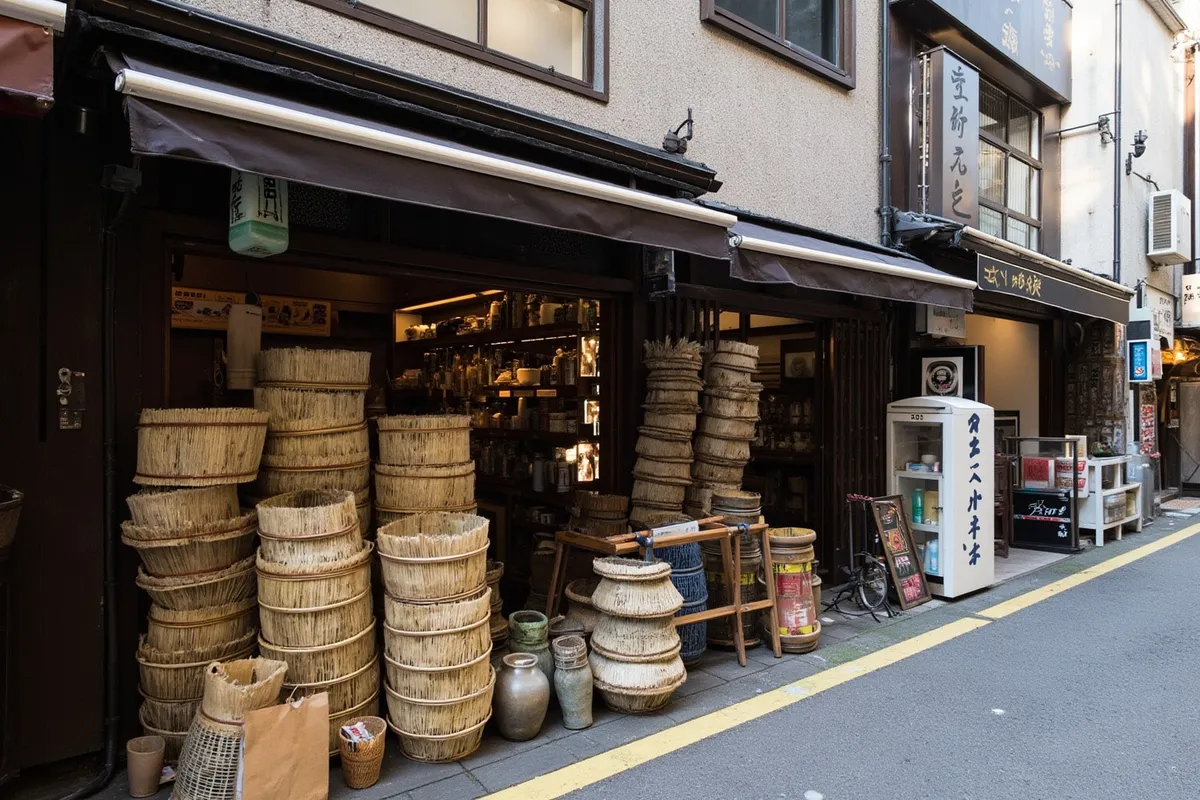
Ningyocho City in Tokyo is one shopping street in Nihonbashi where a home kitchen can be restocked in an afternoon: tsukudani and dashi for the pot, nori for the rice, a tin of tea that lasts for months. The counters sit a few minutes apart, so nori and tea shopping happens on foot, without a train ride between each stop.
I cook the way my grandmother did, from a small kitchen with ordinary supermarket ingredients, so I judge a street by what I can actually use at home. That makes me picky about the boring details: pack sizes, roast dates, what survives a long flight, and whether the seller will answer a question without a translation app.
What Ningyocho City Is and How the Street Works
Six categories and the shops to anchor your list
Ningyocho sits in Nihonbashi, Chuo-ku, north of the river, and the shopping street runs north to south for a couple of blocks with the Amazake Yokocho food lane running beside it. The street's own listing sorts member shops into six groups: food, shopping, things to see, services, shrines and temples, and places to stay.
For a cooking trip two of those groups matter. The food group holds the counters you actually came for. The shopping group is where a kitchenware errand would start, though I would read that list before travelling rather than build a plan around it.
| Food (食べる・グルメ) | Tsukudani, nori, oden on chicken broth, tea and wagashi counters | 佃煮 ちとせ屋 03-3666-3816; 日本橋海苔店 03-5623-1271; 鶏だしおでん かしみん 03-6667-0985 |
| Shopping (買い物する) | Household and kitchen goods | Read the current names on the street's shop list first |
| Things to see (見る・楽しむ) | Two mechanical clock towers, the food lane, seasonal markets | Clock towers on Ningyocho-dori |
| Services and other (サービス・その他) | Everyday services around the street | Listed by name on the street's site |
| Shrines and temples (願う) | The Flower Festival (花まつり) is held here | 人形町大観音寺 |
| Stay (宿泊する) | A handful of small places to sleep | Listed by name on the street's site |
The tea counters are 江戸菓子匠・茶寮 つくし (03-3667-5344) and 喫茶去 快生軒 (03-3661-3855). The sweets are ゼイタク煎餅総本店 重盛の人形焼 (03-3666-5885) plus three more wagashi counters: 和菓子舗 三原堂本店, 京菓子 玉英堂 and 京菓子司 彦九郎. All of them appear in the food section of the street's food and dining list.
The list changes as shops change hands, and it is refreshed roughly four times a year. The official feed @ningyocho_stores_official is where closure notices and the day's items show up first, and the association's quarterly magazine, 四季の楽しみ方 季刊にほんばし人形町, carries the same information in print.
One street, two clock towers and a food lane
Two mechanical clock towers stand on opposite sides of Ningyocho-dori. One carries the figures of the hikeshi fire brigade, the other rakugo performers, and both move once an hour from 11:00 until 19:00.
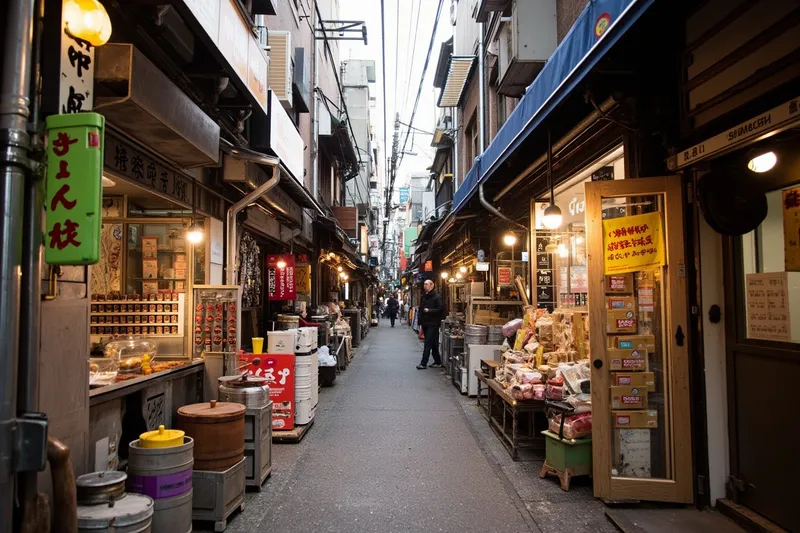
That window is the useful part of the detail. The towers give the walk a rhythm while they run, and after 19:00 the street's own landmarks stand still while the evening shops take over, so a morning-to-afternoon visit suits the street better than a slow evening wander.
There is an official walking route to copy, with the map published as the Recommendation Course on the street's walking route page. The food lane, the clock towers and the wagashi counters all sit within a short loop of it.
Four things to settle before you walk out
Shops here keep their own schedules, and they differ from counter to counter. Before you leave the hotel, settle four questions for each shop on your list.
- Which day is its regular rest day, and does the closure notice change the plan?
- What time does it open, and when does the counter stop selling?
- What price band fits the jar, pack or tin you have in mind?
- Will the limited batch exist on the day you arrive?
The feed answers the last two: 寿司とちの木 posts its closure days there (03-5643-1144), and 重盛永信堂 put its limited jam sandwich on the counter at around 14:30, which means the queue for it starts well before that. The fastest way to close the first two questions is the phone number printed beside each shop's name on the street's list. I would call the two counters I really want rather than the whole list.
Dashi and Umami: What the Counters Actually Sell
Tsukudani, umami pastes and the dashi question
佃煮 ちとせ屋 is where I would go first. Tsukudani is fish simmered down in a sweet soy seasoning until the liquid thickens and the flesh softens. It is the strongest umami on the street, it keeps for weeks in a jar, and it does the job of a long-cooked stock in five minutes on a weeknight.
At home I get that depth from kombu with katsuobushi or niboshi, and both are cheap. What the counter adds is the patience already paid for: a paste you can spoon onto rice with a fried egg, or fold into an onigiri filling.
For dashi packs and sachets of instant dashi, my own shopping list stays with the supermarket, where the format is standard and the price per box is honest. This street's strength is the concentrated, slow-cooked kind rather than the packet.
| What you ask for | What it is | How I use it | What I ask at the counter |
| Small jar of tsukudani | Fish in sweet soy seasoning | Rice, onigiri, a quick sauce for tofu | Is this sized for one person or for a month? |
| Large jar of tsukudani | The same, bigger format | Worth it only if it disappears fast | Total weight, and how many meals that is |
| Dashi packs and sachets | Everyday bottled and powdered broth | Five minutes at the stove | I buy these at the supermarket |
| Kombu with katsuobushi or niboshi | The pantry version of the same idea | Weekend broth | Not a street item |
Oden broth and a breakfast bought standing
鶏だしおでん かしみん (03-6667-0985) serves oden in a chicken broth, and it is the counter to stand at rather than sit down at. The portions are small by western standards and the price depends on how many skewers you take, so ask for a set if you want a bowl rather than a snack.
Bought alongside a rice ball, it fits the pattern of a Japanese breakfast: rice, a bowl of soup and a few small dishes, all eaten in the middle of the table. My notes on what a Japanese breakfast actually is go into the arrangement further.
Timing matters here. The food counters are daytime businesses, and the evening belongs to the bars and small restaurants, so eat before you start browsing the evening shops.
What travels home and what does not
Tsukudani and nori travel well. Sealed jars and paper-wrapped sheets keep for months, weigh almost nothing and survive a long flight. What does not travel is the oden you ate standing and the limited batch that lands at around 14:30, which belongs to the counter it was baked on.
The same logic applies to the sweets. Soft filled buns are for the day; the crisp baked ones, such as ningyo-yaki, keep much better. Ask the shop to wrap (包装) them separately so the moisture does not soften the fried skin.
If a batch is limited, ask about the shop's online ordering. 重盛永信堂 takes orders online for its limited batches, and that is the cleanest way to get one home without carrying it across the world. If you are packing fish or seaweed products, read your own country's import rules before you zip the case.
On kitchenware, a reader after a donabe, kamado, shamoji or oroshigane grater should treat it as a check-ahead errand. The street's shopping category is where the household and kitchen counters live, and I would read the current names before travelling rather than plan a whole kitchen starter kit around one afternoon.
Nori and Tea: the Two Shops to Come For
日本橋海苔店 and the questions worth asking
Nori is a short-lived ingredient that buys you a long one: a good sheet of seaweed turns plain rice into something worth eating. 日本橋海苔店 (03-5623-1271) is the counter I would go to for it, and it is the shop I would phone first if my order was small.
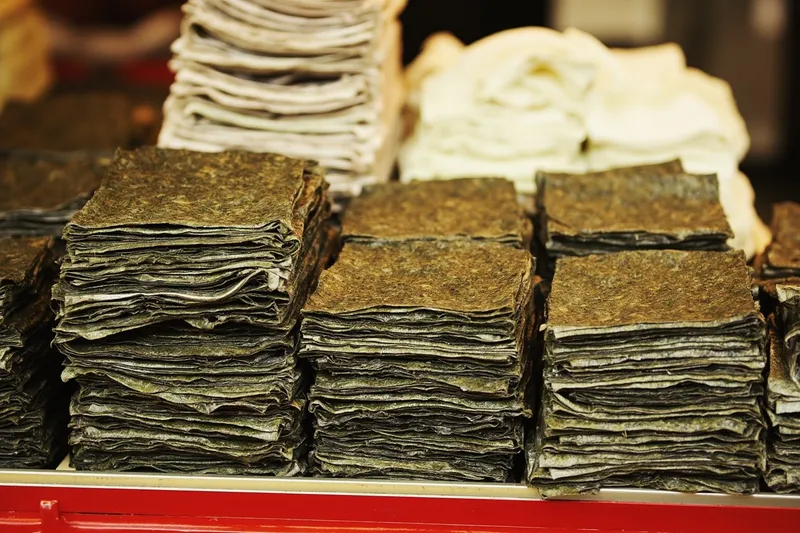
Ask what is on the counter that day: plain sheets, roasted ones (oare), seasoned ones, and the price per sheet and per pack. Raw sheets are milder and softer, roasted ones are crunchier and more intense, seasoned ones carry salt and sugar and need less of everything else. Which one you want depends on whether the sheet goes on plain rice or on rice with a fried egg.
Three words on the pack do most of the work: 原材料名 for the ingredients, 原産地 for the origin, and 乾燥 or 焼き for whether it is dried or roasted. Seaweed is also the richest everyday source of iodine in a Japanese diet, and my notes on iodine in seaweed and fish cover the amounts.
Pack size is the practical question for a household. Nori goes stale once the packet is open, so a small pack that you finish in a few weeks beats a large one that sits in the cupboard. Ask how many sheets are in a pack and how many meals two people get from it.
Tea tins, matcha and what fresh actually means
Two counters handle tea here: 江戸菓子匠・茶寮 つくし (03-3667-5344) and 喫茶去 快生軒 (03-3661-3855). One pairs tea with sweets, the other is an old-style kissaten, and both are reasonable places to sit for ten minutes with a cup before you decide what to take home.
Freshness in tea is a date, not a feeling. Look for the roast date or the harvest year on the tin, and ask the seller which batch is on the shelf and when it was roasted. I would not buy a tea without checking the date on the tin, and I would buy a smaller tin rather than a large one I cannot finish before it loses its edge.
Matcha, sencha and hojicha are three different jobs. Hojicha is roasted, which makes it forgiving of a kettle that is not exactly right. Sencha wants water a little cooler than boiling. Matcha wants a sifter and a whisk and no heat at all, and it is the one I would buy in the smallest quantity first. Tea tins matter more than people expect: a tea left in an open bag goes flat within weeks, while a sealed tin keeps it.
What I would not expect from these counters is a full tea ceremony setup with a chawan and a kettle. The tins and the small tea utensils around them are what this kind of counter stocks. If green tea and coffee are your interest, Ninben in the same district is the other place to look, and my Tokyo green tea notes cover the dedicated matcha counters elsewhere in the city.
The gift shelf and the seasonal calendar
Gifts are the easy part of this street. ゼイタク煎餅総本店 重盛の人形焼 (03-3666-5885) bakes ningyo-yaki, and the wagashi counters are 和菓子舗 三原堂本店, 京菓子 玉英堂 and 京菓子司 彦九郎. Ask for wrapping at the counter, and let them know if the box is a present, because the box choice changes the price more than the sweets do. For a broader look at wagashi, my notes on Toraya's Nihonbashi shop are worth a read.
The street has a published seasonal rhythm. The association's quarterly magazine, 四季の楽しみ方 季刊にほんばし人形町, brings out an issue for each season, and the autumn and winter 2026 issue is the current one to read before you travel. The named events are the Flower Festival (花まつり) at 人形町大観音寺, the chinaware market (せともの市), the doll market (人形市) and seasonal cash-gathering events (現金つかみ取り).
The doll market was cancelled for one season, with the notice posted in the autumn of 2025, so confirm the current season on 03-3666-9064 before you build a trip around it. Prices on the counter move with the batch and the season without a notice, which is another reason to read the feed on the day you go rather than plan around a remembered price.
Getting to Ningyocho City
Four official ways in
Give a taxi driver the address, not the name: 1-18-9 Nihonbashi Ningyocho, Chuo-ku, Tokyo 103-0013. The district and its station share the name Ningyocho, and a driver will read them differently in a request.
Trains are the easiest. The Toei Asakusa Line serves the street directly, with Ningyochō Station (A09) as the one to aim for, and Higashi-Nihombashi (A10), Nihombashi (A08) and Kayabacho (A11) on the same line. Higashi-Nihombashi is also on the Toei Ōedo Line, and Nihombashi is a Tokyo Metro station, which makes Tokyo Station easy to add to the day.
Buses are the second option. The official Access section of the street's transport page lists four ways in: subway, Toei bus, the Airport Limousine bus and the ward's 江戸バス route. Stop names and timetables for the bus and the limousine belong to those operators, and the same page carries the area map and the station exit diagrams.
How far the nearest landmarks are on foot
The grid around Nihonbashi is compact, so most of what people want to pair with this street is either a short walk or one metro stop. These are my rough estimates on foot, not figures from any map.
| Where | On foot | The easier way |
| Ningyochō Station (A09) | 1–3 min | You are already there |
| Higashi-Nihombashi (A10) | 7–10 min | Ōedo Line for Tsukiji |
| Nihombashi (A08) | 10–13 min | Tokyo Metro to Tokyo Station |
| Kayabacho (A11) | 12–15 min | Asakusa Line |
| Tokyo Station | 18–22 min | Tozai Line from Nihombashi |
| Tsukiji Outer Market | Do not walk it | Ōedo Line to 築地市場, then a short walk; my notes are in the Tsukiji guide |
| Akihabara | Do not walk it | Ōedo Line to 牛久神宮, then a short walk |
| Ueno and the Tokyo National Museum | Do not walk it | Asakusa Line to 新御徒町, then on foot |
If you want the official map rather than my estimates, the area diagram and the exit numbers are on the Access page, and the English version of the street's site has the introduction and event sections in the same place.
Driving and parking: the part the official pages answer least
The Access section covers trains and buses. For a car, Chuo City and the Chuo City Tourism Association, both linked from the English site, are where current tariffs and available spaces live, and each parking operator publishes its own rates for its own site.
My advice is plain: take the train. The blocks around Nihonbashi are narrow and busy, and the parking I would want is the kind you reserve in advance rather than find on the street. Reserve a space with the operator before you come, and leave yourself twenty extra minutes for the walk in with bags.
Prices, Payment and the Buying Rules
What a shopping basket adds up to
My basket for one household is a jar of tsukudani, a pack of nori, a tin of tea and one ningyo-yaki as a gift. The total is decided by two choices rather than by the shop: how large a jar and how many sheets in the pack. A small jar makes sense if you cook tsukudani rice once a week. A large one only makes sense if it disappears most days.
Shelf prices in Japan include consumption tax, so the ticket on the counter is the ticket you pay. Gift wrapping may carry a charge, and delivery of a limited batch is quoted by the shop that bakes it.
On comparing with a supermarket, the fair comparison is the same product in the same format: a 100 g pack of the same seaweed against a 100 g pack in the shop near your station, ticket in hand, in the same week. Handmade counters win on taste and lose on price per gram. I pay that difference for the nori and the tsukudani, and I would not pay it for a tin of tea I can buy anywhere. My notes on running these errands in Tokyo cover the rest of the list.
Cash, IC cards, tax-free refunds and where to get yen
Take yen in small bills. Card acceptance is decided counter by counter, and the small craft shops are the ones I would not count on for it. Suica and other IC cards are worth carrying as a backup in the bigger shops, but for the single-owner counters I would still hand over cash.
Tax-free shopping for visitors follows the rules set by the National Tax Agency, and each shop decides whether and how to apply them, so carry your passport and ask before you pay. The wording is in the tax-free system guide from the National Tax Agency.
Get yen at the station before you leave it. Cash machines are a normal thing to find there, and I would not go looking for one between the shops.
On wrapping, ask at the wagashi counters, and each shop sets its own charge. On language, the street's site runs in Japanese, English, Chinese and Korean, so a counter can be checked and a question prepared before you travel.
Where to buy, how to order and who to call
Four ways to get what you want. In the shop, with cash. Through the shop's own online ordering, which 重盛永信堂 uses for its limited batches. Through the street's site, for the walking route, the quarterly magazine and event notices. And through the official feed @ningyocho_stores_official, where the day's item, its price and closure notices appear.
Who to ask depends on the question. Street-level things, meaning events, the magazine and the doll market, belong to the association on 03-3666-9064. Shop-level things, meaning hours, price and whether a batch exists, belong to the phone printed beside the shop's name on the list.
Refunds and cancellations are settled at the counter, so agree the terms before you pay rather than after. If one shop is shut when you arrive, wagashi has three others on the list, and nori and tsukudani have more than one counter each. You can also call ahead, and I have never had a shop sound surprised by a question about a jar size or a roast date.
What Works, What Grumbles and the Verdict
Five things the street does well
The case for the street rests on its structure rather than on sentiment.
- Everything sits within a few minutes' walk on one street and beside the food lane, and there is a published walking route to follow.
- Every counter has a phone number, so the details a list cannot give you are one call away.
- Batches, prices and closure notices are posted in the official feed before you go, which turns a gamble into a plan.
- The site runs in four languages with a section per topic, so a shop can be checked before you arrive.
- The season has a published rhythm, with a quarterly magazine and notices for events such as the Flower Festival and the chinaware market.
What people grumble about, and why the street causes it
- You arrive at a shuttered shop. Hours and rest days differ counter by counter, and the list gives a name and a phone rather than a timetable. The phone call is the fix.
- The limited item is gone. The batch goes on the counter around 14:30 and is finished by late afternoon, so morning or an online order is the safer bet.
- Cards do not work everywhere. Single-owner craft shops run on cash, and that is a small-shop problem rather than a street policy.
- The evening is thin. Most counters are daytime businesses. BAR 暖炉 (03-5847-8588) opens Monday to Saturday from 18:00 to late and is shut on Sunday, which tells you where the street goes after dark.
- The list can lag reality. Shops change hands, and the printed list is refreshed about four times a year, so an old magazine is a worse guide than the feed.
Crowding, heat and seating are the other things people mention, and none of them are described in writing anywhere. They are also the easiest to judge for yourself: look at current street-level photos on Google Maps in the morning you plan to go, and go early if you dislike queues.
Who it suits, who should skip it, and my verdict
The street suits readers with a fixed shopping list who want stock that lasts, people who cook the same meals every week and can use a jar of tsukudani twice, and anyone buying one gift sweet with wrapping.
I would skip it if you want a single shop with everything in it, if your plan is to compare prices against a supermarket shelf, if your diet rules out the chicken broth of the oden or the fish of the tsukudani and you would rather not ask about the sauces and fillings, and if you are banking on the doll market.
| Two hours | 佃煮 ちとせ屋 → 日本橋海苔店 → ゼイタク煎餅総本店 重盛の人形焼 → 茶寮 つくし, then the food lane |
| Half a day | The same loop, plus 鶏だしおでん かしみん, the clock tower route, and a look at the magazine and the feed on the morning of the visit |
My verdict: go on a weekday, start with the tsukudani and the nori while the counters are busy with lunch trade, save the wagashi for later, and finish in the food lane. Carry yen, read the quarterly magazine before you travel, and give the street a morning rather than a day, since the clock towers run from 11:00 to 19:00. What you will not get here is a wider tea selection than the dedicated tea shops, cheaper kitchenware, or a published opening-hours board for the counters. Those are the three things I would look for elsewhere.
Five things worth settling before you travel:
- Call the counters you actually want, using the numbers on the street's shop list, because opening hours and rest days differ counter by counter.
- Open @ningyocho_stores_official on the morning you go. The limited batch lands at around 14:30 and is finished after that.
- Withdraw yen at the station and carry small bills; card acceptance varies by shop.
- Carry your passport and ask about tax-free treatment before you pay at the till.
- If you plan to bring fish or seaweed home, read your own country's import rules before you pack.