
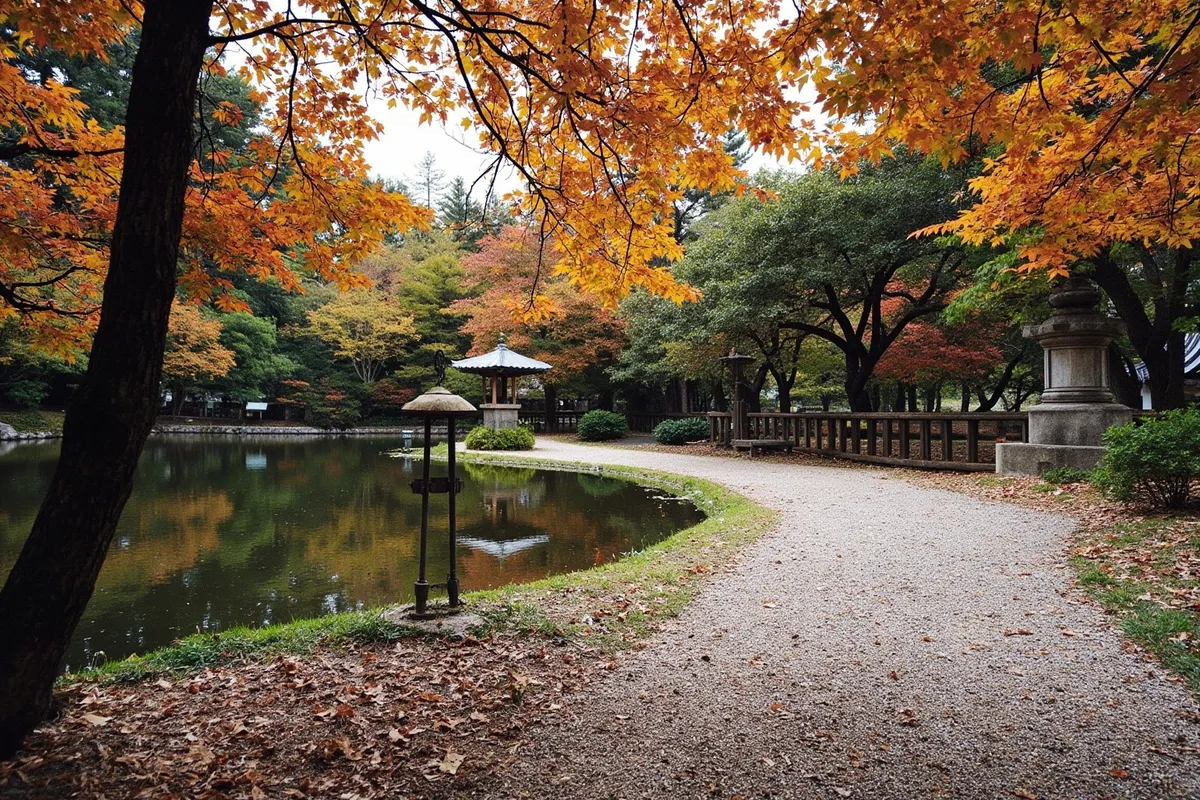
Rikugien Garden is a compact Edo period garden in Bunkyo ward, seven minutes on foot from Komagome Station, and it drops straight into a Tokyo garden walk: a ¥300 ticket, a loop around a pond, tea at the end. The catch is the clock. It opens at 9:00 and shuts at 17:00, last entry 16:30, so 'post-meal' here means after lunch or after an early dinner. Walk in around 16:00, be out by 16:45.
As for quiet: the garden is small with a single main entrance, so everyone passes the same gate and the same teahouse corner, and any queue forms there. Busyness moves with the season and the hour. Public since 16 October 1938 and designated in 1953 a site of exceptional beauty and an important cultural asset, it earns the detour. I would eat first in Komagome or Sugamo and treat the walk as the second half of the meal.
Why a post-meal walk fits this garden, and the one timing caveat
What a post-meal walk is actually for
A Tokyo garden walk has one job: get moving after a meal without turning it into training. Walking after meals is the common version, and post-meal walking Tokyo works best at an easy pace, with moderate-intensity walking the band most energy-expenditure charts use. Half an hour of that burns on the order of 150–200 kcal for a 60–70 kg adult, a rough orientation rather than a prescription. The food-side version of the same idea is hara hachi bu, eating to eight-tenths full, which I have covered in more detail before.
What you actually get at Rikugien:
- 45–60 minutes on a central pond circuit; the whole path network takes about an hour.
- Easy walking on gravel and a few slopes around the artificial hills, flat enough to keep talking.
- ¥300 for the entrance, the only fixed cost of the walk. The meal is what you spend.
- Miniature landscapes of 88 famous poems, a large central pond, tea at Fukiage Chaya on the north-west shore.
One caveat before you plan an evening: the garden closes at 17:00, so the realistic versions are a post-lunch walk, an early dinner with a 16:00 entry, or the paid autumn night viewing. A 19:00 stroll here does not happen on ordinary days.
What kind of garden this actually is
The garden was made in 1702, the fifteenth year of the Genroku period, by Yanagisawa Yoshiyasu, a trusted confidante of shogun Tokugawa Tsunayoshi. In the Meiji period it became a second residence of Iwasaki Yataro, founder of Mitsubishi. His family donated it to the City of Tokyo in 1938 and it opened to the public on 16 October that year; in 1953 it was designated a special site of exceptional beauty and an important cultural asset. It is run today by the Tokyo Metropolitan Park Association as a Special Scenic Park.
What you walk through is a large central pond ringed by artificial hills and forested areas, with miniature landscapes reproducing 88 scenes from famous poems: a classic Edo-period strolling garden, 87,809.41 m² of it, a shade under nine hectares. The name comes from the system of dividing Chinese poetry into six categories, and it is read 'riku', not 'roku'.
The shape of a 45–60 minute visit
There is no map worth studying. The shape is simple: in through the main gate, around the central pond, past Fukiage Chaya on the north-west shore where the teahouse sits, and out. The full network of paths takes about an hour at a leisurely pace, so most people do the pond loop and stop. A tighter cut of the same loop takes about 25 minutes.
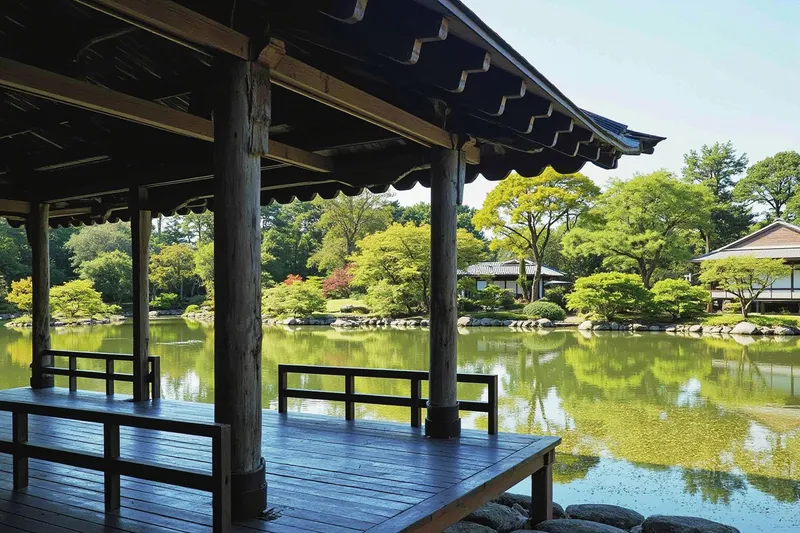
That is the shape that suits a walk after a meal: short, mostly level, and it ends at a teahouse instead of at a gate you have to hurry back to. If you are still hungry afterwards, Fukiage Chaya is the obvious place to sit down.
Getting to Rikugien Garden: address, trains and parking
Address and the official pages
The address is 6-16-3 Hon-komagome, Bunkyo-ku, Tokyo 113-0021. Rikugien is one of the Tokyo Metropolitan Park Association's Special Scenic Parks, and two pages are worth bookmarking: its official English site and the Japanese page, which carries access detail in more depth. The garden office answers on +81-3-3941-2222, service centre hours 9:00 to 17:00, and that number settles anything vague faster than a search.
The two stations that matter
Komagome Station is 7 minutes on foot away, on the JR Yamanote Line and the Tokyo Metro Namboku Line. Sengoku Station, on the Toei Mita Line, is 10 minutes away. The Yamanote brings you in from Ikebukuro or Shinagawa, Namboku drops you underground from central Tokyo, and the Mita line is the approach from the south side.
Usefully, the two stations sit on opposite sides of the garden, so pick the one on the same side as your meal. Getting here is also unremarkable in the best way: tap in with a Suica or PASMO card as you would anywhere in Tokyo.
Driving, parking and taxis
By car, budget for a coin-operated car park around Komagome or Sengoku rather than expecting a space at the gate, and check the Japanese access page before you drive over. A taxi from Ikebukuro is the fallback when you are meeting people at the far end: a rough ride rather than a cheap one, and I would not quote a fare from memory.
None of that really matters, because two stations within 7 and 10 minutes on foot put you close enough to walk in whatever the weather is doing.
Opening hours, tickets and what your money buys
Hours, last entry and the seasonal calendar
Open 9:00 to 17:00, last entry 16:30, and closed from 29 December to 1 January for the year-end holidays. The garden runs on a seasonal programme rather than a fixed calendar: spring brings ume plum blossom (Prunus × yedoensis), wisteria and rhododendron, plus illuminated cherry blossoms; autumn brings lespedeza, Camellia sasanqua and the autumn leaf illumination; winter puts snow ropes on the pines. Colour usually peaks from late November to early December.
Keep the evening programme separate in your head: it is a separately ticketed event with its own dates and prices, and the autumn night viewing below is the edition with confirmed dates for this year.
What admission costs
Rikugien Gardens charges ¥300 for adults and ¥150 for visitors aged 65 and over, and the full rates sit on the garden's admission page. Primary-school children and younger come in free, as do junior-high students who live in Tokyo or attend a school in the city. A teenager aged 13 to 15 who lives and studies outside Tokyo pays the full adult fee, and groups of 20 or more get 20% off the entrance fee.
| Visitor | Daytime admission |
|---|---|
| Adults | ¥300 |
| Adults aged 65 and over | ¥150 |
| Primary-school children and younger | Free |
| Junior-high students living in Tokyo or attending a school in Tokyo | Free |
| Junior-high students aged 13–15 living and studying outside Tokyo | ¥300 |
| Groups of 20 or more | 20% off the entrance fee – ¥300 × 0.8 = ¥240 per adult |
| Two adults | ¥600 total |
Two adults pay ¥600 between them. The published rates do not cover every age band, so if your child falls outside the lines above, ring the office on +81-3-3941-2222. In dollars, ¥300 is about US$2 at roughly ¥150 to the dollar, so check the rate on the day rather than assuming it.
How to pay and what you can book
Daytime entry is a walk-up ticket bought at the gate. There is no online booking and no reservation for the garden itself. Carry yen anyway: the ticket window for the night viewing sells cash only, and some of the shops inside do not take cashless payment.
The one daytime thing worth arranging ahead is a private tea ceremony room. For the night viewing, tickets go through Asoview online, with a limited number per session, so a group should book together rather than one at a time. Live status, ticket availability and event changes come on the garden's X account, @RikugienGarden.
The autumn night viewing: a separate ticket and separate rules
Dates, hours and prices
The Special Nighttime Viewing in Autumn runs each year in late November and early December; the 2026 dates are 25 November to 6 December, 18:00 to 20:30, with last entry at 19:30. It is the one evening walking option at Rikugien, and the details are all on the night viewing page.
| Ticket | Price | How to buy |
|---|---|---|
| Advance | ¥1,000 | Online from 9:00 on 1 November 2026 until 23:59 the day before your visit |
| Same day | ¥1,200 | Online from 9:00 on the day until 19:30, or cash at the window 18:00–19:30 |
| Japanese-issued disability card holders | ¥500 for themselves and one attendant | – |
| Primary-school children and younger | Free | – |
The night ticket is the ticket. No separate daytime entrance fee is charged on top of it, so you are not paying ¥300 as well.
Mind the break in the middle: the garden closes at 17:00 and reopens at 18:00 for night visitors only. You cannot stay in from the afternoon into the night session. Entry is through the main gate only, and you leave by the main gate or the Someimon gate.
Food and drink after dark
During the night session the garden puts out a matcha-and-wagashi counter at Fukiage Chaya and at Shinsen-tei, a Rikugien food stall serving dango, food trucks from shops in the Bunkyo shopping district, and a souvenir stand. Last food orders go in at 20:00. Do that arithmetic before you commit: last entry is 19:30, so a late arrival has about half an hour for food rather than the full two hours.
On an ordinary day none of this exists. There is no restaurant inside Rikugien, only teahouses and the rentable tea ceremony room, so an ordinary post-meal walk starts with a proper meal around Komagome or Sugamo.
Booking, cash and what you cannot do at night
Tickets go through Asoview, which runs Japanese and multilingual ticket pages, with a limited number per session. Buy a group in one go. Advance tickets can be self-cancelled until 23:59 the day before your visit, and they are refunded in full if the event is called off for weather. Same-day tickets can be neither cancelled nor refunded, and they are sold for cash at the window between 18:00 and 19:30, so bring yen.
Night-specific rules: some paths inside the garden are closed after dark, and entry runs through the main gate only. The everyday house rules apply at night too, and they are set out further down.
Tea rooms, teahouses and eating around Rikugien Garden
Renting the tea ceremony rooms
Four rooms inside the garden can be booked, and the pricing works per room or per pair of rooms, not per person. The Gishun-tei tea ceremony room is the one worth ringing ahead about: ¥7,400 for a booking of up to five people, arranged through the garden office on +81-3-3941-2222. For a group rather than a ceremony, the other rooms cost less per head.
| Room | Fee | Capacity |
|---|---|---|
| Shin sentei 'All rooms' | ¥4,800 | up to 25 people |
| Matsu-no-ma and Tsutsuji-no-ma | ¥3,600 for the two rooms together | up to 17 people |
| Momiji-no-ma | ¥1,200 | up to 8 people |
| Gishun-tei tea ceremony room | ¥7,400 per booking | up to 5 people |
Booking runs through the office, and it is the only daytime item here that needs arranging before you arrive. Everything else you can decide on the spot.
Eating before and after the walk
The workable order is eat, walk, tea. Komagome and Sugamo are both within easy reach on foot, and Sugamo Jizo-dori gives you soba and tonkatsu within a few minutes of the station. My Tokyo comfort food counters guide covers the tonkatsu counters in more detail if you want a heavier meal before a long walk. Then the pond, then matcha and a sweet at Fukiage Chaya on the north-west shore.
What you cannot do is eat a restaurant meal in the garden: on an ordinary day there is no restaurant inside, only teahouses and the rentable tea ceremony room. The fixed cost of the walk itself is the ¥300 adult entry, and everything else is what you spend on the meal.
Extending the walk to Kyu-Furukawa Gardens
Kyu-Furukawa Gardens, run by the same association, sits 15 minutes on foot from Komagome Station, which makes the two a natural pairing for one outing. Since Rikugien is 7 minutes from that same station, a loop means coming back through Komagome either way.
Time it honestly: the full Rikugien path network alone takes about an hour, so both gardens plus the walking between them is roughly two hours. The second garden charges its own admission on top of the ¥300, so check the current rate on Kyu-Furukawa's own page and add it to the budget.
Real visitor experience, comfort and house rules
What to check yourself before you go
I do not take crowd talk on trust, mine or anyone else's. The useful version is a short checklist of what to look at yourself in current visitor reviews on Google Maps and Tripadvisor, and the comments worth reading are the ones with photographs of the gate and the pond at the hour you plan to go.
What to look for: how many people are around the central pond and the teahouse at the peak; whether the ticket window queues, and for how long; whether the pond paths are gravel and steps or smooth paving; how busy the maple tunnel gets in autumn. The one channel that is genuinely live is the garden's own account on X, @RikugienGarden, where ticket availability and event changes get posted.
House rules that decide whether a visit works for you
Some rules settle your visit before you arrive. Rikugien is a no-smoking site with no smoking area, so you cannot smoke even outside the gate. Pets are not admitted, not even in a carrier. Recreation and picnic sheets are discouraged, which rules out spreading out a blanket with a bento box. Commercial and unpermitted model photography is refused.
Access is worth checking too: some routes are not accessible to wheelchairs or strollers, with a detour available, so if that matters, ring the office on +81-3-3941-2222 first. The same number answers the odd ones, including umbrellas, bicycles, tripods, whether you may bring your own food, and whether you can go back in after leaving the gate.
Comfort, noise and movement
Surfaces matter more here than they sound: gravel on the pond paths and some slopes around the artificial hills, so shoes with grip are worth more than flat, thin soles. The layout explains the rest. There is one main entrance, so arrivals bunch at the gate and then at the teahouse end of the pond, which is where a 45–60 minute walk spends most of its time anyway. Weekday mornings are the calmest bet, weekends at peak colour the worst case, and a queue at the gate is the one thing that can spoil the mood.
Who should walk Rikugien Garden, and who should skip it
Who it suits
It suits readers who want a low-cost, low-stress walk within about ten minutes of a station, who can manage gravel and a pond loop, and who would rather finish with tea than a restaurant dinner. If you are planning around a meal in Komagome or Sugamo, the timings line up well. Deciding factors: ¥300 for an adult, free entry for primary-school children and younger and for Tokyo junior-high students, and a 45–60 minute core circuit.
One constraint, not hidden: this is a post-lunch or early-dinner walk. The garden closes at 17:00, so as an Edo period garden it is an afternoon destination rather than an after-dinner one. The only exception is the paid autumn night session.
Who should skip it, and what to walk instead
Skip it if you want a restaurant on the site, a route that is fully step-free for a wheelchair or a pushchair, a free flat riverside path, or a late-night stroll. The night viewing is a separate ¥1,000–1,200 ticketed event with its own gates and its own closing time, not an extension of the daytime ticket.
Alternatives, and when I would pick them:
- Shinjuku Gyo-en – wide open lawns, an on-site restaurant and easy access for pushchairs; it charges its own admission and is run by a different organisation, so it is a different kind of day out.
- Hama-rikyu Gardens – flat, close to a big transport hub, with restaurants on site; the better pick when the walk has to be short and the meal matters more.
- Koishikawa Korakuen and Kiyosumi Gardens – ponds, ravines and formal garden terrain with slopes; photographers like them, pushchairs do not.
- Chidorigafuchi Moat Park – free, flat, right by a station, the closest match to a genuine after-dinner walk, though it fills up with couples during cherry season.
The plan I would follow
Post-meal walking Tokyo works fine here as long as the meal happens early. Eat in Komagome or Sugamo, walk in at 16:00, do the central pond circuit, take ten minutes at Fukiage Chaya, and be out by 16:45 for a 17:00 dinner. Budget ¥300 per adult plus the meal, and bring yen rather than assuming cards will work. I would skip the night session unless the autumn leaves are the reason you came, and if you do book it, remember that the advance ticket is refunded in full if the event is called off for weather while a same-day ticket is not.
The thing that makes the detour worth it: the layout still works the way it did in the Genroku period, and it has been protected as a site of exceptional beauty and an important cultural asset since 1953. That combination, at ¥300 and ten minutes from a train, is hard to argue with.
What to check before you go
- Parking: check the Japanese access page of the garden, or call +81-3-3941-2222, before setting out by car.
- Crowds and queues: read recent visitor reviews for the season you are going in, and check @RikugienGarden on the day.
- Kyu-Furukawa's admission, if you plan the two-garden loop: add a second ticket to the budget and check the current rate on its own page.
- Weather: the same X account carries changes to the night programme, and a night event called off for weather means a full refund on advance tickets.
- Umbrellas, bicycles, tripods, your own food and re-entry: the garden office on +81-3-3941-2222 answers these.
Where do I buy the ticket?
Daytime entry is bought at the gate when you arrive, with no online booking or reservation. The autumn night viewing is sold online through Asoview, advance or same day.
Can I pay by card?
Bring yen. Same-day tickets for the night viewing are sold for cash at the window, and some shops inside the garden do not take cashless payment.
How long does the walk take?
About an hour for the whole network of paths, 45–60 minutes for the central pond circuit, and around 25 minutes for a short cut of the same loop.
Is there anywhere to eat inside the garden?
Not a restaurant on ordinary days, only teahouses and a tea ceremony room you can book. During the night viewing, matcha-and-wagashi counters, a dango stall and food trucks open inside.
What happens if it rains?
Check @RikugienGarden for the day's status. If the night viewing is cancelled for weather, advance tickets are refunded in full and same-day tickets are not.
Can I go back in after leaving the gate?
I would not assume a second entry is covered by the ticket. Ring the garden office on +81-3-3941-2222 before you step out.