
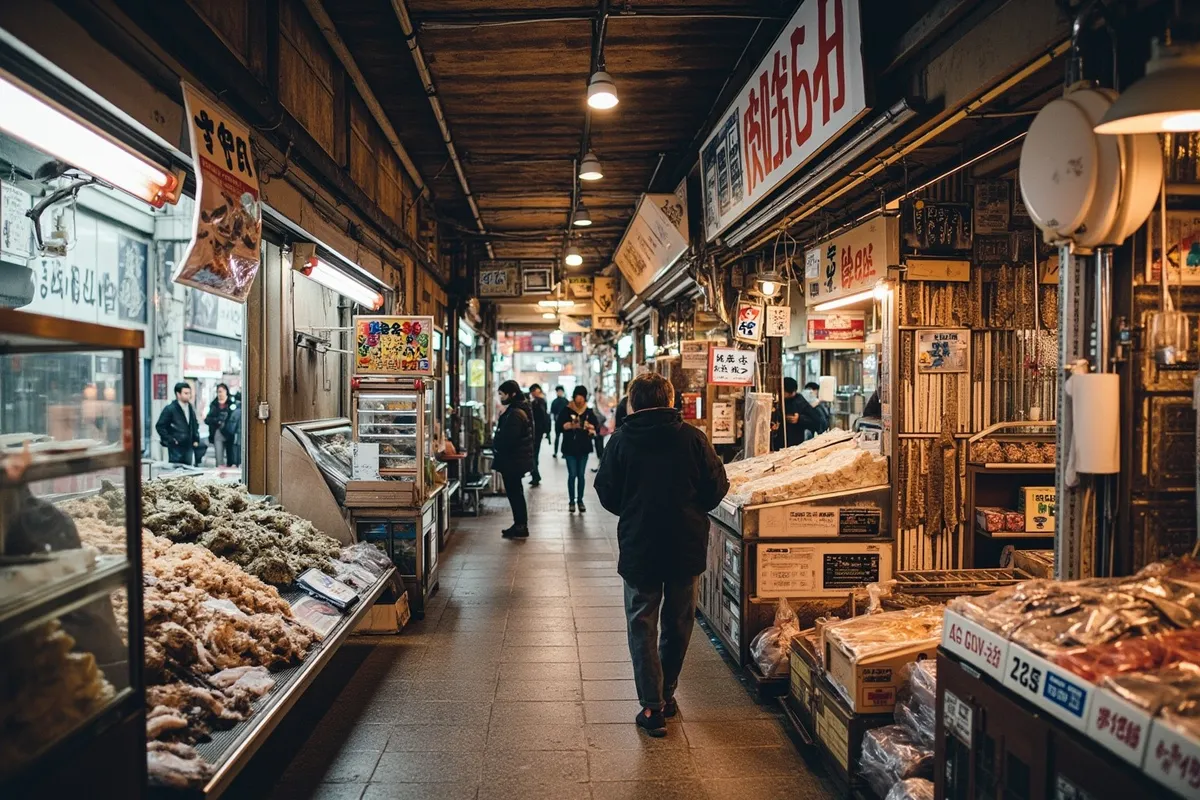
Kuromon Market is the covered arcade in Osaka where a whole tuna gets cut in front of you, uni and ikura come in a takeaway cup over sushi rice, and you can leave with three kinds of pickle for the week. It runs about 580 metres under one roof in Nippombashi, roughly 150 shops from end to end, and the trading here goes back to around 1822.
Everything is priced in yen at the counter and nothing is negotiable. The rest depends on timing: the best fish is on the block early, owner-run stalls sell out by early afternoon, and the counters nearest the entrance charge a premium for being the first ones you meet.
Kuromon Market: 150 shops under one roof in Osaka
What the arcade actually is
Kuromon Ichiba, the market's formal name, is one roofed lane about 580 metres long running south from Sennichimae. Along it are four kinds of trade: fresh seafood, vegetables and fruit, food and drink, and clothing. The fish end pulls the crowds. The pickle and dried-goods counters are the reason most people come back.
The trade began around 1822–1823, when merchants gathered at the black gates near the Enmyoji temple in Nippombashi to sell fish from Sakai and Kishu. Fire took it twice, the Great Namba Fire of 1912 and then the air raids, and it was rebuilt after the war. Chefs still buy their fish and produce here, which is why the place is called Osaka's kitchen, and wholesale trade runs alongside the retail counters.
Allow an hour or two if you plan to eat and shop; half an hour is enough to walk straight through. The Osaka Convention & Tourism Bureau listing has the address, the phone number and the shop count.
| At a glance | Detail |
|---|---|
| Address | 2-4-1 Nippombashi, Chuo-ku, Osaka |
| Phone | 06-6631-0007 |
| Arcade | one covered lane, about 580 m |
| Shops | about 150 |
| Trade | seafood, vegetables and fruit, food and drink, clothing |
| Footfall | about 18,000 on a weekday, up to 150,000 at year end |
| Trading here since | around 1822–1823 |
| Time needed | 1–2 hours with street food, about 30 minutes straight through |
Getting there: Nippombashi Station exit 10
Nippombashi Station exit 10 opens almost onto the arcade, on the Osaka Metro Sakaisuji Line. Sennichimae Station sits further along the same line at the southern end of the covered lane, so there is no long street to walk from the platform.
Namba Station is about a ten-minute walk east, which matters if you arrive with a suitcase. Parking and restaurants are both on site, so a car trip and a sit-down lunch are workable.
Out of the north end you are close to Dotonbori, Hozenji Yokocho, Shinsaibashi and Den Den Town, all within a short walk, so a market visit slots into a day in Namba without extra transport.
| From | How | Time |
|---|---|---|
| Nippombashi Station, exit 10 | Osaka Metro Sakaisuji Line | at the entrance |
| Sennichimae Station | same line, southern end of the arcade | a few minutes on foot |
| Namba Station | on foot | about 10 minutes |
| Dotonbori, Hozenji Yokocho, Shinsaibashi, Den Den Town | on foot | a few minutes |
| Parking | car | on site |
If you were looking for an Asakusa or Tokyo fish market
Searches for an Asakusa food market or a fresh fish market in Tokyo keep landing here, and Kuromon is in a different city: Nippombashi, Chuo-ku, Osaka. What you get instead of a Tokyo street market is a covered wholesale-retail arcade where tuna is cut in front of you, oysters are shucked at the counter, and you eat standing at about 150 counters.
If Tokyo is the real destination, the markets there are a separate trip, and I have written about Tsukiji Outer Market and its first bites for that version of the day.
What Kuromon does well is the shopping half of the equation: pickles, dried goods and a grocery run finished in one lane. Sake gets its own section below, because the answer there is more complicated.
How the arcade works: hours, crowds and the standing counters
One narrow lane, standing counters and the tray rule
The whole market is one lane, and it is narrow. Most food stalls have standing counters with a ledge rather than tables, so you eat shoulder to shoulder with the next person. The market has asked visitors not to eat while walking in the aisles, which is both a courtesy and a practical decision in a lane that fills up around noon.
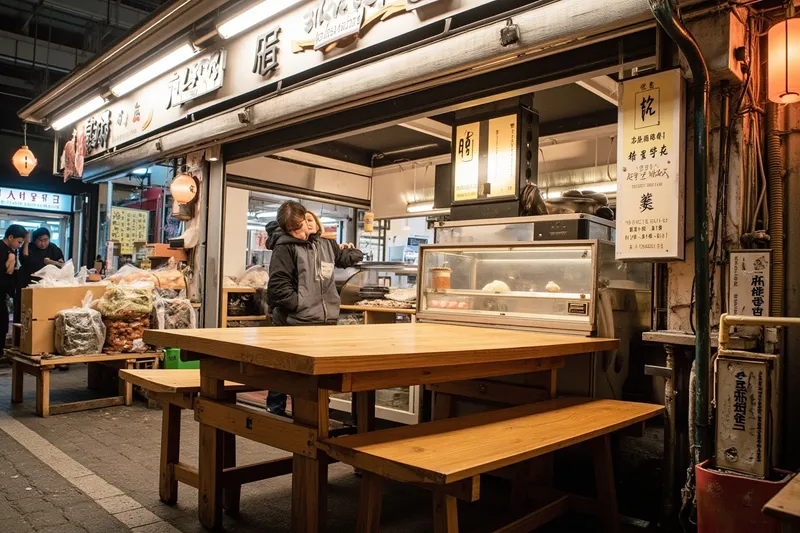
The routine that follows is simple: you eat at the counter, and trays and skewers go back to the stall when you finish.
For orientation, the Misono Building bar is a minute away, Marufuku Coffee three minutes, Takoume five and Chibo Dotonbori six, so a landmark is never far if you need to step out of the lane and get your bearings.
Shop hours change from stall to stall
There is no single opening time. Business hours and holidays vary from location to location, so each shop sets its own clock and its own closing day. A stall open last Tuesday can be shut on Friday.
In practice most stalls trade roughly 09:00–17:00 and many close earlier than that. The market is liveliest from about 08:00 to 18:00, with street-food stalls busiest from late morning into mid-afternoon. From around 16:00 stalls start selling out and closing, and many owner-run shops finish in the early afternoon, so the best selection is in the morning.
For a fixed weekday, the market's own shop list at kuromon.com/jp is the only calendar that matters: each entry gives the hours and the regular closing day for that store.
| Time | What is happening | Best move |
|---|---|---|
| Before 10:00 | Calmest, best selection | Buy fish and fruit first |
| Late morning | Street-food stalls at their busiest | Expect queues, keep to one side |
| Around noon | Central aisle shoulder-to-shoulder | Order, then step aside to eat |
| After 16:00 | Stalls selling out and closing | Go for pickles and dried goods |
How to pick a good counter and which ones to walk past
The most reliable sign of a stall worth your money is a queue of Japanese shoppers at ten in the morning. That line is the shop's own regulars, and it tells you more than any menu board.
The warning sign is a photo-menu board in five languages with a high price for a small portion. Near the main entrances you will also meet stalls that cater to visitors and charge a premium for grilled scallops, crab legs and beef skewers. The food is not bad, but you pay for the location rather than the product.
My rule: walk the first thirty metres past the entrance stalls, then start choosing. The fish and the pickles get better the further in you go.
Eating your way through Kuromon Market
The published seven-dish route, 10:15 to 11:30
The tasting route published on Osaka Tourism runs from about 10:15 to 11:30 and covers seven stops: tuna at Entoki Maguro, a fresh oyster with lemon, a wagyu skewer, a grilled scallop, uni and ikura over rice, a slice of melon and a small fruit pack to take away. The published price for the whole route is about ¥6,400. It is one fixed itinerary with named stalls, not a menu every visitor is charged.
The method matters more than the count. At the maguro specialists the tuna is cut to order, so you get sashimi cut in front of you rather than a tray of pre-sliced fish under a lamp. Oysters arrive shucked at the counter with a squeeze of lemon, and uni and ikura come over sushi rice in a takeaway cup.
Two things I would skip: seafood sitting pre-sliced under lamps, and anything already cooked under a heat lamp. Fugu is a separate question. What is served here has the poisonous parts removed under Osaka's rules, and the rule on who may prepare it sits in Osaka Prefecture's フグの処理に関する規則.
| Stop | What you get |
|---|---|
| Entoki Maguro | tuna cut to order |
| Oyster counter | a fresh oyster with lemon |
| Wagyu stall | a beef skewer |
| Scallop grill | a grilled scallop |
| Uni and ikura | sea urchin and salmon roe over sushi rice, in a takeaway cup |
| Melon counter | a slice of melon |
| Fruit stall | a small pack of fruit to take away |
| Total | seven stops, 10:15 to 11:30, about ¥6,400 |
What it costs at a counter versus at a table
Two numbers get mixed up. A street-food graze of two or three items typically runs ¥2,000–3,000, and a proper sit-down seafood meal inside the market runs ¥3,000–4,000, according to the Ask the City guide to Osaka.
Individual purchases run from about ¥300 to ¥4,000, per the OpenTravelGuide entry. That is per item, not a shopping budget, so a basket of four or five things goes past the top of the range.
Street food here costs noticeably more than the same dish in an ordinary restaurant a few minutes away. I would spend on what you cannot get elsewhere: tuna cut to order, an oyster, uni over rice, and skip the generic skewers. Six takoyaki balls cost ¥500–600, the cheapest satisfying thing to eat standing up.
| Item or spend | Typical amount | What the number covers |
|---|---|---|
| Single item at a counter | ¥300–4,000 | one purchase, not a shopping budget |
| Street-food graze | ¥2,000–3,000 | two or three items eaten on the spot |
| Sit-down seafood meal | ¥3,000–4,000 | a full meal at a table inside the market |
| Six takoyaki balls | ¥500–600 | one portion, eaten standing |
| Published tasting route | about ¥6,400 | seven stops, 10:15 to 11:30 |
The snacks that decide the mood of the walk
Takoyaki comes first, because the Wanaka chain runs a branch here and gets the texture right: crisp shell, molten middle. Tamagoyaki, the thick sweet rolled omelette, is the other constant and the easiest thing to eat standing up.
Yakiimo, the sweet potato roasted in newspaper, comes out in autumn and winter. The premium fruit specialists sell cut cups of melon and other fruit to eat on the spot, which is worth it on a warm day.
Snow crab legs are the expensive one. The meat is sweet and firm, you pull it off the leg yourself, and the season runs from November to February. Buy once, share, and stop there.
Shopping for the week: dried goods, pickles and the sake question
The dried-goods shelf: katsuobushi, kombu and dashi packets
The take-home shelf is the Japanese dried goods store I would plan a trip around, and it sits beside the fish counters rather than apart from them. You get katsuobushi, dried fermented bonito flakes, kombu, the kelp, and ready dashi packets for weeks when there is no time to soak anything.
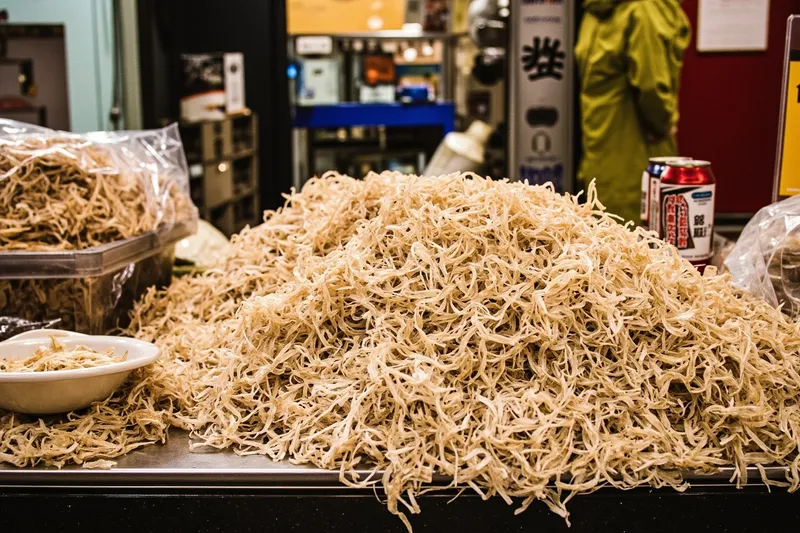
Dried bonito and kombu are the base of dashi-based cooking, the stock under a bowl of miso and half the recipes I cook at home. Ready packets are a shortcut rather than a different product, and in my kitchen I keep both: packets for a weekday, the hard stuff for a weekend. My notes on miso, natto and fermented foods go deeper on the health side.
Fermented and dried goods are also the least fragile things you can buy here, which matters more than the flavour when you are thinking about the trip home.
Tsukemono: takuan, umeboshi, beni-shoga and pickled daikon
Tsukemono is the word for pickles, and the market is strong on the four that do the most work in a weekly basket: takuan, the dried seasoned daikon; umeboshi, the salted fermented plum; beni-shoga, the hot pink pickled ginger; and fresh pickled daikon, the lighter cousin of takuan.
They are used differently, which is why I would not buy just one. Takuan is a thick sweetish slice that stands up to hot udon. Umeboshi is salty and sour at once, and one or two go on rice with a flake of katsuobushi, which is exactly the classic Japanese breakfast. Beni-shoga cuts through fatty meat, and it is the one I always come back with. Pickled daikon works with grilled fish or folded into rice.
Pickles and dried goods are also what travels well in a suitcase. Fresh fruit and seafood do not, so buy those at the end of the trip rather than on the first day.
| Packing | Items |
|---|---|
| Travels well | takuan, umeboshi, beni-shoga, pickled daikon, katsuobushi, kombu, dashi packets |
| Travels with care | yakiimo sweet potato, gift fruit such as muskmelon and Kyoho grapes, cut fruit cups |
| Does not travel | fresh fish and sashimi, oysters and other shellfish, uni and ikura, cut melon |
Sake: what to buy and what to check before you go
Let me be straight about the sake question, since it comes up in searches for where to buy sake and pickles in Tokyo. The city's listing counts sellers of food and drink among the 150 shops, alongside seafood, produce, fruit and clothing, so a liquor counter inside the arcade is plausible. What I cannot tell you is that there is one, so I would not build a shopping list around it. The market's own shop list at kuromon.com/jp/ is where to settle that, along with shop hours, closing days and product prices.
If you want alcohol with your pickles, plan it as a separate stop outside the arcade rather than gambling on the indoor options.
The tax-free rule is narrow and worth knowing before you pay. Japan's tax-free shopping applies to sealed consumables bought for export that meet minimum spending thresholds, per store, per day, and fresh food you eat on the spot does not qualify. The current-year threshold is set by the Japan Tourism Agency.
Paying, packing and the details that decide the bill
Cash first, cards and IC cards where you find them
Cash is the dependable way to pay. A growing number of stalls take cards or IC cards, but that is not all of them, and the smaller counters are the ones most likely to be cash only.
Prices are fixed. There is no bargaining culture here and asking for a discount is out of place, so the price on the board is the price you pay.
My habit is to carry small notes and coins and to buy in smaller amounts rather than one large basket from a single stall. It also spreads my chances of finding something cash-only that I actually wanted.
Buy the fresh things last
On a shopping day the order is the strategy. Perishable fruit and seafood go at the end of the trip, not on the first morning, because a train cools nothing and a hotel room certainly does not. Pickles and dried goods you can buy whenever.
The premium fruit specialists sell gift fruit: muskmelons, white peaches, premium strawberries and Kyoho grapes, packed to be carried and given away. That is the one category where the market is worth the price over a supermarket, because the packaging is part of the product.
For fish, the check is simple: you want fish being cut to order, not pre-sliced fillets under a lamp. And if the fish is for tonight rather than for a photograph, ask for a portion you can finish, because a beautiful block of sashimi for four people in a hotel room is an expensive salad. One practical note on the floor: it runs wet near the seafood stalls, so closed shoes are the sensible choice.
Allergies and the note that smooths things over
A vegetarian can eat here. Fruit, pickles, sweet potato and tamagoyaki are all easy to find, and that is enough to build a plate. The harder truth is that the egg stalls and most others share grills and dashi, so for anyone with a shellfish or fish allergy the shared equipment is a bigger risk than anything printed on a label.
The fix that works at the smaller stalls is a written note. A card with the restriction written in Japanese smooths the exchange over far better than trying to explain it across the counter in English.
On a small card: エビ・カニアレルギーあり、焼き台は共有です(確認をお願いします). Allergic to shrimp and crab, the grills are shared, please check. Hand it over before you order.
Ask the stall you are standing at about shared grills and dashi, and treat a vague answer as a no.
Seasons, recurring gripes and where locals actually shop
A season-by-season shopping calendar
Most of the market is the same all year, so the calendar is short. Two windows matter. Snow crab legs are at their best from November to February. Yakiimo, the newspaper-roasted sweet potato, appears in autumn and winter. Outside those months the arcade is a constant: tamagoyaki, takoyaki, pickles, dried goods, the fruit counters.
What changes across the year is supply rather than the calendar. Because many owner-run stalls finish selling in the early afternoon, the item you came for can be gone by mid-afternoon on an ordinary day in any season. If snow crab or a specific cut of tuna is the point of the trip, go early.
The fixed reference points for any season are the ones in the price table above: six takoyaki balls at ¥500–600, a graze at ¥2,000–3,000, a sit-down seafood meal at ¥3,000–4,000, and the published seven-stop route at about ¥6,400. Those are the numbers to hold in your head when a stall tries to talk you up.
| Window | What to look for | Good to know |
|---|---|---|
| November to February | snow crab legs | season peak, buy early in the day |
| Autumn and winter | yakiimo, roasted sweet potato | sold only in these months |
| All year | takoyaki, tamagoyaki, tsukemono, dried goods, fruit | same counters all year, but stalls sell out in the early afternoon |
The honest downsides and the street locals use instead
Here is where I stop selling it to you. An Osaka editorial ranking gives Kuromon Market 6.5 out of 10 on its locals score: value 5, freshness 5, authenticity 6, crowd level 4, accessibility 9. Its note is that street-food prices run well above equivalent restaurants nearby and that most locals now shop elsewhere. The accessibility score of 9 matches the layout, since the arcade is flat, covered and sits on a metro line.
The street that guide would send you to instead is Tenjinbashisuji, 2.6 kilometres of everyday shopping a short ride away, where locals do their routine shopping and where the same guide prefers to shop over Kuromon for authenticity. For atmosphere and for buying fish cut in front of you, Kuromon wins. For filling a basket at a sensible price, it does not.
The gripes are structural rather than accidental, and they follow from how the place works:
| Gripe | Why it happens |
|---|---|
| Street food costs more than the same dish nearby | visitor counters near the entrance charge a premium |
| The lane is shoulder-to-shoulder at noon | one narrow covered lane with 150 shops end to end |
| Good stuff is gone by mid-afternoon | owner-run stalls sell until their morning stock runs out |
| The floor by the fish counters is wet | shucking and rinsing happen in the open |
| Some counters look tourist-priced | photo menus in five languages with small portions |
Booking, who it suits and the decision
Guided food walks and what to compare before you pay
Guided food walks through the market are sold on the large booking platforms, and it is worth comparing them properly, because the inclusions vary more than the price. Before booking, check what each walk includes, the start time, the language of the guide and the price per person. Some routes are tasting tours, others are market walks with a cooking stop, and the label alone tells you nothing.
Cancellation terms are set by each operator rather than by the market, so read the cancellation window on the operator's own listing before you pay. That is where the real terms are, and it takes a minute.
You do not need a tour to eat here. The market's restaurants and parking are on site, and the accessibility rating of 9 out of 10 is the honest reason most visitors walk the lane comfortably on their own. For a wider look at guided food walks, my notes on Arigato Travel's market tours cover what they include.
| Compare | Where to look |
|---|---|
| What is included | the operator's listing |
| Start time | the operator's listing, mornings catch the best selection |
| Guide language | the operator's listing |
| Price per person | the operator's listing |
| Cancellation window | set by each operator, on their listing |
Who should go and who should skip it
Go if you are building a weekly cooking basket. Tsukemono, katsuobushi, kombu and dashi packets are the reason I would bring a bag, and the fish counters are the part you cannot get in a supermarket back home, whether that is a block of tuna cut to order or a cup of uni over rice.
Go if you can come early. Selection is best before 10:00 and plenty of stalls close in the early afternoon, so the visit depends on the hour you pick.
Skip it if you are buying everyday staples and judging by price, because street food costs more than the same dish a few minutes away and most locals now shop on Tenjinbashisuji. Skip it if you need a table every time, or if your list depends on sake being sold inside the arcade, which I could not confirm.
| Decision | Answer |
|---|---|
| Go if | you want tsukemono and dried goods, can arrive before 10:00, and want to watch food cut and shucked |
| Skip if | you are shopping on price, need a seated meal every time, or count on alcohol being sold inside |
| Best time | a weekday before 10:00; avoid the noon crush |
| What to spend | ¥2,000–3,000 for a graze, ¥3,000–4,000 for a sit-down meal, ¥500–600 for six takoyaki balls |
| Best buys | pickles, katsuobushi, kombu, dashi packets |
| Locals' score | 6.5 out of 10, with accessibility 9 and value 5 |
What to check before you go
- Shop hours and closing days differ from stall to stall: look up the stores you want on the market's own shop list at kuromon.com/jp.
- Parking is on site, and current tariffs and space limits are on the Osaka Convention & Tourism Bureau listing.
- Check that shop list for alcohol too, and plan a separate stop outside the arcade if nothing inside matches.
- Tax-free shopping needs sealed consumables bought for export and a minimum spend per store; the current figure is on the Japan Tourism Agency pages.
- If you need step-free access, phone the market on 06-6631-0007 and ask about entrances and ramps.