
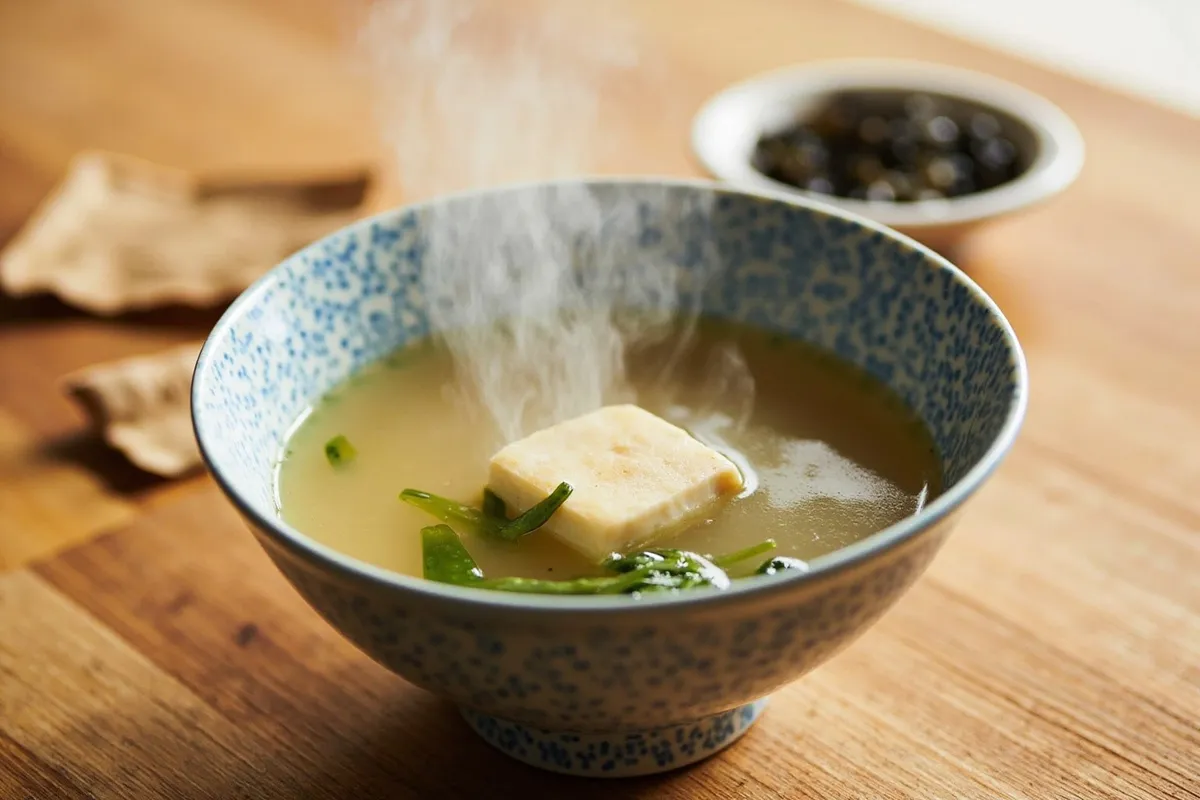
Knowing how to make miso soup is mostly a matter of timing: a pot of dashi, a spoonful of miso stirred in after the heat comes off, and a warm bowl. With dashi already made it takes 15 minutes; from a cold start, add the 30-minute kombu soak and you are looking at nearly an hour.
The two calls are which miso to buy and whether to cook dashi from kombu and bonito flakes or open a packet. Sodium is the part worth watching: one tablespoon of miso (17 g) brings 633.8 mg, about 28% of the 2,300 mg Daily Value, while a 10 g spoon comes to about 373 mg. Miso tubs on US shelves run $11.09 to $22.99, dried kombu $4.98 to $10.00 and bonito flakes 100 g $11.39. A reduced-sodium packet works out at about $1.30 a cup, and a homemade bowl lands in the same range once you count the dashi. The prices are all below.
The Three Parts of Miso Soup: Dashi, Miso, and Toppings
The three parts, and the order that matters
Every bowl is three things: dashi for the liquid and the savoury weight, miso for salt and depth, toppings for texture. Get the order wrong and the miso loses its aroma, because a long boil flattens what a short steep keeps.
| Part | What it does | Everyday example |
|---|---|---|
| Dashi | The hot liquid and most of the savoury depth | Kombu and katsuobushi (bonito flakes) |
| Miso | Fermented soy: salt, body, aroma | Shiro miso (white), awase miso, aka miso (red) |
| Toppings | Texture and bulk, added at the last second | Tofu, wakame, nori, scallion |
Miso goes in after the heat is off. The miso soup recipe published by Japan's Ministry of Agriculture, Forestry and Fisheries stirs the paste in once the pan is off the heat, then adds the green onion and serves. I keep that order in my kitchen, and the aroma sits at the top of the bowl.
Soup belongs to a plate rather than standing alone. Japan's Ministry of Agriculture, Forestry and Fisheries describes the standard Japanese meal as rice, soup, one main dish and two side dishes, a format it calls ichiju sansai. The soup is the wet, salty part, so everything else stays plain. My notes on washoku, the traditional Japanese diet go into why that balance works.
Shiro miso, aka miso, and barley miso: which paste to buy
The pale paste is white miso (shiro miso), sweet and mild enough that a beginner will not notice anything odd. Aka miso (red miso) is darker, saltier and longer fermented. Barley miso uses barley koji instead of rice koji, which gives it a fuller body.
One paste covers both jobs: awase miso, a blend of white and red, is what most shops sell as the everyday jar.
| Paste | Flavour and texture | Sodium per 2 tsp (10 g) | Price |
|---|---|---|---|
| Hikari organic white miso, 500 g | Sweet, mild, dissolves clean | See the label | $17.99 |
| Hikari Kodawattemasu miso, 750 g | Deeper and rounder than the white | See the label | From $19.94 |
| Aged dark miso (Muso), 147 g | Strong and savoury, a finishing paste | See the label | $11.09 |
| Miso Master Organic Mellow White | Soft and rounded | 310 mg, 13% DV | See the buying list |
| Miso Master Organic Country Barley | Barley koji, fuller body | 450 mg, 19% DV | See the buying list |
The milligram figures come from the 2 tsp (10 g) labels, and those percentages work out against a 2,400 mg sodium basis, while the Daily Value used in the US guidelines is 2,300 mg. Prices sit with the other buying figures further down.
Miso averages about 3,730 mg of sodium per 100 g, which is why a spoonful goes further than it tastes. For a first cook I would split the choice in two: pick a mellow white if you want a mild bowl, then read the panel for the spoon you actually use. 310 mg and 450 mg per 10 g is a real difference across three bowls a day.
Toppings that change the bowl: tofu, wakame, nori, scallion
Tofu is the bulk. Firm or extra-firm works, cut into 1.5 cm cubes, added to the hot dashi and warmed through for a minute so it takes the flavour instead of sitting in it.
- Wakame: dried, dropped into cold water while the broth heats. A small pinch per bowl, squeezed dry before it goes in.
- Nori: a sheet cut into strips, scattered over the top at the table.
- Scallion: sliced thin, added after the miso so the green stays green.
- Noshitake (dried shiitake): one piece simmered in the dashi and lifted out before serving.
That is the whole shopping list for toppings. My bowl most often gets tofu and wakame, and green onion when some is left in the fridge. The recipe further down builds the same bowl for two.
How to Make Dashi for Miso Soup
Kombu and katsuobushi dashi in four steps
Dashi from scratch is thirty minutes of doing almost nothing, then a few minutes that need attention. Japan's Ministry of Agriculture, Forestry and Fisheries gives the method I use: 1,000 ml water, 10 g kombu, 20 g dried bonito flakes, as set out in its official dashi instructions.
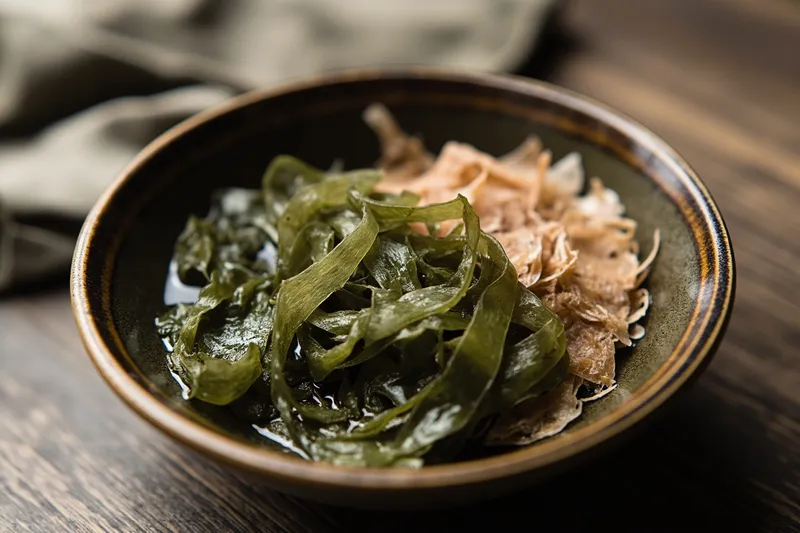
- Put 10 g of kombu in 1,000 ml of cold water and leave it for 30 minutes.
- Heat the water slowly and lift the kombu out just as it begins to boil.
- Add 20 g of bonito flakes (hanakatsuo) to the boiling water, then turn the heat off.
- Steep 2 minutes, then strain through two strainers lined with kitchen paper.
Two things spoil a clear dashi: kombu left in through the boil makes the broth cloudy, and bonito flakes boiled hard turn bitter. Lift the kombu at the first bubbles and take the pan off the heat the moment the flakes land.
| Step | Time | What to watch |
|---|---|---|
| Kombu soak | 30 min | Cold water, no heat |
| Heat to a boil | About 5 min | Lift the kombu at the first bubbles |
| Bonito steep | 2 min | Heat off, lid on |
| Strain | 1 min | Two strainers, kitchen paper |
Two of those times are fixed; the boil-up depends on your hob and how much water you started with.
I keep a kettle thermometer next to the stove for the kombu step, mostly so I stop before the bubbles turn aggressive. The pot itself is an ordinary saucepan, and nothing else is required.
Instant dashi and dashi-miso paste: the shelf shortcuts
| Option | What it is | Time | Price | Sodium |
|---|---|---|---|---|
| Konbu dashi sachets | Seaweed stock that dissolves in hot water | 1 min | $14.99 for 16 sachets, about $0.94 each | Read the panel |
| Instant dashi (hōraku) | Dried bonito and kombu stock in a block or sachet | 1 min | Compare per sachet on the shelf | Read the panel |
| Dashi-miso paste | Stock and miso in one concentrate | 1 min plus boiling water | Compare per tub | Read the panel |
The sachet wins on speed and gives up the body: a konbu pack reads cleaner and more marine, while a bonito packet pushes it deeper. That is the general rule, not something I measured side by side.
For a weekday bowl, a konbu sachet with your own toppings is a fair trade. For a Sunday, I make the dashi.
No-fish dashi with kombu and noshitake
A second route to dashi skips the fish entirely: kombu for the sea, dried shiitake for the body. The kombu soak carries over as it is, 10 g in 1,000 ml of cold water for 30 minutes. The shiitake part is my own ratio rather than a set rule: 10 g of noshitake in 400 ml of water brought to a slow simmer for 20 minutes, kombu added for the last 5 minutes, then strained through a fine-mesh strainer lined with kitchen paper.
That base makes a vegetarian bowl, provided the miso itself carries no bonito. Most miso is soy, koji and salt, but read the ingredients.
Dried shiitake does not sit on the mainstream American grocery shelf, so plan for an Asian grocery store or an online order. Fresh shiitake is not a swap, it needs different time and gives a different result.
How to Make Miso Soup Step by Step: The 15-Minute Bowl
A homemade miso soup recipe, measured for two bowls
The 15 minutes starts with dashi already made. From cold, the 30-minute kombu soak is added, so budget nearly an hour.
| Ingredient | Two bowls | Spoon equivalent |
|---|---|---|
| Dashi | 500 ml | 2 cups |
| Miso, light bowl | 10 g | 2 tsp |
| Miso, fuller bowl | 17 g | 1 tbsp |
| Firm tofu | 100 g, in 1.5 cm cubes | – |
| Dried wakame | 4 g, rehydrated | A small pinch |
| Green onion | 2 stalks, sliced thin | – |
| Salt | None | The dashi is already salted |
The dashi and miso amounts are measured, and the tofu and wakame are the quantities I use at home. I wrote it this way so the numbers stay in one place when you cook for two.
- 0:00. Warm 500 ml of dashi until it steams, about 5 minutes. Do not let it boil hard.
- 5:00. Put the dried wakame in cold water to soften while the broth heats.
- 7:00. Add the tofu cubes and the squeezed-dry wakame, and let them warm through for a minute.
- 10:00. Take the pan off the heat. Ladle broth into the bowl, add the miso to the ladle, stir it to a paste and pour it back in.
- 13:00. Scatter the green onion over the top and take the bowl to the table.
Miso goes in after the heat comes off, the same order the Ministry of Agriculture, Forestry and Fisheries uses in its official miso soup recipe, and the green onion goes in after the miso. Keep the bowl warm rather than returning it to the heat, because more boiling flattens the aroma.
Tools that matter: scale, thermometer, strainer
A pinch of salt is a guess, and one teaspoon of table salt is about 2,400 mg of sodium. A scale turns that into a number you can repeat.
- Buy first: a kitchen scale that reads down to 1 g, a fine-mesh strainer, and a roll of kitchen paper. The strainer and paper are what turn cloudy bonito water into a clear bowl.
- Buy later: a kettle thermometer, useful for the kombu step and unnecessary for the miso.
- Skip: a full dashi-making setup. A saucepan, a ladle and a strainer cover it.
On tools, I keep my kitchen silicone-free as a matter of preference rather than any health claim, and I would not spend money on that alone. What matters is a bowl that holds heat: a warmed donburi next to a proper rice bowl is the serving I grew up with, and cold ceramic takes the warmth out of a small bowl fast.
When the bowl goes wrong: lumps, salt, thin broth
- The miso will not disperse. Whisk the spoonful into a ladle of hot broth first, then stir the ladle back into the pan. Miso pastes sit for months and the oil and salt separate from the soy.
- The soup is too salty. Add hot dashi that has no miso in it, taste, and stop. More miso makes it worse, and you cannot stir salt back out of a bowl.
- The broth is cloudy. Strain it again through kitchen paper, and next time lift the kombu before the boil and keep the bonito off a rolling boil.
- The bowl tastes weak. Add miso off the heat instead of salt, in small amounts. One extra tablespoon is another 633.8 mg of sodium, so a teaspoon at a time.
None of these is a disaster. A weak bowl gets more miso, a salty bowl gets more dashi, and a cloudy one gets strained. That is the whole repair kit.
Instant Miso Soup Packets vs Homemade Miso Soup
Packet or homemade: sodium, price and time
| Homemade, 1 tbsp miso | Homemade, 10 g miso | Packet, 25.8 g | |
|---|---|---|---|
| Sodium | 633.8 mg | About 373 mg | 960 mg standard, about 336 mg reduced |
| Share of the 2,300 mg Daily Value | 28% | About 16% | 40% on the standard panel |
| Calories | 34 kcal from the miso | About 20 kcal from the miso | 50 kcal |
| Price per serving | $1.27–$2.10 | $1.09–$1.57 | About $1.30 for the reduced-sodium pack |
| Time at the stove | 30 min soak, 8 min dashi, 15 min assembly | The same | About 1 min |
A standard packet carries about two and a half times the sodium of a light homemade bowl, while the reduced-sodium version lands close to it. The homemade bowl is not automatically the cheaper option either.
Here is where the money goes. 10 g of dried kombu is about $1.00 at $2.77 an ounce, and 20 g of bonito flakes about $2.28, so one batch of dashi is roughly $3.28 and gives about four bowls. A tablespoon of miso costs $0.45 in the cheapest tub by the gram, $0.61 in the 500 g white miso, and $1.28 in a small 147 g tub of aged dark miso. That puts a homemade bowl at $1.27 to $2.10, and the packet figure comes from the reduced-sodium Miso-Cup at $5.19 for four, about $1.30 a cup.
The reduced-sodium cup is the packet case that holds up: at 65% less sodium than the standard cup it works out to about 336 mg, close to the 373 mg in a light homemade bowl. The standard cup at 960 mg is the one I would skip when I am watching sodium, and the 2025–2030 Dietary Guidelines for Americans, released on 7 January 2026, named highly processed foods as a category to cut back on, with salty ready-to-eat foods among the things to limit.
Reading the label: sodium, servings and added salt
- Milligrams of sodium, and the serving size in grams. Two tsp (10 g) is the serving on the Miso Master labels, so 310 mg and 450 mg are directly comparable.
- Servings per container. A 500 g tub at 10 g a bowl is a lot of bowls, and the panel tells you how many it counts.
- Added salt in the ingredient list. The Miso-Cup lists added salt, and the Miso Master white miso lists sun-dried sea salt.
- Yeast extract. The Miso-Cup lists it, and it adds to the umami that makes the cup taste more like soup than salt water.
- Allergen lines. Soy is the one to read, and for a fish-free household the bonito in the packet matters too.
US labels carry % Daily Value, and that is the number to read. The 13%, 19% and 40% panels on these products work out against a 2,400 mg sodium basis, while the Daily Value in the guidelines is 2,300 mg, so the printed percentages read slightly low against the daily figure.
One piece of background that does not change what you buy: the front-of-pack Health Star Rating in Australia and New Zealand is voluntary, and in February 2026 the food ministers of both countries asked FSANZ to consider making it mandatory. US shoppers do not need it.
Batch cooking a week of soup and using up leftover miso
Dashi batches, miso per bowl. Make the broth double, 2,000 ml of water with 20 g kombu and 40 g bonito flakes, and leave the miso out of it. Each bowl gets its paste stirred in off the heat at the table, which is also how you control how salty the week turns out.
Keep the dashi in the fridge and use it within a few days, freeze the rest, and reheat gently without a rolling boil. Miso that has boiled hard tastes flat, so add a fresh spoonful at the end instead. If tofu is in the bowl, refrigerate it within about two hours of cooking.
A tub of miso also lasts longer than a bowl. These are the four places I put the leftovers, with the ratios I use:
- Salad or cucumber dressing: 1 tbsp miso, 1 tbsp rice vinegar, 1 tsp sesame oil.
- Glaze for roasted vegetables or fish: 1 tbsp miso, 1 tbsp mirin, brushed on in the last few minutes.
- Butter for corn and bread: 1 tsp miso melted into 10 g of butter.
- Marinade for tofu or chicken: 1 tbsp miso, 1 tbsp soy sauce, a little grated ginger.
How Much Salt Is in a Bowl of Miso Soup?
Sodium math: one tablespoon, one bowl, one day
| Reference | Sodium | Salt equivalent |
|---|---|---|
| 1 tsp table salt | About 2,400 mg | 1 g |
| 1 g of salt | 400 mg | 1 g |
| 1,000 mg of sodium | – | About 2.5 g of salt |
| 1 tbsp miso (17 g) | 633.8 mg | About 1.58 g |
| 10 g of miso | About 373 mg | About 0.93 g |
The salt equivalents are calculated from 1 g of salt equals 400 mg of sodium. Miso averages about 3,730 mg of sodium per 100 g, which is why a spoon that tastes mild still adds up.
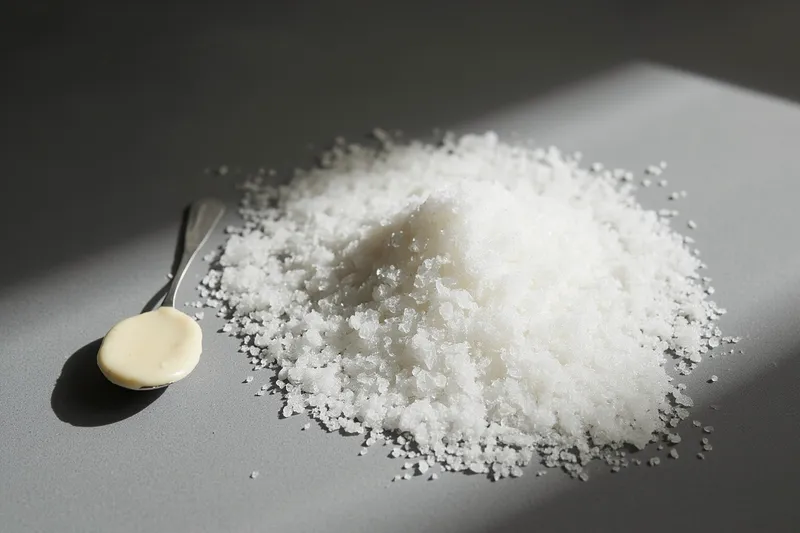
Now put it against the day. One tablespoon in a bowl is 633.8 mg, a little under a third of the 2,300 mg Daily Value on US labels, and about a third of the 2,000 mg a day that the WHO recommends for adults. Americans average more than 3,300 mg a day, according to the CDC's salt guidance, and the global average in 2021 was 4,278 mg. Soups sit among the top five sodium sources for US adults, and miso soup is not the one people picture when they say salty.
Cooking a lighter bowl: miso strength, added salt and potassium
Five levers, and only the first one is about the paste.
- Halve the miso. 2 tsp instead of 1 tbsp takes the bowl from about 634 mg of sodium to about 373 mg.
- Skip added salt. The dashi is already salted by the kombu and the bonito flakes, so the bowl needs nothing else.
- Keep potassium foods on the plate. Japan's Ministry of Agriculture, Forestry and Fisheries notes that potassium helps sodium leave the body, and names vegetables, wakame, tubers, fruit and dairy as foods to eat alongside salty dishes.
- Stop at one scoop. Japanese meals do not double the paste to fix a weak bowl.
- Keep the rest of the plate plain. Rice, vegetables and a little fish or tofu is enough.
Where the bowl sits against other Japanese dishes, salt per serving:
| Dish | Salt per serving |
|---|---|
| Kake udon | About 5.6 g |
| Oden | About 3.8 g |
| Nigiri sushi, without dipping sauce | About 3.7 g |
| Mixed sandwich | About 3.2 g |
| Sautéed chicken | About 1.1 g |
| This recipe's bowl with 10 g of miso | About 0.93 g (calculated) |
A bowl of miso is one of the lighter items on that list, which is worth remembering when the shopping trolley is full of instant noodles. Japan's 2025 dietary targets put daily salt below 7.5 g for men, below 6.5 g for women and below 6.0 g for people being treated for high blood pressure, while the 2023 national survey put the average at 9.8 g. The WHO's salt advice points the same way: limit commercial sauces, dressings and instant products, and pick lower-sodium versions when you have the choice.
What fermented soy does for the gut, and what the research does not prove
The best evidence I have found is not about miso. In a 17-week randomized study with 18 adults per arm, a diet high in fermented foods steadily increased gut microbiome diversity and decreased inflammatory markers compared with a high-fibre diet. It is a good result, and also one study, two arms, 18 people a side, and a diet rather than a single food, so it says nothing yet about a bowl of miso on its own.
What I take from it is a plate, not a spoonful. Miso fits the balanced-plate pattern I wrote about in how a smaller rice bowl changes the proportions of a meal, and the 2025–2030 Dietary Guidelines put protein at 1.2 to 1.6 g per kilogram of body weight a day for adults, which a bowl of miso with tofu and wakame helps you reach without much effort.
In Canada the numbers to watch are a 1,500 mg target for most people with a 2,300 mg ceiling, and an average intake of 2,760 mg a day, 77% of it from processed foods. Miso soup made at home is not on the processed side of that line.
Buying and Stocking Miso and Dashi in the US
What miso and dashi cost, and where to buy them
| Item | Size | Listed price |
|---|---|---|
| Hikari organic white miso | 500 g (17.6 oz) | $17.99 |
| Hikari Kodawattemasu miso | 750 g (26.4 oz) | From $19.94 |
| Aged dark miso (Japan Gold USA Muso) | 147 g (5.2 oz) | $11.09 |
| Dried kombu, organic | 1.76 oz | $4.98 ($2.77 an oz) |
| Dried kombu | 4 oz | $10.00 |
| Dried bonito flakes (hanakatsuo) | 100 g | $11.39 |
| Konbu dashi soup base | 128 g, 16 sachets | $14.99 (about $0.94 a sachet) |
| Edward & Sons Reduced Sodium Miso-Cup | 4 pack | $5.19 (about $1.30 a cup) |
These are the prices I could compare across listings, mostly supermarket listings plus the brand's own store, and the same 500 g white miso is listed from $22.99 by other sellers. Read the shelf tag rather than trusting any single listing.
Pack economics are simple: $0.027 a gram in the 750 g tub, $0.036 in the 500 g one and $0.075 in the 147 g tub. A small tub costs less on the way in and more by the gram, so if you cook miso soup twice a week the big one works out cheaper over a year.
Where to find them: miso paste and the konbu dashi sachets sit in the international aisle of a mainstream supermarket, dried kombu and bonito flakes are easier in an Asian grocery store or online, and tofu, scallion and dried wakame are ordinary grocery items whose price changes with the shop.
Label checks: soy, gluten and sodium per serving
| What to look for | What it tells you | Where you see it |
|---|---|---|
| Soybeans on the list | The paste is soy-based, so it is out for a soy allergy | Miso Master white miso lists organic soybeans |
| Barley or barley koji | Not a gluten-free miso | Miso Master Country Barley is made with barley koji |
| Gluten-free certification | Made for a gluten-free diet | Hikari organic white miso is listed as certified gluten-free |
| Sodium and the serving size in grams | What you really get per spoonful | 2 tsp (10 g) on the Miso Master labels |
| Yeast extract | Added umami and a sign of a more processed item | The Miso-Cup lists it |
Two things to check in a soy-allergy kitchen: the paste, which lists soybeans, and the dashi packet, where bonito makes the cup a fish product. Most konbu sachets are seaweed only and fine, but read the list either way.
For the low-sodium end of the shelf, the reduced-sodium Miso-Cup is the one to look at: 65% less sodium than the standard cup, $5.19 for four, about $1.30 a cup.
Should you make your own miso paste?
Making miso is koji, soy and salt, then time. Koji is the mould that does the work; the Miso Master white miso label lists handmade rice koji and koji spores among its ingredients, and koji can be bought online if you want to try. Light pastes are ready in a couple of months, aged ones take a year or more, and the paste has to be salt-adjusted before it goes near a soup bowl.
| Store-bought paste | Home-fermented paste | |
|---|---|---|
| Time | Minutes | Weeks to months |
| Cost | $0.027 to $0.075 a gram | Koji, soy, salt and jars |
| Texture | Even and smooth | Variable, and part of the point |
| Risk | None | Mould, salt ratio, sanitation |
The risks are the honest part. Salt is the preservative, and if the ratio is wrong the batch goes off; a warm kitchen and a jar that is not sanitised are both problems. Some producers label a paste as pasteurised (ama-hoto) or unpasteurised (nama-gata), which is worth a look if you care about live cultures in the paste.
Would I bother? Not for the soup. I keep a tub of white miso for the week and would ferment my own only because the process is interesting, and because a shelf full of miso makes a meal plan dull.
What to Cook This Week and What to Stock
The decision in one screen
| If you want | Do this | Cost and time |
|---|---|---|
| A normal bowl on a weeknight | Dashi made ahead, 1 tbsp miso stirred in off the heat | $1.27–$2.10 a bowl, 15 minutes |
| A lighter bowl | 2 tsp miso, wakame and tofu, no extra salt | $1.09–$1.57, about 373 mg sodium |
| No time at all | A Miso-Cup packet with your own wakame and tofu added at the table | About $1.30 a cup |
| The lowest-sodium option | The reduced-sodium cup | About 336 mg sodium |
My week runs on the first row: a pot of dashi made when I have twenty spare minutes, and one spoon of miso stirred into each bowl off the heat. I keep a tub of white miso, dried kombu, bonito flakes, dried wakame, tofu and scallion in the cupboard and the fridge door.
When the week collapses, the packet wins on speed, and the reduced-sodium cup is close enough on sodium to a light homemade bowl that I do not mind the swap. The standard cup at 960 mg is the one I leave on the shelf.
FAQ
How much miso goes into one bowl?
About 10 g (2 tsp) for a light bowl and 17 g (1 tbsp) for a fuller one. A tablespoon carries 633.8 mg of sodium, about 28% of the 2,300 mg Daily Value; 10 g comes to about 373 mg.
Can I make miso soup without dashi?
You can, and it will taste flat. The salt and some depth come from the miso, but the savoury weight of the bowl comes from the dashi. A konbu sachet in hot water is the shortcut.
Why does my miso stay lumpy?
Miso pastes sit for months and the oil and salt separate from the soy. Whisk the spoonful into a ladle of hot broth until smooth, then stir the ladle back into the pan.
Can I reheat or freeze miso soup?
Freeze the dashi, not the finished soup, and reheat gently without a rolling boil. Add a fresh spoonful off the heat at the end, since boiled miso tastes flat.
Which miso should a beginner buy?
A mellow white miso for the taste, and read the panel for the salt: the two Miso Master tubs I compared carry 310 mg and 450 mg per 10 g. Barley miso is not gluten-free.
Is miso soup healthy if I drink it every day?
A bowl a day fits a plate of rice, vegetables and fish or tofu, as long as the rest of the day is not salty too. The gut evidence on fermented foods rests on one small study, so I treat miso as food.