
Maeda-en Aoyama is the Tokyo tea house of a Japanese tea company, and the easier place to buy from is its US shop: Maeda-en USA, operated by G.T. Japan, Inc. in Irvine, California. The matcha there is grown and packed in Japan, a tin starts at $13.00, and a bag of genmai-cha is $5.90. The part I rate above the tins is the recipe library that comes with it: nineteen drink and dessert recipes, all open in the browser without an account and without a paywall.
I brew matcha at home most weeks, and I am fussy about two things: the powder must not clump, and the drink must not be so sweet that you cannot taste the tea. Maeda-en's own brewing instructions are short enough to print and stick to the fridge. Prices below are the shop's own, in US dollars.
Maeda-en Aoyama and the shop that actually ships
What the store is, and where the Tokyo side fits
The store that sells the tins is Maeda-en USA, operated by G.T. Japan, Inc. The label on the ceremonial matcha says it is imported by G.T Japan, Inc. (Maeda-en), Irvine, California, and the site footer credits the same company. It is a company shop rather than a marketplace: the matcha is grown in Japan, packed in Japan, and shipped to the US in tins you can order one at a time.
The Tokyo half of the brand is the tea house most photos come from. Its current address and opening hours sit on the company's Japanese-language site, maedaen.co.jp, and the store's own Where to Find page lists physical stockists. Everything else here is about brewing the same tea at home, which is where I spend my matcha attention.
Four matcha tins, $13 to $43, and what each one is for
| Tin | Price | In a home kitchen |
|---|---|---|
| Culinary Matcha | $13.00 | Baking and drinks where sugar covers the sharper notes |
| Shiki Matcha (universal quality) | $19.00 | The drinking middle: lattes, iced matcha, desserts |
| Ceremonial Matcha | $33.00 | Straight tea, whisked thin, no milk |
| Kai-yo no Mukashi Matcha | $43.00 | The top rung. Gifts and the days you want to be fussy |
The shop describes the powder as natural green tea powder sourced from Japan with an extremely fine texture, and says it suits a traditional tea ceremony as well as beginners. That fine grind is why it sifts well and clumps less than a coarser kitchen matcha. The matcha collection is where the four tins sit, and each tin's net weight is on its own product page; on the ceremonial one it is 1.0 oz, so 28 g.
How to buy: free US shipping over $50, eight ways to pay
Orders over $50 ship free inside the US, and taxes, discounts and the shipping charge are worked out at checkout, so on a smaller basket you see the real number before you pay. Payment covers most bases: Visa, Mastercard, American Express, Discover, Apple Pay, Google Pay, Shop Pay, plus direct debit from a US bank account.
Two small things worth knowing. The ceremonial matcha label carries a California warning printed on the tin: "CA WARNING: Risk of reproductive harm from exposure to lead", which is the Proposition 65 notice. The site footer also links the store's own Instagram, @maedaenus, which is where I would look first when a limited tin is marked sold out.
Matcha recipes at home: the drinks worth the whisk
Ten drinks from the Maeda-en kitchen, free and open to everyone
The recipe library has nineteen posts split between drinks and desserts, and every one opens in the browser with no account and no paywall. The recipe index is the place to start, and the drinks are the half I cook from most.
- Vanilla Matcha Latte: the baseline. Sweeten before the milk goes in.
- Black Sesame Matcha Latte: nutty and salty. The paste splits if you pour too fast.
- Sea Salt Cream Matcha Latte: the salted cream needs a cold base or it sinks.
- Pumpkin Spiced Matcha Latte: spiced pumpkin is heavy, so matcha goes in lightly.
- Iced Strawberry Matcha Latte: blend the powder with the milk first, ice second.
- Lavender Syrup Matcha Latte: floral and faintly perfumed. Syrup, not dried buds.
- Hoji-cha Milk Tea: roasted rather than green, so it is the evening one.
- Matcha Iced Cocoa: cocoa hides bitterness well. A forgiving first drink.
- Matcha Martini: there is alcohol in the glass. Read the ingredients.
- Iced Strawberry Green Tea: the newest post in the list, and green tea rather than matcha.
Three posts from 2026 show the library keeps moving: Checkered Matcha Shortbread in January, Lavender Syrup Matcha Latte in March, Iced Strawberry Green Tea in April.
Brewing: half a teaspoon, 120 ml, water just off the boil
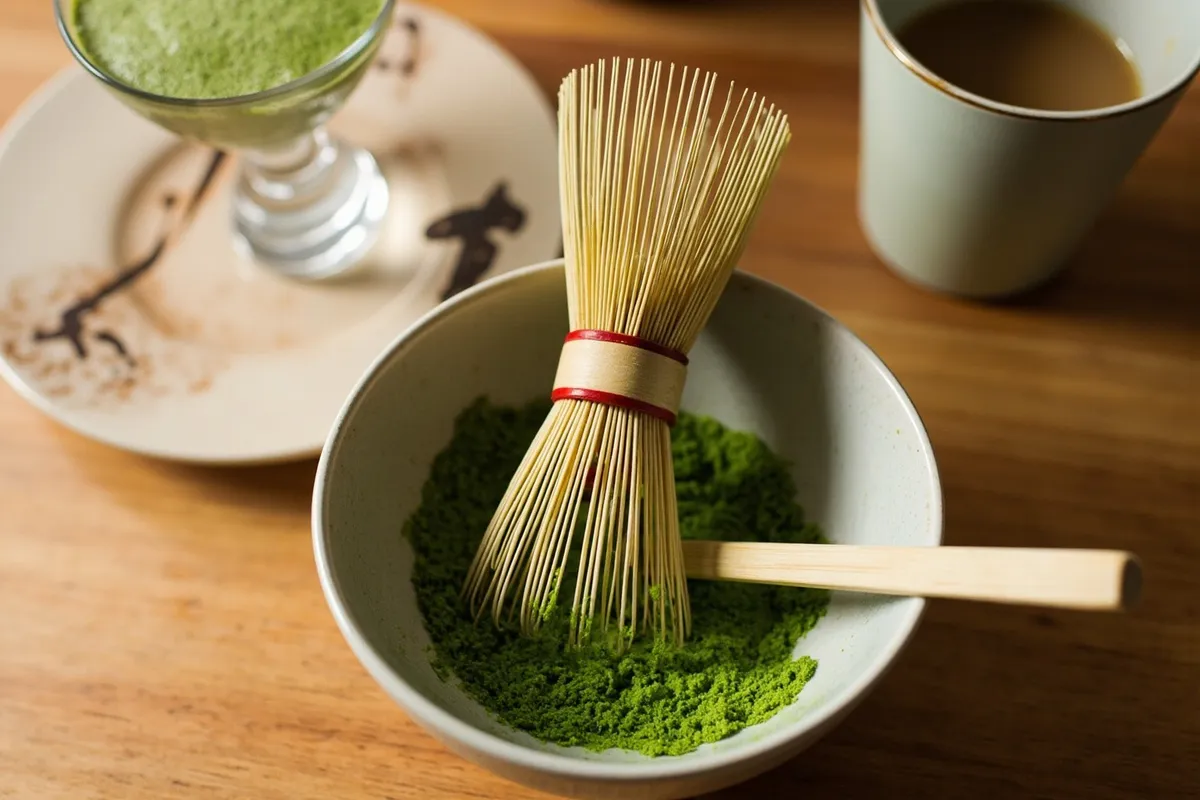
Maeda-en's own directions on the ceremonial tin are the ones I print out: half a teaspoon of powder into the bowl, then about 4 fl oz (roughly 120 ml) of water at 158–176 °F, whisked with a bamboo chasen. The product page carries the same numbers, and they are a good place to start.
- Sift the powder through the chashaku so no hard lumps sit at the bottom.
- Pour the water in and whisk in a W shape, keeping the whisk low and moving steadily.
- Stop while the surface is glossy rather than foamy, because the foam is the bitter part.
- Tap the whisk on the rim to knock the bubbles off.
Thin usucha is more water and less powder, whisked until smooth. Thick koicha is twice the powder and no foam, and it tastes rounder and keeps you full longer. Water at 70–80 °C is the sweet spot: boil it, pour it, wait a minute, and you avoid thin, scalded tea.
Half a teaspoon of matcha powder is roughly one gram, which makes the rest of the arithmetic easy. If your first cup tastes grassy rather than sweet, that is normal. Matcha is more savoury than most people expect, and it takes a few cups before the sweetness arrives.
Caffeine, sugar and the second drink of the day
The ceremonial tin's label says 3.2 g of caffeine per 100 g of powder and prints the level as "High". A one-gram serving works out at roughly 32 mg, so the afternoon cup is worth counting if caffeine is something you watch. For the evening there is the herbal shelf, which the shop describes as "low- and non-caffeine Japanese herbal teas for everyday relaxation": dokudami-cha and mugi-cha barley tea, with soba-cha buckwheat tea alongside.
| Sweetener | How it behaves in the bowl |
|---|---|
| None | Usucha is fine unsweetened. A latte without sugar just tastes bitter. |
| Maple syrup | The neutral default. Disolves into warm matcha without adding body. |
| Condensed milk with maple | Sweetest and creamiest, closer to a dessert drink than to tea. |
| Monk fruit or erythritol | Sweet with almost no sugar. Use less than the packet says, because matcha bitterness hides under sweetness, not under more powder. |
The caffeine ladder runs from matcha at the top down through the roasted and grainy teas, then the herbal line. My evening cup is the library's Hoji-cha Milk Tea, sometimes with a spoonful of black sesame paste stirred through, and a strip of yuzu peel on a sen-cha when I want something sharper.
Matcha desserts: one tin turns into five bakes
Five dessert recipes and how each behaves in a home oven
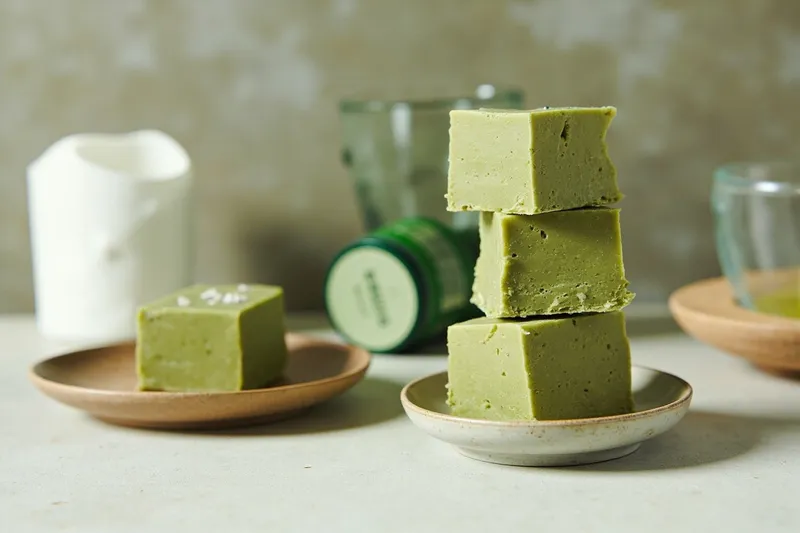
The dessert half of the library holds five I keep: Matcha Fudge, Matcha Mug Cake, Peppermint Matcha Bark, White Chocolate Matcha Cookie and Checkered Matcha Shortbread, the newest published in January 2026. They succeed and fail in completely different ways, so it helps to know what each one wants.
- Fudge sets in the fridge, not on the stove. Lined tin, a few hours before cutting.
- Bark goes into the freezer until it snaps. At room temperature it only bends.
- The mug cake is a 60–90 second microwave job, or a short oven bake.
- Shortbread wants a proper chill in the fridge before cutting, or the edges crumble.
- The white chocolate cookie gets its chew from the chocolate, and the matcha disappears into it.
All of them pull in milk, and the bark and the cookie add nuts as well, so read the ingredient list on the recipe page before baking for someone with an allergy.
Which tin to bake with: the cheap one is the right one
In a fudge or a cookie, the gap between a culinary tin and a ceremonial one disappears behind sugar and chocolate. The green note still shows through, but the grassy finish and the astringent edge are mostly covered. The money is better spent on a tin you drink from and a cheap tin for the oven.
Culinary Matcha at $13.00 covers every bake on that list, and it is the tin I would start with from scratch. The ceremonial tin works in baking too, at two and a half times the price per tin, which is a hard sell for a fudge. The same prices sit side by side in the matcha collection above.
Storage, freshness and the usual beginner mistakes
Matcha keeps well in a sealed tin, out of the light and away from moisture. Use a dry spoon, wipe the rim before you screw the lid back on, and move the tin to the fridge once it is open. The bamboo whisk gets rinsed under the tap straight after use and stood upright to dry, because a whisk left wet in the bowl goes musty and then mouldy.
Fresh matcha smells grassy and sweet. When it turns flat and dull, or starts smelling of the kitchen cupboard, the tin has had its day. Best-by dates are printed on the label, so read the tin rather than trusting a shelf life you half remember.
The beginner mistakes are unglamorous: tipping the powder straight into the bowl without sifting, and dipping in with a wet spoon. Fix those two and the tea mostly looks after itself.
What it actually costs: tins, tea bags and the price of a cup
Tin, weight, cost per gram, cost per cup
| Matcha tin | Price | Net weight | Per gram | Cups at 1 g |
|---|---|---|---|---|
| Ceremonial Matcha | $33.00 | 1.0 oz (28 g) | ≈$1.18 | ≈28 |
| Culinary Matcha | $13.00 | on the product page | – | – |
| Shiki Matcha | $19.00 | on the product page | – | – |
| Kai-yo no Mukashi Matcha | $43.00 | on the product page | – | – |
The ceremonial tin is the one where the arithmetic is fully on show: 28 g at $33.00, about $1.18 a gram, and a one-gram serving makes roughly 28 cups. A home matcha or matcha latte therefore costs about $1.18 in tea, before milk and sweetener. The $13.00 culinary tin is the cheapest matcha on the shelf, and Everyday Genmai-cha at $5.90 is the cheapest tea.
One limited tin, Tsuji-Midori, is marked sold out at $19.99, down from $22.99, which is enough to say that small lots do disappear. Outside that, prices on the matcha and tea range hold steady rather than moving with the seasons, and the dated signals live on the blog instead.
The rest of the Japanese green tea shelf
| Tea | Format | Price | What it is for |
|---|---|---|---|
| Everyday Sen-cha | tea bags | $6.90 | Clean and grassy, the everyday green |
| Gold Sen-cha | loose leaf | $9.30 | More high notes than the bags |
| Everyday Genmai-cha | tea bags | $5.90 | Roasted rice, gentle |
| Gold Genmai-cha | loose leaf | $7.80 | Same idea, looser leaf |
| Everyday Hoji-cha | tea bags | $7.70 | Roasted and smoky |
| Everyday Kuki-cha | tea bags | $10.00 | Twigs and stems, thick |
| Mugi-cha barley tea | tea bags | $8.00 | Toasted barley, good cold in summer |
| Soba-cha buckwheat tea | tea bags | $8.50 | Roasted buckwheat, nutty |
| Dokudami-cha | tea bags | $10.00 | Mild herbal |
Beside the matcha, the same shop sells the rest of the Japanese green tea range. I would begin with the $5.90 genmai-cha, because a bag under six dollars is the cheapest way to find out whether green tea fits you at all. The herbal line sits apart, described by the shop as low- and non-caffeine teas for everyday relaxation.
Bags, sachets and bulk: buying for more than one cup
Then the larger formats: sen-cha with matcha and genmai-cha with matcha in 100-bag packs at $24.00 each, iced green tea bulk in 60 bags for $25.00, MatchaBooster sachets at $7.35 in unsweetened, sweetened, genmai and yuzu, matcha powder in bulk at $89.00, and NAKED MATCHA sticks as a 12-pack for $12.40 or a 50-pack for $38.50. The tea collection has the lot.
One packaging note: "Organic" appears in the name of one product only, and the tins are described as natural green tea powder sourced from Japan, which is a description rather than a certification. The site menu also carries a green tea ice cream collection, and that is the one part of the shop I would phone about rather than order blind.
Gear, the ten-minute routine and ordering without surprises
The $99 Hario set, and the cheaper kit
The HARIO Matcha Tea Set is $99.00, reduced from $110.00: a double-walled glass bowl, a bamboo chasen and a tin of Maeda-en ceremonial matcha in one box. That is the easy route, since the bowl and the whisk arrive with the powder already in the box and there is nothing to source separately.
It is also $99 before you have bought a sieve. If you already own a bowl, a chasen and a small sieve set you up for a fraction of that, and if you want a proper chawan the Kappabashi kitchenware street guide has good ones for less. The whisk is the only piece you replace: rinse it under the tap and stand it upside down to dry, because a chasen left wet in a bowl will not last the week.
A weekday cup in ten minutes
Here is the weekday script. Kettle on, half a teaspoon of Shiki or ceremonial matcha into the bowl, sift it, wait for the water to come off the boil, whisk while it cools, sweeten with maple or a monk-fruit sweetener, then top with oat or coconut milk for a latte. In a hurry, make it strong, shake it with milk and ice in a jar, and pour it over more ice. Ten minutes end to end, and most of that is the kettle waiting.
The weekend version is the library's MatchaBooster sachets, in unsweetened, sweetened, genmai and yuzu. An unsweetened one with hot oat milk makes a decent desk latte, and the yuzu one is good over ice in the warm months. For a shared office, the sen-cha and genmai-cha packs with matcha mixed in hold 100 bags each. On the science side, I covered green tea and matcha, including what the research supports in a separate piece.
Tea cost stays where the cost section puts it: about $1.18 a cup on the ceremonial tin. Milk, syrup and ice are not part of that number.
Before you order: sold-out tins, trade buyers and shipping
Small lots go: Tsuji-Midori at $19.99 is marked sold out. If a tin is a gift, order it before you need it rather than after.
Shipping inside the US is free over $50, and below that the cost is worked out at checkout, so put the tea in the basket and read the total before you commit. For addresses outside the US the free-shipping threshold is a US one, so read the store's shipping policy page first.
Trade buyers have a registration form in the site menu for a wholesale account, and there is no price list behind it, so ask for minimums and terms before planning a display order. The shop's own address is 1652 Deere Avenue, Irvine, California, and the phone number is (949) 251-9601 for anything you would rather ask than read.
Who should order, and who should skip it
Three ways in, and what each one costs
| Route | What you get | Cost |
|---|---|---|
| Maeda-en's own tins | Culinary for baking, Shiki for drinking, ceremonial for straight tea | $13.00, $19.00, $33.00 |
| HARIO set | Glass bowl, bamboo whisk and a tin of ceremonial matcha | $99.00, was $110.00 |
| Tokyo counter | A finished matcha made for you in the room, with food | Address and hours on maedaen.co.jp |
For a home setup I would take the $13.00 culinary tin first, add the $19.00 Shiki for drinking, and save the $33.00 ceremonial tin for the days a tin is going in a tin. The $43.00 Kai-yo no Mukashi is the gift or the special-occasion buy.
Supermarket tins of culinary matcha usually cost less per gram, but the lot varies and no competitor price is worth printing here. What the Maeda-en money buys is a named origin and the recipe library that comes with it. To compare the Tokyo room with others, my Tokyo green tea trail and my notes on Ippodo Tea Tokyo Midtown cover choosing matcha in the city.
The honest drawbacks
- Shipping on orders under $50 is charged, and the amount appears at checkout rather than on the shelf.
- Outside the US the free-shipping threshold does not apply, and delivery terms are on the shipping policy page.
- Limited tins sell out, and there is no restock date to plan around.
- The ceremonial matcha label carries the California Proposition 65 warning about lead.
- The herbal line is sold as low- and non-caffeine, which is a weaker claim than caffeine-free.
- The 28 g ceremonial tin is small if you drink matcha daily. A $5.90 bag of genmai-cha is the sensible second pot.
Who it suits, and who should skip it
It suits people who want to brew at home and would rather buy one named tea than hunt between brands, bakers who need a cheap culinary tin, and households that want a second, gentler drink in the evening from the herbal shelf. It suits you less if you want a latte that arrives ready to drink, if every cent of the per-cup cost matters, or if you are buying for a shop and need published bulk terms.
The price ladder and the free library make this one of the more complete home matcha setups for what it costs. Start with the $13.00 culinary tin for baking, move to the $19.00 Shiki or the $33.00 ceremonial for drinking, and treat the herbal line as the evening option. The caveats are logistical rather than about the tea: shipping thresholds, limited tins that sell out, and a stockist list that lives on one page of the site.
What to check before you order
- Shipping under $50: put the tea in the basket and read the checkout total.
- Orders outside the US: read the store's shipping policy page first.
- Returns: the terms sit on the store's policy pages, so read them before a large order goes out.
- Buying locally: the Where to Find page lists stockists, which saves the shipping wait.
- A Tokyo trip: maedaen.co.jp for the current Aoyama address and opening hours.